%22%3E%0A%3Cpath%20d%3D%22M6.54255%2010.5649H11.6919L18.2344%2026.2012H12.5956L11.7766%2024.1207H6.34486L5.54469%2026.2012H0L6.54255%2010.5649ZM10.4869%2020.44L9.06543%2016.665L7.64396%2020.44H10.4869Z%22%20fill%3D%22white%22%2F%3E%0A%3Cpath%20d%3D%22M18.8271%2014.095H23.8635V16.5331C24.5507%2014.8951%2025.6615%2013.8314%2027.6572%2013.9161V19.2631H27.1207C24.9931%2019.2631%2023.8635%2020.4398%2023.8635%2023.1227V26.201H18.8271V14.0855V14.095Z%22%20fill%3D%22white%22%2F%3E%0A%3Cpath%20d%3D%22M28.5703%2010.0095H33.7855V13.229H28.5703V10.0095ZM28.655%2014.0951H33.6914V26.2106H28.655V14.0951Z%22%20fill%3D%22white%22%2F%3E%0A%3Cpath%20d%3D%22M34.916%2023.0567L39.8394%2018.0392H35.1137V14.0854H46.8056V17.2391L41.8539%2022.2566H46.8056V26.2009H34.916V23.0473V23.0567Z%22%20fill%3D%22white%22%2F%3E%0A%3Cpath%20d%3D%22M47.2002%2020.1952V20.1481C47.2002%2016.7309%2050.0431%2013.8032%2054.0346%2013.8032C58.026%2013.8032%2060.8219%2016.6838%2060.8219%2020.101V20.1481C60.8219%2023.5653%2057.9789%2026.4929%2053.9875%2026.4929C49.9961%2026.4929%2047.2002%2023.6123%2047.2002%2020.1952ZM55.9926%2020.1952V20.1481C55.9926%2018.9525%2055.1077%2017.9923%2053.9969%2017.9923C52.8861%2017.9923%2052.0483%2018.9431%2052.0483%2020.101V20.1481C52.0483%2021.3436%2052.9332%2022.3038%2054.044%2022.3038C55.1548%2022.3038%2055.9926%2021.353%2055.9926%2020.1952Z%22%20fill%3D%22white%22%2F%3E%0A%3Cpath%20d%3D%22M62.0459%2014.095H67.0822V15.7801C67.8542%2014.7823%2069.078%2013.8032%2070.7913%2013.8032C73.3424%2013.8032%2074.9427%2015.4883%2074.9427%2018.2183V26.2011H69.9064V19.8374C69.9064%2018.7925%2069.2851%2018.1994%2068.532%2018.1994C67.7789%2018.1994%2067.0917%2018.8019%2067.0917%2019.8374V26.2011H62.0553V14.0856L62.0459%2014.095Z%22%20fill%3D%22white%22%2F%3E%0A%3Cpath%20d%3D%22M75.9782%2022.7651V22.718C75.9782%2020.2987%2077.7762%2018.9431%2080.5909%2018.9431C81.6076%2018.9431%2082.9161%2019.169%2083.4527%2019.3856V19.1879C83.4527%2018.0771%2082.7655%2017.4369%2081.2122%2017.4369C79.9696%2017.4369%2078.9247%2017.7005%2077.8609%2018.1241L76.976%2014.7728C78.3693%2014.2362%2079.9696%2013.8879%2082.0783%2013.8879C84.5447%2013.8879%2086.1356%2014.3963%2087.1993%2015.46C88.1125%2016.3732%2088.4608%2017.5405%2088.4608%2019.3008V26.2011H83.4244V24.9773C82.5772%2025.8905%2081.4475%2026.4835%2079.9413%2026.4835C77.6161%2026.4835%2075.9688%2025.1562%2075.9688%2022.7557L75.9782%2022.7651ZM83.4997%2021.7202V21.2118C83.2079%2021.0989%2082.7655%2021.0141%2082.3418%2021.0141C81.344%2021.0141%2080.7886%2021.6166%2080.7886%2022.3697V22.4168C80.7886%2023.1228%2081.2969%2023.5935%2081.9465%2023.5935C82.8314%2023.5935%2083.4997%2022.8875%2083.4997%2021.7296V21.7202Z%22%20fill%3D%22white%22%2F%3E%0A%3Cpath%20d%3D%22M95.4834%2018.4818V18.4347C95.4834%2013.7937%2099.0983%2010.3389%20103.739%2010.3389C107.156%2010.3389%20109.463%2012.0051%20110.771%2014.3774L106.488%2016.8814C105.914%2015.7706%20105.085%2014.9987%20103.673%2014.9987C101.922%2014.9987%20100.765%2016.5331%20100.765%2018.397V18.4441C100.765%2020.4586%20101.96%2021.8801%20103.673%2021.8801C105.142%2021.8801%20105.961%2021.0799%20106.601%2019.9315L110.884%2022.3508C109.576%2024.6572%20107.401%2026.5399%20103.542%2026.5399C99.2395%2026.5399%2095.4928%2023.3016%2095.4928%2018.4912L95.4834%2018.4818Z%22%20fill%3D%22white%22%2F%3E%0A%3Cpath%20d%3D%22M111.365%2022.7651V22.718C111.365%2020.2987%20113.163%2018.9431%20115.978%2018.9431C116.994%2018.9431%20118.303%2019.169%20118.839%2019.3856V19.1879C118.839%2018.0771%20118.152%2017.4369%20116.599%2017.4369C115.356%2017.4369%20114.311%2017.7005%20113.248%2018.1241L112.363%2014.7728C113.756%2014.2362%20115.356%2013.8879%20117.465%2013.8879C119.931%2013.8879%20121.522%2014.3963%20122.586%2015.46C123.499%2016.3732%20123.847%2017.5405%20123.847%2019.3008V26.2011H118.811V24.9773C117.973%2025.8905%20116.834%2026.4835%20115.328%2026.4835C113.003%2026.4835%20111.355%2025.1562%20111.355%2022.7557L111.365%2022.7651ZM118.886%2021.7202V21.2118C118.595%2021.0989%20118.152%2021.0141%20117.729%2021.0141C116.731%2021.0141%20116.175%2021.6166%20116.175%2022.3697V22.4168C116.175%2023.1228%20116.684%2023.5935%20117.333%2023.5935C118.218%2023.5935%20118.886%2022.8875%20118.886%2021.7296V21.7202Z%22%20fill%3D%22white%22%2F%3E%0A%3Cpath%20d%3D%22M125.363%2014.095H130.4V16.5331C131.087%2014.8951%20132.198%2013.8314%20134.193%2013.9161V19.2631H133.657C131.529%2019.2631%20130.4%2020.4398%20130.4%2023.1227V26.201H125.363V14.0855V14.095Z%22%20fill%3D%22white%22%2F%3E%0A%3Cpath%20d%3D%22M134.569%2020.2327V20.1857C134.569%2016.3449%20136.875%2013.7937%20139.737%2013.7937C141.573%2013.7937%20142.599%2014.5939%20143.371%2015.46V10H148.407V26.1916H143.371V24.7043C142.552%2025.5892%20141.62%2026.4835%20139.775%2026.4835C136.847%2026.4835%20134.56%2023.9323%20134.56%2020.2233L134.569%2020.2327ZM143.493%2020.1668V20.1198C143.493%2018.9242%20142.627%2017.9452%20141.479%2017.9452C140.33%2017.9452%20139.464%2018.896%20139.464%2020.1198V20.1668C139.464%2021.3906%20140.33%2022.3414%20141.479%2022.3414C142.627%2022.3414%20143.493%2021.3906%20143.493%2020.1668Z%22%20fill%3D%22white%22%2F%3E%0A%3Cpath%20d%3D%22M149.971%2010.0095H155.186V13.229H149.971V10.0095ZM150.055%2014.0951H155.092V26.2106H150.055V14.0951Z%22%20fill%3D%22white%22%2F%3E%0A%3Cpath%20d%3D%22M156.738%2014.095H161.775V15.7801C162.547%2014.7823%20163.77%2013.8032%20165.484%2013.8032C168.035%2013.8032%20169.635%2015.4883%20169.635%2018.2183V26.2011H164.599V19.8374C164.599%2018.7925%20163.977%2018.1994%20163.224%2018.1994C162.471%2018.1994%20161.784%2018.8019%20161.784%2019.8374V26.2011H156.748V14.0856L156.738%2014.095Z%22%20fill%3D%22white%22%2F%3E%0A%3Cpath%20d%3D%22M170.671%2022.7651V22.718C170.671%2020.2987%20172.469%2018.9431%20175.283%2018.9431C176.3%2018.9431%20177.608%2019.169%20178.145%2019.3856V19.1879C178.145%2018.0771%20177.458%2017.4369%20175.905%2017.4369C174.662%2017.4369%20173.617%2017.7005%20172.553%2018.1241L171.668%2014.7728C173.062%2014.2362%20174.662%2013.8879%20176.771%2013.8879C179.237%2013.8879%20180.828%2014.3963%20181.892%2015.46C182.805%2016.3732%20183.153%2017.5405%20183.153%2019.3008V26.2011H178.117V24.9773C177.27%2025.8905%20176.14%2026.4835%20174.634%2026.4835C172.309%2026.4835%20170.661%2025.1562%20170.661%2022.7557L170.671%2022.7651ZM178.192%2021.7202V21.2118C177.9%2021.0989%20177.458%2021.0141%20177.034%2021.0141C176.036%2021.0141%20175.481%2021.6166%20175.481%2022.3697V22.4168C175.481%2023.1228%20175.989%2023.5935%20176.639%2023.5935C177.524%2023.5935%20178.192%2022.8875%20178.192%2021.7296V21.7202Z%22%20fill%3D%22white%22%2F%3E%0A%3Cpath%20d%3D%22M184.707%2010.0095H189.743V26.2012H184.707V10.0095Z%22%20fill%3D%22white%22%2F%3E%0A%3Cpath%20d%3D%22M190.524%2024.7419L192.228%2021.8801C193.697%2022.7932%20195.335%2023.2357%20196.709%2023.2357C197.199%2023.2357%20197.444%2023.1227%20197.444%2022.8309V22.7838C197.444%2022.5391%20197.218%2022.379%20196.003%2022.0778C192.944%2021.3247%20191.061%2020.5057%20191.061%2017.9922V17.9452C191.061%2015.2811%20193.189%2013.7937%20196.342%2013.7937C198.338%2013.7937%20200.315%2014.302%20201.774%2015.1963L200.173%2018.1899C198.884%2017.4839%20197.331%2017.0603%20196.314%2017.0603C195.824%2017.0603%20195.608%2017.1921%20195.608%2017.4368V17.4839C195.608%2017.7286%20195.871%2017.8793%20197.095%2018.1899C200.155%2018.943%20202%2019.7903%20202%2022.2755V22.3225C202%2024.9584%20200.023%2026.4928%20196.747%2026.4928C194.393%2026.4928%20192.266%2025.8904%20190.534%2024.7419H190.524Z%22%20fill%3D%22white%22%2F%3E%0A%3Cpath%20fill-rule%3D%22evenodd%22%20clip-rule%3D%22evenodd%22%20d%3D%22M211.368%204.36764C217.191%20-1.45588%20226.632%20-1.45588%20232.456%204.36764C238.279%2010.1912%20238.279%2019.6324%20232.456%2025.4559L221.912%2036L211.368%2025.4559C205.544%2019.6324%20205.544%2010.1912%20211.368%204.36764ZM214.009%207.55761C213.948%207.86849%20213.916%208.39718%20213.916%209.14566V10.4189C213.916%2011.1832%20213.948%2011.7198%20214.013%2012.0267C214.078%2012.3317%20214.278%2012.6168%20214.617%2012.8762C214.956%2013.1376%20215.403%2013.3316%20215.958%2013.4623C216.512%2013.593%20217.1%2013.6584%20217.837%2013.6584C218.573%2013.6584%20219.217%2013.591%20219.769%2013.4524C220.322%2013.3158%20220.761%2013.1178%20221.086%2012.8604C221.411%2012.6029%20221.605%2012.3178%20221.666%2012.0069C221.728%2011.6961%20221.759%2011.1674%20221.759%2010.4189V9.14566C221.759%208.38134%20221.728%207.84473%20221.662%207.53781C221.597%207.23287%20221.397%206.94971%20221.058%206.68834C220.72%206.42696%20220.272%206.23291%20219.718%206.10223C219.163%205.97154%20218.536%205.90619%20217.839%205.90619C217.102%205.90619%20216.459%205.97352%20215.906%206.11213C215.352%206.24875%20214.914%206.44677%20214.589%206.70418C214.265%206.9616%20214.071%207.24673%20214.009%207.55761ZM219.276%2024.8638C222.876%2024.8638%20224.557%2024.2064%20224.557%2021.862V21.858V21.3155C224.557%2019.6581%20223.516%2018.971%20220.252%2018.3136C219.278%2018.1136%20218.908%2017.9136%20218.908%2017.3136V16.9414C218.908%2016.6543%20219.177%2016.5117%20219.413%2016.5117C219.749%2016.5117%20219.918%2016.7137%20219.918%2016.9414V18.1136H224.391V17.3988C224.391%2015.4563%20223.347%2014.4266%20219.177%2014.4266C216.15%2014.4266%20213.896%2015.3414%20213.896%2017.3711V17.7433C213.896%2019.5155%20214.805%2020.3155%20218.201%2021.0303C218.28%2021.0472%20218.355%2021.063%20218.427%2021.0781C219.329%2021.2674%20219.647%2021.3341%20219.647%2021.9174V22.2897C219.647%2022.6619%20219.546%2022.8045%20219.142%2022.8045C218.67%2022.8045%20218.637%2022.5471%20218.637%2022.262V21.2897H213.894V21.7471C213.894%2024.149%20215.476%2024.8638%20219.276%2024.8638ZM225.424%2024.5569H229.925V14.7355H225.424V24.5569ZM226.955%2013.5019H229.925V6.06064H227.092V9.411L225.193%206.06064H222.359V13.5019H225.193V10.1199L226.955%2013.5019ZM218.269%2012.152C218.204%2012.2688%20218.055%2012.3262%20217.825%2012.3262L217.827%2012.3282C217.604%2012.3282%20217.459%2012.2767%20217.398%2012.1758C217.336%2012.0748%20217.305%2011.8074%20217.305%2011.3758V7.90068C217.305%207.51852%20217.352%207.28684%20217.445%207.20962C217.538%207.13239%20217.675%207.09279%20217.851%207.09279C218.059%207.09279%20218.198%207.14031%20218.265%207.23734C218.332%207.33239%20218.366%207.55416%20218.366%207.90068V11.3203C218.366%2011.7579%20218.334%2012.0352%20218.269%2012.152Z%22%20fill%3D%22white%22%2F%3E%0A%3C%2Fg%3E%0A%3Cdefs%3E%0A%3CclipPath%20id%3D%22clip0_15229_1462%22%3E%0A%3Crect%20width%3D%22237%22%20height%3D%2236%22%20fill%3D%22white%22%2F%3E%0A%3C%2FclipPath%3E%0A%3C%2Fdefs%3E%0A%3C%2Fsvg%3E%0A)
3 Ideal Arizona Cardinals Targets For Every Round of The NFL Draft
In this story:
We’re just a few weeks away from the 2026 NFL Draft, and Arizona Cardinals fans are already zoning in on their favorite prospects, dreaming of ideal picks in every round. This draft is one of the most pivotal the franchise has faced in recent years, putting significant pressure on general manager Monti Ossenfort to make the right decisions.
I’ve outlined what I consider to be the perfect prospects for each round for Arizona to target. Players were chosen based on a combination of positional need and personal preference. Within each round, I’ve ranked three players from top to lowest priority, reflecting my opinion and their approximate value based on several major draft boards. Keep in mind that higher picks in each round will naturally feature better players than those available to teams with later selections.
A few positions were intentionally left off this list: running back, tight end, and safety. My reasoning is that the current depth chart at these spots is relatively stable, with less urgency to address them in this draft. Running back is a minor exception following the free-agent signing of Tyler Allgeier.
With that said, let’s get started with the third overall pick.
Round One
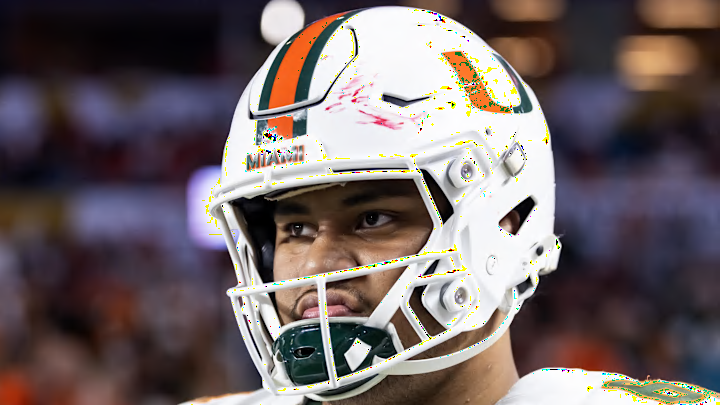
1. Francis Mauigoa, OT, Miami
Mauigoa is my preferred pick for the Cardinals, and I know that won't be popular with many fans. There is a current fear that if Arizona passes on Rueben Bain Jr., they would be making the same "mistake" they made in 2023 when they passed on Will Anderson Jr. for Paris Johnson Jr. There's no denying that Anderson has been amazing, but it's not as though the Cardinals drafted a bust.
Right now, the right side of the offensive line is a much greater weakness than the pass rush, which at least has Josh Sweat. Adding Mauigoa can round out one of the league's worst offensive lines and give Mike LaFleur a better infrastructure to build his offense around.
2. Rueben Bain Jr., EDGE, Miami
Don't worry, Cardinals fans—Bain is my second choice here. For what it's worth, I wouldn't fault the team for drafting Bain over Mauigoa, as he continues to dominate the draft process after three great seasons at Miami. Bain feels like a can't-miss player.
I mentioned the Cardinals have Sweat up front, but he's obviously not enough to drive the pass rush by himself. With Bain opposite him, Arizona would see a drastic improvement to their defense and take a step forward in competing with the elite offenses in the NFC West.
3. David Bailey, EDGE, Texas Tech
Bailey rounds out my top three players for Arizona to draft with the third overall pick (or after a slight trade down). I've been high on Bailey for the better part of a year, and he made sure to make his presence known in his lone season with Texas Tech. Bailey proved himself to be a well-rounded defender, and his sack production shot through the roof.
The difference between him and Bain comes down to scheme fit, as Bailey isn't far behind as a prospect. The Cardinals could select him over Bain and still feel just as excited about his addition. Bailey's potential is sky-high.
Round Two
1. Ty Simpson, QB, Alabama
There's a chance that drafting Simpson could require a move up the draft, potentially back into the first round. If the Cardinals value him enough—and I recently discussed my affinity for him and his fit in this offense—then they shouldn't have any issue doing so. Still, there's the possibility that Arizona could find him available at the top of round two.
Simpson isn't for everyone, but he's got the athleticism and arm talent teams look for, even if he's a bit shorter than some may prefer. He looked excellent throughout most of the season, though he struggled at times when facing pressure. If the Cardinals make their offensive line a priority in the draft—something I would call necessary if they want Simpson to find immediate success—then I fully endorse this selection.
2. Emmanuel Pregnon, IOL, Oregon
This is the first instance where an interior offensive line prospect lines up with the draft pick. Pregnon is a terrific guard with three seasons of great performances. There isn't too much to worry about at this point for Pregnon, who looks and feels the part of a future full-time starter in the pros. For Arizona, Pregnon makes perfect sense as a draft selection.
Something worth noting is that he spent the majority of his career playing on the left side of the line, where Isaac Seumalo is set to start. This could force Pregnon to swap to the right side if he hopes to become a starter as a rookie. Swapping sides of the offensive line is easier for guards than tackles, which should, in theory, make the move a bit easier. He's at least played some snaps on the strong side, so if he can find his footing (no pun intended), he could become a high-level starter.
3. Max Iheanachor, OT, Arizona State
Another right tackle prospect for the Cardinals, who wouldn't have to go far to add his services. Iheanachor is a massive power blocker who took his game to another level in 2025. A strong week at the Senior Bowl turned him into one of the most popular prospects over the last two months, and his stock hasn't slowed down during this surge upward.
Should the Cardinals prioritize a different position with the third overall pick, then Iheanachor becomes my top target for early Day Two. Iheanachor has backed up his draft status at every available opportunity, and it might lead him to stay put in the desert and become a full-time starter for Arizona.
Round Three
1. Keylan Rutledge, IOL, Georgia Tech
Rutledge was spectacular throughout his college career, and it was never more evident than during his two years at Georgia Tech. The Yellow Jackets fielded one of the nation's best run games, powered by quarterback Haynes King, and Rutledge was one of his best blockers up front. He plays with the nastiness and edge you love to see from your guards and will give feelings of nostalgia to longtime fans.
The fit for the Cardinals needs little explanation, and he's already accustomed to the right side of the line, unlike Pregnon. The mid-rounds are a great place to find quality guards, and that's what Rutledge presents for teams. Arizona can rest easy knowing the high-floor blocker can start early and give Isaiah Adams the push he needs to compete.
2. Elijah Sarratt, WR, Indiana
I find wide receiver to be lower on my list of needs for the Cardinals after signing Kendrick Bourne, especially following Michael Wilson's breakout year. I also don't see any reason to move on from Marvin Harrison Jr. yet, so the position can be addressed later on.
As far as Sarratt goes, he's an expert in contested catches and is no stranger to the end zone, with 44 career touchdowns. Although he needs refinement in his route running to create better separation due to a lack of top-end speed, I have more confidence than concern for his outlook at the next level. Sarratt can be eased into the offense before securing a larger role down the road.
3. Garrett Nussmeier, QB, LSU
If the Cardinals pass on drafting Simpson but are still looking to take a quarterback from this class, I implore them to take a hard look at Nussmeier. The 2026 class is severely lacking in future starters, with a lot of "JAGs" available, but Nussmeier doesn't fit that bill—at least not for me. His two years starting at LSU showed a player who can read the field, make all the throws, and get the most out of his receivers. His late-season benching had more to do with the coaching staff than his play, even if he did take a step backward.
I think it's more than fair to say that Nussmeier's ceiling is much lower than other prospects, but I would counter that by stating he has a high floor. With Nussmeier, it feels like you know exactly what you're getting, for better or worse. Arizona could do much worse than adding him to their quarterback room to at least make 2026 more exciting.
Round Four
1. Daylen Everette, CB, Georgia
Spoiler alert, all three proposed players for round four that we will discuss are cornerbacks. We've seen historically that the mid-rounds are Ossenfort's sweet spot for drafting defensive backs. With this year's class being filled to the brim with cornerbacks, there's no shortage of value and future contributors to be found in rounds three through five.
Everette comes from a long line of great Georgia defensive backs, many of whom have found long-term success in the pros. Although he saw plenty of highs and lows during his time with the Bulldogs, even being overshadowed by teammates at times, Everette still displayed the goods to be a potential starter one day. I could see Everette push for playing time like Denzel Burke did last year, and the fifth-rounder from Ohio State became a much more reliable player than many thought. If that's Everette's trajectory, then I love his value here.
2. Malik Muhammad, CB, Texas
The next corner up is Muhammad, who also descends from a rich history of defensive backs. Muhammad had some major fanfare entering 2025, with tons of hype to become a Day One player. Things didn't work out that way for him, however, and he'll look to become a future steal for a team rather than a lottery ticket.
Muhammad has the goods to be a starter in the NFL. Though he does have a slender frame, it has not stunted his knowledge of how to play the position. The mental processing that Muhammad has is what the position needs for a successful transition to the pros, and he's more than smart enough and technically sound to do so. Perhaps a move inside as a nickel corner could be what unlocks his true potential.
3. Tacario Davis, CB, Washington
On the complete opposite side of the size equation is Davis, who Arizona sports fans are very familiar with. Davis played his first three seasons for the Arizona Wildcats before transferring to Washington for his final season. In that time, we saw Davis' best and worst to give us a feel for what he would become; all signs point toward a big-body defensive back with clear struggles and strengths.
When at his best, Davis displayed awesome ball skills, including a whopping 15 pass deflections as a sophomore in 2023. At his worst, Davis looked lost and a victim of his own size in 2024. His gamble to move to Washington largely paid off, and we saw more good than bad in his encore college season. With some refinements to the way he uses his body in coverage, Davis is already built and has shown the promise to become the ultimate cover man. At his best, he's Riq Woolen; at his worst, he's Riq Woolen.
Round Five
1. Ja'Kobi Lane, WR, USC
Lane is a fascinating case study, as we've seen exactly what he is from start to finish over three seasons. The best of all his abilities is his competitiveness in the red zone, as evident by his 18 touchdowns in 30 games. He also finished his college career with 13.8 yards per reception and displayed some awesome downfield playmaking skills. The struggles he has will be in everything leading up to the catch, including game speed and route running.
Guys like Lane are available in round five due to significant gaps in their play style, but they are more than solvable. Lane would find himself learning behind several other big-frame wide receivers who have struggled with the same issues while adapting to the pros. If he responds well to coaching, we could see Lane find his way onto the field sooner rather than later.
2. Ar'maj Reed-Adams, IOL, Texas A&M
Once upon a time, Reed-Adams had the hype to be the first interior offensive lineman off the board. A six-year player, Reed-Adams found himself as a starter the last four seasons -- two with Kansas and two with Texas A&M -- where he played very up-and-down across all levels of competition. He checks the eye test for the position, but there's work to be done with his processing, which isn't the best news for a veteran player.
Taking a swing on a player like Reed-Adams is what the later parts of the draft are all about. It's not as though we haven't seen him play up to his opposition, and he can stonewall the strongest of defenders and move bodies around. The cleanup is mainly needed with his technique, which can mask some of his processing issues and make him a reliable depth player for a thin Cardinals guard room.
3. Harold Perkins Jr., LB, LSU
Perkins is one of the most intriguing prospects in the class. As a freshman, Perkins dominated the SEC with 7.5 sacks and four forced fumbles. He followed it up with 5.5 sacks and three more forced fumbles as a sophomore, to go with 26.0 TFLs in that time frame. An untimely ACL injury as a junior stunted everything, however, and he was not nearly himself as a senior. His tweener size caught up to him, too, and his pass rushing prowess was taken out of the equation as he began learning how to play the linebacker spot rather than edge rusher.
With so many moving parts to Perkins' college career, it's left his role in the NFL quite ambiguous. At 6'1 and 223 lbs, he is far too small to commit to being a full-time pass rusher, but there's a lot of work and polishing left to do for him to become a well-rounded linebacker. His stock is climbing right now after a dominant pro day for LSU, which could be what teams were waiting to see. Arizona would be an interesting team to take on the freakish Perkins, but they cannot repeat the sins of their past and refuse to commit him to learning one spot over another.
Round Six
1. Pat Coogan, IOL, Indiana
A three-year starting offensive lineman with experience playing both guard spots before settling in at center should make Coogan one of Day Three's more sought-after prospects. Coogan was instrumental in Indiana's CFP National Championship team, anchoring an offensive line for Heisman Trophy winner Fernando Mendoza and a dynamic running back duo that each topped the 1,000-yard rushing mark.
There's a lot to like here for the veteran, and he can wear multiple hats in the desert. The Cardinals would be a dream landing spot for Coogan, as he can be the primary backup and potentially the heir at center to Hjalte Froholdt. His aforementioned experience at guard could also lead to starting time at a different position. Arizona would love having a Swiss Army knife like Coogan on their offensive line.
2. Cade Klubnik, QB, Clemson
I remain one of the few fans of Klubnik, who suffered a bad season along with nearly every other player on the 2025 Clemson Tigers football team. There was significant growth during his junior season that, in my opinion, has been largely forgotten. Klubnik put everything together and went from looking like a five-star bust to a future NFL starter. He still showed those skills last year, though there was far too much inconsistency (and certainly injuries) that clouded that perception.
This culminates in the perfect storm for Klubnik to become a late-round waiver. I won't call him the next Brock Purdy by any means, but I see a far higher ceiling for Klubnik than other quarterbacks typically drafted this late. I highly encourage the Cardinals to at least consider kicking the tires on a deep, albeit limited-upside, quarterback class, with Klubnik as my preferred candidate.
3. Caden Curry, EDGE, Ohio State
Curry's 2025 production eclipsed his career totals from his previous three seasons in a reserve role for Ohio State. His team-high 11 sacks were nearly double second place on the team, and he finished fourth in both total tackles (66) and solo tackles (40). Though the box score was impressive, the play on the field wasn't as consistent as one would prefer, which lands him in the back end of the draft. A deep edge-rushing class doesn't help matters, either.
Players like Curry are always tough to assess — was his surge in production due to the cast around him, or did three years in a part-time role allow him to put everything together? Most of the evidence points to the former, which slots him into a rotational role for the Cardinals. Curry could wind up being a star if he receives and implements next-level coaching, and he's the definition of a lottery ticket for Arizona to buy low on.
Round Seven
1. Parker Brailsford, IOL, Alabama
Similar to Coogan, Brailsford has experience throughout the interior of the offensive line. That being said, he saw far better play when lined up at center, and a lighter frame will likely limit him to that position, even if he can successfully add weight and play at a high level. Brailsford measured under 290 lbs at the Scouting Combine, and his 27 reps on the bench press don’t always translate against bigger defenders.
There is a lot of physical work that Brailsford must complete to thrive in the pros, and that’s always an obstacle when evaluating potential impact. Teams could do far worse than taking Brailsford late, considering his starting experience for both Alabama and Washington. Arizona should welcome a well-versed starter to their room.
2. Domani Jackson, CB, Alabama
At his best, Jackson projects as a long-term professional player; at his worst, he may struggle to find a consistent role. He checks off every box physically, with traits to match, and has experience going up against top-tier receivers in multiple leagues. However, Jackson was far too volatile and inconsistent on a near down-to-down basis, making him a classic lottery-ticket prospect.
Given the Cardinals’ tendency to draft defensive backs, Jackson could be a target if the front office opts to focus their earlier picks elsewhere. Rounding out their 2026 class with Jackson would be a solid way to cap a draft that needs to be a hit, especially if things break his way.
3. Jordan Hudson, WR, SMU
Speaking of inconsistent players, Hudson was polarizing during his college career. His three seasons at SMU featured big plays downfield alongside stretches with little impact. Things came together in 2025 for Hudson in his college swan song, as he led the Mustangs in receptions, receiving yards, and receiving touchdowns. His game seemed to be coming together, though there’s still much to refine.
Cardinals fans may want to see the team take a wide receiver early in the draft, but I don’t believe the position is as dire a need as others, making Hudson the perfect choice to close out a draft. He can contribute on special teams and, with the right coaching, potentially earn a bigger role down the line.
 Add us as a preferred source on Google
Richie, an Arizona native, has been with Cardinals on SI since 2022 and also is the host of Locked on Sun Devils. He's a graduate of Arizona State University and loves providing all fans in the Valley with valuable insight and strong opinions for their favorite football team. Follow Richie on X at @RichieBradz36 for more!