%22%3E%0A%3Cpath%20d%3D%22M0%209.72534H5.31306L11.3609%2017.2239V9.72534H16.9943V26.7196H11.945L5.63335%2018.8819V26.7196H0V9.72534Z%22%20fill%3D%22white%22%2F%3E%0A%3Cpath%20d%3D%22M18.4827%2020.1632V20.1161C18.4827%2016.1595%2021.3276%2013.145%2025.303%2013.145C30.0132%2013.145%2032.1987%2016.4233%2032.1987%2020.4552C32.1987%2020.7472%2032.1987%2021.0864%2032.1704%2021.3784H23.645C24.0313%2022.5465%2024.9545%2023.1494%2026.1414%2023.1494C27.14%2023.1494%2027.9596%2022.6878%2028.8356%2021.7929L31.7936%2024.148C30.4842%2025.8436%2028.6096%2027.04%2025.7458%2027.04C21.403%2027.04%2018.4639%2024.2987%2018.4639%2020.1726L18.4827%2020.1632ZM27.1777%2018.9479C27.0552%2017.6856%2026.3016%2016.9603%2025.3313%2016.9603C24.361%2016.9603%2023.7487%2017.7327%2023.5791%2018.9479H27.1777Z%22%20fill%3D%22white%22%2F%3E%0A%3Cpath%20d%3D%22M32.1045%2013.4653H37.3705L38.727%2018.8066L40.3284%2013.4182H44.7183L46.348%2018.8537L47.7516%2013.4653H52.9517L48.9009%2026.8233H44.285L42.5139%2021.1429L40.6958%2026.8233H36.1081L32.1045%2013.4653Z%22%20fill%3D%22white%22%2F%3E%0A%3Cpath%20d%3D%22M65.3677%2020.7L58.9619%209.72534H65.3206L68.2315%2015.3116L71.1707%209.72534H77.4634L71.0576%2020.6247V26.7196H65.3772V20.7H65.3677Z%22%20fill%3D%22white%22%2F%3E%0A%3Cpath%20d%3D%22M74.9102%2020.1442V20.0971C74.9102%2016.3572%2078.0189%2013.1543%2082.3899%2013.1543C86.7609%2013.1543%2089.8225%2016.3101%2089.8225%2020.05V20.0971C89.8225%2023.8369%2086.7138%2027.0399%2082.3428%2027.0399C77.9718%2027.0399%2074.9102%2023.884%2074.9102%2020.1442ZM84.5283%2020.1442V20.0971C84.5283%2018.7877%2083.558%2017.742%2082.3428%2017.742C81.1276%2017.742%2080.2044%2018.7876%2080.2044%2020.05V20.0971C80.2044%2021.4065%2081.1747%2022.4522%2082.3899%2022.4522C83.6051%2022.4522%2084.5283%2021.4065%2084.5283%2020.1442Z%22%20fill%3D%22white%22%2F%3E%0A%3Cpath%20d%3D%22M91.1602%2013.4652H96.671V16.1406C97.4247%2014.3413%2098.6399%2013.1826%20100.825%2013.2768V19.1268H100.241C97.9145%2019.1268%2096.671%2020.4174%2096.671%2023.3566V26.7291H91.1602V13.4747V13.4652Z%22%20fill%3D%22white%22%2F%3E%0A%3Cpath%20d%3D%22M101.871%209H107.382V17.5442L110.227%2013.4652H116.228L112.073%2018.8537L116.294%2026.7196H110.396L108.475%2023.074L107.382%2024.487V26.7196H101.871V9Z%22%20fill%3D%22white%22%2F%3E%0A%3Cpath%20d%3D%22M122.897%2018.2695V18.2224C122.897%2013.1449%20126.901%209.35791%20132.271%209.35791C135.182%209.35791%20137.537%2010.3282%20139.383%2011.9297L136.199%2015.7637C135.078%2014.8123%20133.844%2014.2847%20132.44%2014.2847C130.226%2014.2847%20128.625%2015.9804%20128.625%2018.2884V18.3355C128.625%2020.7377%20130.302%2022.3862%20132.676%2022.3862C133.646%2022.3862%20134.183%2022.2355%20134.616%2022V20.3043H131.705V16.6587H139.939V24.5246C138.092%2026.0319%20135.521%2027.0775%20132.44%2027.0775C127.146%2027.0775%20122.897%2023.5355%20122.897%2018.2601V18.2695Z%22%20fill%3D%22white%22%2F%3E%0A%3Cpath%20d%3D%22M141.493%209H147.202V12.5232H141.493V9ZM141.587%2013.4652H147.098V26.7196H141.587V13.4652Z%22%20fill%3D%22white%22%2F%3E%0A%3Cpath%20d%3D%22M148.389%2022.961V22.9139C148.389%2020.2668%20150.358%2018.7878%20153.438%2018.7878C154.559%2018.7878%20155.991%2019.0327%20156.566%2019.2776V19.061C156.566%2017.8458%20155.812%2017.1392%20154.116%2017.1392C152.76%2017.1392%20151.62%2017.4313%20150.452%2017.8929L149.481%2014.2283C151.008%2013.6443%20152.76%2013.2581%20155.068%2013.2581C157.762%2013.2581%20159.514%2013.8139%20160.673%2014.982C161.671%2015.9805%20162.058%2017.2617%20162.058%2019.1834V26.7385H156.547V25.4009C155.623%2026.3994%20154.389%2027.0494%20152.731%2027.0494C150.179%2027.0494%20148.389%2025.5893%20148.389%2022.9704V22.961ZM156.622%2021.8117V21.2559C156.302%2021.1334%20155.821%2021.0392%20155.36%2021.0392C154.267%2021.0392%20153.664%2021.6987%20153.664%2022.5182V22.5653C153.664%2023.3378%20154.22%2023.8559%20154.926%2023.8559C155.897%2023.8559%20156.622%2023.0835%20156.622%2021.8211V21.8117Z%22%20fill%3D%22white%22%2F%3E%0A%3Cpath%20d%3D%22M163.716%2013.4652H169.227V15.3116C170.075%2014.2188%20171.412%2013.1543%20173.277%2013.1543C176.066%2013.1543%20177.818%2015.0007%20177.818%2017.9869V26.729H172.307V19.7579C172.307%2018.6181%20171.629%2017.9587%20170.8%2017.9587C169.971%2017.9587%20169.227%2018.6181%20169.227%2019.7579V26.729H163.716V13.4746V13.4652Z%22%20fill%3D%22white%22%2F%3E%0A%3Cpath%20d%3D%22M180.494%2022.2825V17.7231H178.939V13.4745H180.494V10.1492H186.005V13.4745H189.066V17.7231H186.005V21.0767C186.005%2022.0753%20186.466%2022.4333%20187.342%2022.4333C187.851%2022.4333%20188.435%2022.292%20189.019%2022.0188V26.2673C188.143%2026.7289%20186.834%2027.021%20185.496%2027.021C182.246%2027.021%20180.494%2025.5137%20180.494%2022.2825Z%22%20fill%3D%22white%22%2F%3E%0A%3Cpath%20d%3D%22M189.452%2025.1182L191.317%2021.9907C192.918%2022.9892%20194.718%2023.4697%20196.225%2023.4697C196.762%2023.4697%20197.026%2023.3472%20197.026%2023.0363V22.9892C197.026%2022.7254%20196.781%2022.5559%20195.443%2022.2167C192.089%2021.3878%20190.026%2020.4928%20190.026%2017.7515V17.7044C190.026%2014.7935%20192.353%2013.1638%20195.801%2013.1638C197.987%2013.1638%20200.144%2013.7196%20201.755%2014.6899L200.003%2017.9682C198.59%2017.1957%20196.894%2016.7341%20195.773%2016.7341C195.236%2016.7341%20195%2016.8754%20195%2017.1486V17.1957C195%2017.4595%20195.292%2017.6291%20196.63%2017.9682C199.984%2018.7972%20202%2019.7204%20202%2022.4334V22.4805C202%2025.3726%20199.842%2027.0494%20196.244%2027.0494C193.672%2027.0494%20191.336%2026.39%20189.442%2025.1276L189.452%2025.1182Z%22%20fill%3D%22white%22%2F%3E%0A%3Cpath%20fill-rule%3D%22evenodd%22%20clip-rule%3D%22evenodd%22%20d%3D%22M211.368%204.36764C217.191%20-1.45588%20226.632%20-1.45588%20232.456%204.36764C238.279%2010.1912%20238.279%2019.6324%20232.456%2025.4559L221.912%2036L211.368%2025.4559C205.544%2019.6324%20205.544%2010.1912%20211.368%204.36764ZM214.009%207.55761C213.948%207.86849%20213.916%208.39718%20213.916%209.14566V10.4189C213.916%2011.1832%20213.948%2011.7198%20214.013%2012.0267C214.078%2012.3317%20214.278%2012.6168%20214.617%2012.8762C214.956%2013.1376%20215.403%2013.3316%20215.958%2013.4623C216.512%2013.593%20217.1%2013.6584%20217.837%2013.6584C218.573%2013.6584%20219.217%2013.591%20219.769%2013.4524C220.322%2013.3158%20220.761%2013.1178%20221.086%2012.8604C221.411%2012.6029%20221.605%2012.3178%20221.666%2012.0069C221.728%2011.6961%20221.759%2011.1674%20221.759%2010.4189V9.14566C221.759%208.38134%20221.728%207.84473%20221.662%207.53781C221.597%207.23287%20221.397%206.94971%20221.058%206.68834C220.72%206.42696%20220.272%206.23291%20219.718%206.10223C219.163%205.97154%20218.536%205.90619%20217.839%205.90619C217.102%205.90619%20216.459%205.97352%20215.906%206.11213C215.352%206.24875%20214.914%206.44677%20214.589%206.70418C214.265%206.9616%20214.071%207.24673%20214.009%207.55761ZM219.276%2024.8638C222.876%2024.8638%20224.557%2024.2064%20224.557%2021.862V21.858V21.3155C224.557%2019.6581%20223.516%2018.971%20220.252%2018.3136C219.278%2018.1136%20218.908%2017.9136%20218.908%2017.3136V16.9414C218.908%2016.6543%20219.177%2016.5117%20219.413%2016.5117C219.749%2016.5117%20219.918%2016.7137%20219.918%2016.9414V18.1136H224.391V17.3988C224.391%2015.4563%20223.347%2014.4266%20219.177%2014.4266C216.15%2014.4266%20213.896%2015.3414%20213.896%2017.3711V17.7433C213.896%2019.5155%20214.805%2020.3155%20218.201%2021.0303C218.28%2021.0472%20218.355%2021.063%20218.427%2021.0781C219.329%2021.2674%20219.647%2021.3341%20219.647%2021.9174V22.2897C219.647%2022.6619%20219.546%2022.8045%20219.142%2022.8045C218.67%2022.8045%20218.637%2022.5471%20218.637%2022.262V21.2897H213.894V21.7471C213.894%2024.149%20215.476%2024.8638%20219.276%2024.8638ZM225.424%2024.5569H229.925V14.7355H225.424V24.5569ZM226.955%2013.5019H229.925V6.06064H227.092V9.411L225.193%206.06064H222.359V13.5019H225.193V10.1199L226.955%2013.5019ZM218.269%2012.152C218.204%2012.2688%20218.055%2012.3262%20217.825%2012.3262L217.827%2012.3282C217.604%2012.3282%20217.459%2012.2767%20217.398%2012.1758C217.336%2012.0748%20217.305%2011.8074%20217.305%2011.3758V7.90068C217.305%207.51852%20217.352%207.28684%20217.445%207.20962C217.538%207.13239%20217.675%207.09279%20217.851%207.09279C218.059%207.09279%20218.198%207.14031%20218.265%207.23734C218.332%207.33239%20218.366%207.55416%20218.366%207.90068V11.3203C218.366%2011.7579%20218.334%2012.0352%20218.269%2012.152Z%22%20fill%3D%22white%22%2F%3E%0A%3C%2Fg%3E%0A%3Cdefs%3E%0A%3CclipPath%20id%3D%22clip0_15232_2585%22%3E%0A%3Crect%20width%3D%22237%22%20height%3D%2236%22%20fill%3D%22white%22%2F%3E%0A%3C%2FclipPath%3E%0A%3C%2Fdefs%3E%0A%3C%2Fsvg%3E%0A)
Giants' Most Memorable First-round Draft Picks at Each Selection Since 1970 AFL-NFL Merger
The Giants have made 50 first-round draft picks since the NFL-AFL Merger in 1970 and have picked at almost every spot in the first round since then. Let's take a look back at the most memorable picks--good or bad--chosen at each slot in the first round (if applicable).
No. 1 Overall
The Giants haven't picked first overall since 1965 (running back Tucker Frederickson), which was before the AFL-NFL merger in 1970, so that pick doesn't make the cut, nor does the 1992 selection of quarterback Dave Brown out of Duke in the first round of the supplemental draft.
The closest the Giants have had to the first overall pick in the draft was quarterback Eli Manning, whom they acquired in a 2004 draft-day trade with the Chargers.
Manning doesn't count for this article since the players must have been selected by the Giants in the primary draft from 1970 onward.
No. 2 Overall | LB Lawrence Taylor, North Carolina (1981)
The second overall spot in the draft has been very good to the Giants in the post-AFL-NFL merger.
Running back Saquon Barkley may have the potential to usurp this spot someday, but today, it belongs to linebacker Lawrence Taylor, the greatest linebacker to grace an NFL field.
While it's well-known that the New Orleans Saints famously passed up the chance to draft Taylor in favor of South Carolina running back George Rogers, what's not as commonly known is that Taylor came within a hair of ending up as a member of a Giants division rival.
In 1981, then Saints head coach Bum Phillips received an offer from the Dallas Cowboys, who tried to move up from No. 26 to No. 1 to draft Taylor. Fortunately for the Giants, Phillips passed on the offer as he felt that with 17 picks in the draft--the most of any team that year, he had more than enough assets.
The Saints took Rogers, the Giants snapped up Taylor, and in the span of 13 years, Taylor helped deliver two Super Bowl championships while also cementing his place as one of the greatest players in the game.
No. 3 Overall | LB Carl Banks, Michigan State (1984)
Three years after Taylor, the Giants added linebacker Carl Banks, another cornerstone player who would be instrumental in the franchise's first two Super Bowl championships.
Banks, a familiar voice on the Giants radio broadcast team and who regularly does film breakdowns and television programs for the team, at one point prior to the 1984 draft didn't even know if he would get drafted.
Banks had a hard time getting noticed by scouts before the draft, but his college head coach, George Perles, got him an invitation to the Blue-Gray game in Mobile, Alabama. Banks put up a defensive MVP performance, earning an invite to the Senior Bowl and scouting combine.
On draft day, Banks watched the draft from Perles' office, where he got the call from Giants head coach Bill Parcells who advised him that he would be joining Taylor, Harry Carson, and two other All-Pro linebackers in New York as the franchise's third-overall pick.
Banks went on to play an integral role in many Giants games throughout his career, including Super Bowl XXI, where he led the Giants defense with ten tackles.
No. 4 Overall | QB Phillip Rivers, North Carolina State (2004)
Before this year's draft, the Giants have only picked at number four overall once since the merger, using the pick on a player that never wore the team's uniform.
That would be Phillip Rivers, who was at the core of the historic draft-day trade the Giants made with the then-San Diego Chargers to acquire Eli Manning, who had been the No. 1 overall pick that year.
Years later, general manager Ernie Accorsi, who engineered the trade, revealed that had there been no chance of the Giants getting Manning, they were prepared to select Ben Roethlisberger out of Miami instead.
Fortunately, the Giants were able to pull off what's perhaps the greatest trade in franchise history, which brought then their eventual two-time Super-Bowl MVP quarterback.
Meanwhile, Rivers went on to have a substantial career with the Chargers, making the Pro Bowl eight times and joining Manning and Roethlisberger in the NFL's top-ten in passing yards and touchdown leaders.
No. 5 Overall | DE Gary Jeter, USC (1977)
A storied career at USC saw Gary Jeter earn three first-team all-conference recognitions, a first-team All-American selection, three Rose Bowl starts, and a National Championship in 1974. It was a hard resume for the Giants to pass up at the number five pick, especially considering Jeter was a local, having grown up in Plainsboro, New Jersey.
Jeter didn't quite live up to his USC prestige, only making the Pro Bowl once in 1980 as a reserve. But he did make 57 starts for the Giants and helped the organization break its 17-year playoff drought in 1981.
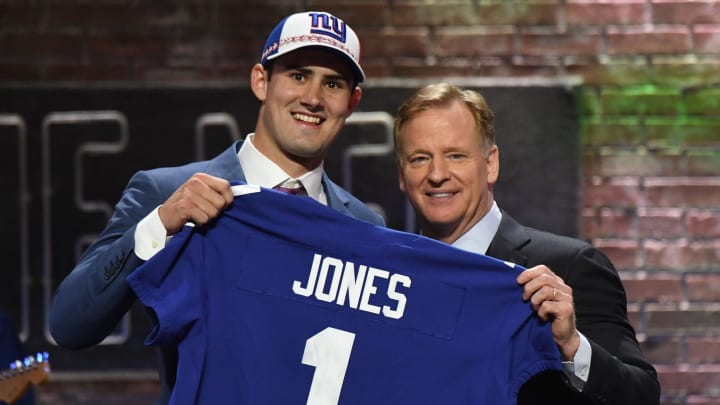
No. 6 Overall | QB Daniel Jones, Duke (2019)
Giants fans don't have to think too far back to remember the only time they've picked sixth overall since the merger. That's when general manager Dave Gettleman shocked the NFL just last year by selecting Duke quarterback Daniel Jones and David Cutcliffe protege to inherit one of Cutcliffe's other proteges (Manning).
Some draft experts didn't even expect the Giants to take a quarterback with their first pick after the 2018 season, but in the days leading up to the draft, more reports about Jones' link to the Giants began to emerge.
When the pick was announced, it was met with a modest flurry of boos, confusion, and some cheers by fans, as Jones was not pegged to be a first-round talent coming out of Duke.
Jones put a lot of those criticisms in the rear-view mirror with an impressive rookie season, but his legacy has yet to be defined.
No. 7 Overall | QB Phil Simms, Morehead State (1979)
Jones wasn't the first Giants quarterback selection to draw boos from the fan base after he was announced as the team's No. 1 pick. The selection of Simms in 1979 garners startling comparisons to the selection of Jones in 2019.
Unlike Jones, in a time where the draft wasn't a spectator event that hosted prospects in person and was not a staple of the internet, Simms didn't hear the outrage over his selection until hours after it had happened.
But Simms was met with some in-person confusion over his selection from his fellow college peers. Few at Morehead State expected Simms to get drafted as high as he did, and the football program even had to put together a last-minute press conference after the selection because of how shocking of a development it was.
Simms was able to turn those boos into cheers over time, as he led the Giants to their first Super Bowl championship in 1986.
No. 8 Overall | CB Mark Haynes, Colorado (1980)
Mark Haynes isn't a name that echoes throughout pantheon of Giants lore but not because of a lack of talent. Haynes lived up to his top-10 draft pick billing, earning three Pro-Bowl and two All-Pro nods with the Giants from 1980 to 1985.
But Haynes missed out on the chance to truly cement a legacy in New York when he was traded to the Denver Broncos in 1986 and ended up on the losing end of a Super Bowl matchup against the Giants that very same year.
No. 9 Overall | OT Ereck Flowers, Miami (2015)
If Ereck Flowers never played a snap with the Giants, he would still earn this spot and would probably be remembered more fondly by Giants fans. As the only ninth-overall selection by the Giants since the merger, Flowers proved to be one of the worst top-10 draft picks by any team in the last decade.
Flowers proved to be a liability at left tackle and helped to waste the Giants' window on offense with Odell Beckham Jr. and Manning. However, his recent success elsewhere proves he is not unfit to play in the NFL, but maybe just unsuitable to play left tackle.
No. 10 Overall | S Terry Kinard, Clemson (1983)
Terry Kinard's records at Clemson as the program's all-time leader in interceptions (17) and tackles by a defensive back (294) still stand today and helped earned him a top-10 draft selection in 1983.
Kinard's talent translated to the NFL, as he racked up 31 career interception and earned a Pro Bowl nod in 1988.
Kinard was part of the Giants' 1986 Super Bowl championship team but just missed out on the chance to win a second ring when he was traded to the Houston Oilers in 1990.
No. 11 Overall | RB Ron Dayne, Wisconsin (2000)
One of the best seasons by a Wisconsin running back in program history in 1999 earned Ron Dayne the Heisman Trophy and an early first-round selection by the Giants in the 2000 draft.
Dayne returned to New Jersey, where he broke national records as a discus thrower at Pine Hill High School, but he couldn't quite translate any of his high school or college gridiron glory to the NFL.
Dayne was supposed to form a power and speed backfield combination with Tiki Barber and filled in as a solid power back his first two seasons, but never broke the 1,000-yard rushing mark.
Dayne's production harshly declined each year after 2001 and was never signed to a second contract by the Giants.
No. 12 Overall | WR Odell Beckham Jr., LSU (2014)
The selection of Odell Beckham Jr. might be someday be considered a significant turning point in the history of the Giants franchise.
When Beckham was drafted in 2014, the glory of the organization's most recent Super Bowl runs was still fresh, despite consecutive years out of the playoffs. Still, Beckham's emergence in New York foreshadowed an eventual franchise downturn.
Beckham's talent, personality, and privilege of playing in the nation's media capital rapidly made him one of the league's biggest stars, but not necessarily the type of player that coincided with the Giants' gritty, blue-collar tradition.
Without much winning, Beckham Jr.'s exploits and highlights became the center of the media attention surrounding the Giants in the years he was there, quickly transforming his reputation in the eyes of some from an exciting youngster to a polarizing diva.
Beckham's New York legacy might positively be defined not so much by his fingertip catch against the Cowboys during a Sunday night primetime game, but instead, by the team's decision to trade him to the Browns in 2019, the Giants getting safety Jabrill Peppers, and two draft picks they turned into defensive lineman Dexter Lawrence II and edge rusher Oshane Ximines.
Beckham will get the chance to put his mark on the legacy of that trade when he returns to MetLife Stadium as an opponent of the Giants in 2020.
No. 13 Overall | LB Jim Files, Oklahoma (1970)
Jim Files was the first Giants' first-round pick since the merger. He only played four seasons in the NFL but started all 56 games for the Giants from 1970-1973. Files recorded five interceptions and even returned one for a touchdown in 1972 against the Denver Broncos.
No. 14 Overall | TE Jeremy Shockey, Miami (2002)
Jeremy Shockey was another story of a young star's descent into eventual exile from the Giants. After earning a first-team All-Pro nod as a rookie in 2002, Shockey surged into New York stardom and the good graces of ownership, as Wellington Mara became a father figure to Shockey, who grew up without a father of his own.
When Mara passed away in 2005, Shockey lost the guidance of that father figure, and began to become isolated from the team. He continued to be a productive offensive player for the Giants but became a locker room liability when he began to question the coaches.
After a leg injury in December 2007, Shockey's isolation from the team culminated in his absence from the team's Super Bowl sideline for safety reasons.
Like Beckham, Shockey's time with the Giants ended in a trade, as he was sent to the Saints in 2008 for a second and fifth-round draft pick.
No.15 Overall | DE Jason Pierre-Paul, South Florida (2010)
The selection of Jason Pierre-Paul is the last first-round pick the Giants have used on a pass rusher in nearly a decade. Pierre-Paul lived up to his first-round billing early in his career, as he led the team with 16.5 sacks in 2011, as a core defensive player on the Giants' last Super Bowl team.
He followed that performance up with a 12.5 sack season in 2014, but the following year as he was poised to cash in on his production, he suffered a permanently damaged right hand as a result of a fireworks accident.
Pierre-Paul did overcome the accident and returned to the Giants, even earning a second contract, but was traded to the Tampa Bay Buccaneers in 2018, where he posted 12.5 sacks in his first season with the Bucs.
No. 17 Overall | RB Tyrone Wheatley, Michigan (1995)
Tyrone Wheatley earned a first-round draft selection off a prestigious career at Michigan, which saw three First-Team All-Big Ten selections, a Big Ten offensive player of the year award, and two Big Ten championships.
Wheatley, who these days is the head football coach at Morgan State, played four seasons with the Giants but didn't eclipse the 600-yard rushing mark. He found greater success with the Oakland Raiders from 1999-2004.
No. 18 Overall | C Brian Williams, Minnesota (1989)
Brian Williams spent his entire 11-year NFL career with the Giants but didn't spend a whole lot of time on the field for the first five. Williams served as a reserve lineman and special teamer during his first four seasons but worked his way up to a full-time starter by 1994.
Unfortunately, he suffered a fractured infra-orbital bone during a training camp practice in 1997 when he was accidentally poked in the eye. The injury created double vision when he focused above or below a 15-degree angle and necessitated surgery.
Williams would miss the 1997 and 1998 seasons only to return for a final season in 1999 when he appeared in 12 games.
No. 19 Overall | OT Luke Petitgout, Notre Dame (1999)
Luke Petitgout earned an All-Independent first-team selection his senior year at Notre Dame and a spot on the Giants offensive line as a key starter from 2000 to 2006. Petitgout made 82 starts at left tackle for the Giants, including 16 games for the 2000 Giants team that lost to the Baltimore Ravens in Super Bowl XXXV.
No. 20 Overall | Texas CB Aaron Ross (2007)
Ross earns this spot by default as the Giants' only 20th-overall selection since the merger, but that's not to say he wasn't a valuable player on the Giants' two Super Bowl runs in 2007 and 2011.
Ross never developed into an elite cornerback or even earned a Pro-Bowl nod, but he did snag six interceptions in his first two seasons as a Giant, and four more in 2011.
Ross is also a champion at the college level, having been a part of Texas' 2005 National Championship team that defeated USC in the 2006 Rose Bowl.
No. 21 Overall
The Giants have not drafted at 21 overall since the NFL-AFL merger. Still, they have had two draft picks in their history that were selected 21st overall, the last one sharing a position and a surname (though no relation) with another player on this list.
That draft pick is tackle Clyde Flowers, chosen out of TCU in 1944.
No. 22 Overall | CB Will Allen, Syracuse (2001)
Like Ross, Allen also earns this spot by default. But Allen also earned his stripes on defense as a rookie with four interactions and a forced fumble. Allen wasn't able to build on his rookie season, however, but started all 32 games for the Giants in 2004 and 2005.
No. 23 Overall | TE Evan Engram, Mississippi (2017)
Engram is another player that earns this spot by default, but he would certainly have a case even if the Giants had drafted with the 23rd overall pick before.
His case would rest mainly on an impressive rookie season, though injuries have kept him from emerging as a star tight end. If Engram can stay healthy, he has all the talent to carve a vital role in Jason Garrett's offense in 2020 and cement his spot as the Giants' best 23rd overall pick for many years to come.
No. 24 Overall | RB Rodney Hampton, Georgia (1990)
Rodney Hampton probably expected to get picked in the top 10 coming out of Georgia in 1990, but despite sliding down the draft board to No. 24 overall, he proved his worth as a running back in eight strong seasons in the NFL.
Hampton played his entire career with the Giants and became a fan favorite for his running style and consistency, eclipsing the 1,000-yards mark five straight years from 1991 to 1995 while earning two Pro-Bowl nods in 1992 and 1993.
No. 25 Overall | DT William Joseph, Miami (2003)
William Joseph earns this spot by default. In four seasons with the Giants from 2003 to 2006, Joseph racked up seven sacks in 55 starts. He was injured in the 2007 season but did receive a Super Bowl ring for the Giants' Super 42 victory.
No. 26 Overall
The Giants have not drafted at No. 26th overall since the merger, but the last time they did have a 26th overall pick, they selected tackle Frank Lasky out of Florida in 1963.
No. 27 Overall | FB Jarrod Bunch, Michigan (1991)
Jarrod Bunch played three seasons with the Giants from 1991 to 1993 as a reserve power back. Bunch's best season as a rusher came in 1992 when he rushed for 501 yards and three touchdowns.
Bunch is one of five fullbacks to be drafted in the first round by the Giants throughout their history and the only one of the post-merger era.
He retired in 1994 but is transitioned into the entertainment industry and now owns his own production company Bunch Time Productions.
No. 28 Overall | WR Mark Ingram, Sr, Michigan State (1987)
The highlights of Mark Ingram Sr's career came in the Giants' historic 1990 postseason run. In the NFC Championship game against the San Francisco 49ers, Ingram caught five passes for 82 yards. Two weeks later, in Super Bowl XXV against the Buffalo Bills, he caught another five passes for 74 yards, finishing as the Giants' leading receiver.
No. 29 Overall | WR Hakeem Nicks, North Carolina (2009)
Hakeem Nicks filled a pressing need at wide receiver for the Giants after the team cut Plaxico Burress.
Nicks was a true No. 1 receiver for the Giants, and by 2010, his second season, he eclipses the 1,000-yard mark and tallied 11 touchdowns.
Nicks became a playoff hero in 2011 as the Giants' leading receiver in that year's postseason en route to their latest Super Bowl championship.
No. 30 Overall | CB DeAndre Baker, Georgia (2019)
The Giants have never started a draft knowing that they'd have the No. 30 overall pick, but last year, they did engineer a trade with the Seahawks. The Giants sent picks No. 37 (second round), No. 132 (fourth), and No. 142 (fifth) to the Seahawks to get back into the bottom of the first round where they made Baker the first cornerback off the board.
The selection of Baker also marked the first time in franchise history the Giants had three first-round draft picks in a draft. Although the player himself had an up-and-down season, the Giants are hopeful that he'll take a significant step forward in his second season this year.
No. 31 Overall | S Kenny Phillips, Miami (2008)
Kenny Phillips entered the 2008 draft coming off back-to-back first-team All-ACC honors in 2006 and 2007.
In a draft class that was regarded as thin at safety, the Giants made Phillips the first safety selected late in the first round. He would play five seasons in New York, including the 2011 Super Bowl season, which also marked his best season with four interceptions. However, a knee injury that reportedly developed into patellofemoral arthritis ended up cutting short Phillips' career.
No. 32 Overall | DE Mathias Kiwanuka, Boston College (2006)
In the 2006 draft, the Giants traded down with the defending-Super Bowl champion Pittsburgh Steelers to the bottom of the first round.
That trade netted them a first-team All-ACC pass rusher in Mathias Kiwanuka, who went on to become a vital member of the Giants' pass-rushing core that led the way to Super Bowl championships in 2007 and 2011.
Kiwanuka spent his entire nine-year career with the Giants, racking up 38.5 career sacks. Kiwanuka was a versatile player on the Giants' defense, rotating between playing defensive end and outside linebacker. His best season as a pass rusher came in 2008 when he recorded eight sacks.
 Add us as a preferred source on Google