%22%3E%0A%3Cpath%20d%3D%22M0%209.72534H5.31306L11.3609%2017.2239V9.72534H16.9943V26.7196H11.945L5.63335%2018.8819V26.7196H0V9.72534Z%22%20fill%3D%22white%22%2F%3E%0A%3Cpath%20d%3D%22M18.4827%2020.1632V20.1161C18.4827%2016.1595%2021.3276%2013.145%2025.303%2013.145C30.0132%2013.145%2032.1987%2016.4233%2032.1987%2020.4552C32.1987%2020.7472%2032.1987%2021.0864%2032.1704%2021.3784H23.645C24.0313%2022.5465%2024.9545%2023.1494%2026.1414%2023.1494C27.14%2023.1494%2027.9596%2022.6878%2028.8356%2021.7929L31.7936%2024.148C30.4842%2025.8436%2028.6096%2027.04%2025.7458%2027.04C21.403%2027.04%2018.4639%2024.2987%2018.4639%2020.1726L18.4827%2020.1632ZM27.1777%2018.9479C27.0552%2017.6856%2026.3016%2016.9603%2025.3313%2016.9603C24.361%2016.9603%2023.7487%2017.7327%2023.5791%2018.9479H27.1777Z%22%20fill%3D%22white%22%2F%3E%0A%3Cpath%20d%3D%22M32.1045%2013.4653H37.3705L38.727%2018.8066L40.3284%2013.4182H44.7183L46.348%2018.8537L47.7516%2013.4653H52.9517L48.9009%2026.8233H44.285L42.5139%2021.1429L40.6958%2026.8233H36.1081L32.1045%2013.4653Z%22%20fill%3D%22white%22%2F%3E%0A%3Cpath%20d%3D%22M65.3677%2020.7L58.9619%209.72534H65.3206L68.2315%2015.3116L71.1707%209.72534H77.4634L71.0576%2020.6247V26.7196H65.3772V20.7H65.3677Z%22%20fill%3D%22white%22%2F%3E%0A%3Cpath%20d%3D%22M74.9102%2020.1442V20.0971C74.9102%2016.3572%2078.0189%2013.1543%2082.3899%2013.1543C86.7609%2013.1543%2089.8225%2016.3101%2089.8225%2020.05V20.0971C89.8225%2023.8369%2086.7138%2027.0399%2082.3428%2027.0399C77.9718%2027.0399%2074.9102%2023.884%2074.9102%2020.1442ZM84.5283%2020.1442V20.0971C84.5283%2018.7877%2083.558%2017.742%2082.3428%2017.742C81.1276%2017.742%2080.2044%2018.7876%2080.2044%2020.05V20.0971C80.2044%2021.4065%2081.1747%2022.4522%2082.3899%2022.4522C83.6051%2022.4522%2084.5283%2021.4065%2084.5283%2020.1442Z%22%20fill%3D%22white%22%2F%3E%0A%3Cpath%20d%3D%22M91.1602%2013.4652H96.671V16.1406C97.4247%2014.3413%2098.6399%2013.1826%20100.825%2013.2768V19.1268H100.241C97.9145%2019.1268%2096.671%2020.4174%2096.671%2023.3566V26.7291H91.1602V13.4747V13.4652Z%22%20fill%3D%22white%22%2F%3E%0A%3Cpath%20d%3D%22M101.871%209H107.382V17.5442L110.227%2013.4652H116.228L112.073%2018.8537L116.294%2026.7196H110.396L108.475%2023.074L107.382%2024.487V26.7196H101.871V9Z%22%20fill%3D%22white%22%2F%3E%0A%3Cpath%20d%3D%22M122.897%2018.2695V18.2224C122.897%2013.1449%20126.901%209.35791%20132.271%209.35791C135.182%209.35791%20137.537%2010.3282%20139.383%2011.9297L136.199%2015.7637C135.078%2014.8123%20133.844%2014.2847%20132.44%2014.2847C130.226%2014.2847%20128.625%2015.9804%20128.625%2018.2884V18.3355C128.625%2020.7377%20130.302%2022.3862%20132.676%2022.3862C133.646%2022.3862%20134.183%2022.2355%20134.616%2022V20.3043H131.705V16.6587H139.939V24.5246C138.092%2026.0319%20135.521%2027.0775%20132.44%2027.0775C127.146%2027.0775%20122.897%2023.5355%20122.897%2018.2601V18.2695Z%22%20fill%3D%22white%22%2F%3E%0A%3Cpath%20d%3D%22M141.493%209H147.202V12.5232H141.493V9ZM141.587%2013.4652H147.098V26.7196H141.587V13.4652Z%22%20fill%3D%22white%22%2F%3E%0A%3Cpath%20d%3D%22M148.389%2022.961V22.9139C148.389%2020.2668%20150.358%2018.7878%20153.438%2018.7878C154.559%2018.7878%20155.991%2019.0327%20156.566%2019.2776V19.061C156.566%2017.8458%20155.812%2017.1392%20154.116%2017.1392C152.76%2017.1392%20151.62%2017.4313%20150.452%2017.8929L149.481%2014.2283C151.008%2013.6443%20152.76%2013.2581%20155.068%2013.2581C157.762%2013.2581%20159.514%2013.8139%20160.673%2014.982C161.671%2015.9805%20162.058%2017.2617%20162.058%2019.1834V26.7385H156.547V25.4009C155.623%2026.3994%20154.389%2027.0494%20152.731%2027.0494C150.179%2027.0494%20148.389%2025.5893%20148.389%2022.9704V22.961ZM156.622%2021.8117V21.2559C156.302%2021.1334%20155.821%2021.0392%20155.36%2021.0392C154.267%2021.0392%20153.664%2021.6987%20153.664%2022.5182V22.5653C153.664%2023.3378%20154.22%2023.8559%20154.926%2023.8559C155.897%2023.8559%20156.622%2023.0835%20156.622%2021.8211V21.8117Z%22%20fill%3D%22white%22%2F%3E%0A%3Cpath%20d%3D%22M163.716%2013.4652H169.227V15.3116C170.075%2014.2188%20171.412%2013.1543%20173.277%2013.1543C176.066%2013.1543%20177.818%2015.0007%20177.818%2017.9869V26.729H172.307V19.7579C172.307%2018.6181%20171.629%2017.9587%20170.8%2017.9587C169.971%2017.9587%20169.227%2018.6181%20169.227%2019.7579V26.729H163.716V13.4746V13.4652Z%22%20fill%3D%22white%22%2F%3E%0A%3Cpath%20d%3D%22M180.494%2022.2825V17.7231H178.939V13.4745H180.494V10.1492H186.005V13.4745H189.066V17.7231H186.005V21.0767C186.005%2022.0753%20186.466%2022.4333%20187.342%2022.4333C187.851%2022.4333%20188.435%2022.292%20189.019%2022.0188V26.2673C188.143%2026.7289%20186.834%2027.021%20185.496%2027.021C182.246%2027.021%20180.494%2025.5137%20180.494%2022.2825Z%22%20fill%3D%22white%22%2F%3E%0A%3Cpath%20d%3D%22M189.452%2025.1182L191.317%2021.9907C192.918%2022.9892%20194.718%2023.4697%20196.225%2023.4697C196.762%2023.4697%20197.026%2023.3472%20197.026%2023.0363V22.9892C197.026%2022.7254%20196.781%2022.5559%20195.443%2022.2167C192.089%2021.3878%20190.026%2020.4928%20190.026%2017.7515V17.7044C190.026%2014.7935%20192.353%2013.1638%20195.801%2013.1638C197.987%2013.1638%20200.144%2013.7196%20201.755%2014.6899L200.003%2017.9682C198.59%2017.1957%20196.894%2016.7341%20195.773%2016.7341C195.236%2016.7341%20195%2016.8754%20195%2017.1486V17.1957C195%2017.4595%20195.292%2017.6291%20196.63%2017.9682C199.984%2018.7972%20202%2019.7204%20202%2022.4334V22.4805C202%2025.3726%20199.842%2027.0494%20196.244%2027.0494C193.672%2027.0494%20191.336%2026.39%20189.442%2025.1276L189.452%2025.1182Z%22%20fill%3D%22white%22%2F%3E%0A%3Cpath%20fill-rule%3D%22evenodd%22%20clip-rule%3D%22evenodd%22%20d%3D%22M211.368%204.36764C217.191%20-1.45588%20226.632%20-1.45588%20232.456%204.36764C238.279%2010.1912%20238.279%2019.6324%20232.456%2025.4559L221.912%2036L211.368%2025.4559C205.544%2019.6324%20205.544%2010.1912%20211.368%204.36764ZM214.009%207.55761C213.948%207.86849%20213.916%208.39718%20213.916%209.14566V10.4189C213.916%2011.1832%20213.948%2011.7198%20214.013%2012.0267C214.078%2012.3317%20214.278%2012.6168%20214.617%2012.8762C214.956%2013.1376%20215.403%2013.3316%20215.958%2013.4623C216.512%2013.593%20217.1%2013.6584%20217.837%2013.6584C218.573%2013.6584%20219.217%2013.591%20219.769%2013.4524C220.322%2013.3158%20220.761%2013.1178%20221.086%2012.8604C221.411%2012.6029%20221.605%2012.3178%20221.666%2012.0069C221.728%2011.6961%20221.759%2011.1674%20221.759%2010.4189V9.14566C221.759%208.38134%20221.728%207.84473%20221.662%207.53781C221.597%207.23287%20221.397%206.94971%20221.058%206.68834C220.72%206.42696%20220.272%206.23291%20219.718%206.10223C219.163%205.97154%20218.536%205.90619%20217.839%205.90619C217.102%205.90619%20216.459%205.97352%20215.906%206.11213C215.352%206.24875%20214.914%206.44677%20214.589%206.70418C214.265%206.9616%20214.071%207.24673%20214.009%207.55761ZM219.276%2024.8638C222.876%2024.8638%20224.557%2024.2064%20224.557%2021.862V21.858V21.3155C224.557%2019.6581%20223.516%2018.971%20220.252%2018.3136C219.278%2018.1136%20218.908%2017.9136%20218.908%2017.3136V16.9414C218.908%2016.6543%20219.177%2016.5117%20219.413%2016.5117C219.749%2016.5117%20219.918%2016.7137%20219.918%2016.9414V18.1136H224.391V17.3988C224.391%2015.4563%20223.347%2014.4266%20219.177%2014.4266C216.15%2014.4266%20213.896%2015.3414%20213.896%2017.3711V17.7433C213.896%2019.5155%20214.805%2020.3155%20218.201%2021.0303C218.28%2021.0472%20218.355%2021.063%20218.427%2021.0781C219.329%2021.2674%20219.647%2021.3341%20219.647%2021.9174V22.2897C219.647%2022.6619%20219.546%2022.8045%20219.142%2022.8045C218.67%2022.8045%20218.637%2022.5471%20218.637%2022.262V21.2897H213.894V21.7471C213.894%2024.149%20215.476%2024.8638%20219.276%2024.8638ZM225.424%2024.5569H229.925V14.7355H225.424V24.5569ZM226.955%2013.5019H229.925V6.06064H227.092V9.411L225.193%206.06064H222.359V13.5019H225.193V10.1199L226.955%2013.5019ZM218.269%2012.152C218.204%2012.2688%20218.055%2012.3262%20217.825%2012.3262L217.827%2012.3282C217.604%2012.3282%20217.459%2012.2767%20217.398%2012.1758C217.336%2012.0748%20217.305%2011.8074%20217.305%2011.3758V7.90068C217.305%207.51852%20217.352%207.28684%20217.445%207.20962C217.538%207.13239%20217.675%207.09279%20217.851%207.09279C218.059%207.09279%20218.198%207.14031%20218.265%207.23734C218.332%207.33239%20218.366%207.55416%20218.366%207.90068V11.3203C218.366%2011.7579%20218.334%2012.0352%20218.269%2012.152Z%22%20fill%3D%22white%22%2F%3E%0A%3C%2Fg%3E%0A%3Cdefs%3E%0A%3CclipPath%20id%3D%22clip0_15232_2585%22%3E%0A%3Crect%20width%3D%22237%22%20height%3D%2236%22%20fill%3D%22white%22%2F%3E%0A%3C%2FclipPath%3E%0A%3C%2Fdefs%3E%0A%3C%2Fsvg%3E%0A)
Patricia Traina's 7-Round Giants-only Mock Draft
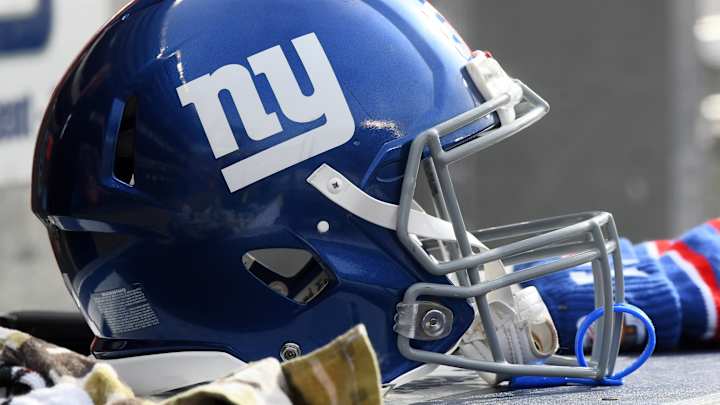
Although I've accepted the fact that readers enjoy mock drafts, I admit that I still don't like doing them.
It's virtually impossible to know what all 32 teams are thinking, and my experience has shown that prospects that that draft analysts and media are high on don't necessarily reflect the opinions of the NFL community.
In short, mock drafts are darn near impossible to come close to getting right, and in some cases, they just go against everything you know to be true. That makes it frustrating.
But hey, who am I to argue with what people (my editors and you, the readers) want?
So that brings me to my Giants-only, seven-round mock draft. I used Fan Speak's simulator. My account allows me to execute trades, which I did in this mock draft.
In choosing which big boards to use, I opted for random boards since all 32 teams don't use the same draft boards.
The result? You'll see them below, but it wasn't an easy exercise, and I'm not even sure I agree with every pick made. Nonetheless, here is my mock draft in which I tried to marry need and best player available as much as possible.
Mock away!
Pre-Draft
Before I started my simulation, I received two trade offers, one from the Browns and the other from the Jets for the No. 4 overall pick.
Cleveland’s offer included their first-rounder (Pick No. 10), two third-rounders (Picks 73 and 97), and their seventh-rounder (No. 245).
The Jets’ offer was for their first-rounder (Pick No. 11), their second-rounder (No. 48), and a third-rounder (Pick No. 79).
I chose to accept the Browns' offer for two reasons. First, I didn't want to trade out of the top 10 spots, and second, the Browns' offer gave me three more picks in the Top 100.
With that offer established before the teams started going on the clock, here is my mock draft:
Round 1, No. 10: LB Isaiah Simmons, Clemson
Ok, right off the bat, I'd be shocked if Simmons falls to No. 10, but in this simulation, he did, and I don't control how the players fall in the simulation.
Why Simmons over an offensive tackle which, by the way, I still think is Need No. 1 on this team?
First, Simmons at No. 10 is a tremendous value. This is a player who can fill any number of needs on the defense, depending on the subpackage. This, to me, makes Simmons an every-down player, much like a Day 1 offensive tackle would be.
Second, the addition of Cam Fleming changed things up for me. Fleming is a serviceable offensive tackle who can play on either side of the line. And I think in a pinch, he could even give you a few games as a starter, which he did for the Cowboys.
That kind of flexibility allows for the Giants to wait until Day 2 to draft an offensive tackle, who at that point in the draft, will need some development. Fleming's presence allows the Giants to develop a prospect to where come mid-year or whenever injuries kick in, then a transition could be made.
Round 2, No. 36: OT Isaiah Wilson, Georgia
Day 2 is where I hoped to find value regarding an offensive tackle. I think in Georgia’s Isaiah Wilson (6’6”, 350 pounds), accomplished that. Wilson projects as a right tackle prospect at the next level but has some additional developing to do as he only has two seasons of college football experience under his belt.
Again, with Cam Fleming on board, I don’t think there’s a need to push a rookie into the starting lineup right away. With Wilson, who has the skill set to develop into a fine NFL tackle, there for the taking at No. 36, I thought the value was just too good to pass up.
Round 3, No. 74 (from Cleveland): C Cesar Ruiz, Michigan
When we speak about the Giants center position, often folks forget that the Giants have Spencer Pulley under contract.
Pulley admittedly didn't have one of his better seasons last year in the handful of snaps he got (including one game as a starter), but the year before, he was solid.
Why he drop off? Part of that was on Pulleu, but let's ask ourselves how much having a rookie quarterback behind him who was still learning to identify defenses factored into that equation?
The bottom line is that Pulley has the experience and is serviceable. I don't think he's the long-term answer, but if the Giants were able to grab New Jersey native Cesar Ruiz out of Michigan at No. 74, I don't think I'd be too upset with the pick.
Would I want a rookie center as a Day 1 starter on the offensive line? No. Learning to identify complex NFL defenses and making the corresponding protection calls takes time. With a quarterback entering his second year (after struggling last year with identifying defenses) under center, I just think it would be risky to put a young center into the lineup on Day 1 of the season.
Ruiz, who, if he comes here, would also likely have to learn guard since the Giants historically have liked versatile linemen, could be a long-term solution.
Round 3, No. 97 (from Cleveland): TE Adam Trautman, Dayton
The Giants need tight ends. Repeat. The Giants need tight ends. If last year's stats are any indication, expect new offensive coordinator Jason Garrett, who as head coach of the Cowboys saw his offense run 12-personnel 30% of the time (12th most in the NFL0 in 2019, to run a lot of two-tight end sets.
The problem is the Giants tight ends position is in a state of flux. Yes, they added Levine Toilolo to the mix via free agency--he's a solid blocker who could give you a reception here and there but who probably isn't going to be your first choice.
They also have last year's rookie wonder Kaden Smith, who like Toilolo came from Stanford University and from the 49ers, the latter the same tight end factory that gave the league George Kittle.
But the Giants are going to need more. Evan Engram, who was supposed to be their top dog at the position, cannot stay healthy. After having foot surgery late in the season, he is projected to be ready to go without limitations by training camp.
And speaking of Engram, the Giants have to decide by May whether to exercise the option year on his rookie deal. Usually, doing so would be a no brainer, even if the Giants wanted to trade Engram at some point. But given his injury history, it wouldn't be a surprise if that gives the team pause in exercising that option.
Trautman ranked as NFL.com's fourth-best tight end, was too good of a value to pass up at this spot. A former high school quarterback, Trautman posted 70 receptions for 916 yards (13.1 per catch) and 14 touchdowns (fifth in the FCS) in 11 starts last season.
Trautman, who like Engram is thought of as more of a receiving option than a blocker, intrigues as a possible replacement should Engram not be ready to go this year or if the Giants do decide to move on from him.
Round 3, No. 99 (Comp): LB Malik Harrison, Ohio State
Remember how some were saying the Giants let safety Landon Collins walk away for nothing in free agency? Well, in my mock draft, they have a chance to turn "nothing" into a versatile linebacker prospect named Malik Harrison out of Ohio State, an athlete who can play all three linebacker positions and who is solid in run support.
As a junior, Harrison was named All-Big Ten after finishing tied for the lead on the Buckeyes with 81 tackles (8.5 for loss, 2.5 sacks, and one interception). Harrison is a downhill type of linebacker and a thumper who wraps up well and who can be used as a spy. Coverage isn't necessarily a strength of his right now, but if you need him to occasionally blitz, he can probably give you a few quality snaps in that capacity.
Round 4, No. 110: WR Gabriel Davis, UCF
The wide receiver class is historically deep to where guys who would initially go high in the draft are likely to slip to Days 2 and 3.
One such prospect who could slip is Davis. Davis is a solid blocking receiver (another trait that people tend to overlook in receivers yet, which is so important, especially when it comes to providing blocking down the field for the running game). He also has an expansive catch radius, which has allowed him to haul in off-target passes that otherwise might fall incomplete.
Davis finished last season as the Knights' team leader in receiving (72 receptions, 1,241 yards, 17.2 average, 12 touchdowns). He has shown some success in being able to fight off press coverage.
Although he doesn't have to quickest release, he does have a second and third gear that enables him to create some separation to where he could potentially develop into a deep-ball threat.
Round 5, No. 150: DL Jason Strowbridge, North Carolina
I ran my mock draft simulation before the Giants added Austin Johnson, my thinking here being that the Giants need some additional depth for the defensive line rotation. Strowbridge, the best available on the board when I was on the clock here, projects at a rotational defender who needs to work on achieving a more consistent pad level.
He's a solid defender at the point of attack who uses his hands well to disengage from blocks, but he's going to need that all-important coaching at the next level to smooth out a lot of the rough spots in his game--playing with better control and the pad level being among them--before earning a role in the rotation.
Round 6, No. 183: QB Anthony Gordon, Washington State
I know, I know. A quarterback? Really, Patricia?
Yes, and this pick is another "best player available" scenario. I don't know what Joe Judge's thinking is regarding drafting and developing a young quarterback, but with a baker's dozen of draft picks in this simulation, why not take that risk?
Gordon lost the competition for the Cougars' starting job to last year's NFL rookie wonder Gardner Minshew, now with Jacksonville. Gordon, who also was a baseball pitcher, was a 2015 draft pick by the New York Mets baseball team in the 36th round, but he stuck with football.
Gordon has only started 14 college games, so regardless of who drafts him, he's a prospect who will likely land on a practice squad where he can work on all aspects of his game, including learning to read defenses better.
Round 7 - Disclaimer
I desperately wanted to trade at least two of my picks in the sixth and seventh-round, but I was unable to find a deal I liked. So I ended up with five picks in the seventh round.
In some ways, that's not a bad thing because it assures teams of getting the players they want rather than having to scramble in the post-draft rat race to get undrafted free agents to sign. The odds of so many seventh rounders making the 53-man roster aren't very promising.
With that said, here's a quick look at the players I did choose the best available when I was on the clock but who project as practice squad candidates.
Round 7, No. 218: DL McTelvin Agim, Arkansas
Agim moved from defensive end to defensive tackle, so he's still learning the position. In one season as a full-time defensive tackle, he recorded 8.5 tackles for loss and five sacks in 2019, while also finishing with 39 total tackles and a forced fumble.
Round 7, No. 238 (via Saints, Eli Apple trade): G Drew Richmond, USC
Richmond is a graduate transfer from Tennessee. He primarily played at offensive tackle, playing both on the left and right sides. Likely due to the lack of foot speed to play tackle, he was moved inside to guard.
Round 7, No. 244 (via Cleveland in the mock draft trade): S Antoine Brooks, Jr., Maryland
Some draft analysts have questioned precisely where Brooks would fit into a defense, but one common trait with which many scouting reports seem to agree is he doesn't have is the ability to play single-high, despite having solid instincts and recognition ability. Perhaps best suited to play in the box, Brooks is also a prospect whose physical style of play would be welcomed on special teams.
Round 7, No. 247 (comp): LB Justin Strnad, Wake Forest
Strnad (pronounced stir-NAD) offers acceptable sideline-to-sideline speed and range, and solid athleticism. He projects as either an inside linebacker in a 3-4 alignment or as a weakside linebacker in a 4-3. He is a solid tackler who can also lend some aggressiveness on special teams. Strnad did suffer a biceps injury in October, so where he ends up going depends on how his medical evaluation checks out.
Round 7, No. 255 (comp - Mr. Irrelevant): RB Patrick Taylor, Jr., Memphis
Taylor appealed due to his size (6-foot 1, 217 pounds); the problem though is he sometimes plays with hesitation rather than simply pounding ahead into a pile and trying to move it. Taylor is capable of running both between the tackles and to the outside, though there have been some knocks against this vision and his burst.
 Add us as a preferred source on Google
Patricia Traina has covered the New York Giants for 30+ seasons, and her work has appeared in multiple media outlets, including The Athletic, Forbes, Bleacher Report, and the Sports Illustrated media group. As a credentialed New York Giants press corps member, Patricia has also covered five Super Bowls (three featuring the Giants), the annual NFL draft, and the NFL Scouting Combine. She is the author of The Big 50: The Men and Moments that Made the New York Giants. In addition to her work with New York Giants On SI, Patricia hosts the Locked On Giants podcast. Patricia is also a member of the Pro Football Writers of America and the Football Writers Association of America.
Follow Patricia_Traina