%20%20--%3E%0A%3Csvg%20version%3D%221.1%22%20id%3D%22Layer_1%22%20xmlns%3D%22http%3A%2F%2Fwww.w3.org%2F2000%2Fsvg%22%20xmlns%3Axlink%3D%22http%3A%2F%2Fwww.w3.org%2F1999%2Fxlink%22%20x%3D%220px%22%20y%3D%220px%22%0A%09%20width%3D%2239px%22%20height%3D%2240px%22%20viewBox%3D%220%200%2039%2040%22%20enable-background%3D%22new%200%200%2039%2040%22%20xml%3Aspace%3D%22preserve%22%3E%0A%3Cpath%20fill%3D%22%23FFFFFF%22%20d%3D%22M38.5%2C7H28.2v26h10.3V7z%22%2F%3E%0A%3Cpath%20fill-rule%3D%22evenodd%22%20clip-rule%3D%22evenodd%22%20fill%3D%22%23FFFFFF%22%20d%3D%22M26.1%2C25.5c0%2C5.8-4.1%2C7.5-12.9%2C7.5C3.9%2C33%2C0%2C31.2%2C0%2C25.2v-1.1h11.6%0A%09v2.4c0%2C0.7%2C0.1%2C1.4%2C1.2%2C1.4c1%2C0%2C1.2-0.4%2C1.2-1.3v-0.9c0-1.6-0.9-1.6-3.5-2.2C2.2%2C21.7%2C0%2C19.7%2C0%2C15.3v-0.9C0%2C9.3%2C5.5%2C7%2C12.9%2C7%0A%09c10.2%2C0%2C12.8%2C2.6%2C12.8%2C7.4v1.8h-11v-2.9c0-0.6-0.4-1.1-1.2-1.1c-0.6%2C0-1.2%2C0.4-1.2%2C1.1v0.9c0%2C1.5%2C0.9%2C2%2C3.3%2C2.5%0A%09c8%2C1.6%2C10.5%2C3.3%2C10.5%2C7.5V25.5z%22%2F%3E%0A%3C%2Fsvg%3E%0A)
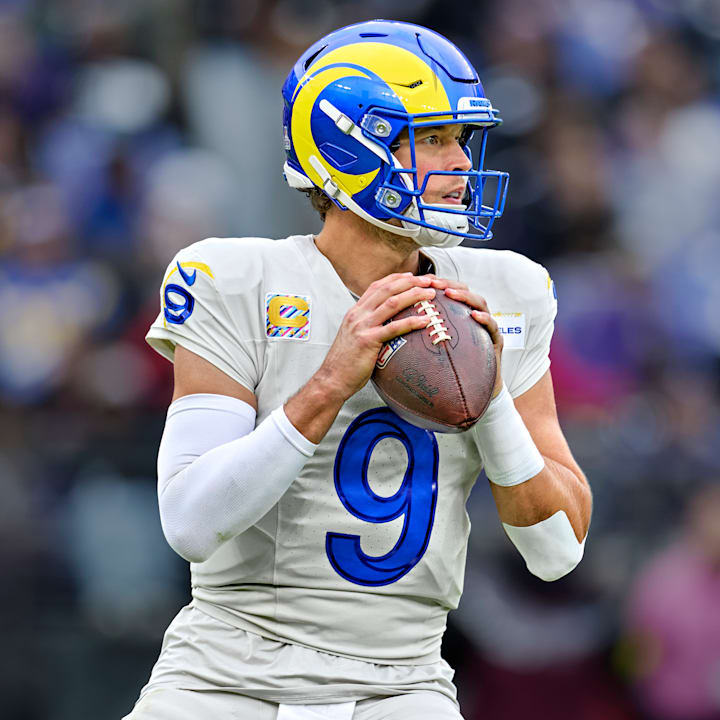
Matthew Stafford Gave Up on History, But Is Driven to Make More of It
I:
In Dallas, amid those glorious 1990s—the Cowboys shaping a dynasty, NFL television rights exploding—a young quarterback fell for his first love: Steve Sabol, more or less. This boy fell for football. And not just football but its history. And not even in preparation for his chosen career: pro quarterback, gunslinger, one star in the galaxy he memorized in childhood.
Young Matthew Stafford loved NFL Films, the lore-shaping machine Sabol cofounded, as much as anyone loves anything. He preferred clips unspooling in black and white. He studied Johnny Unitas, Bart Starr, Vince Lombardi, the sport’s origins, the AFL merger and his hometown Cowboys, throughout their most bombastic championship seasons.
Vivid memories. Afternoons rushing home, bunkering in the family room, downing Dr Peppers, eating candy bars and watching large men, playing for existential stakes, collide on TV. That kid, the one who treated football history like a mission statement, still lurks just beneath Stafford’s superstar armor, which doubles as his excessively thick—and long-ago thickened—skin. “Football was great back then, right?” Stafford says, voice teeming with child-like wonderment. “The Cowboys! And the Niners! And the Packers! Elway was still going! Just these unbelievable, great quarterbacks to watch.”
Outside of class and practices for multiple sports, Stafford immersed in cold breaths, epic triumphs and voiceovers delivered in ominous, serious tones. Everything dripped with vast, grand significance.
Which taught him that history mattered in the NFL.
Only in high school did Stafford dare to dream of carving his own space on NFL Films. He did even that rarely, thoughts bubbling up every so often. Like: “Would it not be unbelievable to be a part of that for just a second?”

This isn’t something Stafford discusses often. Which is only because Stafford, now in season No. 17, rarely discusses anything in depth publicly. When he sat with Sports Illustrated in November, Stafford didn’t expect to open any veins. He remains a private person in a public job. A nation of football devotees believes, after watching him play for almost two decades, that they know him. The shockingly small number who actually do insist most don’t know Stafford … not really or not at all.
In this interview, Stafford spoke with unflinching honesty, presenting Matthew Stafford as most have never heard him. Take those historical leanings. Juxtapose them against the arc of his career, in a historical sense, certainly, but especially in relation to Rejuvenation Season, aka 2025.
He’s rolling now, Stafford as you’ve never heard him, core football nerd with vast intellect and nearly photographic recall. “Frankly, the NFL has grown into this massive, [tons of] media, international game,” he says. “That’s helped everybody, sure, financially, all these things. But when I think of the NFL, I think of the Ice Bowl. NFL Films. [That history] just … enchanted me.”
He pauses, as if transported back to simpler times. When football history mattered, but his place within that lore did not. When millions didn’t assess his career for him. When wider audiences didn’t diminish his accomplishments. Or see his career for what it is—worthy of a Hall of Fame induction, no maybe, no debates.
You know, back when football history made sense to Matthew Stafford.

Feb. 14, 2022:
The morning after—in this case, Super Bowl LVI at SoFi Stadium—Matthew Stafford returns home after sunrise. After hours of swirling confetti, how-does-it-feel, parties, bro hugs, drinks, stories and I love you, mans. He hasn’t changed yet. Black T-shirt. Black jeans. White socks. He has just taped a podcast. Disney reps will knock in the next hour.
Stafford is, at long last, a Super Bowl champion. Write it in bold letters!
Narratives are changing this morning, as Stafford exits his house and strolls into the backyard for his Almost Famous moment. He’s headed toward … no way … come on … the pool? Yes, and the man in black is sort of bouncing and swaying as he strolls, the way the body tends to when epic revelry meets epic release.
His wife, Kelly, films from behind. “No!” she says, laughing and half-heartedly. “Nooo!”
Matthew takes another step, then half steps, half face-plants into his pool. He remains there, splayed out, floating but otherwise not moving, eyes downcast, head underwater, lingering and not for long but for long enough to explain everything he had carried in silence, the heft higher than anyone might have guessed. “Maybe I should grab him,” Steve Cundari, one of Stafford’s closest friends, jokes.
Cundari sees, at that moment, what Stafford never says. “He realized, ‘I f---ing did it. I just proved however many millions of people wrong,’” Cundari says now. “You could see the years of pressure and weight and hate and battle and injury just … evaporate.”
“Super Bowl champion!” Kelly shouts.
Matthew hears her and responds with a lighthearted, warm-water fist pump. Then: “Woo-hoo!” That’s it. He is excited. But not like he just won the Super Bowl that taunted him. Like he’s excited and exhausted and just won the Super Bowl, after not just all the losing but all the injuries and snubs and nonsense.
Stafford had fashioned NFL history, for himself and his team. Nobody could take that from him. All lingering doubts would vanish. Right?
Aug. 18, 2025
The quote that projected Rejuvenation Season in Los Angeles still lives on a white board in the office of general manager Les Snead. Andrew Luck, retired NFL quarterback and current GM of Stanford football, said these words while meeting with the Rams’ scouting staff at the start of training camp.
This session marked Stafford’s return to football. From spine-neck-back pain. From four injurious years before that, starting in 2021, through ’24. And from another round of rumors—that Stafford might retire, that he would, that the Rams wanted him to, so they could slot in Aaron Rodgers.
Stafford put zero energy toward another round of falsehoods. He spent all his time, instead, in recovery. The pain slowly abated, steadily through Aug. 17, when head coach Sean McVay and Reggie Scott, the franchise’s vice president of sports medicine and performance, asked Stafford if he wanted to jump in the next day, and not for a stretch. Did he want to try full-go? He hadn’t thrown live in months.
Like, Stafford says now, “F--- it. I’m going to play football this year, and let’s see what we’ve got.”
Snead watched with even more intent than usual. Stafford did far more than return to football. He carved up an elite defense for lunch. He wasn’t fully healthy; NFL players, especially those still playing at 37, rarely are. He didn’t need to be. Stafford whistled passes toward ace receiver Puka Nacua. He arced deep balls to Davante Adams, elite offseason addition, signed with another championship in mind. Stafford looked like, well, MATTHEW STAFFORD—an elite superstar who just might play forever. Snead and Stafford both knew that day. This season could end like the one four years ago, with confetti raining from the ceiling.
That afternoon, Snead asked Stafford to swing by. The quarterback reclined on a leather couch in the GM’s office. Snead started with the obvious. “You weren’t Matthew Stafford today. You were f---ed up. In a good way–Freddy f---ing Krueger.”
In Stafford’s story, this season—at once: joyful, relieving, expected, inevitable, fraught, transformative, tense and, critically, not over—represents an unfinished masterpiece. It layered a ghosts-of-seasons-past nature into 2025. Everything that has happened—and that will—ties directly to his longer football arc.
Few humans could understand Stafford the way Luck can. The pain. The glory. The nonsense. And the lines the best quarterbacks must straddle, incorporating everything—pain and glory and nonsense—forever intertwined, each heightened by the others.
“To be a good NFL QB you have to be a little f---ed up,” Luck told the Rams’ evaluators. “And you have to choose toughness.”
Snead pointed that quote out to the player who best embodies it: Stafford, back to being Freddy Krueger—to hunt for more history, more clarity and, most importantly, to take another celebratory plunge.

II:
In only his second career game, Week 2 in 2009, his first start at Ford Field, Stafford approached Vikings starter Brett Favre. Stafford recalls feeling “nervous as s---.” He extended his hand, shakily.
Stafford: Hey, Brett, nice to meet you.
Favre shook it.
Favre: Hey, good to meet you, kid. Big fan of your game.
Stafford (seriously): You can’t say that to me! I’m a fan of you!
There it was: joy, pure and unadulterated—and not entirely borne from playing in the NFL. No, this joy stemmed from a childhood spent studying NFL luminaries. “You know,” he says, “history-makers, pillars, just unbelievable players.”
Playing in Detroit—12 seasons, eight of them under .500, with zero playoff victories and no season above 11 wins—took that joy and made it harder to find, impossible to summon. Ask Stafford, specifically, about those seasons, spent carrying not just a franchise but the franchise that most needed a savior. Ask him about lifting those Lions as high as anyone could. About never blaming anyone but himself, never leaking anonymous info to shift accountability, never even considering leaving until near the end of his final season there. All while fighting through injuries, mockery, hopelessness.
Stafford, the quarterback, improved in every major statistical metric. He became more accurate, cut down his interception percentage and still threw for country miles, behind leaky offensive lines, while the Lions yielded points as if they played for Etroit—no D.
Yes, he wanted to be appreciated outside of the Motor City limits, Stafford says, recognized for how he led, his play, all that lifting. Wanted to be considered among the NFL’s best.
In 2011, Stafford authored his first best-in-class season. Two years worth of injuries had healed, allowing him to play freely, with abandon; finding joy in footballs slung into tight windows or the parabolic arcs of long touchdown passes. He threw for 5,038 yards and 41 touchdowns, becoming only the third quarterback in NFL history to reach 5K, after Dan Marino in 1984 and Drew Brees in 2008. (Brees, again, along with Tom Brady also eclipsed 5,000 yards that season.) Stafford steered Detroit past all its Detroit-ing, through will and skill—and Calvin Johnson—back to the playoffs for the first time since the previous century. He won the Comeback Player of the Year award. Even shut up the well-he-doesn’t-win crowd.
Late in the season, Detroit’s team president, Tom Lewand, called. Votes were in. Pro Bowl votes. “You’re the third alternate for the NFC,” Lewand informed him.
Stafford’s analytical brain churned. “I’m, like, the fourth guy ever to throw for 5,000 yards [in a single season].” He considered that season’s selections: Michael Vick, Matt Ryan, Brees. Then he pivoted, in that instant, deciding never to fall into this Rodney Dangerfield no respect routine again.
Another vivid memory. Of letting go. “Well, f--- it,” Stafford decided. “If you don’t make it now, you never will. If 5,000 yards and 40-something touchdowns and the playoffs for the first time [in forever] isn’t enough, quit f---ing worrying.”
Stafford poured his focus into teammates. He would be great for them. Forever that young NFL Films superfan, Stafford notes that he has, since, made two Pro Bowls, in 2014 (named an alternate, initially) and ’23—he also made this season’s roster, but after the SI interview. For the record, upon being named for the first time, Stafford thought: “I didn’t play that [well].” (The ’14 nod resulted after his passing yards and touchdown throws dropped from the previous year, amid a second playoff appearance in Detroit.)
But that mindset—focused on people who mattered and games they won together—had already solidified.
The historian, still pretty young, gave up on making history in the NFL in only his third season. He still refuses to consider that concept.
August 2025:
What was clear in college at Georgia and in his first 16 NFL seasons further crystallized at Rams headquarters in the weeks between Stafford’s first practice and the opener, at Houston on Sept. 7. It’s disingenuous to examine Stafford and not wax poetic in regard to that arm.
Actual historians might note: The NFL hasn’t seen another quite like his. As in, ever. As in, period. Stafford makes more throws, more often, that are more spectacular, than the vast majority of NFL superstars would ever dare launch. His right arm, in typical, metaphorical senses, is the equivalent, always, of something that flings/launches/propels objects long distances with great accuracy.
Arm strength is not Stafford’s only talent. Not even close. But when he resumed practicing this summer, Rams players and coaches admit they sometimes lost concentration—from the poetic nature of his passes.
Nacua saw Stafford layering footballs against zone coverage, feathers dropped in for TDs. He saw Stafford manipulating defenders into Keystone Cops routines. Saw elite ball placement. Shifting arm angles. Big brain allowing Stafford to see what will happen before it does. Elite anticipation. Zip. Nacua affirms that Stafford’s arm talent hasn’t dipped.
“If God were to make a quarterback,” Nacua says, “it’s No. 9.”
Consider all Rams awestruck before everyone else caught up with Stafford’s MVP turn. Adams caught passes from Aaron Rodgers for nine seasons, and he says, firmly, without hesitation, that Stafford and Rodgers possess the most arm talent in NFL history.
Adams would know that specific delineation better than almost anyone alive. “I don’t know why people have [underappreciated] or slighted him throughout his career,” Adams says. “But he is one of the all-time greats. That’s for sure.”
For most of his football life, that was Stafford, God’s quarterback, the positional prototype in real life. “We’ve had good plays [designed and called] versus certain coverages, and he makes them wide open. He does that all the time,” McVay says. “He makes amazingly difficult throws look routine.”
In contrast, take a spin through social media. Call the most fan-y fan in your contacts, that guy who wears jerseys every day in middle age. Ask anyone who doesn’t know Stafford, who hasn’t played with him, who perhaps cannot separate 12 (mostly) losing seasons from 17 years of (mostly) sheer greatness.
Ask them: Is Stafford one of the best NFL quarterbacks ever? You will get answers, but not consensus. Like all the losing in Detroit robbed Stafford of his innate ability to throw.

III:
In November 2020, when Detroit fired Matt Patricia, Stafford told interim head coach Darrell Bevell he would address the locker room in the aftermath. His ribs ached. His elbow felt almost detached from his throwing arm. The season was over, just like the three before it.
Stafford asked his teammates to consider what football meant to them, to remember that history recorded every game. And if football meant what they said it meant to them.
Kelly points to that season, No. 12, as their low point in Detroit. “It hit me,” she says, “that we had been there, and he had gotten just zero out of it.”
By just zero, Kelly means on-field success. She’s not here to trash the Lions, past coaches or Detroit. But 12 seasons with zero playoff wins is … just zero. “It’s hard to watch someone you love just continue to put their body through hell without anything in return, without—I’m not even saying people noticing—just team success.”
After his penultimate game in 2020, Kelly broached a topic both Staffords had considered but not discussed. “Have you ever thought of leaving?” she asked, gingerly.
Of course. It wouldn’t be simple or absent bruising. But Matthew wanted to win Super Bowls—and hadn’t come particularly close, despite a career already three times longer than league average. He meant so much to Detroit. Detroit meant as much to him.
Stafford knew. He needed to leave; and, more than that, he needed a way out. The Lions could refuse. Few would blame them. He had to try.
On the morning after the Lions finale, Matthew looked at Kelly, then said, in his own, non-ominous NFL Films voice of vast historical significance, “I’m gonna ask today.”
“Very unlike him,” Kelly says. “I didn’t think he would ever do it.”
Matthew called on his drive home. He couldn’t wait. He had visited with ownership; had stated what he wanted, even though it hurt, those words, departing his mouth. “They were surprised,” he said.
He didn’t know anything for certain. Lions brass told him they would try but couldn’t promise anything. Still, support from management after this ask, to leave, still rings as “incredible” for Kelly, who highlights ownership, especially Martha Firestone Ford, for doing more than required for the Staffords.
That day, Kelly heard her husband, his voice easy on maybe the single most emotional of his life to then. “It wasn’t like he was torn,” she says. “He had given that place everything he had. My goodness. He was … at peace.”
The next year, in Los Angeles, with the Rams, after the rarest NFL trade—a blockbuster both teams felt great about—Stafford won. And not just a playoff game but the Super Bowl that had long eluded him.
He thanked Von Miller, the pass rusher who joined him in L.A.
He watched the clincher—an Aaron Donald sack—while bent forward on one knee, next to his new head coach, the one who wanted him. “Gets me teary-eyed just thinking about it,” McVay says.
Stafford playfully hit his leg. Then said, “Oh, man. You did it. We did it.”
Any anecdote from that day speaks to Stafford’s impact on those around him; as intended, always but especially from 2011 onward. So many detractors liked to hold up the best and second best single seasons by any wide receiver, ever, and then point to Calvin Johnson (1,964 yards, 2012) and Cooper Kupp (1,947 yards, 2021) like they threw footballs to themselves.
Zoom out, though. Examine the still-short list of the 200 best individual seasons by a receiver, ever. Stafford was the quarterback for seven of those. And not just the two wideouts perched atop the list. Golden Tate and Puka Nacua, too. (Nacua made the list in 2023 and has 1,639 receiving yards this season, which would slot him at 23rd all time even if he doesn’t play in Week 18.)
“I’ve been blessed to play with a bunch of great players,” Stafford says, acknowledging the obvious without diminishing his role. It’s playing with them that matters, elevating teammates into the history he worshipped.
As for … Matthew Stafford? “I [still] can’t even fathom thinking about myself in that role,” he says. This isn’t a “humbly” accepted Oscar. This is Stafford, sticking to the pledge he made in 2011. He’s still letting go.
Stafford’s body began failing him in 2021, during the championship season, long before the Almost Famous dip. He began wearing a sleeve on his right elbow and not for stylistic reasons. He had injured that throwing elbow during training camp, then made it worse by trying to fix the injury himself, right there on the field. “I tore my tendon off the bone,” he tells SI. “I wore the sleeve to keep the damn thing from blowing all the way.”
In the 2022 season, the Rams used roughly a dozen O-line combinations—in their first 13 games alone. Tackle Andrew Whitworth, who retired after the Super Bowl but remains a close friend, notes that centers whom Stafford had hardly said hello to were snapping footballs into his hands. Every time he threw, Stafford told McVay, the inside of that elbow felt like an M80 going off. “Nobody’s tougher,” McVay says.
The elbow wasn’t even Stafford’s worst injury that season, according to his wife. Stafford entered concussion protocol in November, then flew, with Kelly, to Pittsburgh to meet with neurologists. “It made me fearful,” she says. “Because that’s when this isn’t worth it.”
As the specialists explained head trauma, traumatic brain injuries and CTE, Kelly’s mind drifted back to brain surgery she underwent to remove a benign tumor in 2019. She turned to Matthew and told him, “If you chance [your future health], I’m going to resent you. Because there’s [former players who] don’t have healthy brains. And I don’t think it’s fair of you to ask me and your girls to deal with the aftermath when that shows up in 20 years.”
Matthew promised his wife after that season: If he ever experienced any concussion symptoms, he would remove himself, immediately. She never believed he would retire, not then and not now and not any time in the immediate future.
The next season would threaten that premise more than any injury. The Rams wanted Stafford back; they needed him in 2023. But there were price points, salary cap issues, a team to construct around him. Other franchises reached out to gauge Stafford’s availability, hunting for a discount Snead never planned to offer. “Wow,” Snead would respond. “Never.”
The Rams understood they had a “handshake deal” with Stafford. All parties would take each year and do their own analysis, which would allow them to focus on the present, not the next, say, four seasons.
Executives met with Stafford and his reps several times that spring. Tension elevated as weeks flew by. The Rams wanted Stafford to return. Stafford wanted to be appreciated for his skill and keep winning. He loved football, and realized his time remaining was finite and impossible to discern. Snead calls this persevering energy, which netted a compromise that set up another run.
The Rams still modified his practice reps through all of 2024. Stafford still chose daily pain, in every season from ’21 through last year.
Last year, L.A. started slowly, which owed to yet another injury; this time, the thumb on his throwing hand. Those who pointed out he threw only 20 touchdown passes, his lowest tally when playing a full season since 2012, missed why.
Stafford still pushed the Rams to 10–7 and, with a late–season surge, into the playoffs, still won a division title and beat the 14–3 Vikings in the wild-card round. The day the Rams packed up, 2024 over, Stafford told Snead, almost in passing, that he would return again. “I’m coming back,” he said. Just that. An epic announcement delivered via shrug.
“All right!” Snead responded. “Let’s circle back soon. Like, if you need more time.”
Stafford believed the end of ’24 projected a season more like ’21. He knew through the depth he witnessed in practice and the coalescing of the offense.
“I don’t need time to think about it,” Stafford said. “I’m doing it.”
He wasn’t after full health or consensus on his Pro Football Hall of Fame candidacy. Stafford understood he might never get either of those things. Neither mattered.
He wanted another ring.

Nov. 2, 2025, Week 9:
Like Stafford’s historical bona fides, the Rams started 2025 amid doubt that grew from elements of fairness but wasn’t fair at all. After the Super Bowl triumph, over the next three seasons, Los Angeles went 5–12, 10–7, 10–7. Stafford spent each week of those in pain, which varied only by severity.
Then the spine-neck-back agony returned last summer, owing to an older compression fracture; the return was as “acute,” Stafford says, as anything he dealt with since his final season in Detroit.
In response to dozens of published reports, each heavy on anonymous sources, all hinting at his retirement, Stafford relied on the only source who ever mattered—himself. He wasn’t retiring. He had finalized another contract this past May—for $44 million, which won’t prompt anyone to cry poverty for him but is still considerably less than what other quarterbacks with lesser talent banked.
Stafford was older, more mature. He had let go of personal recognition. He knew what it took to win, and what it cost. His career had heaped pressure atop pressure—to rescue the Lions, make Detroit respectable again, win in L.A. and in his first year, no less, return from injury after injury.
Before this season’s opener, Kelly reminded him of what mattered. He loved his coach, team, teammates. He could play with ease, owing to lower pain levels (after the spine pain lessened). She encouraged him: Talk smack, celebrate and more vociferously, let loose, even consent to being mic’d up.
“You don’t have anything to prove anymore,” she reminded him.
Week 1: Stafford becomes the 10th quarterback, ever, to surpass 60,000 career passing yards.
Week 3: Philadelphia drops L.A. in a 2024 playoffs rematch after a blocked field goal at the final whistle.
Week 5: San Francisco upends L.A., in overtime. The Rams are still 3–2, their losses to elite teams by a combined 10 points.
Week 7: There’s that joy again. In London, at Wembley Stadium, Stafford adds dominate-for-an-international-crowd to his résumé, with five touchdown passes against the Jaguars.
He becomes just the fourth quarterback in NFL history to record 20-plus touchdowns and no more than two INTs in any season’s first eight games, joining Rodgers, Patrick Mahomes and Brady, who did that twice.
The offense turns 13-personnel groupings—three tight ends, one receiver, one back—into yet another fad started by McVay. Stafford tells SI he never played this much 13-personnel, ever, at any level.
That Stafford embraced McVay’s latest schematic twist since their championship highlights the growth of their symbiosis. McVay can design plays, counters and game plans with his—maybe you’ve heard?—brilliant offensive mind. Stafford can diagnose and distribute at the sport’s highest levels. Each understands the other better.
Both lost joy from ’21 through 2024.
As the first half of ’25 unfolded, both were also in the process, four years later, of fully rediscovering just that. Together.

IV:
Stafford continued letting go. Children helped. His family grew to include four daughters, leaving Dad surrounded by feminine energy but not absent critics in close proximity. He left football at work and parented with intention, driving the girls to school on Tuesday mornings and learning the newfangled approach to math instruction so he could tutor them.
He found joy there, too, separate entirely from football and accolades and Hall of Fame debates. Almost. Kelly saw four daughters who humbled him, because they’re kids and kids speak truths.
Typical scene: Matthew returns home after another football game. One daughter or several or all of them—their youngest, 5-year-old Tyler, is the most likely future pundit—rain criticism upon him.
“Dad, you lost! If you didn’t throw the ball to the other team so much (!), maybe … ”
Dad will respond, softly, gently, sarcastically: “Thanks, guys.”
He moves on from at-home criticism the same as all the rest. Won’t impact him at all.
Confidants want to share the sides of Stafford that remain largely unknown.
Like: He is the rare NFL QB who doesn’t wear a play call sheet on his wrist. This is not to look more fashionable. This is because he’s brilliant.
“A genius,” Cundari says.
“Intimidating,” Whitworth says. “I’m talking, and he’s entertaining me, because he already knows what I’m going to say.”
“He’s my phone-a-friend,” Nacua says.
Like: You’ll never meet someone more loyal.
Like: The man’s calves. Kelly likes to joke that she hopes their daughters get that from him, this underrated Stafford superpower. He jokes back, “Are you into calf guys? Because that’s what I have going for me!”
“I can appreciate his calf game is strong,” McVay says. “Sturdy lower half. Since he has been playing a lot of tennis, I tell him he looks like [Carlos] Alcaraz.”
Like: He’s funny as hell.
Authentic.
Swaggy.
Like: He has Brady’s reverse aging gene. Make no mistake. Stafford is ripped. So much so that Kelly sometimes begs him to eat dessert.
Like: He does pilates in the offseason.
They could go on. They don’t have to.
Nov. 9, 2025: Week 10
Los Angeles bludgeons San Francisco. Stafford records four touchdown passes and no interceptions for the third consecutive game, an NFL first.
He leads the NFL with 25 touchdowns thrown, against a meager two interceptions. Twenty of those have been delivered against the blitz, a tally that’s already the most NFL Next Gen stats has ever tracked. Stafford’s passer rating has never been higher. His yards per attempt has climbed back to 2021 levels. Related: The Rams have won their past four games by a combined margin of 82 points.
Week 11: After beating their long-hated division rival, Seattle, L.A. climbs atop all power rankings. Adams already has 10 touchdown receptions. Pro Football Focus is highlighting the offensive line’s run blocking as the second-best in the league. Stafford hasn’t thrown a pick in seven games, while tossing 22 TDs, another NFL first for a seven-game span.
Even Stafford must acknowledge the obvious: This is the best he has performed, statistically, in any of his 17 seasons. Proof is three game-winning drives and a winning streak that will grow to six games the following week against Tampa Bay. Five of those victories were delivered by margins of at least two touchdowns.
Week 13: The streak ends in a tough, rainy, road loss at Carolina. Stafford turns the ball over three times, snapping his NFL record streak of 28 touchdown passes without throwing a ball to the other team.
Weeks 14 and 15: Two more victories, over Arizona and Detroit, respectively, quiet any renewed doubts. Even an away stadium serenades Stafford with M-V-P chants. The Rams score 45 against the Cardinals, accumulating 530 yards of offense. The next week, they host Stafford’s former team, the Lions. Stafford throws two more touchdowns as L.A. gains 519 more yards. His success rate hovers at 54.1%, another career high. Next Gen says Stafford has thrown the most touchdowns this season from under center.
Many will say that Stafford has aged like fine wine. That’s not true. He has aged like fine wine that spoiled, spent time on IR, lost so many Food & Wine competitions, left for another vineyard, peaked, somehow came to taste worse and kept pushing until resembling fine wine again. Only this wine tasted better than ever before.
Week 16: The Rams, minus Adams, lose to the Seahawks, in the rain, in Seattle, in an epic game within an epic rivalry. Stafford throws for 457 yards and three scores despite lacking one of his main targets. He loses even after throwing a touchdown pass in overtime.
The next morning, his MVP odds … drop.

V:
As he prioritized and let go, those closest to Stafford still encouraged him to open up more, especially in public. He had always been reserved, a celebrity who never acted like one, a normal dude who wasn’t normal at all, the champion forever clad in T-shirts and hats turned backward. “I wish you let people in, just a little,” Kelly often told him.
Those same confidants now wonder if the decade-plus of losing in Detroit, combined with how little Stafford revealed in those days, twinned to diminish how his career was and is viewed.
“People in the NFL that know quarterback play, they know the top 20, 15, 10,” says Jimmy Garoppolo, Stafford’s backup. “Outside of that, anyone can make any ‘evaluation.’”
Such “evaluations” criminally underrate Stafford and have for years. He wins, the counter-argument goes, while piloting offenses loaded with talent. Which would apply to every Super Bowl champion, ever.
Hasn’t Stafford lifted two franchises far beyond any reasonable expectations? Won’t his statistics, by the end, rank in the top 10 or adjacent in every possible category? Didn’t he already win a Super Bowl? And yet, deep into this 2025 season of rejuvenation, many still wonder, out loud, if Stafford must win MVP to make the Hall of Fame.
This season, after 16 weeks and 15 games, Stafford led all NFL quarterbacks in, well, just about everything: passing yards, touchdown passes, touchdown percentage, interception percentage, first downs, average yards per attempt, average yards per game, QB rating, deep-ball attempts, EPA per play and success rate.
After a Monday night loss in Atlanta with only (for him) 269 yards, that upped his season-long interception total from five to eight, he’s suddenly looking up at a couple of his peers in categories he’d led nearly wire-to-wire.
Many critical of Stafford’s MVP candidacy this season cited yet another supposed advantage—the sentimental vote. Narratives continued shifting. In 2025, his career record went over .500 for the first time. He added historical footnotes almost every week. So, if the vote was, indeed, sentimental, which is disrespectful to both Stafford and the voters, what exactly is the issue? This season merits MVP consideration all by itself.
The biggest, reasonable strike against him is the Rams’ record relative to their divisional peers. L.A. ranks among the best three to five teams in football. But three of those teams—the Seahawks, Rams and 49ers—play in the NFC West. The Rams are currently in third place in their division. But if that counts as a point for Drake Maye to win MVP, shouldn’t the fact that Stafford beat Seattle and San Francisco, already, this season, count, too? Shouldn’t the Patriots also need to win their conference? What about not getting the Dolphins and Jets four times in a 17-game season?
He’s not going to lobby for MVP. But he wants to win; he wouldn’t give it back or to another quarterback.
The only time his legacy comes up is not even at home. It’s when he’s meeting with one of the girls’ basketball teams or dropping them at school. It’s when teammates say they loved watching him in second grade. Stafford still refuses to consider his place in NFL history, even when moments like those force him toward introspection. “Pretty wild,” Nacua says. He sees Stafford only in that light. Stafford won’t even look until the end.
Stafford will turn 38 one day before Super Bowl LX this February. That would make him the third-oldest player (tied) to win league MVP. He’s not banking on that happening. “When I first came to the NFL, man, the shield really meant something,” he says. “Not to say it doesn’t now. But there is so much individual, global branding, so much star power, and not every voice is heard.”
Winning MVP would be deserved. Needing an MVP for HOF consideration would be absurd. “I wouldn’t need to see it to put him in,” says Adams, likely Canton-bound himself.
Contrast all this useless debate with what matters to Stafford: “The admiration, respect that I have for this game, it brings me joy,” he says. “Like, I love being a part of [the NFL]. I love being a part of this team. I don’t even think about [my legacy]. I still hold those guys up here,”—he raises his right hand, indicating a high bar—“ya know?”
McVay watches Stafford play this season and sees a family man at quarterback, who’s as healthy as he has ever been in Los Angeles. “You’re seeing somebody who pours a lot into the people that matter, and it’s being given back to him—this still, settled human who is totally present,” McVay says.
Stafford, in other words, has rediscovered the joy in football. He’s celebrating with finger-gun salutes, or land-shark shimmies.
Whitworth watches his close friend and sees that latter-stage glow from those NFL players who last as long as they did and have. “It’s almost like passing the point of no return,” Whitworth says. “He’s got a head coach who runs an awesome program. A place he loves to live. A family that smiles when he’s around. He’s just grateful and happy every time that ball slaps his hand and he says, “Turbo, set, hut!”
His daughters come to games now. They will remember him, the quarterback, even if remembering means they offer some, ahem, constructive criticism. “You can’t play forever,” Kelly says. “Nearing the end allowed him to have fun and play free. I’ll miss the hell out of watching him compete and do what he loves. But there’s also going to be a sense of relief.”
Just don’t expect such sadness/relief any time soon, barring another major injury. The handshake deal remains in place. Each year, Stafford and the Rams will do their own assessments. Never say never, but no one in his inner circle believes Stafford will retire after this season, even if he wins another championship and could retire, like Elway, completing the rarest sendoff in pro football—out on top.

Postscript:
For all the veins that Stafford opens in November, one thing he says surprises more than anything else. Listen to him detail the Rams, their locker room culture, the vibe in ’21 and the vibe in ’25. The impact of Los Angeles on him is as clear as the California skies most afternoons for practice. What then, will he do, when his career ends? Will he identify more as a Lion? Or a Ram?
He’s already split, which speaks to what they’ve built, together, in Los Angeles. “I don’t know,” Stafford says. “It’s gonna be a tough call at some point.”
Perhaps that tough call will begin with a poetic end to 2025. Maybe Stafford loses the MVP race. Story of his career. But maybe Los Angeles wins another Super Bowl and its quarterback earns another ring. Maybe that gets Stafford into the Hall. Regardless, what mattered is winning another Super Bowl. That history isn’t subjective. That history cannot be taken away.
Stafford, forever in wet blanket mode, says he cannot, will not, define anything just yet. “I don’t know,” he says. “I don’t think [my career is] done, No. 1. And I’m still in it.”
The teenaged historian gave up on personal history and rediscovered the primal, pure joy that drew him to football in the first place. Which is how Stafford became—forget the MVP debates—a Super Bowl–caliber quarterback again. And this legacy is the one that matters.
More NFL From Sports Illustrated
 Add us as a preferred source on Google
Greg Bishop was a senior writer for Sports Illustrated and has covered every kind of sport and every major event across six continents for more than two decades. He previously worked for The Seattle Times and The New York Times. He is the co-author of two books: Jim Gray’s memoir, “Talking to GOATs”; and Laurent Duvernay Tardif’s “Red Zone”. Bishop has written for Showtime Sports, Prime Video and DAZN, and has been nominated for eight sports Emmys, winning two, both for production. He has completed more than a dozen documentary film projects, with a wide range of duties. Bishop, who graduated from the Newhouse School at Syracuse University, is based in Seattle.
Follow GregBishopSI