%20%20--%3E%0A%3Csvg%20version%3D%221.1%22%20id%3D%22Layer_1%22%20xmlns%3D%22http%3A%2F%2Fwww.w3.org%2F2000%2Fsvg%22%20xmlns%3Axlink%3D%22http%3A%2F%2Fwww.w3.org%2F1999%2Fxlink%22%20x%3D%220px%22%20y%3D%220px%22%0A%09%20width%3D%2239px%22%20height%3D%2240px%22%20viewBox%3D%220%200%2039%2040%22%20enable-background%3D%22new%200%200%2039%2040%22%20xml%3Aspace%3D%22preserve%22%3E%0A%3Cpath%20fill%3D%22%23FFFFFF%22%20d%3D%22M38.5%2C7H28.2v26h10.3V7z%22%2F%3E%0A%3Cpath%20fill-rule%3D%22evenodd%22%20clip-rule%3D%22evenodd%22%20fill%3D%22%23FFFFFF%22%20d%3D%22M26.1%2C25.5c0%2C5.8-4.1%2C7.5-12.9%2C7.5C3.9%2C33%2C0%2C31.2%2C0%2C25.2v-1.1h11.6%0A%09v2.4c0%2C0.7%2C0.1%2C1.4%2C1.2%2C1.4c1%2C0%2C1.2-0.4%2C1.2-1.3v-0.9c0-1.6-0.9-1.6-3.5-2.2C2.2%2C21.7%2C0%2C19.7%2C0%2C15.3v-0.9C0%2C9.3%2C5.5%2C7%2C12.9%2C7%0A%09c10.2%2C0%2C12.8%2C2.6%2C12.8%2C7.4v1.8h-11v-2.9c0-0.6-0.4-1.1-1.2-1.1c-0.6%2C0-1.2%2C0.4-1.2%2C1.1v0.9c0%2C1.5%2C0.9%2C2%2C3.3%2C2.5%0A%09c8%2C1.6%2C10.5%2C3.3%2C10.5%2C7.5V25.5z%22%2F%3E%0A%3C%2Fsvg%3E%0A)
The 60 Greatest Moments in Super Bowl History
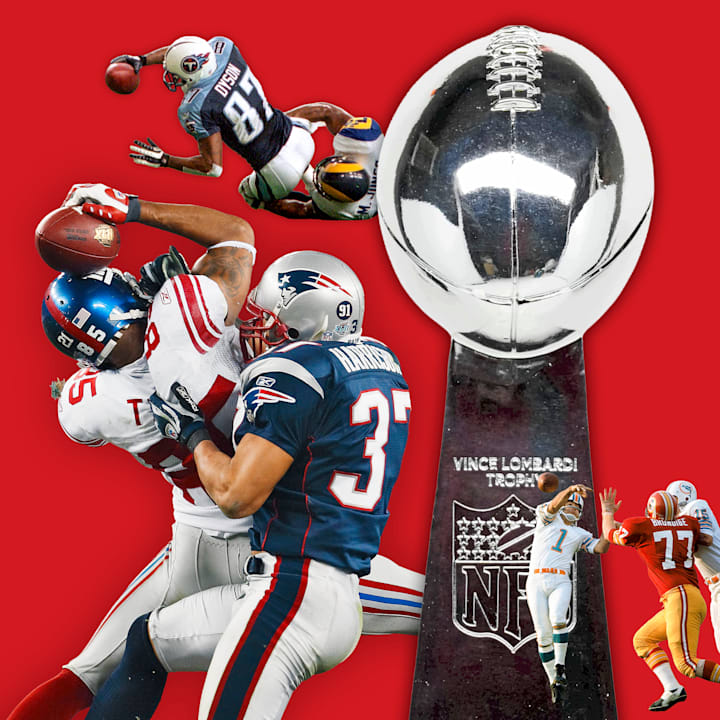
This February, the Super Bowl turns 60.
Before Super Bowl LX gets underway at Levi’s Stadium in Santa Clara, Calif., it’s worth reflecting on where the game has been and how it’s grown since the inaugural Super Bowl, then known as the AFL-NFL World Championship Game, took place at the LA Memorial Coliseum in January 1967.
Back then, Vince Lombardi and Hank Stram roamed the sidelines, a pair of future Hall of Fame coaches representing not only their own teams but also the leagues—the NFL and the AFL, respectively.
Today, the Super Bowl is an American holiday, consistently topping television ratings among all programs for the year. It has become more than a game, but a celebration of Americana, a date everyone circles on their calendar, whether it’s to watch football, commercials, the halftime show or simply to gather with friends.
But it wasn’t always that way. The game has grown slowly over the years, exploding into the showstopper it is now. And that’s due to great football, but more importantly, the moments impossible to forget for those who witnessed them.
To that point, Sports Illustrated put together a blue-ribbon panel to vote on the top 60 moments in Super Bowl history. In an effort to get a precise list, all panelists (listed below) selected from a list of more than 100 moments and ranked their personal choices from 1 to 60. Once all the lists were compiled, we had our master list, which you’ll see below.
Panelists
Bob Glauber: Retired Giants beat writer, Newsday
Dave Dameshek: NFL analyst and host, Football America!
Colleen Wolfe: NFL Network host
Doug Farrar: NFL writer, Athlon Sports
Jarrett Bailey: NFL writer, SB Nation
Mike Tanier: NFL writer, Too Deep Zone
Frank Schwab: NFL and sports betting writer, Yahoo Sports
Peter King: Retired NFL national reporter, Sports Illustrated and NBC Sports
Bill Polian: former NFL general manager, six-time Executive of the Year
D. Orlando Ledbetter: Falcons beat writer, The Atlanta Journal-Constitution
Sal Paolantonio: National NFL correspondent, ESPN
Les Bowen: retired Eagles beat writer, Philadelphia Daily News and Inquirer
Rick Gosselin: Pro Football Hall of Fame voter
Clark Judge: Pro Football Hall of Fame voter
Amy Trask: CBS Sports NFL analyst, former Raiders front office executive
Jason Cole: Pro Football Hall of Fame voter
John Turney: NFL historian; writer, Pro Football Journal
Tim Graham: Senior NFL writer, The Athletic
Howard Balzer: Pro Football Hall of Fame voter
Aaron Schatz: ESPN+ NFL analyst, founder of Football Outsiders
Sal Capaccio: Bills reporter, WGR550
John McClain: Pro Football Hall of Fame voter
Matt Verderame: Sports Illustrated NFL staff writer
And we start with the opening play of the only Super Bowl ever played outdoors in a cold-weather city.
60. Super Bowl XLVIII: The Seahawks score a safety on the opening play
The Broncos were favored by 2.5 points. They received the opening kickoff. Then, on the first play from scrimmage, Super Bowl XLVIII began to unfurl.
With Broncos quarterback Peyton Manning adjusting the call at the line, center Manuel Ramírez launched the snap over Manning’s head and into the end zone. Running back Knowshon Moreno fell on the ball and was touched down by Seahawks defensive end Cliff Avril, resulting in only one of nine safeties in Super Bowl history.
The moment was the start of a Seattle onslaught, as the Seahawks charged to a stunning 43–8 victory at MetLife Stadium.

59. Super Bowl LVI: Matthew Stafford makes the perfect throw to Cooper Kupp
For years, Matthew Stafford wasted away in Detroit, spending 12 seasons on a Lions team often out of the playoff race by Thanksgiving. In his first year with the Rams, though, Stafford had his chance to shine.
In the fourth quarter of Super Bowl LVI at SoFi Stadium, Stafford and Los Angeles had the ball trailing 20–16 with 3:07 remaining, facing second-and-7 at the Bengals’ 46-yard line. Stafford then unleashed the throw that would define his career, launching a no-look strike to receiver Cooper Kupp down the seam for a 22-yard gain.
Ultimately, Stafford found Kupp in the end zone to cap the drive, giving the Rams a 23–20 lead which held up in the final moments.
58. Super Bowl XXXVII: The Buccaneers score three defensive TDs in rout of Raiders
Super Bowl XXXVII was a classic contrast. The Raiders with their top-ranked offense. The Buccaneers sporting their top-ranked defense.
On Super Sunday, it was Tampa Bay that emerged with the best unit on the field. Under former Raiders coach Jon Gruden, then in his first year with the Buccaneers, the NFC champions dismantled MVP quarterback Rich Gannon. Gannon threw five interceptions and was sacked five times, with three of his picks being returned for scores.
In the third quarter, corner Dwight Smith went 44 yards with a theft, putting Tampa Bay up 34–3. In the fourth, All-Pro linebacker Derrick Brooks did the exact same, before Smith added a second pick-six to end the scoring.
It was the first Super Bowl victory for the Buccaneers after coming into the league in 1976.
57. Super Bowl I: Opening kickoff
On Jan. 15, 1967, America changed. The Super Bowl was born in the Los Angeles Memorial Coliseum.
That day, the National Football League’s Packers were looking for their second consecutive world title, taking on the Chiefs of the upstart American Football League. Green Bay was, predictably, a heavy favorite under Hall of Fame coach Vince Lombardi, coming into the game laying 14 points.
On a sunshine-bleached 54-degree day, Chiefs kicker Fletcher Smith sent the opening kickoff spinning into the air, and it was returned for 20 yards by Packers corner Herb Adderley.
Green Bay proved itself the superior team, winning 35–10 behind Bart Starr, who threw for 250 yards and a pair of touchdowns.
56. Super Bowl XXXI: Brett Favre hits Andre Rison for TD, rips off helmet and celebrates
After 29 seasons of wandering in the abyss, the Packers finally reached the Super Bowl once again.
This time, they didn’t have Vince Lombardi standing on their sideline, but were chasing the trophy bearing his name. To win it, Green Bay needed to beat the Patriots and coach Bill Parcells at the Louisiana Superdome.
On the Packers’ first offensive drive of the evening, Green Bay faced second-and-9 at its own 46-yard line. MVP quarterback Brett Favre took a deep drop and launched a bomb for receiver Andre Rison, who secured the ball and raced 54 yards for a touchdown.
In celebration, Favre ripped off his helmet and smiled wide, running with his headgear raised over himself. It was a symbol of the night, as the Packers went on to a 35–21 victory.
55. Super Bowl XLI: Prince playing the halftime show in a downpour
Super Bowl XLI wasn’t a great game. The most memorable part of the outcome from a historical perspective was Peyton Manning finally winning it all, giving him security from being the best quarterback to never win a championship.
Arguably, the most entertaining part of the night was when the Colts and Bears were in the locker room, seeking refuge from the downpour that enveloped Miami Gardens. While the teams were inside, Prince came onto the halftime show stage and gave a stirring performance, including such hits as “Purple Rain” and “Let’s Go Crazy.”
While the show only lasted a few seconds more than 12 minutes, it remains one of the most iconic performances we’ve seen on the biggest stage North American sports has to offer.

54. Super Bowl XXX: Larry Brown grabs two INTs en route to MVP award
It was supposed to be a mismatch. The AFC’s Steelers taking on the NFC’s Cowboys, a team looking to win its third Super Bowl in four years.
Instead, the game turned out to be competitive. Pittsburgh hung around and trailed by three points with the ball midway through the fourth quarter. However, the game swung when Steelers quarterback Neil O’Donnell dropped back and threw directly to Cowboys corner Larry Brown, who intercepted the wayward pass and raced to the Pittsburgh 6-yard line. Two plays later, Dallas running back Emmitt Smith ran in for a touchdown to ice the contest.
For Brown, it was his second interception of the game, having snatched one earlier off O’Donnell in the third quarter. Brown’s performance earned him a five-year, $12.5 million deal from the Raiders that offseason, a massive sum in 1996.
53. Super Bowl XV: Rod Martin nabs three interceptions off Ron Jaworski
Coming into the 1980 season, the Raiders were expected to be an also-ran. Instead, Oakland entered the playoffs as a wild-card team, then beat the Oilers, Browns and Chargers before taking on the Eagles in New Orleans for the title.
While quarterback Jim Plunkett was terrific with 261 yards and three touchdown passes, it was Rod Martin who stole the show. Martin, an eventual All-Pro linebacker in his fourth year, intercepted Eagles quarterback Ron Jaworski three times to help Oakland earn a 27–10 upset victory.
In his 12-year career, Martin had 14 regular-season interceptions. But in Super Bowl XV, the fourth-year linebacker picked off Jaworski on the opening drive, and then again in the third and fourth quarters. To this day, Martin is the only player with three interceptions in a Super Bowl.
52. Super Bowl V: John Mackey catches tipped ball for 75-yard TD
In Super Bowl history, there has never been a more blunder-filled game than the fifth edition.
In January 1971, the Colts and Cowboys got together in a game marked by desperation. Baltimore was attempting to erase its stunning Super Bowl III loss, while Dallas was trying to shed the label of Next Year’s champion. The result was a game with 11 combined turnovers.
Yet the best and longest play of the day came in the second quarter. On third-and-10 from the Baltimore 25-yard line, Hall of Fame quarterback Johnny Unitas dropped back and threw up the seam, with the ball being deflected twice. It ended up in the hands of fellow Hall of Famer, tight end John Mackey, who raced 75 yards for a touchdown.
Ultimately, the Colts won 16–13 on a 32-yard Jim O’Brien field goal in the dying seconds.
51. Super Bowl LIV: Tyreek Hill and Patrick Mahomes hook up for Jet Chip Wasp
The Chiefs’ dynasty almost never was. In their first Super Bowl appearance of the Patrick Mahomes era, Kansas City trailed San Francisco 20–10 with less than eight minutes remaining and faced third-and-15.
Then, Mahomes took a 12-step drop and heaved the ball down the left side with Tyreek Hill settling underneath the pass for a 44-yard gain. Four plays later, Mahomes found Travis Kelce in the end zone, touching off a 21-point onslaught to win 31–20, beating the 49ers in the Super Bowl for the first of two times.
Mahomes’s throw to Hill became etched in Super Bowl lore by the play name of Jet Chip Wasp, something Mahomes asked offensive coordinator Eric Bieniemy to call in the moment. Without it, Kansas City likely has more Super Bowl losses than wins.
50. Super Bowl XIII: Lynn Swann makes leaping catch for TD
The NFL in the 1970s was defined by the Cowboys and Steelers. The two teams combined to win six titles in the decade, while facing each other in a pair of Super Bowls.
While both matchups were filled with Hall of Famers on both sides of the ball, no player is more synonymous with Pittsburgh’s pair of triumphs over America’s Team than Lynn Swann.
In Super Bowl XIII, the Steelers held a 21–17 lead going into the fourth quarter before running back Franco Harris rumbled in for a 22-yard touchdown. After the following kickoff was fumbled away, the Steelers regained possession, and on the first play, threw an 18-yard touchdown pass to a soaring Swann, leaping over the Dallas secondary to essentially put the game away.

49. Super Bowl LII: Brandon Graham strips Tom Brady to seal the deal
Going into Super Bowl LII, the prevailing belief was that Tom Brady would outduel backup quarterback Nick Foles. On the surface, he did.
Brady put up an unfathomable stat line of 505 passing yards and three touchdowns, helping New England to 33 points. Yet it was the play Brady couldn’t make that ended up defining the end of the 2017 season.
Trailing 38–33 with 2:16 remaining, the Patriots had second-and-2 from the Patriots’ 33-yard line. Brady dropped back and was stripped by defensive end Brandon Graham, and the fumble was recovered by Derek Barnett.
From there, the Eagles added a 46-yard field goal with 1:10 remaining, icing the franchise’s first Super Bowl victory.
48. Super Bowl IV: 65 Toss Power Trap
The Chiefs were expected to be a speed bump. The Vikings, favored by 12 points, entered Tulane Stadium with a 12–2 record and a defense allowing 9.5 points per game.
Yet in Super Bowl IV, Kansas City dominated the Purple Gang. The Chiefs got out to an early 9–0 lead on the strength of three Jan Stenerud field goals before recovering a fumble on a kickoff return. On third down from the 5-yard line, Kansas City coach Hank Stram called 65 Toss Power Trap, a play designed for running back Mike Garrett to take an inside handoff and find space off the left side of the offensive line.
Upon the snap, Garrett ran behind the pulling block of right guard Mo Moorman, going in untouched for a touchdown and 16–0, second-quarter lead.
The Chiefs eventually won 23–7, giving the AFL its second consecutive Super Bowl title.
47. Super Bowl XVI: Dan Bunz makes huge stop on Niners’ goal-line stand
Very few Super Bowls have been as unique as the one produced by the 1981 season. Neither the 49ers nor Bengals had made the previous postseason, and neither was expected to make any significant headway in ’81.
Yet both ended up at the Pontiac Silverdome in January. In Super Bowl XVI, the Niners raced out to a 20–0 halftime lead before Cincinnati scored a third-quarter touchdown and then had a second-and-goal at the 1-yard line.
After a Pete Johnson run was stuffed, MVP quarterback Ken Anderson threw to Charles Alexander on a flare pass inside the 1-yard line. What appeared to be a sure-fire touchdown was thwarted by linebacker Dan Bunz, who made the tackle short of the end zone. On fourth down, San Francisco once again stuffed an inside Johnson run, helping the 49ers preserve a 26–20 victory and their first Super Bowl title.
46. Super Bowl XLVII: The lights go out in the Superdome
The Ravens were cruising to a blowout victory over the 49ers for their second Super Bowl win in franchise history. Then, the power went out in New Orleans.
Due to a massive power failure, the Mercedes-Benz Superdome went dark, causing a 34-minute delay during the third quarter while workers worked to fix the issue. The stoppage gave San Francisco time to calibrate a new game plan, helping the Niners get back into the game before ultimately falling short, 34–31.
While the outage ultimately didn’t shape the outcome of the game, it provided drama in a contest that was lacking any until the stadium went dark.
45. Super Bowl XXXI: Desmond Howard goes the distance on kick return
Howard’s career had been wholly underwhelming after winning the Heisman Trophy in 1991 with the Michigan Wolverines.
The fourth pick in 1992 to Washington, Howard became a bust in the nation’s capital before bouncing to the expansion Jaguars in ’95. But in ’96, Howard signed a one-year deal with the Packers and finally had his moment in the pros.
In Super Bowl XXXI, Green Bay led the Patriots 27–21 in the third quarter. New England kicked off to Howard, who promptly raced a Super Bowl-record 99 yards for the touchdown, making the game 35–21 and finishing off the scoring.
It was also the capstone for Howard’s special year as a returner, in which he scored five return touchdowns, including two in the playoffs.

44. Super Bowl XLIV: Tracy Porter’s pick-six wins it for Saints
Entering the Super Bowl as 4.5-point underdogs to the Colts, the Saints were fighting hard but trailing 17–16 to Indianapolis heading into the fourth quarter.
In the final 15 minutes, Drew Brees led the Saints on a 59-yard touchdown drive, capped off by Jeremy Shockey’s 2-yard scoring grab. Still, leading by seven points with less than four minutes remaining, Peyton Manning had Indianapolis at the New Orleans’ 31-yard line facing third-and-5.
Trying a quick throw to All-Pro receiver Reggie Wayne, Manning’s pass was jumped and picked off by corner Tracy Porter, who ran 74 yards to a championship-clinching score, giving the Saints their first and only title in franchise history.
43. Super Bowl XLI: Devin Hester starts the Super Bowl with a bang
Tony Dungy knew better. For the two weeks leading up to Super Bowl XLI, the coach of the favored Colts told the special teams to kick away from Devin Hester at all costs.
Then, the morning of the game, a sermon from the team pastor spoke of not living in your fears. Dungy heard the words and told his coordinator to kick to Hester. The Colts wouldn’t live in their fears. Then, kicker Adam Vinatieri sent the ball away amidst a sea of flashbulbs going off. And then Hester went the distance. A 92-yard kick return on the opening play.
Unfortunately for the Bears, Hester’s moment also convinced Dungy to stay away from the only returner ever enshrined in the Pro Football Hall of Fame. Indianapolis ultimately rallied and won 29–17, giving the Colts their first title since relocating from Baltimore in 1984.
42. Super Bowl XI: Willie Brown returns INT for TD
For the better part of a decade, the Raiders were a great team that could never win a big game. In 1976, that finally changed.
Oakland has reached either the AFC title game or Super Bowl in seven of nine seasons before going 13–1 and rolling into Super Bowl XI for a date with the NFC’s Vikings. The game was never close, with the Raiders leading 16–0 at halftime. Trailing 26–7 in the fourth quarter, Minnesota quarterback Fran Tarkenton threw an out-breaking route to the right side.
Tarkenton’s pass was picked off by future Hall of Fame corner Willie Brown, who raced 75 yards for a touchdown. Brown’s play was immortalized by NFL Films, which for decades has used the close-up footage of Brown’s face as he ran stoically with the play of a lifetime.
41. Super Bowl XXII: Washington scores 35 points in second quarter
Super Bowl XXII is a historic day in sports history. For the first time in NFL history, a Black man was the starting quarterback in the Super Bowl, as Doug Williams led an underdog Washington squad against counterpart John Elway and the AFC’s Broncos.
Early on, it appeared Denver would avenge its Super Bowl defeat from the previous year. The Broncos took a 10–0 lead entering the second quarter, only to watch Washington put on a display still unmatched in Super Bowl history.
Williams threw four touchdown passes while Timmy Smith rushed for a 58-yard score as Washington put up 35 unanswered points in the quarter, en route to a 42–10 victory. All told, Williams won MVP honors with 340 yards and four touchdowns, while Smith ran for a Super Bowl record 204 yards.
40. Super Bowl X: Bradshaw to Swann gives Steelers consecutive titles
Lynn Swann never had 1,000 receiving yards in a season. He only played nine years and was just a three-time Pro Bowler. Yet Swann is one of the more revered receivers of all time, largely because of Super Bowl X.
On that Miami afternoon, Swann caught just four balls but made all of them count. The first two were acrobatic specials over corner Marc Washington. The fourth clinched a Super Bowl and consecutive titles for the Steelers.
In the fourth quarter, and nursing a 15–10 lead, Pittsburgh faced third-and-4 from its own 36 yard line with 3:31 remaining. Quarterback Terry Bradshaw dropped back and launched a bomb to Swann, who outraced Washington and caught the pass before sprinting into the end zone. Bradshaw was knocked out on the play by defensive lineman Larry Cole, but the pass was perfect, and the Steelers had their second title.
39. Super Bowl IV: Otis Taylor shakes loose to clinch another win for AFL
Kansas City wasn’t expected to compete with the Vikings in Super Bowl IV. By halftime, the narrative was far different with the Chiefs holding a 16–0 advantage.
After the break, Minnesota got on the board with a Dave Osborn touchdown run, but the Chiefs had the knockout blow coming. On the following drive, quarterback Len Dawson had Kansas City at the Minnesota 46-yard line with 1:50 remaining in the third quarter. He hit a simple comeback route, which star receiver Otis Taylor took the distance by way of a pair of broken tackles.
For the Chiefs, it meant a world championship, something which had eluded them in Super Bowl I. It was also the last meaningful moment of the American Football League, which ceased to exist at game’s end, with the two leagues merging for the 1970 season.
38. Super Bowl XXIV: Joe Montana throws five touchdown passes to beat Broncos
There have been few Super Bowl performances more overwhelming than Joe Montana’s showcase against the Broncos in Super Bowl XXIV.
With the 49ers looking to repeat as champions and cement themselves as a dynasty, Montana put on a clinic against Denver’s top-ranked defense. The future Hall of Fame quarterback threw for 297 yards and five touchdowns, with all the scoring strikes coming before the midway mark of the third quarter.
Montana spread the ball around, finding Jerry Rice for three touchdowns, and both wideout John Taylor and tight end Brent Jones for one apiece as well. The result was a 55–10 win, still the biggest margin of victory in a Super Bowl.
37. Super Bowl XX: Ditka and Ryan, who hated each other, were both carried off the field
There’s a strong argument that the greatest single-season team of all time is the 1985 Bears. The fact that they were so dominant despite their two main coaches despising each other makes their 15–1 record and romp through the playoffs even more impressive.
Chicago lost just once before shutting out the Giants and Rams in the NFC playoffs. In Super Bowl XX, the Bears thrashed the wild-card Patriots, beating them 46–10 at the Louisiana Superdome.
At the game’s end, coach Mike Ditka was picked up and carried off the field. Surprisingly, defensive coordinator Buddy Ryan was also carried off, with his charges knowing it was his final game before taking over as head coach in Philadelphia. It’s the only time two coaches were carried off the field together.

36. Super Bowl XXVII: Leon Lett gets chased down by Don Beebe
Sometimes it is the heart of a man, not his stats, that measures a player’s value and enduring impact on the game.
This was certainly the case for Bills receiver Don Beebe in Super Bowl XXVII. Buffalo was aiming to win its first Super Bowl despite making its third consecutive appearance. Unfortunately for the Bills, the game got away due to nine turnovers, and the Cowboys ran up a 52–17 lead late in the fourth quarter.
With 4:56 remaining, Buffalo backup quarterback Frank Reich was stripped of the ball. Dallas defensive tackle Leon Lett picked up the loose football and ran goalward, celebrating a few yards early by lowering the ball Michael Irvin-style towards the turf. Unbeknownst to Lett was that Beebe, running full-speed behind him, had caught up and knocked the ball free inches before Lett crossed the goal line.
Buffalo lost by a whopping margin, but Beebe’s effort gave both him and the Bills some national respect.
35. Super Bowl LVIII: Chiefs win in overtime on TD pass to Mecole Hardman Jr.
The Chiefs became a dynasty in Super Bowl LVIII, doing so in the most dramatic fashion possible.
Kansas City only managed three first-half points but came alive in the second half, tying the 49ers at 19–19 going into overtime. San Francisco won the coin toss and surprisingly elected to receive, taking possession and scoring three points on a 27-yard field goal.
Down three and with the ball, Chiefs quarterback Patrick Mahomes engineered a 13-play, 75-yard drive culminating in a 3-yard touchdown pass in the final seconds of the extra session. The win gave Kansas City its third Super Bowl in five years.
34. Super Bowl XXXII: Terrell Davis overcomes migraine with 158 yards, 3 TDs
John Elway had three previous chances to win the Super Bowl and was blown out each time. Then, in his fourth appearance and Denver’s fifth, the Broncos finally broke through on the legs of a man who could barely see.
Suffering from a migraine headache and sustaining blurry vision as a result, Terrell Davis fought through the pain to rush for 157 yards and three touchdowns, while also serving as a decoy in a second-quarter touchdown run by Elway.
On a night where the Broncos were 11-point underdogs to the defending-champion Packers, it was Davis who helped lead Denver to its first Super Bowl win, emerging as 31–24 victors in San Diego.
33. Super Bowl LVII: On one ankle, Patrick Mahomes runs 26 yards to a title
The Chiefs getting to the Super Bowl appeared a formality. At 14–3 and the conference’s top seed, they rolled into the playoffs. Then something else rolled. Patrick Mahomes’s ankle.
Dealing with a high ankle sprain from the divisional round to the end of the Super Bowl, Mahomes put on a legendary performance against the Eagles. Facing a ferocious Philadelphia pass rush, which had 70 sacks that season, Mahomes wasn’t brought down once, and with the game tied 35–35 in the final moments, the future Hall of Famer had his moment.
Facing first-and-10 from the Kansas City 43-yard line with 2:55 left, Mahomes escaped the pocket and hobbled for 26 yards, dashing toward an eventual game-winning field goal by Harrison Butker. For the Chiefs, it was their second Super Bowl win in the current era and the first of back-to-back titles.
32. Super Bowl XIV: John Stallworth catches the game-winning deep ball
The Steelers weren’t supposed to struggle with the Rams. After all, Pittsburgh was a dynasty, winning three of the past five Super Bowls. Los Angeles was 9–7 and starting backup quarterback Vince Ferragamo.
Shockingly, the Rams led 19–17 at the Rose Bowl entering the fourth quarter. Then, with the Steelers facing third-and-8 from their own 27-yard line, quarterback Terry Bradshaw and receiver John Stallworth hooked up for the ultimate game-changer.
Bradshaw went long down the middle for Stallworth, who made a beautiful over-the-shoulder grab to beat corner Rod Perry for the eventual game-winning 73-yard touchdown. Two drives later, Stallworth once again beat Perry for 45 yards, all but sealing a 31–19 Steelers win.
31. Super Bowl XXXIV: Warner finds Bruce for a 73-yard TD in the final two minutes
In the ultimate storybook season, the Rams saw two eventual Hall of Famers author a storybook finish.
After taking a 16–0 lead over the Titans at the Georgia Dome, St. Louis watched as Tennessee tied the game. With the ball at their own 27-yard line and 2:12 remaining in regulation, the Rams called an all-go special with receiver Isaac Bruce streaking down the right side.
As quarterback Kurt Warner dropped to throw, he was hit upon release by defensive end Jevon Kearse. The ball was a bit short, but Bruce made the adjustment and raced past fallen corner Denard Walker for the go-ahead score. The Rams would famously hold on, with Mike Jones tackling Titans receiver Kevin Dyson at the 1-yard line as time ran out.
30. Super Bowl XXI: Phil Simms goes 22/25 in epic performance
The Giants were looking for their first championship since 1956. Thirty years later, quarterback Phil Simms made sure to deliver it.
Against the Broncos, Simms and the favored Giants fell behind 10–9 at halftime before rallying to win 39–20. The quarterback, once benched in 1983 for Scott Brunner, had his finest hour at the Rose Bowl, completing 22-of-25 passes for 268 yards and three touchdowns. Simms’s completion percentage of 88.0% remains a Super Bowl record.
For the Giants, it was the first of four Super Bowl titles the franchise has won, including another in 1990, when Simms was sidelined by a foot injury.
29. Super Bowl LV: Tom Brady beats Patrick Mahomes for his seventh title
For two decades, the only questions surrounding the Patriots was whether coach Bill Belichick or quarterback Tom Brady was more responsible for their 20-year, two-dynasty run at the top of the NFL mountain.
That question was answered for many in Super Bowl LV, when the underdog Buccaneers took on Patrick Mahomes and the two-loss Chiefs, and thoroughly dominated in a 31–9 win. For Brady, it was his seventh ring while also becoming the second starting quarterback to ever win a Super Bowl with two different franchises.
Meanwhile, it also made the claim of Mahomes being better than Brady a tough one to make. While Mahomes and Brady split their head-to-head matchups at three apiece, Brady won both playoff contests, including Super Bowl LV and the 2018 AFC title game at Arrowhead Stadium.
28. Super Bowl LI: Julian Edelman makes the catch of a lifetime
The Patriots trailed 28–3, looking like a beaten club in Super Bowl LI against the Falcons. Then, New England began to rally, an all-time comeback symbolized by a miracle catch from receiver Julian Edelman.
Trailing 28–20 with under three minutes remaining, Brady threw deep down the middle on first-and-10 for Edelman, only to see the pass broken up. Incredibly, Edelman stuck with the ball, dove, and got his hands underneath it for a key 23-yard completion to the Falcons’ 41-yard line.
After tying the game four plays later, New England won the toss and then won its fifth title in the first overtime game in Super Bowl history on a 2-yard touchdown run from James White.

27. Super Bowl I: Max McGee’s one-handed TD catch
The first Super Bowl wasn’t a big deal nationally. In fact, despite the game being held under sunny skies at the L.A. Memorial Coliseum, only 61,946 attended, even though the stadium had a capacity of 94,000.
Most football fans and experts believed the NFL champion Packers would hammer the AFL representative Chiefs, and they were right: Green Bay won 35–10. Still, there were a few seminal moments during the game, including one of the Super Bowl’s greatest catches to this day.
Midway through the first quarter of a scoreless tie, Green Bay quarterback Bart Starr threw a pass to flanker Max McGee. The pass was well behind McGee, who reached back with his right hand, snagged the ball and raced 37 yards for the first score in Super Bowl history. It was the first of two scores for McGee, who had seven receptions for 138 yards.
26. Super Bowl XIII: Jackie Smith drop
Jackie Smith waited his entire life for this moment. After languishing on the Cardinals for 15 years, the Hall of Fame tight end finally reached the Super Bowl in his first season with the Cowboys.
In the third quarter, trailing 21–14, Dallas quarterback Roger Staubach spotted Smith alone in the middle of the end zone. Staubach delivered a strike … and Smith dropped the ball. The Cowboys then settled for a field goal before allowing the Steelers to score 14 consecutive points, losing 35–31 at the Orange Bowl.
For Smith, the moment not only defined the game but, cruelly, his career. The man caught 480 passes for 7,918 yards and 40 touchdowns during his NFL days, but a singular mistake became the moment for which so many remember him.
25. Super Bowl XX: William Perry scores in dominant Bears win
Walter Payton. Jim McMahon. Mike Ditka and Buddy Ryan. The Super Bowl Shuffle.
All of those men and musical tunes are emblematic of the 1985 Bears, but perhaps nothing warms the memory such as The Fridge. That season, Chicago had rookie defensive tackle William Perry, known by his appliance-motivated moniker due to weighing 335 pounds.
After scoring two touchdowns during the season, Perry was given the chance to carry the ball with the Bears leading the overwhelming Patriots 37–3 in Super Bowl XX. From the 1-yard line, Perry slammed into the New England end zone before authoring a thunderous spike, putting an exclamation point on Chicago’s only Super Bowl victory, coming 46–10 over the Patriots.
24. Super Bowl II: Vince Lombardi gets carried off in final win with Packers
There’s arguably never been a better tenure for a coach than the one Vince Lombardi enjoyed with the Packers.
Taking over Green Bay in 1959 after the Packers had a single win the year prior, Lombardi earned a winning record before earning a championship game appearance in ’60. The following two years saw the Packers win NFL titles before earning two more rings in ’65 and ’66, the latter coming in Super Bowl I.
In the 1967 season, Green Bay won just nine games but survived the NFL playoffs to reach Super Bowl II against the Raiders. That day, the Packers won 33–14 at the Orange Bowl before the team carried Lombardi off the field. It proved his final game with Green Bay as coach before returning to the sidelines with Washington in ’69, before dying of stomach cancer in September 1970.
23. Super Bowl XXV: The national anthem by Whitney Houston
Most Super Bowl moments happen on the field, deciding championships and legacies. But every once in a while, something attached to the game also leaves an indelible mark.
Such was Whitney Houston and her rendition of “The Star-Spangled Banner” leading up to Super Bowl XXV between the Bills and Giants at Tampa Stadium. As is true in so many cases, the context matters. Not only was Houston’s performance flawless, it also came on the heels of the United States entering the Persian Gulf War.
As Houston sang, fans and players alike shed tears as thousands in the crowd held up small American flags, handed out at the gates before the game. The result is one of the most patriotic moments in sports history, matched by the vocal greatness of Houston.
22. Super Bowl V: Jim O’Brien kicks game-winning FG at the gun
There’s never been an uglier Super Bowl than the fifth edition. How so? There were 11 turnovers between the Cowboys and Colts, with the game played in complete desperation.
Dallas entered the game known as Next Year’s Champions, having reached the NFL playoffs three of the past four seasons without getting to the Super Bowl. Meanwhile, Baltimore had lost to Joe Namath and the Jets in Super Bowl III despite being favored by 18 points.
On this day, the teams traded mistakes and ultimately wound up tied at 13–13 with under two minutes left. Then, the game’s final turnover came when Colts linebacker Mike Curtis intercepted Dallas quarterback Craig Morton, setting up kicker Jim O’Brien with a 32-yard field goal attempt for the win. O’Brien connected with five seconds remaining, giving Baltimore its only Super Bowl victory before the team relocated to Indianapolis in 1984.
21. Super Bowl VII: Garo Yepremian’s gaffe leads to Mike Bass touchdown
The Dolphins were about to have the best symmetry in NFL history. They were leading Washington 14–0, lining up for a Garo Yepremian 42-yard field goal. If Yepremian knocked the ball through, and Miami’s defense could hold in garbage time, the Dolphins would win 17–0 to cap off a 17–0 season.
Instead, chaos ensued. Yepremian’s kick was blocked at the line, only for the diminutive Cyprus native to recover. Then, Yepremian attempted to throw and battled the ball into the air, caught by corner Mike Bass, who raced 49 yards for Washington’s first score.
Luckily for the Dolphins, they warded off Washington’s last-ditch effort on its next and final drive, finishing off the only untied and unbeaten season in modern NFL history.

20. Super Bowl XLVI: Eli Manning finds Mario Manningham for the perfect deep ball
When one thinks of Eli Manning making an incredible throw in the Super Bowl, the mind immediately rushes to David Tyree and his helmet. But in reality, Manning has never made a better throw than the one he launched four years later, locating Mario Manningham for a 38-yard connection down the left sideline.
Trailing 17–15 with under four minutes remaining in regulation, the Giants faced first-and-10 from their own 12-yard line. On the drive’s first play, Manning found Manningham in the smallest of windows, fitting the ball between the cornerback, safety and the sideline.
After review, the play was upheld. Eight plays later, Ahmad Bradshaw backed into the end zone, giving New York a 21–17 lead, which it would hold onto for its fourth Super Bowl victory in franchise history.
19. Super Bowl XXIX: Steve Young breaks record with six TD passes
For years, Steve Young lived in Joe Montana’s shadow. Young took over for an injured Montana in 1991 and ’92, winning MVP honors in the latter season before doing it again in ’94. Still, two NFC championship game defeats to the Cowboys left 49ers fans down on Young, who, unlike Montana, hadn’t added to the Niners’ trophy case.
But in Super Bowl XXIX, all that changed. After defeating Dallas in the NFC title game, the 49ers entered as 19-point favorites over the Chargers. Young then had the day of days, throwing for 325 yards and six touchdowns in a 49–26 romp over the AFC champs.
Young’s effort earned him MVP honors, while his half-dozen scoring strikes remain a Super Bowl record.
18. Super Bowl XLIV: The Saints gamble and win with an onside kick
No team embodied losing more than the Saints for most of their history. Upon entering the NFL as an expansion team in 1967, New Orleans endured 20 consecutive losing seasons and didn’t win a playoff game until the 2000 campaign.
The Saints finally reached their first Super Bowl in 2009, playing the favored Colts in Miami. Trailing 10–6 at halftime, coach Sean Payton called for a surprise onside kick to start the third quarter.
As a result, New Orleans recovered and scored on a 16-yard Pierre Thomas reception, helping the Saints win 31–17 and earn their first, and only, Super Bowl victory.
17. Super Bowl XXXVI: Tom Brady authors his first big comeback
Facing the two-touchdown favorite Rams in the Louisiana Superdome, Tom Brady began his legacy as the greatest quarterback of all time.
While New England’s defense should get the majority of the credit for beating the Greatest Show on Turf, holding them to 17 points, Brady is the one forever remembered for engineering a game-winning drive in the dying seconds.
With 1:21 remaining in a 17–17 tie and New England taking over at its own 17-yard line, famed commentator and Hall of Fame coach John Madden believed the Patriots should play for overtime. Instead, Brady led the Patriots on a 53-yard drive on five completions before Adam Vinatieri began the dynasty with a 48-yard field goal as time expired.
16. Super Bowl VII: Dolphins finish off NFL’s only perfect season
There are 59 Super Bowl champions, but only one is perfect.
On Jan. 14, 1973, Miami met Washington at the LA Memorial Coliseum. The Dolphins entered the game 16–0, having navigated the playoffs with wins over the Browns and Steelers en route to the Super Bowl. Meanwhile, Washington had hammered the Packers and Cowboys, winning by a combined score of 42–6.
Going into the game, Miami was only a one-point favorite, with many believing the Dolphins had feasted on a soft, AFC-heavy schedule. However, Super Bowl VII proved no contest despite a 14–7 final score, with Miami outgaining Washington behind a rushing attack that notched 184 yards, led by Hall of Fame fullback Larry Csonka, who gained 112 yards.
The final play was Miami star defensive end Bill Stanfill sacking quarterback Billy Kilmer, giving the Dolphins their capstone.
15. Super Bowl XXXII: John Elway’s helicopter ride
For years, John Elway and Dan Marino looked to be destined for legendary careers without the ultimate achievement. Both members of the famed 1983 draft class, Elway had reached three Super Bowls to Marino’s lone appearance, but all four games resulted in blowouts.
In Elway’s 15th season, the Broncos made it back once more, this time as 11-point underdogs to the defending champion Packers. With the game in San Diego, Denver and Green Bay went back and forth throughout, leading to the most memorable moment of the evening.
Tied at 17 and facing third-and-6 at the Packers’ 12-yard line, the 37-year-old Elway scrambled right and dove head-first for a first down, clearing linebacker Brian Williams while being simultaneously hit by safety LeRoy Butler and defensive back Mike Pryor. Elway gained eight yards, and Denver scored the go-ahead touchdown two plays later before winning 31–24.
14. Super Bowl XVIII: Marcus Allen goes the distance on a 74-yard jaunt
The Raiders were the standard for much of the 1970s and ’80s alongside the Cowboys, Steelers and 49ers, winning three Super Bowls in eight years between 1976 to ’83.
However, entering Super Bowl XVIII in Tampa, Los Angeles was expected to struggle against Washington, a defending champion who beat the Raiders in the regular season. However, the underdogs destroyed Joe Gibbs’s team, winning 38–9 in one of the most lopsided Super Bowls of all time.
While much of the night was forgettable for anybody not a Silver & Black fan, the game did provide one of the greatest runs in NFL history. Leading 28–9 in the final minute of the third quarter, future Hall of Fame running back Marcus Allen took a handoff, went left, reversed course and galloped across the field, eventually scoring on a brilliant 74-yard carry, giving the Raiders a 35–9 advantage.
13. Super Bowl XXXIV: The Tackle
No Super Bowl has ever had a more dramatic ending in regulation. And few, if ever, entered with a better story.
For the Rams, it was a dream season. They went 13–3 and hosted the first NFL playoff game in St. Louis history behind MVP quarterback Kurt Warner, who threw 40 touchdowns after stocking Hy-Vee groceries only a few years earlier.
Against the Titans, St. Louis built a 16–0 lead before Tennessee tied the game. After a 73-yard touchdown strike to Isaac Bruce from Warner, the Rams led 23–16 with six seconds remaining, and the Titans were at the St. Louis 10-yard line.
On the play, Steve McNair completed a pass to Kevin Dyson, who was tackled by the legs at the 1-yard line by linebacker Mike Jones, preserving the Rams’ first Super Bowl title.

12. Super Bowl XVII: John Riggins breaks 43-yard run to sink Dolphins
In 1982, the NFL was upside down. The league had only a nine-game season due to the players’ strike, and as a result, the playoffs were scrapped in favor of the Super Bowl tournament, allowing 16 of 28 teams to make the postseason.
As a result, Washington and Miami showed up, two teams that had met in the Super Bowl a decade before. In this game, one-loss Washington fell behind multiple times in the first half before drawing to 17–13 in the fourth quarter, facing a fourth-and-1 from the Dolphins’ 43-yard line.
After riding fullback John Riggins and his 444 playoff rushing yards to the Super Bowl, coach Joe Gibbs called I-Left 70 Chip, designed for Riggins to crash through the left side. Riggins did exactly that, breaking a tackle from corner Don McNeal and racing into the end zone for the game-winning touchdown, giving Washington its first Super Bowl win, 27–17.
11. Super Bowl X: Lynn Swann makes two levitating leaps
Lynn Swann is in the Hall of Fame despite having 5,462 career receiving yards. That’s outside the top 250 all-time, behind players such as Cole Beasley, Jabar Gaffney, Jessie Hester and Bobby Joe Conrad.
Yet Swann deserves to be in Canton, solely on his Super Bowl exploits. Swann was at his best in Super Bowl X against the Cowboys, catching only four passes but making three of them all highlight-reel grabs.
While the last one was a 64-yard, championship-sealing touchdown catch, the first two were legendary in their own right. In the first quarter, quarterback Terry Bradshaw aired it out for Swann down the right sideline, with the receiver leaping over corner Mark Washington for a toe-tapping, 32-yard gain. A quarter later, Bradshaw found Swann down the middle for a leaping, juggling 53-yard reception, again beating the beleaguered Washington.
Pittsburgh won 21–17, with Swann totaling 161 yards and a touchdown in the victory.
10. Super Bowl XLIII: Santonio Holmes turns Pittsburgh into Sixburgh
This edition of the Super Bowl wasn’t expected to be a classic. The Steelers entered the game as 6.5-point favorites against the Cardinals, a team that had never played on Super Sunday and was 9–7 in the regular season.
Yet, as the game unfolded, it became one of the most iconic Super Bowls of the era. The Steelers never trailed until the final three minutes, after a 64-yard spectacular catch and run by Larry Fitzgerald, who caught a second-and-10 slant route, beating corner Ike Taylor and taking it the distance to give Arizona a 23–20 lead with 2:47 remaining in regulation.
Still, the Steelers had time. After eight plays, Pittsburgh had moved the ball 72 yards to the Cardinals’ 6-yard line with 48 seconds remaining. On the following snap, quarterback Ben Roethlisberger had ample time in the pocket, surveyed the field and finally fired in the back-right corner of the end zone.
Receiver Santonio Holmes began the play in the right slot and worked inside. Yet with everything covered, the third-year veteran worked back toward the pylon. Despite being smothered by three defensive backs, including Dominique Rodgers-Cromartie, Ralph Brown and Aaron Francisco, Holmes located the ball, kept his toes inbounds and maintained control of the ball for a game-winning touchdown, giving Pittsburgh its sixth Super Bowl title.
9. Super Bowl XXII: Doug Williams becomes first Black QB in Super Bowl
The game was a laugher. Washington won 42–10 as 3.5-point underdogs, blowing out the Broncos in the Super Bowl for the second consecutive season.
Yet few games have ever been more important in the sport’s history, primarily because of what was accomplished and represented. In January 1988, the NFL had never had a Black quarterback start or win the Super Bowl. That changed in Super Bowl XXII, when Doug Williams led Washington into battle as the NFC’s champion.
After falling behind 10–0 at Jack Murphy Stadium in San Diego, Williams and his team caught fire in record-setting fashion. Washington scored 35 points in the second quarter, including four touchdown passes by Williams. The onslaught led to a blowout by halftime, along with Williams being named the game’s MVP with a statline of 340 yards and four scores.
Since then, other Black quarterbacks have started and/or won the Super Bowl, including Patrick Mahomes, Jalen Hurts and Russell Wilson, but Williams was the man who broke down barriers and won it all.
8. Super Bowl XLIII: James Harrison goes 100 yards with an INT return
The greatest defensive play in Super Bowl history, according to our panel.
In Super Bowl XLIII, the Steelers raced to a 10–0 lead, threatening to blow out the underdog Cardinals. But Arizona rallied and closed to 10–7 with a first-and-goal at the Pittsburgh 2-yard line with 18 seconds remaining in the first half.
On the play, future Hall of Fame quarterback Kurt Warner had one problem. Arizona was without timeouts, almost guaranteeing a pass. Presnap, the Steelers showed an all-out blitz but ultimately brought five men, with the team’s leading sack artist, outside linebacker James Harrison, faking a rush before dropping into zone coverage. Warner never saw him, fielding the snap in shotgun formation and quickly firing inside to star receiver Anquan Boldin.
Harrison was in a perfect position and snagged the pass at the goal line before racing toward the right sideline, escorted by defensive end Brett Keisel and defensive back Deshea Townsend.
Harrison broke the tackles of Warner and tight end Leonard Pope at the Pittsburgh 40-yard line before avoiding running back Tim Hightower. Finally, Harrison exhaustingly crossed the opposite goal line while being tackled by wideout Larry Fitzgerald. The score is the longest in Super Bowl history and gave Pittsburgh a 17–7 halftime lead before winning 27–23 for the franchise’s second title in four years.
7. Super Bowl XXIII : Joe Montana to John Taylor wins it with 34 seconds left
Trailing 16–13, the 49ers found themselves on their own 8-yard line with 3:10 remaining in regulation. Despite moving the ball at will to the tune of 350 yards leading into the final drive, the offense had accounted for only one touchdown.
Then, in typical Joe Montana fashion, San Francisco began moving. With five short passes and two Roger Craig runs, the 49ers moved to Cincinnati’s 45-yard line, facing second-and-20. From there, Montana found legendary receiver Jerry Rice for 27 yards and a first down. Two plays later, San Francisco faced second-and-2 from the 10-yard line with 39 seconds remaining.
On the play, tight end Brent Jones was supposed to be on the left end of the offensive line. Not hearing the call, the second-year man stayed on the sideline. Receiver John Taylor, who was supposed to be aligned elsewhere, took Jones’s spot and ran a skinny post, beating corner Ray Horton for the eventual game-winning touchdown for San Francisco’s third title in eight years.
The play, ironically, was Taylor’s first catch of the evening, coming in the final game for Niners’ Hall of Fame coach Bill Walsh.
6. Super Bowl XXV: Wide Right
Super Bowl XXV took place in Tampa, opening with a patriotic show in the wake of the start of the Gulf War. Thousands waved little American flags as Whitney Houston belted out the national anthem, a rendition so stirring that ESPN made a documentary about it.
That moment was buttressed by the game’s ending, with so many things happening within the near-60 game minutes in between. The Bills entered the contest as a 6.5-point favorite. Still, they couldn’t shake the pesky Giants, who, behind the power running of Ottis Anderson and the genius of defensive coordinator Bill Belichick, staked themselves to a 20–19 lead in the dying minutes.
Buffalo’s hurry-up offense drove into position for the game-winning field goal, setting up Scott Norwood with a 46-yard attempt as seven seconds showed on the clock. Instead of becoming the hero who brought the Bills their first Super Bowl title, Norwood’s kick sailed wide right, setting off a string of four consecutive Super Bowl losses for Buffalo. In contrast, the Giants danced off the field with their second championship in five campaigns.
5. Super Bowl LII: The Philly Special
The Eagles had Nick Foles. The Patriots had Tom Brady and were defending Super Bowl champions. Correctly, Philadelphia decided on a bit of trickery to level the playing field.
Leading 15–12 in the final minute of the first half, the Eagles faced fourth-and-goal at the Patriots’ 1-yard line. Instead of kicking a chip-shot field goal or running the ball, coach Doug Pederson called for running back Corey Clement to take a direct snap before pitching the ball to tight end Trey Burton, who, rolling right, threw a soft pass into the front right corner of the end zone, finding Foles for the touchdown.
Without question, the Philly Special, as it came to be known, is the most iconic trick play in Super Bowl history. It gave Philadelphia a 22–12 lead at halftime in a game the Eagles would eventually win, 41–33.
For the Eagles, it was their first Super Bowl win in franchise history, with Foles not only catching a touchdown but throwing for 373 yards and three others.

4. Super Bowl LI: The Patriots come back from down 28–3 and win in OT
With three minutes remaining in the third quarter of Super Bowl LI, the Falcons led the Patriots 28–3. It wasn’t just a blowout; it was a coronation for an Atlanta team looking to bring a city its first NFL title while also capping Matt Ryan’s MVP campaign.
Instead of a moment to savor, it quickly turned into a nightmare for the Falcons. The Patriots scored on four consecutive drives to end regulation, including three touchdowns and a field goal. Meanwhile, Atlanta fell apart with a turnover deep in its own territory while taking a crushing holding penalty on its penultimate regulation drive, taking the Falcons out of field goal range for what would have been a clinching attempt at 28–20.
The game then went to overtime, a Super Bowl first. There, the Patriots won the toss and moved down the field one more time, with Tom Brady completing five consecutive passes, helping New England set up with first-and-goal at the Atlanta 2-yard line.
From there, James White ran right and barreled over the goal line, giving the Patriots the most memorable comeback in NFL history, winning 34–28 to give Brady and the franchise their fifth championship.
3. Super Bowl III: Joe Namath jogs off the field with No. 1 finger in the air
No single game has ever mattered more in American sports. No player has mattered more to professional football than Joe Namath.
On Jan. 12, 1969, Namath and his American Football League Jets entered Super Bowl III as 18-point underdogs to the NFL’s Colts. After the Packers had easily dispatched the AFL-champion Chiefs and Raiders in the first two Super Bowls, it was all but assumed Baltimore would roll over New York.
Instead, one of sport’s greatest upsets was authored on an overcast afternoon in Miami. The Jets scored the game’s first 16 points and eventually won 16–7 on the backs of five takeaways, while Namath earned MVP honors with 206 passing yards.
At the game’s conclusion, Namath ran off the field amid a sea of reporters, teammates and photographers, raising his right index finger in the air to signify the championship. NFL Films captured the moment and became one of the most iconic images of America’s grandest stage, showcasing the exact frame when the Super Bowl became more than a footnote laced with curiosity.
2. Super Bowl XLII: The Helmet Catch
The Patriots were one defensive stop from immortality. Forget being a champion. New England was attempting to become only the second unbeaten, untied team in modern NFL history, trying to cap a perfect season.
In the way were the 10–6 Giants, a wild-card squad that had pushed the Patriots, but were trailing 14–10 in the final minutes. After narrowly converting a fourth-and-1 on a Brandon Jacobs run, New York faced third-and-5 from its own 44-yard line with 1:15 remaining.
Miraculously, quarterback Eli Manning escaped what appeared to be a sure sack before firing late and across the middle, the ultimate no-no. Yet little-used receiver David Tyree caught the ball and pinned it to his helmet, swinging both the pigskin and his hands inches above the ground while being hit by safety Rodney Harrison. The result was a 32-yard reception and one of the greatest plays in Super Bowl history.
Four snaps later, Manning found Plaxico Burress in the left corner of the end zone with 39 seconds remaining, giving the Giants a 17–14 lead, which they’d never relinquish. While Burress’s touchdown won the game, Tyree’s catch has become synonymous with both Super Bowl XLII and miracle finishes.

1. Super Bowl XLIX: Seattle decided to throw, and Malcolm Butler called game
The game was more than a decade ago. Still, if you talk to some Seahawks defenders, they remain stunned and furious over the call.
Trailing 28–24 after more than 59 minutes of a phenomenal game, the Seahawks drove to New England’s 1-yard line. With the clock ticking down, most expected Patriots coach Bill Belichick to call a timeout. Instead, Belichick held his ground while Seattle got to the line with Russell Wilson in shotgun and star running back Marshawn Lynch to his left.
Lynch, the most powerful back of his era, was universally believed to be getting the ball, as Seattle would pound the ball in with three downs at its disposal. Additionally, Lynch had run for four yards and had 102 on the night.
With 26 seconds remaining and a potential second consecutive title in the offing, Wilson took the snap and fired right, looking for Ricardo Lockette on a pick play. Instead, he found corner Malcolm Butler, who jumped the route and boxed Lockette out for the interception.
The stunning turn of events gave New England its first title in a decade, leaving both the Seahawks and the country in a state of disbelief.
More NFL on Sports Illustrated
 Add us as a preferred source on Google
Matt Verderame is a national NFL staff writer for Sports Illustrated, writing features, columns and more. Before joining Sports Illustrated in March 2023, Verderame wrote for FanSided and SB Nation. He’s a proud husband to Stephanie and father of two girls, Maisy and Genevieve. In his spare time, Verderame is an avid collector of vintage baseball cards.
Follow MattVerderame