%20%20--%3E%0A%3Csvg%20version%3D%221.1%22%20id%3D%22Layer_1%22%20xmlns%3D%22http%3A%2F%2Fwww.w3.org%2F2000%2Fsvg%22%20xmlns%3Axlink%3D%22http%3A%2F%2Fwww.w3.org%2F1999%2Fxlink%22%20x%3D%220px%22%20y%3D%220px%22%0A%09%20width%3D%2239px%22%20height%3D%2240px%22%20viewBox%3D%220%200%2039%2040%22%20enable-background%3D%22new%200%200%2039%2040%22%20xml%3Aspace%3D%22preserve%22%3E%0A%3Cpath%20fill%3D%22%23FFFFFF%22%20d%3D%22M38.5%2C7H28.2v26h10.3V7z%22%2F%3E%0A%3Cpath%20fill-rule%3D%22evenodd%22%20clip-rule%3D%22evenodd%22%20fill%3D%22%23FFFFFF%22%20d%3D%22M26.1%2C25.5c0%2C5.8-4.1%2C7.5-12.9%2C7.5C3.9%2C33%2C0%2C31.2%2C0%2C25.2v-1.1h11.6%0A%09v2.4c0%2C0.7%2C0.1%2C1.4%2C1.2%2C1.4c1%2C0%2C1.2-0.4%2C1.2-1.3v-0.9c0-1.6-0.9-1.6-3.5-2.2C2.2%2C21.7%2C0%2C19.7%2C0%2C15.3v-0.9C0%2C9.3%2C5.5%2C7%2C12.9%2C7%0A%09c10.2%2C0%2C12.8%2C2.6%2C12.8%2C7.4v1.8h-11v-2.9c0-0.6-0.4-1.1-1.2-1.1c-0.6%2C0-1.2%2C0.4-1.2%2C1.1v0.9c0%2C1.5%2C0.9%2C2%2C3.3%2C2.5%0A%09c8%2C1.6%2C10.5%2C3.3%2C10.5%2C7.5V25.5z%22%2F%3E%0A%3C%2Fsvg%3E%0A)
How John Skipper Brought Soccer—and the World Cup—to American Audiences
The parrot lived in a gilded cage inside the gilded cage of Trump Tower. From their twin perches 49 stories above Fifth Avenue, Chuck Blazer and his tropical bird surveyed Central Park and the world beyond it. Up there in the clouds, the white-bearded Blazer, a parrot summoned to his shoulder, “looked like Zeus,” thought John Skipper. Vladimir Putin once told the 300-plus-pound Blazer he looked like Karl Marx. Either way, bearded and birded, Blazer cut an arresting figure.
Skipper had ascended to Blazer’s lair because he needed the parrot—or rather its owner—to vanquish a peacock. The peacock was the mascot of the National Broadcasting Company, headquartered in the art deco landmark six blocks away at 30 Rockefeller Plaza. The chairman of NBC Sports, Dick Ebersol, was so long identified with that network that he’d come to resemble, in Skipper’s mind, an actual peacock, looking down with feathers fanned on ESPN, the cable sports arriviste based in a former industrial park roughly 107 miles north of midtown Manhattan, in Bristol, Conn.
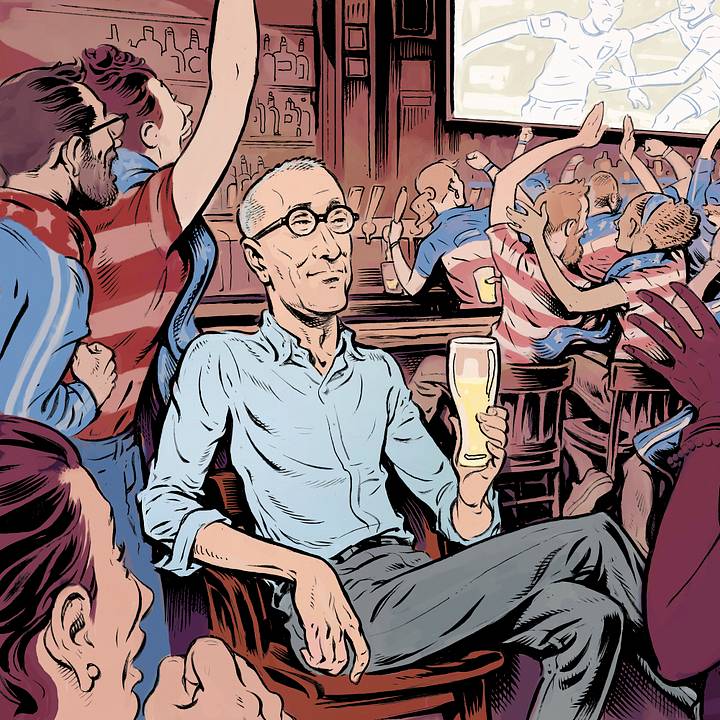
Skipper, in that October 2005, was nominally Ebersol’s counterpart, the newly anointed head of all content for ESPN. As a middle-aged convert to soccer, Skipper was visiting Trump Tower to enlist Blazer’s help in beating NBC to the most popular event in all of sports, the FIFA World Cup, whose United States television rights were not yet sold for the 2010 and 2014 tournaments.
Toward that end, Blazer really was Zeus-like, the most powerful man in American soccer, one of 25 members of the FIFA executive committee. These were the people who helped decide who hosted World Cups and who got to televise them. Skipper was under the impression that Ebersol had a handshake deal with Sepp Blatter, the FIFA chief, to award U.S. rights to NBC. Skipper also suspected that FIFA was not filled with men of unwavering loyalty. “Dick Ebersol,” as Skipper would later put it, “had a handshake that didn’t mean s---.”

Skipper by then was so enamored of the world’s game that he called the kind of football played by the Green Bay Packers and Alabama Crimson Tide—on every reference, with a hint of contempt—“American tackle football.” As in: “I grew up in North Carolina playing American tackle football.”
And he did, in Lexington, N.C., in the wide, rolling plateau of the Piedmont Triad, America’s furniture-making capital, whose walnut, pine and poplar trees were turned into easy chairs and end tables for a nation newly in thrall to television. When Skipper was born in 1955, all that furniture coming out of North Carolina was suddenly arranged around another piece of furniture: the glowing hearth of a console TV.
2026 World Cup: 48 Countries. 48 Covers. One Global Game.
On Feb. 9, 1964, 8-year-old John Skipper gazed into the bottle-green glass of his family’s portable RCA Victor, its plastic cabinet colored a mid-century magenta, and watched four young men from Liverpool break America.
His father had his own louvered window on the world, the pigeonhole letter cabinet at the Lexington post office. There, Darrell Skipper, a mail carrier, earned extra money on Saturday mornings sorting mail from the great canvas sacks that washed up on the loading dock. The brand-new $500,000 post office at the corner of State and West opened the same week in November 1967 that Rolling Stone published its first issue. All of life was in those U.S. Mail sacks—draft notices, love letters, birthday cards, the college acceptances that brought deliverance from Vietnam—but preteen John tagged along with his dad to read the magazines.
The Village Voice had a single subscriber in Lexington, bringing news from the distant planet of bohemian Manhattan. But John’s favorites were Rolling Stone and especially Sports Illustrated, with its full-color accounts of faraway games of American tackle football. In the post office, the boy was held spellbound, careful to return the magazines to their pigeonholes uncreased, as if still unread. After studying English literature at the University of North Carolina, he moved to New York City, and a job at Rolling Stone.
There, he met the magazine’s national affairs correspondent, Hunter S. Thompson. Together, Skipper says, they “broke a bunch of stuff” playing American tackle football in the halls at a staff party, among a group of “roughnecking guys who had too much to drink and too much ingestion of other stuff.” Still, as he had in the Lexington post office, Skipper preferred sports to music; after nearly a decade, he left Rolling Stone and ultimately wound up at ESPN. He transformed a nascent website with a ridiculous name—ESPNET.SportsZone.com—into a juggernaut renamed ESPN.com. He also started ESPN the Magazine.
By then, Skipper had a young family. His wife, Jessica, and their two boys, Nick and Clay, lived in Wilton, Conn., halfway between Manhattan and Bristol. Skipper triangulated his time among Seattle, New York City and Wilton—until that fateful day in 2000 when Skipper’s triangle became a rectangle. His boss, Disney chairman Michael Eisner, added London to his monthly itinerary.
Eisner himself had flown to England to consider buying the London soccer team Queens Park Rangers, as a companion to the Disney-owned Anaheim Mighty Ducks of the NHL and Anaheim Angels of Major League Baseball. Instead, Eisner bought a soccer website in London, Soccernet.com, and told Skipper that it was now part of his digital purview. Skipper knew nothing about soccer beyond “coaching” his boys with other dads back in Wilton, but nevertheless made the first of his monthly visits to the U.K., where, to his everlasting surprise, he became Hugh Grant in a turn-of-the-century rom-com. Instead of falling in love with Julia Roberts in Notting Hill, he fell hard for football in other lyrical London precincts: Fulham, Islington, Chelsea.
What did he love about football? For starters, everything. He loved England’s decaying stadiums (he called them “grounds”), loved their Victorian facades concealing immaculate fields (“pitches”), loved that everything and everyone in English football—from Craven Cottage to Crystal Palace—had a name straight from Harry Potter.
He learned the game’s rich new vernacular—British broadcasters declaiming about clubs and crests and perfectly weighted passes—and became one of those Americans who say “nil” instead of “zero” and “top of the table” instead of “first place”. He steeped himself in the burgeoning canon of English football literature—Fever Pitch, Among the Thugs—even as the English Lit major recognized, in the second half of the name Tottenham Hotspur, a Shakespearean protagonist: Harry Hotspur, slain by Prince Hal in Henry IV, Part 1.
When his Soccernet staff insisted he choose a favorite club, Skipper chose Spurs the way Goldilocks chose porridge. Chelsea was too posh, Arsenal too obvious, Man United too successful and West Ham “too dangerous.” These clubs and their grounds and their century-long histories were brand-new to him, an unexplored continent of characters, lore, chants and traditions. He would discover the game the way a child does, from scratch.

Fittingly, Soccernet was started by a child. In the mid-1990s, 12-year-old Tom Hadfield of Brighton, England, first encountered the internet at his friend Rupert’s house and began corresponding with strangers around the world who asked him the results of English soccer games. He started a website with his father, Greg, to provide a burgeoning audience with scores and injury news at a time when Manchester United results didn’t run in U.S. newspapers and matches didn’t air on American TV. Father and son sold Soccernet to the U.K.’s Daily Mail, which sold it to Disney, which was housed in the shadow of the Hammersmith Flyover, an elevated stretch of the A4 motorway.
Under Skipper, Soccernet retained a 12-year-old’s spirit, at once a labor of love and an engine of commerce, suffused by a little boy’s enchantment with the game. When Skipper arrived, the office was as male as a monastery. “They were all blokes, they all drank, they all dressed sloppy, and they all loved football,” he recalls. “I mean, they loved football.”
Quickly, so did he. There were two historic grounds in the London Borough of Hammersmith and Fulham: Fulham’s Craven Cottage and Chelsea’s Stamford Bridge. He planned his monthly visits to London around the fixtures schedule. He attended around 15 matches a year and evangelized with the zeal of the newly converted. What’s more, Skipper was convinced he could make his countrymen love this game nearly as much as he did and break the Premier League in America the way another group of Brits had done on The Ed Sullivan Show, on that magenta RCA Victor, in his boyhood home in North Carolina 40 years earlier.
Soon, Skipper would have the power to do just that. In 2005, Mark Shapiro resigned as head of content at ESPN. And though Skipper had no production experience in TV, he wanted to add the medium to his already full plate. He prepared a pitch for the vacant job that involved a seismic shift in strategy.
ESPN president George Bodenheimer invited Skipper to make that pitch on a Boston Whaler, on Long Island Sound, on a windy Saturday. The two men drank beer. When it came time for Skipper to make his case for promotion, he produced a dozen pages of notes on yellow legal paper. A sudden gust blew across the bow, and Skipper’s pitch was carried away in the wind.
He didn’t need his notes. He told Bodenheimer his vision to abandon original programming—including made-for-TV movies and Saturday morning aerobics—and focus on live sports, whose rights were expensive but whose rewards were potentially astronomical. In this way, too, he hoped to Trojan-horse into the United States a steady diet of international football. Bodenheimer wondered aloud why America would suddenly care about soccer when historically it hadn’t. “George, come to a game,” Skipper pleaded. And though he didn’t—“George is an American tackle football guy”—he listened. “It’s the greatest spectator sport in the world,” Skipper told him.
“When Skipper wanted to chase his passion for soccer and the World Cup,” Bodenheimer recalled, “I immediately gave him permission.”
Skipper got the job on Oct. 6, 2005, giving him 27 days to persuade FIFA to award ESPN the U.S. television rights to the 2010 and 2014 World Cups. Before flying to Zurich, he had dinner with Major League Soccer commissioner Don Garber, who was eager to secure the league’s first television rights fee. To that point, ESPN and ABC had paid no money to the league and simply split the ad revenue. Skipper knew NBC was loath to televise MLS as a prerequisite to get the World Cup. The two men dined at Shun Lee, a dim sum palace near the ABC building on the Upper West Side of Manhattan. The place whose chef claims to have invented General Tso’s chicken would be cradle to another American-international fusion—of world football and U.S. television—if Skipper could get himself to Switzerland immediately. The clock was ticking, and it was enormous.
In Zurich, the home of FIFA, Skipper and two colleagues washed up at the Hotel Storchen, a Wes Anderson confection opened in 1357 that looks out across the Limmat River to a city of steeples, striped awnings and secret bank accounts. Looming over the “Hotel Stork,” on the tower of St. Peter’s, was the biggest church clock face in all of Europe, 28 1/2 feet in diameter, its golden hands counting—with precision Swiss timing and a symphony of bells—every hour that FIFA’s president refused to meet with Skipper. Deign was the word Skipper used: Sepp Blatter “didn’t deign” to see him. Blatter was a potentate, the most powerful man in the world’s most popular sport, and meeting with the newly empowered American TV executive was somehow beneath his dignity.
To friends, Skipper would come to call Sepp Blatter by a nickname, “Septic Bladder,” with its double barrel of scatological implications. But he endured these small indignities for one reason: He wanted to spread the gospel of soccer to its last heathen outpost, the United States. Installed at the Storchen, Skipper hoped to emulate the nesting bronze stork on the hotel’s exterior and fly home with a bundle of joy: the rights to broadcast World Cups to an audience of sports fans who were historically agnostic to, or openly contemptuous of, soccer.
“What can you say about soccer other than it is boring, tedious, confusing, mystifying, bewildering and virtually impossible to watch,” wrote one of them, an Alabama newspaper columnist named Paul Finebaum, on the occasion of the previous World Cup, in 2002. In time, Finebaum would be paid for his punditry by ESPN. If the network couldn’t convert every American to love world football as much as Skipper did, at least ESPN would have its soccer critics where Lyndon Johnson liked to have his: inside the tent pissing out, rather than outside the tent pissing in.
Skipper could never be certain if he had the support of that parrot-shouldered soccer macher with the quintessential surname for an international sports official: Blazer. On Fifth Avenue, Queens native Chuck Blazer straddled his Rascal scooter like Alexander the Great astride his elephant. In his role as deputy secretary of the Concacaf, the North American and Caribbean confederation of FIFA, Blazer kept offices on the entire 17th floor of Trump Tower, layers of atmosphere below his 49th floor condo. To Skipper, Blazer suggested he made his fortune as inventor of the yellow smiley face icon. “That’s mine,” Blazer said, showing him the smiley face on a Post-It note in Trump Tower, where he rented a separate apartment, at $6,000 a month, for his cats.
And so Skipper lobbied Niclas Ericson, then FIFA’s director of TV. From Zurich, he traveled by train to Zug, one of the world’s wealthiest hubs, an international tax haven, where he promised Ericson he would leverage ESPN’s myriad channels to televise every single match of the World Cups live, something no other suitor could reasonably do. Skipper didn’t say that some of those matches might air at 3 a.m. on ESPN News. But they would be live. NBC, he noted, had aired some Olympic events on tape delay and called them “plausibly live.”

In the end, it wasn’t Skipper’s promise to televise every match as it unfolded that won the day. He did what FIFA respected most: He showed them the money. ESPN paid $40 million for the 2010 World Cup, and $60 million for the 2014 World Cup. Had he wildly overpaid? The figure certainly sounded extravagant. He still affects a Dr. Evil accent when he says: “We paid—count it—one hundred million dollars.”
Even for the Walt Disney Company, this was a significant outlay. The 2006 World Cup, by comparison, was already scheduled to air on ESPN for the princely sum of nothing. Those rights had been purchased years earlier by the marketing arm of MLS, which would produce the games and air them on ESPN in exchange for the ad revenue.
Before he could televise the 2010 World Cup on ESPN, Skipper doubled down, acquiring the rights to broadcast the English Premier League on ESPN2 in the United States, on Saturday mornings, when the network’s programming leaned heavily into fishing. In 2009, the Premier League began airing on Saturday mornings at 7:30 Eastern, creating a new time slot for live sports in America. A growing niche of soccer-mad Yanks ate it up, with beans and toast. The peculiarly American cliché that soccer is boring finally had a riposte: not as boring as watching men fish.
American soccer fans, starved and scarved, had a ravenous appetite for international football. The 2010 World Cup final between Spain and the Netherlands, live from Johannesburg, aired at 2:30 p.m. in New York. Andrés Iniesta scored four minutes before the final whistle to give Spain a 1–0 win. It was the most watched men’s soccer game to that point in U.S. history, with 15.45 million viewers on ABC and another 8.821 million viewers on Spanish-language Univision. “The 2010 World Cup,” Bodenheimer would write years later, “proved that big events can transform companies.”
Chuck Blazer, it turns out, did not make his fortune from the smiley face emoji. Rather, he had pocketed bribes and kickbacks for years in his role at Concacaf, and failed to pay personal income tax on his ill-gotten fortune, eventually turning federal informant in the corruption scandal that engulfed FIFA in 2015, when Blatter resigned.
Blazer died in 2017, the same year Skipper would resign as president of ESPN. Skipper had, he said, long been a recreational user of cocaine but insisted it had never affected his work. But when someone from whom he bought the drug tried that December to extort him—and by extension the Walt Disney Company—he had little choice but to surrender the job he loved. He later cofounded Meadowlark, a media company that produces documentaries and podcasts, and took a small ownership stake in Triestina, in Serie C, the third tier of professional football in Italy, which he is quick to note is even less glamorous than it sounds.
It’s a far cry from that day in South Africa when Skipper watched with fascination the respective entourages of Blatter and former U.S. President Bill Clinton square off at the 2010 World Cup over which group would be the first to exit a VIP room at the Loftus Versfeld Stadium in Pretoria. Clinton and his entourage won.
That was June 23, 2010, at the U.S.-Algeria match, which Skipper watched with the crowd, not the VIPs, flanked by his son Clay and ESPN’s head of security. In the moments after Landon Donovan scored his 91st-minute match winner that allowed the U.S. to advance to the knockout stage—perhaps the most important goal in U.S. men’s soccer history—the forward exhorted the American fans in attendance.
“I am taking the liberty of believing he pointed to where we were sitting,” Skipper says of Donovan. The TV executive knew this electric moment was appearing on screens across America, in homes and in bars, on laptops and on smartphones, at noon in New York City and at 9 a.m. in L.A. He was in two worlds, 10 time zones apart. “And I thought,” Skipper says, “everything was worth it.”
More Soccer from Sports Illustrated
 Add us as a preferred source on Google
Special Contributor, Sports Illustrated Steve Rushin was born in Elmhurst, Ill. on September 22, 1966 and raised in Bloomington, Minn. After graduating from Bloomington Kennedy High School in 1984 and Marquette University in 1988, Rushin joined the staff of Sports Illustrated. He is a Special Contributor to the magazine, for which he writes columns and features. In 25 years at SI, he has filed stories from Greenland, India, Indonesia, Antarctica, the Arctic Circle and other farflung locales, as well as the usual locales to which sportswriters are routinely posted. His first novel, The Pint Man, was published by Doubleday in 2010. The Los Angeles Times called the book "Engaging, clever and often wipe-your-eyes funny." His next book, a work of nonfiction, The 34-Ton Bat, will be published by Little, Brown in 2013. Rushin gave the commencement address at Marquette in 2007 and was awarded an honorary Doctor of Letters for "his unique gift of documenting the human condition through his writing." In 2006 he was named the National Sportswriter of the Year by the National Sportswriters and Sportscasters Association. A collection of his sports and travel writing—The Caddie Was a Reindeer—was published by Grove Atlantic in 2005 and was a semifinalist for the Thurber Prize for American Humor. The Denver Post suggested, "If you don't end up dropping The Caddie Was a Reindeerduring fits of uncontrollable merriment, it is likely you need immediate medical attention." A four-time finalist for the National Magazine Award, Rushin has had his work anthologized in The Best American Sports Writing, The Best American Travel Writing and The Best American Magazine Writing collections. His essays have appeared in Time magazine andThe New York Times. He also writes a weekly column for SI.com. His first book, Road Swing, published in 1998, was named one of the "Best Books of the Year" by Publishers Weekly and one of the "Top 100 Sports Books of All Time" by SI. He and his wife, Rebecca Lobo, have four children and live in Connecticut.