%20%20--%3E%0A%3Csvg%20version%3D%221.1%22%20id%3D%22Layer_1%22%20xmlns%3D%22http%3A%2F%2Fwww.w3.org%2F2000%2Fsvg%22%20xmlns%3Axlink%3D%22http%3A%2F%2Fwww.w3.org%2F1999%2Fxlink%22%20x%3D%220px%22%20y%3D%220px%22%0A%09%20width%3D%2239px%22%20height%3D%2240px%22%20viewBox%3D%220%200%2039%2040%22%20enable-background%3D%22new%200%200%2039%2040%22%20xml%3Aspace%3D%22preserve%22%3E%0A%3Cpath%20fill%3D%22%23FFFFFF%22%20d%3D%22M38.5%2C7H28.2v26h10.3V7z%22%2F%3E%0A%3Cpath%20fill-rule%3D%22evenodd%22%20clip-rule%3D%22evenodd%22%20fill%3D%22%23FFFFFF%22%20d%3D%22M26.1%2C25.5c0%2C5.8-4.1%2C7.5-12.9%2C7.5C3.9%2C33%2C0%2C31.2%2C0%2C25.2v-1.1h11.6%0A%09v2.4c0%2C0.7%2C0.1%2C1.4%2C1.2%2C1.4c1%2C0%2C1.2-0.4%2C1.2-1.3v-0.9c0-1.6-0.9-1.6-3.5-2.2C2.2%2C21.7%2C0%2C19.7%2C0%2C15.3v-0.9C0%2C9.3%2C5.5%2C7%2C12.9%2C7%0A%09c10.2%2C0%2C12.8%2C2.6%2C12.8%2C7.4v1.8h-11v-2.9c0-0.6-0.4-1.1-1.2-1.1c-0.6%2C0-1.2%2C0.4-1.2%2C1.1v0.9c0%2C1.5%2C0.9%2C2%2C3.3%2C2.5%0A%09c8%2C1.6%2C10.5%2C3.3%2C10.5%2C7.5V25.5z%22%2F%3E%0A%3C%2Fsvg%3E%0A)
The Story Behind All 48 Sports Illustrated World Cup Covers

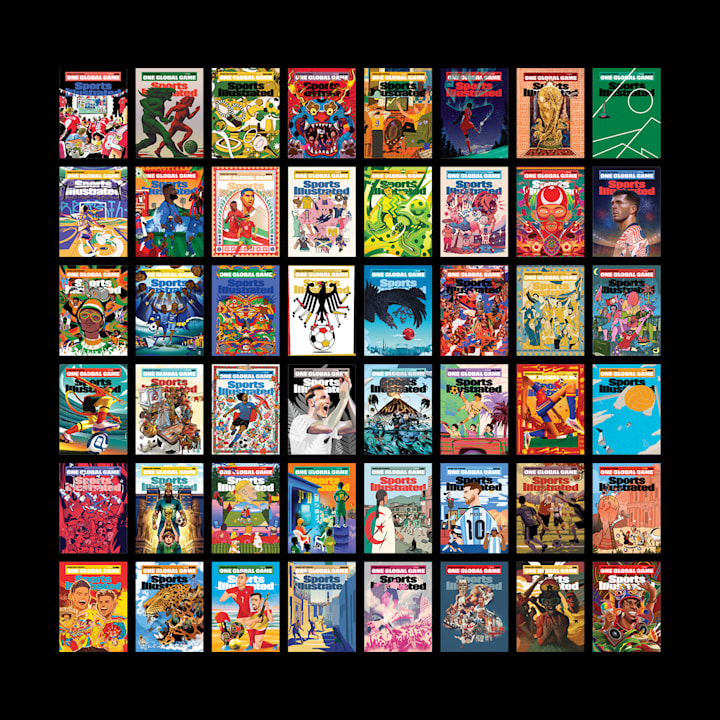
Sports Illustrated’s World Cup preview covers through the years have featured some of the biggest names in soccer: Messi, Ronaldo, Mbappé. But last fall, when we started making plans for the cover of this issue, creative director Stephen Skalocky had an idea: What if we tried something a little more … democratic? Yes, the World Cup is all about superstars. But the true joy of the tournament stems from the ways it brings communities and cultures together every four years. Soccer (or football, or fútbol) is the global game. It also carries a localized resonance in nearly every country on the map. This World Cup, with its expanded 48-team field, would directly touch more communities than ever before. What if we celebrated that local spirit rather than a few transcendent personalities?
So as those 48 nations fell into place, Skalocky began reaching out to artists living in or strongly connected to each one with a simple ask: Create an illustration that captures the cultural heartbeat of soccer in your country. Along with art director Stephen Goggi, designer Lila Shokr and SI FC editors Brian Goldfarb, Dan Willis and Toby Cudworth, Skalocky spent months exploring ideas, refining sketches and locking down final color.
The results add up to one of the most ambitious projects in SI’s history. Forty-eight artists, 48 countries, 48 windows into the many ways sports and culture overlap. (Four—Argentina, France, Mexico and the United States—are featured as magazine covers. You can explore all 48 covers here and on our social channels.)

Some illustrations focus on the heroes those fan bases will cheer on (or suffer with) this summer: Argentina and Messi, the U.S. and Christian Pulisic, Spain and Lamine Yamal. Gonçalo Viana, representing Portugal, surrounded Ronaldo and Bruno Fernandes with cultural touchstones including a Portuguese guitar. “Fado is Portugal’s national music style,” explains Viana. “It intertwines with the way we view football, as it is full of sad themes where one cannot escape fate and for most of our national squad’s career we’ve always seemed to fail when reaching the big stage.”
Football is life, indeed. Other artists focused on the togetherness the sport creates, regardless of match results. “In Senegal, football is a shared ritual that extends far beyond the stadium,” says illustrator Audrey d’Erneville. “When an important match is on, neighbors gather outside corner shops to watch together on a small television, turning the street into a communal viewing space.”
Some pieces are more conceptual—such as Uruguay, which references the poster made for the very first World Cup, hosted and won by that nation in 1930. Artist Gabriela Sánchez updated the image of a sprawling goalkeeper, with a color palette echoing the national flag and Uruguay’s distinctive grassland landscape. It may be a cliché to call soccer the beautiful game, but the artistry of the sport extends far beyond those who play it. That’s the spirit that we hope flourishes as the world comes to North America this summer.
Group A
Mexico
Illustration by C.R. Canseco
“There is a specific kind of rhythm in Mexican culture—a strength that comes from moving together. These aren’t just athletes; they are warriors. This is a portrait of our spirit in motion—a team moving forward with an ancient soul, but contemporary action.”
South Africa
Illustration by Studio MUTI
“South Africa is a place of vibrancy, energy and passion, much like the supporters of Bafana Bafana themselves. With this illustration, we wanted to capture that spirit through bold color, movement and flowing forms that reflect the rhythm, excitement, and unity that the beautiful game inspires both on and off the pitch.”
South Korea
Illustration by Sakiroo
“The illustration focuses on capturing the heartbeat of Korean football culture, centered around a modern reinterpretation of the ‘Haechi,’ a mythical guardian in Korean tradition. I wanted to channel the explosive energy of the stadium and the fans’ passion through the Haechi’s dynamic aura and lines, portraying a grand cultural festival that embodies both fierce protection and unity.”
Czechia
Illustration by Jindřich Janíček
The illustration pays homage to Czechia’s deep-rooted football culture that spans generations, gathers crowds and creates passionate atmospheres around the country.

Group B
Canada
Illustration by Michael Byers
Set against the backdrop of a pine tree-lined pitch and rocky mountains in the distance, a player kicks the ball into the night sky, creating a luminous trail in the shape of a maple leaf and in the glowing colors of the Northern Lights, representing Canada’s northern region.
Switzerland
Illustration by Maria Grejc
“Playing into Switzerland’s famous minimalist design, this illustration is a play on the classic Swiss postcard featuring mountains and a cable car, but with the composition built entirely from elements of a football pitch.”
Qatar
Illustration by Diyar Al Asadi
“From the torch to the trophy, Qatar’s story is drawn in glory. This illustration celebrates the World Cup journey with horses of strength, landmarks of pride and a falcon carrying our dream to the global stage.”
Bosnia and Herzegovina
Illustration by Natasa Jovanic
“The illustration depicts a cozy Bosnian flat during an important football match: friends gathered, each absorbing the intensity in their own way as the room fills with noise, tension and shared emotion. The interior has an old school feel, featuring a heavy wooden table with a traditional coffee pot, sugar cubes and snacks, on top of a red Byzantine carpet and a wooden parquet floor. A cat is watching the game as well.”

Group C
Brazil
Illustration by Denis Freitas
“In Brazil, football is played everywhere, from residential condominiums to community courts, and many of these community spaces have been the starting point for some of the country’s greatest talents. The illustration shows this trajectory through a scene of two teenagers playing football on a community court, with various decorative elements and visual expressions that typically appear across the country during the World Cup.”
Morocco
Illustration by Mohamed Elwaid
“The idea was to highlight three iconic players currently shining in the Moroccan national team—Achraf Hakimi, Brahim Díaz and Ayoub El Kaabi—through a dynamic composition. I incorporated visual elements inspired by traditional Moroccan architecture, especially the shapes of doors commonly found in cities like Marrakech and Taroudant, along with zellige patterns that reflect Moroccan identity. The overall frame is designed in the form of a postage stamp to tie the concept together.”
Haiti
Illustration by Lyne Lucien
“I felt this was the strongest concept to show the culture around celebration, the players and a bit of Haiti’s history with the Toussaint Louverture statue in the background, as we like to honor our ancestors when we celebrate.”
Scotland
Illustration by Want Some Studio
“When I was asked to create the illustration, one phrase sprang to mind when it comes to Scotland and soccer: ‘It’s the hope that kills you!’ The Tartan Army of Scotland fans are well known around the world for bringing the party—a banging atmosphere, joyous crowds and plenty of beer. But the on-field success has been, at the best of times, mixed. The fans know this, yet their hope is undiminished. They still bring that party wherever they go. Considering it has been 28 years since our last World Cup finals appearance, I tried to create the sense of a photo memory book to remember the ups and downs of the campaign and of what’s to come.”
Group D
United States
Illustration by Nate Sweitzer
“With this illustration, I chose to highlight Christian Pulisic, the USMNT’s star forward, shouldering the weight of a nation’s expectations on the world’s biggest stage. I aimed to capture the excitement of hosting matches on American soil as a potential source of unity and hope in an increasingly divided nation. The sky is illuminated with fireworks, referencing the United States’ semiquincentennial celebration this summer. Layered over Pulisic are a diverse cohort of flag-waving fans, inspired by the team’s red-and-white-striped kits, to show our country’s shared excitement in joining together to support the team.”
Paraguay
Illustration by Fafo Ferrão
“This illustration captures soccer culture in Paraguay through the lens of street football. It shows how growing up in this environment can inspire a kid to dream of one day reaching a stadium full of passionate fans. Here, flip flops become goalposts, matches are watched from fences or trees, chipa vendors pass by, and even stray dogs join the game. A celebration at the National Pantheon nods to a local meme, while the lion represents the strength and spirit of the Albirroja.”
Australia
Illustration by Andrew Archer
“This illustration gives a dynamic look referencing Australia, featuring the Southern Cross stars, a kangaroo, Indigenous peoples art style and the Union Jack from the flag, all in the Socceroos colors of yellow, green and golds.”
Türkiye
Illustration by Tayfun Pekdemir
“The cover centers on a symbolic portrait that blends contemporary football culture with layered cultural references, aiming to capture both the collective energy and a more psychological, atmospheric tone.”
Group E
Germany
Illustration by Christoph Niemann
“For most German soccer fans, the essence of the team is the Bundesadler, or iconic federal eagle. The black and white look with hints of red and gold capture the country’s colors, and the eagle is wearing sport socks and football boots.”
Curaçao
Illustration by BLEND, Sander van Beusekom
“The cover depicts two kids cheering together, holding our flag, cheering together and dreaming big! In the background, our soccer players embrace each other in a team hug and our colorful city parts—connected by our Queen Juliana Bridge—symbolize the unity of the colorful people on our small island in the Caribbean. The big Blue Wave is coming—so you better hold on, surf along, get inspired and get to know us!”
Côte d’Ivoire (Ivory Coast)
Illustration by Ngadi Smart
“My concept was centered on capturing Les Éléphants’ fans’ vibrant passion for their national team and sport during game days, which are celebrations filled with the joy of football, music and dancing. I was inspired by the many photos and videos of Ivorian fans in the stadiums, as well as those of street celebrations in Côte d’Ivoire during those days. Les Éléphants’ primary orange, white and green colours are also featured prominently.”
Ecuador
Illustration by Cavadrio
“The illustration is built around visual elements that represent Ecuador’s identity. The composition includes references such as the Mitad del Mundo monument, iconic landscape and details connected to Ecuadorian football culture. The players are inspired by emblematic Ecuadorian football figures and are placed within a dynamic scene that blends sport, geography and cultural symbolism.”

Group F
Netherlands
Illustration by Mr. Nelson Design
“The fan culture surrounding the Dutch national football team is defined by a carnival-like, almost theatrical atmosphere. Supporters show up draped in the national color orange, sporting outrageous costumes: wooden clogs, cheese wheels and carrots worn as hats. In recent years, thousands of Dutch fans have marched together through host cities in what’s become known as the oranje mars, a orange-hued procession toward the stadium. These are the images I wanted to capture: the color, the chaos and the sense of collective joy that makes the Orange Army unlike any other set of supporters in the world. The illustration also reaches into history. The faces of legends like Johan Cruyff and Marco van Basten appear alongside Virgil van Dijk, representing the current generation carrying that legacy forward. Woven into the imagery are subtle nods to the defining moments of the Dutch football story, including its most bittersweet chapters.”
Japan
Illustration by Yohey Horishita
“The cover features the Japanese team’s symbol, Yategarasu, the three-legged crow, soaring above Tokyo’s skyline with Mt. Fuji in the background. Dallas AT&T Stadium appears below, marking the location of the match against the Netherlands.”
Sweden
Illustration by Sander Berg
“The cover celebrates the supporter culture in Sweden—the game is nothing without them. Go out to town on matchday and you’ll be met by a sea of yellow clad vikings proudly displaying their merch.”
Tunisia
Illustration by Sonia Ben Salem
“This scene depicts a family gathered to watch the match outdoors because in Tunisia in the summer, we live outdoors. It’s the youngsters who’ve decided to watch the match with their grandparents and you can see plenty of details that evoke our Mediterranean coastline and our warm hospitality, including the watermelon—the essential fruit of balmy summer nights.”

Group G
Belgium
Illustration by KAAN Illustration
“In Belgium, fans are normally strongly divided by their support of their local club, but during the World Cup, they will all come out to support the same team: The Belgian Red Devils.”
Egypt
Illustration by Amira Tanany
“The concept was inspired by the collective experience of football culture in Egypt, where matches are not only watched but lived—transforming everyday spaces like local cafés into vibrant, stadium-like environments filled with energy, connection, and shared emotion. At the same time, these spaces feel as intimate and familiar as a living room, filled with traditional Egyptian coffee, tea and local food shared among friends.”
Iran
Illustration by Rashin Kheiriyeh
“Like the phoenix rising from fire, Iran enters the world stage with unity, courage and an unbroken spirit. My illustration portrays an Iranian football player surrounded by motifs and designs from Persian culture.”
New Zealand
Illustration by Nigel Buchanan
“The silver fern, or ponga, is an iconic and powerful symbol of New Zealand’s identity that is known for its unique silvery-white underside. It is ubiquitous with New Zealand’s sports teams.”
Group H
Spain
Illustration by Lisett Ledón
“In this piece, I wanted to capture the vibrant pulse of Spanish football fandom by blending tradition with the electrifying energy of its future. Centered around Lamine Yamal—the undisputed star and promise of a new generation—the illustration weaves together iconic cultural symbols like the abanico (hand fan) and the vuvuzela, reflecting the passionate, noisy and festive atmosphere of the Spanish stands. Through a bold palette and dynamic shapes, the artwork celebrates a “New Spain” that honors its roots while leaping boldly toward World Cup glory.”
Cabo Verde (Cape Verde)
Illustration by Aires Melo
“The illustration focuses on the volcanic origins of our nation, islands defined by stunning beaches, beautiful people and deep-rooted traditions. The Blue Sharks are depicted in a powerful scene, carrying traditional musical instruments while dressed in our iconic “Panu di Tera” patterns, blending our daily way of life with the spirit of the game.”
Saudi Arabia
Illustration by Bayan Yasien
“This piece is about where football truly begins—not in stadiums, but in the streets, neighborhoods and everyday spaces where passion is first discovered. In Saudi Arabia, football is part of community culture, where children turn ordinary places into stages for dreams, energy and future legends.”
Uruguay
Illustration by Gabriela Sánchez
“The illustration references the poster for the first World Cup, which was hosted and won by Uruguay. The sky blue background references the team’s jersey and the nickname often given to the national team, and the soccer ball acts as the sun. It also acknowledges Uruguay’s distinctive landscape of vast grasslands and expansive skies. The figure references Roque Gastón Máspoli, a beloved player who was part of the team that won the 1950 World Cup at the Maracanã.”
Group I
France
Illustration by Renaud Vigourt
“The illustration depicts the team as a French Cancan group, juggling soccer balls while dancing on stage. Kylian Mbappé is depicted as a Monsieur Loyal character, in front of an audience composed with famous French characters from movies, literature, cartoons, comics and more.”
Senegal
Illustration by Audrey d’Erneville
“This piece explores the communal culture of football in Senegal, where neighborhoods gather outside local corner shops to watch important matches together.”
Norway
Illustration by Natalie Foss
“In Norway we have a well-known word friluftsliv (pronounced free-loofts-liv), which translates to ‘open air life.’ It’s a word that represents the cultural philosophy of connecting with nature and spending time outside, no matter the weather. I wanted to capture that in my illustration, as well as the community part of the football culture in Norway. We meet to watch football together, especially on TV, either with family or friends. Nature and football is something that connects a lot of us.”
Iraq
Illustration by Ahmed Herokai
“The central character in the illustration is Gilgamesh, representing Iraq and symbolizing strength, history and ancient civilization. Behind him is the Ishtar Gate, representing Mesopotamian heritage and Iraq’s deep historical roots. In front of Gilgamesh, there is an Iraqi child holding the World Cup trophy, symbolizing the future and hopes of lifting the trophy. On both sides are the lamassu, or winged bulls, which represent protection and ancient Iraqi mythology. In the background, there are palm trees, as they are an important symbol of the country’s landscape. The overall composition connects Iraq’s ancient civilization with the modern dream of football and the World Cup.”
Group J
Argentina
Illustration by Martin Laksman
In this piece, Messi is represented as a cultural symbol that transcends sport. In Argentina, football is not just a game, but perhaps the ultimate expression of the people’s identity. That’s why iconic national figures like Messi and Maradona are intertwined with other elements of Argentine culture: tango, the Obelisk, wine and choripán, the most popular food in stadiums across the country. In the background, scenes from the neighborhood of La Boca, home of the world-famous Boca Juniors, and landscapes from the north come together with fans celebrating the victory in the last World Cup. Children playing football in the street add another layer, an image present in every corner of the country that reflects the deep connection Argentines have with the sport.
Algeria
Illustration by Salim Zerrouki
“The concept focuses on street football, as seen across African countries—played among cars, in tight urban spaces. In the foreground, a female supporter proudly displays the Algerian flag. What makes Algeria special is the incredible density of Algerian flags you see everywhere.”
Austria
Illustration by Michael Pleesz
“What is typically Austrian are the small clubs, the kind almost every village or small town has. There are small football pitches behind the school or next to the cow pasture. And on Sundays, the villagers come to the match to passionately cheer on their team.”
Jordan
Illustration by Omar Momani
“This piece draws a parallel between past and present generations. In the background, ancient civilizations, such as the Nabataeans, are shown carving Petra and early statues in the desert, representing Jordan’s deep-rooted history. In the foreground, the current national team mirrors that same act, carving the World Cup trophy out of rock, as if continuing the legacy of building something meaningful for the country. Around them are small touches of everyday Jordanian life, such as families and fans in traditional clothing, celebrating and supporting, to reflect the cultural identity and collective pride behind the team.”
Group K
Portugal
Illustration by Gonçalo Viana
“I opted to portray the Portuguese team via its two natural leaders, Cristiano Ronaldo and Bruno Fernandes. Ronaldo is repeating a gesture he often employs when scoring for Portugal, which is pointing down to himself and shouting, ‘I’m here!’ In this instance he is, instead, pointing to a golden ball at his feet, the coveted Ballon D’Or, a symbol of glories past, yes, but a glow that still carries him forward. Fernandes is holding a Portuguese guitar, a symbol of Fado, Portugal’s national music, perennially filled with stories of sadness and fate—a nod to the many times the team got so close to the prize but fell just a little bit short. Next to both players is a Barcelos Rooster, an extremely colorful ceramic rooster that has, over the years, become one of the most recognizable symbols of Portugal. It is whimsy and excessive, like so many of the tricks our players love to employ while juggling the ball.”
Uzbekistan
Illustration by Olga Aleksandrova
“This represents a typical Uzbek neighborhood: boys playing football in a courtyard. Street football is a strong part of the culture—almost every backstreet has kids with a ball, dreaming of playing professionally. They may not have a stadium or a chance to see a World Cup now, but today’s empty yard can become tomorrow’s full tribune.”
Colombia
Illustration by Diego Patiño
“This piece references the famous and eccentric fans of the Colombian team and features people celebrating, playing drums and wearing some traditional items such as the vueltiao hat, all in the traditional yellow, blue and red colors of the Colombian flag.”
DR Congo
Illustration by Edizon Musavuli
“The art represents local cultural symbols, players, fans—like the viral ‘Statue Man’—all centered within the leopard head, a nod to the national team’s nickname.”
Group L
England
Illustration by The Sporting Press
“Football is so inextricably linked with English culture that many football moments have manifested in the English psyche. The illustration mixes in recent and vintage memories, with references to Trafalgar Square, Council Estate, alleyways and more.”
Croatia
Illustration by Vedran Klemens
“Croatia may appear small and calm, but when the national team succeeds, the entire country transforms. Streets fill with energy, color and celebration, as the red-and-white pattern takes over everything. The heart-shaped sun is a nod to the ‘fiery heart’ of the team, symbolizing the passion and unity that bring the country together during the World Cup.”
Ghana
Illustration by Hanson Akatti
“I took inspiration from Ghana Black Stars fans who dress up in very elaborate and colourful outfits and body paint.”
Panama
Illustration by Mickey Torres
“A vibrant, close-up portrait of a joyful character. The young man is displaying a radiant, contagious grin with his eyes squinting from the pure excitement of the football match. On his head, he wears a detailed, colorful and traditional Diablico Sucio headpiece and mask with its striking feathers. He is holding a raspado, a shaved ice cone with colorful syrup. His pet, a small and friendly Caribbean iguana, is right beside him in a playful pose, sharing in the joy.”
 Add us as a preferred source on Google