%20%20--%3E%0A%3Csvg%20version%3D%221.1%22%20id%3D%22Layer_1%22%20xmlns%3D%22http%3A%2F%2Fwww.w3.org%2F2000%2Fsvg%22%20xmlns%3Axlink%3D%22http%3A%2F%2Fwww.w3.org%2F1999%2Fxlink%22%20x%3D%220px%22%20y%3D%220px%22%0A%09%20width%3D%2239px%22%20height%3D%2240px%22%20viewBox%3D%220%200%2039%2040%22%20enable-background%3D%22new%200%200%2039%2040%22%20xml%3Aspace%3D%22preserve%22%3E%0A%3Cpath%20fill%3D%22%23FFFFFF%22%20d%3D%22M38.5%2C7H28.2v26h10.3V7z%22%2F%3E%0A%3Cpath%20fill-rule%3D%22evenodd%22%20clip-rule%3D%22evenodd%22%20fill%3D%22%23FFFFFF%22%20d%3D%22M26.1%2C25.5c0%2C5.8-4.1%2C7.5-12.9%2C7.5C3.9%2C33%2C0%2C31.2%2C0%2C25.2v-1.1h11.6%0A%09v2.4c0%2C0.7%2C0.1%2C1.4%2C1.2%2C1.4c1%2C0%2C1.2-0.4%2C1.2-1.3v-0.9c0-1.6-0.9-1.6-3.5-2.2C2.2%2C21.7%2C0%2C19.7%2C0%2C15.3v-0.9C0%2C9.3%2C5.5%2C7%2C12.9%2C7%0A%09c10.2%2C0%2C12.8%2C2.6%2C12.8%2C7.4v1.8h-11v-2.9c0-0.6-0.4-1.1-1.2-1.1c-0.6%2C0-1.2%2C0.4-1.2%2C1.1v0.9c0%2C1.5%2C0.9%2C2%2C3.3%2C2.5%0A%09c8%2C1.6%2C10.5%2C3.3%2C10.5%2C7.5V25.5z%22%2F%3E%0A%3C%2Fsvg%3E%0A)
Shai Gilgeous-Alexander Is Sports Illustrated’s 2025 Sportsperson of the Year
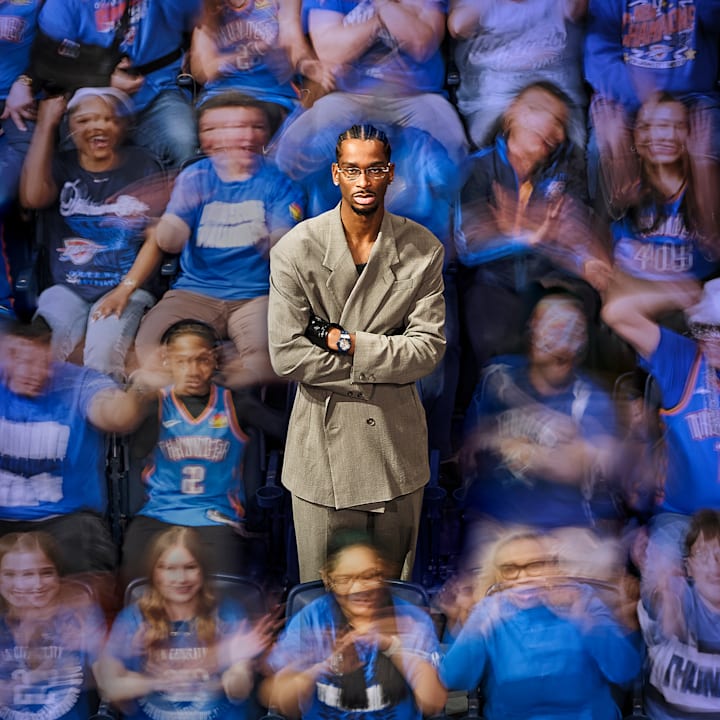
Last June, with the confetti still being swept off the Paycom Center floor, a blue-clad crowd gathered inside the Broadway 10 Bar & Chophouse to celebrate Oklahoma City’s NBA championship. Surrounded by friends and family (and a healthy number of their friends and their families), Thunder players, coaches and staffers partied deep into the night. Guests picked at buffet tables lined with steak medallions and crab cakes. Against a wall, the Larry O’Brien trophy rested as a prop for pictures. Champagne that went largely untouched in Oklahoma City’s locker room—what do you expect from a title winner led by a bunch of early-20-somethings who needed help figuring out how to pop the cork?—flowed liberally into glass flutes. A few freshly shotgunned beer cans littered the floor. In the middle of it all was Shai Gilgeous-Alexander, the NBA’s MVP, scoring champion and Finals MVP, the fourth player ever to complete that trifecta in one season. In between hugs and high fives, Gilgeous-Alexander was overheard offering a promise: I can be so much better.
“Well,” says Gilgeous-Alexander, “I can be.” It’s mid-November and he is in the backseat of a black SUV speeding down an empty Oklahoma City highway. The suggestion that it seemed strange to be thinking about improving after one of the greatest single seasons in sports history draws a shrug. “I think more than anything I was excited by the fact that I had achieved those things and still had so much room to grow,” he says. As a teenager, Gilgeous-Alexander jotted down goals in a notebook. Division I scholarship. NBA player. Lottery pick. Over time the goals got more ambitious. All-Star. MVP. NBA champion. “There’s an obsessiveness to him,” says Nate Mitchell, who has been training Gilgeous-Alexander since he was 16.
There’s also a palpable self-assuredness to Gilgeous-Alexander. He doesn’t see anything about his success as all that complicated. (“Nothing about him boils down to like an epiphany or an anecdote,” says Thunder coach Mark Daigneault.) He ties his rise to NBA superstardom to what earned him a scholarship to Kentucky or turned him into a lottery pick. “The way I saw it was when I was in ninth grade, nobody saw me and was like, ‘He’s going to be the 11th pick in the NBA draft,’ ” says Gilgeous-Alexander. “And I did it, so why can’t I just implement the same thing on a different scale, on a different level using the same process?”
That work bred confidence. Last May, Oklahoma City lost Game 3 of the conference semifinals in overtime, giving Denver a 2–1 series lead. As the Nuggets celebrated, cameras caught Gilgeous-Alexander grinning while a fan heckled him as he walked off the floor. “In my mind I was like, When we win, you’re going to feel like absolute dogs---, ” he says. “That’s why I started laughing. He’s acting like they won Game 7. I was like, I’m going to remember that face. He’ll feel it when we win.”
“Ruthlessly consistent” is how Daigneault describes Gilgeous-Alexander. Daigneault first met him in 2019, when Shai was acquired from the Clippers as the centerpiece of a deal with the Clippers for Paul George. Well, sort of. The real prize at the time was the cache of draft picks, five first-rounders and two swaps. Gilgeous-Alexander was a skinny combo guard coming off a decent rookie year.
Daigneault, then an assistant, liked what he saw early. When COVID-19 shut the season down in 2020, the team scattered. Months later, when the NBA returned, Daigneault was struck by the changes to Gilgeous-Alexander’s physique and his game, calling an early scrimmage a “whoa moment.” Asked about Gilgeous-Alexander’s pandemic improvements, Mitchell launches into a description of hourslong workouts at an empty gym before pausing. “Wait,” he says, “can we still get in trouble for that?”

Oklahoma City’s rise to NBA champion has been methodical. The Thunder won 22 games in 2020–21, a season after having stripped away the last remnants of their first would-be dynasty. They won a whopping 24 the next season and didn’t crack .500 until ’23–24. There were double-digit losing streaks, pick-centric deals and (justifiable) grumblings of tanking from league officials. But the Thunder never deviated. They believed in the plan, and it paid off.
Gilgeous-Alexander is wired similarly. He was cut from his high school’s version of a junior varsity team. It took him 15 games to permanently crack the starting lineup at Kentucky. Three guards were taken before him in the 2018 draft. In his first season with the Thunder, he was an off-the-ball complement to Chris Paul. Skepticism didn’t dissuade him. It motivated him. “He had a vision for himself,” says Daigneault. “He saw this earlier and clearer than anyone.”
Did he see this, being named Sports Illustrated’s 2025 Sportsperson of the Year? Probably not, though his mother, Charmaine, insists her two boys, 27-year-old Shai and his younger brother, Thomasi, were avid readers of SI Kids. Still, Gilgeous-Alexander is the 72nd recipient of SI’s top honor and the first Canadian to win the award outright since Wayne Gretzky in 1982. He earned it for leading the Thunder to a franchise record 68-win season. For steering the team to two Game 7 closeouts in the playoffs. For etching the name of a small market oil town in the heart of college football country onto basketball’s most coveted trophy. For his charitable works, both in OKC and in Canada.
And for not taking his foot off the gas. Through December, Oklahoma City was 29–5, miles ahead of its closest competitor in the Western Conference. The Thunder went 18–1 before Jalen Williams, an All-NBA guard, had played a minute. Shai has been the driving force, with numbers across the board equal to or better than last season. Not since 2018 has the NBA had a back-to-back champion, but with Gilgeous-Alexander the Thunder are the favorites to do it. And if you believe him, he’s just getting started.
In November, after Gilgeous-Alexander cooked his team for 30-plus points, a rival assistant coach bemoaned the lack of ways to stop him. It isn’t just that SGA is efficient in the paint (51.9%), from midrange (50%) and beyond the arc (37.5%). “He’s a 6' 6" Tim Duncan,” grumbled the coach. When he attacks the rim, he’s unpredictable: Shai finished last season in the top five in shots out of drives, passes out of drives and assists out of drives, along with getting to the free throw line nearly nine times per game. “The body control, the handle, and you combine that with the touch,” says Warriors coach Steve Kerr. “There’s an art to that. He’s mastered that art.” Indeed, it’s as if Gilgeous-Alexander was manufactured on an assembly line of superstar parts.
He wasn’t. He grew up in Hamilton, a port city in hockey-mad Ontario. “That’s not our style,” Charmaine Gilgeous says. She is an energetic 53-year-old, a self-styled alpha female who refers to former Canadian prime minister Justin Trudeau as “the one dating y’all’s Katy Perry.” She was raised in Scarborough, a suburb of Toronto popular among immigrants. Charmaine’s parents came from Antigua and Barbuda in the 1970s. She took to track early, earning a scholarship to Alabama, where she became a five-time All-American and earned a spot as a sprinter for Antigua and Barbuda in the ’92 Olympics.

Charmaine’s approach to sports was simple: Try everything. Before track stuck, she dabbled in gymnastics, hockey, figure skating. She eventually found her calling. Her children, she reasoned, would do the same. Shai spent his youth shuttling from basketball courts to soccer pitches, football fields to hockey rinks. He even dabbled in skateboarding. “I think I love the game so much,” he says, “because I was never burned out by it.”
Charmaine knew her kids would be athletes. “Good genetics,” she says proudly. Track was out. “Horrible mechanics,” she says with a laugh. Football interested Shai for a while. Soccer stuck longer. When Shai committed fully to basketball, Charmaine told him: Set no limits. Her words, says Thomasi, were “undercover lessons.” Meaning: “We don’t need anyone’s validation or approval.” Adds Shai, “She always made delusional confidence seem normal.”
Basketball became all-consuming. Vaughn Alexander, Shai’s father, renovated the top of a vacant garage into a full court. Shai, Thomasi, who played two seasons at Evansville, and Nickeil Alexander-Walker, the Hawks guard and Shai’s cousin, spent countless summer hours there, running drills, firing worn-down basketballs through chain-link nets. YouTube offered Shai his basketball education: Allen Iverson’s crossover. Kobe Bryant’s fadeaways. Dwyane Wade’s Eurosteps. In high school he studied Rod Strickland, a similarly built guard who excelled using pace and angles. He’d watch, rewatch and then practice the moves relentlessly.
He learned to control his emotions. Use them, really. This version of Gilgeous-Alexander is unflappable. He doesn’t yell at teammates. “We have coaches for that,” he says. He doesn’t get rattled. “An unwavering sense of poise” is how Nickeil describes it.

That wasn’t always true. Gilgeous-Alexander described himself as a hotheaded teenager. Nothing serious. “Kid stuff,” says Charmaine. In his first few weeks at Kentucky he’d call his mom fuming at his lack of playing time. Still, he knew he needed to control his emotions. Harness them. “Weaponize them,” says Gilgeous-Alexander. “Like use anger or use sadness, use excitement, use them in ways that can help me and motivate me. I think especially the negative emotions. As a kid, I always shied away or acted like I didn’t feel them, and then it would be overwhelming and I would explode. And it would be an inappropriate setting or time or place. I would look crazy. Figuring out how to reverse that was big for me.”
Big, too, for Oklahoma City. That steadiness proved useful during the Thunder’s title run. In Game 7 against Denver in the conference semis, Gilgeous-Alexander racked up 35 points in 36 minutes. In the championship-deciding game against Indiana, he scored 29. Like the stars he patterned his play after, Gilgeous-Alexander thrives in pressure moments. “He has about the highest level of emotional regulation and maturity as you could possibly expect from somebody,” says Daigneault. “And for our team, it’s contagious.”
There’s a story Thunder GM Sam Presti likes to share. In the summer of 2019, he was in his office at the Thunder practice facility putting the finishing touches on a roster deconstruction. He had finalized the deal for George and was close to an agreement with Houston for Russell Westbrook. That night, after working on an op-ed for The Oklahoman that detailed how the team would dig itself out of the basketball rubble, Presti was walking down a hallway and heard the sound of a bouncing basketball. It was Gilgeous-Alexander, fresh off completing his physical, in the gym getting up shots. Watching from an office window Presti thought to himself: Wouldn’t it be something if this guy turned out to be a really good player.
Presti, certainly, won’t claim to have foreseen an MVP talent—no one did—but once it became apparent, the organization mobilized to foster it. “Tactically, it was, How do we maximize this elite skill that he has?,” says Daigneault. Give him the ball, for one. Paul was traded in 2020. Dennis Schröder, another playmaker, was shipped out, too. Later that year in the bubble, the Thunder marveled at how Gilgeous-Alexander could slip through tight spaces. The emphasis shifted to widening them.
An example: Two weeks before the start of the 2020–21 season, Oklahoma City traded for Al Horford. What looked like a salary dump by Philadelphia that yielded a first-rounder was, to the Thunder, more. They wanted to see how Gilgeous-Alexander operated alongside a shooting big man. When he arrived, Horford immediately got the mission. “Sam said, ‘This is the guy, he’s going to be great,’ ” recalls Horford. “And you could see it. His body control, his strength, his quickness. It was all there.”
Even the dark days served a purpose. Pressure-free environments offer the opportunity for a player to be the focal point of an offense. Oklahoma City took some beatings during those lean years. But they played a bunch of close games, too: 35 of the Thunder losses between ’20–21 and ’22–23 were decided by five points or less, invaluable experience for a developing star.

Among the lessons Oklahoma City learned from its last would-be dynasty was the importance of breaking bad habits early. As successful as those Thunder teams from the 2010s were—you remember them, led by that Durant guy—they could be sloppy. Talent was enough to overcome those flaws, but OKC didn’t want to white-knuckle wins again. With Shai, the emphasis early was on polishing weaknesses. Less dribbling. Fewer contested shots. Making the right reads. It wasn’t about the numbers but how he got them.
Presti, who played guard at Emerson College, was schooled in the San Antonio Spurs’ system. Information is his currency, and he can’t get enough of it. Gilgeous-Alexander is the same. Identify a weakness, he’ll fix it. Erratic from three? He’ll work until he’s pushing 40%. Defenses taking away driving lanes? He’ll find new angles to attack. After two postseasons of watching defenses load up on him, Shai spent last summer working on playing off the ball.
The Thunder sought players to complement Gilgeous-Alexander. But the team didn’t want to be dependent on him. It wasn’t about building around a singular talent—as, say, Houston did with James Harden—but for that talent to be the centerpiece of a modern NBA roster. Draft capital was invested in versatile, multipositional players. Some picks hit (Chet Holmgren, Jalen Williams). Others didn’t (Darius Bazley, Aleksej Pokuševski).
The losing was tough. But not discouraging. Gilgeous-Alexander signed a five-year extension in August 2021. When the inevitable trade speculation surfaced, he told reporters, “I know what I signed up for.” He bought into Presti’s vision hook, line and jumper. “The way I saw it, I had no choice but to trust him,” says Gilgeous-Alexander. “It’s not my job to put an NBA team together. You’d probably be better [at it] than I would. So for me, it was just making sure that I’m the best player for his basketball team.”
In 1993, Oklahoma City voters approved its first Metropolitan Area Projects plan—MAPS for short—a temporary sales tax that funded, among other things, the construction of Paycom Center and a convention center across the street. Thirty years later voters approved another tax—this one to usher in the arena’s replacement. Sometime this year construction will begin on a new $900 million arena, which residents voted overwhelmingly (71%) to foot most of the bill for. “The Thunder,” says Oklahoma City mayor David Holt, “fundamentally changed our identity.”

Holt should know. A lifelong Oklahoman, he remembers the city P.T.—pre-Thunder—before the surge in population, before the flood of outside business interest, before economic diversification. Back then, Oklahoma City’s name was synonymous with the 1995 federal building bombing that killed 168 people. “We were proud of our response,” says Holt. “But you can’t build an economy on that.” These days, any time Holt engages with business leaders, conversations routinely begin with the Thunder.
The predominantly white Great Plains region might seem an odd fit for a Black kid from Canada. Not so, insists Gilgeous-Alexander. Oklahoma City’s small market status is familiar for someone who grew up in the shadow of Toronto. “Hamilton is not Toronto,” says Gilgeous-Alexander. “Just like Oklahoma City is not L.A. It’s people that put in the work every day. That go home to their families. That’s the environment I grew up in.”
Besides, in Oklahoma City, Gilgeous-Alexander can just be himself. Everyday things are just that. Grocery shopping. Dinner with his wife, Hailey. Gilgeous-Alexander is a regular at soccer practice with his 1 1/2-year-old son, Ares. “It’s perfect for me,” says Gilgeous-Alexander. “Everything about it just fits.”
“If you were to pick an NBA star to be on the Thunder, the perfect match would be Shai.”SGA's brother, Thomasi
Most of Gilgeous-Alexander’s major life events have happened in Oklahoma. Forget basketball. He became a husband in OKC, marrying his high school sweetheart. In his MVP speech last May, Gilgeous-Alexander thanked Hailey for showing him “what love really meant.”
“My whole life has been closed up with emotion,” says Gilgeous-Alexander. “And it’s hard to be in a relationship of that sort when you’re just so closed off. She’s helped me with opening up. With accepting and then knowing what to do with emotions as you open up.”
He became a father in Oklahoma. If Gilgeous-Alexander lived an uncomplicated life before, Ares further simplified it. Practice, go home. Games, go home. “He always says, ‘Whatever happens during basketball, it’s O.K,’ ” says Hailey. “ ‘I’ll be O.K. because I have you guys and the rest of my family.’ ”
Raising Ares has offered an unexpected benefit. “It’s made me a better leader,” says Shai. “He’s forced me to take a step back and look at the bigger picture. Like, if my teammate does something wrong, I’ll take a step back and think about how they feel. He’s shown me all the things that you think matter in life don’t even really matter.”

He’s built a brand in Oklahoma City. If that seems improbable, remember that all that big market/small market stuff went out in the age of Instagram. These days your reach is as far as your following, and Shai’s (4.7 million) is considerable. He notes he has fans all over the world, even in places “I’ve never bounced a ball.” His social profile is a mix of basketball and well-lit fashion shots. He’s met designers (Virgil Abloh, Louis Vuitton’s first Black artistic director, stands out), walked runways and designed his own sneaker (the Shai 001, which sold out in minutes), all while living in a zip code filled with people comfortable in western boots and Stetsons.
Fashion is just a hobby, Shai insists. “I don’t have an end goal,” he says. “Just learn, soak it all up and see where I can take it.” He started drawing as a kid and fell deeper into it when he got to the NBA. “You have a lot of free time on the road,” he says. Nickeil traces the passion to Charmaine, with her sleek black outfits and bottomless bag of sunglasses. Charmaine points higher up the family tree to Shai’s grandmothers. Regal is how Charmaine describes them. “Always well-dressed.”
Turning pro in that world, Shai says, will have to wait. “It’s a lot of work,” he says. He’s found inspiration in conversations with designers, discovering parallels between their creative processes and his own. He finds the pressures strangely similar. “In that world, it’s so objective-based,” says Gilgeous-Alexander. “Like, do people like it or not? I like to see what people are inspired by, what makes them them. The most credible designers and creators are unapologetically themselves.”
As he is. Last spring’s playoff run spotlighted not only Gilgeous-Alexander’s skills, but also his fits. The black leather, Matrix-style jacket he wore in the second round. The Cowichan sweater he rocked in the Finals. The John Lennon T-shirt, the double-knee pants, the Canadian tux. Want to get a rise out of Shai? Walk into the locker room with shoes that don’t match your outfit, offers teammate Lu Dort.

Shai sees no obstacles to building an empire in Oklahoma. His affection for the area grew days after winning the title, when he looked out at tens of thousands of fans lining the streets for the championship parade, sweating through 101° heat. “Seeing the pride and the joy that they had in us winning,” says Gilgeous-Alexander, “almost as if they were on the team.”
He still does plenty of community work in Canada, where—in addition to refurbishing basketball courts and visiting children in the hospital—he’s on the verge of launching an after-school music program in Hamilton to give kids an outlet for expression. In OKC, he has become a supporter of the children’s hospital. With Hailey, he volunteers at a community center that supports autistic kids. Thomasi sums it up well: “If you were to pick an NBA star to be on the Oklahoma City Thunder,” he says, “the perfect match would be Shai.”
Let’s get the obligatory stuff out of the way. Yes, Gilgeous-Alexander wants to win more championships. Yes, he would love to win multiple MVPs. Yes, he sees the seeds of a potential dynasty in OKC. Presti’s wizardry has so stocked Oklahoma City’s rotation that its two most recent first-round picks, Nikola Topić and Thomas Sorber, have not played a minute. After a loss to the Mavericks in the 2024 playoffs, Presti addressed the team’s biggest shortcoming, its physicality, by picking up Isaiah Hartenstein and Alex Caruso. Not only that, but a Thunder team on pace to destroy the NBA record it set last year for point differential (+12.9) could have as many as four first-rounders in next June’s draft—including one from the Shai deal with the Clippers.
That’s great, says Gilgeous-Alexander. But it isn’t what fuels him. What does? “Maximizing my potential,” he says. Where some saw a near perfect season, Gilgeous-Alexander noted flaws. He didn’t think the Thunder played great in the playoffs. He thinks he can be more efficient defensively. He thinks he can do more to understand the “psychological warfare” in each game. Lou Williams, Shai’s teammate with the Clippers, once told him: Every possession is a game within a game. The words stuck. “I was never someone who was like, ‘I’m doing this so I can win any championship,’ ” he says. “My motivation was to do this so that I get to the point where I’m the best version of myself every night.”
Surely, that’s just humble rhetoric … right? Ring culture has defined the NBA for generations. On Inside the NBA Shaquille O’Neal still routinely clubs Charles Barkley with his 4–0 edge in hardware. The most cited reason for a trade demand is a chance to win a championship.
Not Shai. “He doesn’t look at the game of basketball like an accolade,” says Thomasi. “He looks at it like, There’s little parts of the game that I’m not perfect at yet, and I want to be perfect at them.” Nickeil says when they talk about legacy, championships never come up. “He’s trying to be the best man he can be,” says Alexander-Walker. “That’s what it comes down to, the push of what do we leave behind for our children, and what we want them to see when they look at us.”

So how, exactly, does an MVP get better? It isn’t about any specific statistic, though Gilgeous-Alexander is sure he can improve some. Again, it’s the game within the game. Like finding ways to conserve energy. At 27, Gilgeous-Alexander can absorb 35-plus minute burdens without sacrificing efficiency. But that won’t always be the case. Last summer he studied how Michael Jordan and Kobe Bryant increased their post play later in their careers. How LeBron James improved as an off-the-ball cutter in his second go-round in Cleveland. How Jason Kidd transformed from an open floor blur to a 40% three-point shooter. “Your body forces you to do that,” says Gilgeous-Alexander. “You want sustained success over a career, you have to be better without the ball.”
Sustained success. His eyes widen when he finds the words, as if he spotted a seam to split a double team. That’s what he’s seeking. If championships follow, so be it. Gilgeous-Alexander was barely a teenager during the Thunder’s last rise. “That team had three MVP talents and anybody would have bet the house that they were going to eventually figure it out and win,” he says. “But you just never know with life and how things work out.”
Maybe. But Shai’s pretty close to figuring it out. “I still pinch myself sometimes,” he says. “To where I was 10 years ago.” His voice trails off. “Growing up you have goals and you write them down and you’re like, I’m going to get this one day. But way more people do that and don’t achieve their goals than actually achieve them. So it’s always like a is-this-really-my-life? type of feeling. And I don’t know if that’ll ever go away.”
More NBA on Sports Illustrated
 Add us as a preferred source on Google
Chris Mannix is a senior writer at Sports Illustrated covering the NBA and boxing beats. He joined the SI staff in 2003 following his graduation from Boston College. Mannix is the host of SI’s “Open Floor” podcast and serves as a ringside analyst and reporter for DAZN Boxing. He is also a frequent contributor to NBC Sports Boston as an NBA analyst. A nominee for National Sportswriter of the Year in 2022, Mannix has won writing awards from the Boxing Writers Association of America and the Pro Basketball Writers Association, and is a longtime member of both organizations.
Follow sichrismannix