%20%20--%3E%0A%3Csvg%20version%3D%221.1%22%20id%3D%22Layer_1%22%20xmlns%3D%22http%3A%2F%2Fwww.w3.org%2F2000%2Fsvg%22%20xmlns%3Axlink%3D%22http%3A%2F%2Fwww.w3.org%2F1999%2Fxlink%22%20x%3D%220px%22%20y%3D%220px%22%0A%09%20width%3D%2239px%22%20height%3D%2240px%22%20viewBox%3D%220%200%2039%2040%22%20enable-background%3D%22new%200%200%2039%2040%22%20xml%3Aspace%3D%22preserve%22%3E%0A%3Cpath%20fill%3D%22%23FFFFFF%22%20d%3D%22M38.5%2C7H28.2v26h10.3V7z%22%2F%3E%0A%3Cpath%20fill-rule%3D%22evenodd%22%20clip-rule%3D%22evenodd%22%20fill%3D%22%23FFFFFF%22%20d%3D%22M26.1%2C25.5c0%2C5.8-4.1%2C7.5-12.9%2C7.5C3.9%2C33%2C0%2C31.2%2C0%2C25.2v-1.1h11.6%0A%09v2.4c0%2C0.7%2C0.1%2C1.4%2C1.2%2C1.4c1%2C0%2C1.2-0.4%2C1.2-1.3v-0.9c0-1.6-0.9-1.6-3.5-2.2C2.2%2C21.7%2C0%2C19.7%2C0%2C15.3v-0.9C0%2C9.3%2C5.5%2C7%2C12.9%2C7%0A%09c10.2%2C0%2C12.8%2C2.6%2C12.8%2C7.4v1.8h-11v-2.9c0-0.6-0.4-1.1-1.2-1.1c-0.6%2C0-1.2%2C0.4-1.2%2C1.1v0.9c0%2C1.5%2C0.9%2C2%2C3.3%2C2.5%0A%09c8%2C1.6%2C10.5%2C3.3%2C10.5%2C7.5V25.5z%22%2F%3E%0A%3C%2Fsvg%3E%0A)
Alysa Liu’s Return Came on Her Terms, Just in Time for a Shot at Olympic Gold
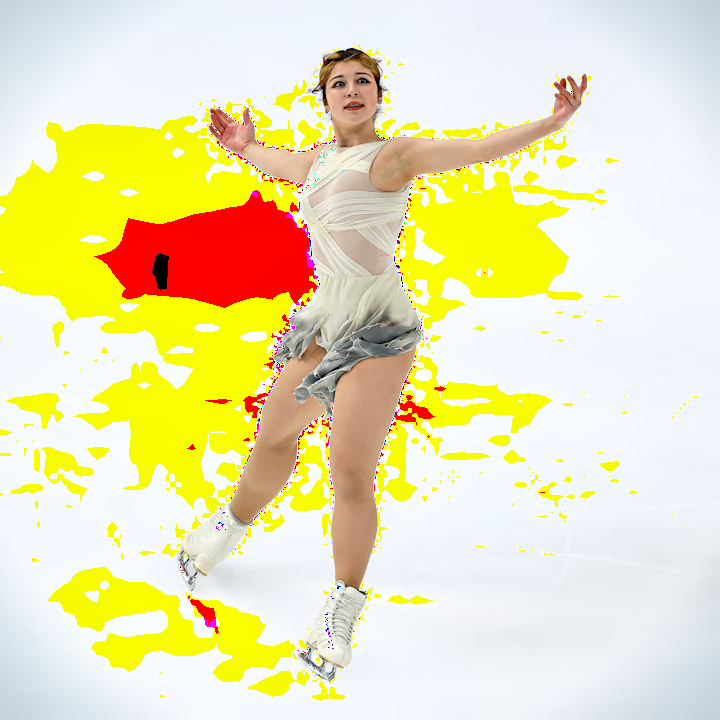
Finally, Alysa Liu is in charge of the direction her life is taking. Not just in figure skating, to which the erstwhile prodigy returned, two years after announcing her retirement in April 2022, to win six of her first 12 events, including the 2025 world championships last March and the ’25 Grand Prix Final in December. Not just in her programs, where she has taken on a greater role in selecting her costumes, her choreography and her music. And not even just in her off-ice future, where she is studying psychology at UCLA.
No, literally: At 20, Liu now has a driver’s license.
“I really have so much control over my life,” she gushes. “I can just go wherever I want, and I’m not on, like, my dad’s schedule. Before, he would drive me to the rink, pick me up. I was more on his timing. Now I’m on my own.”
So far, her timing is just about perfect. Her decision to retire at 16—two months after finishing sixth in her Olympic debut in Beijing and just a few weeks after winning bronze at the 2022 world championships—seemed abrupt to many onlookers. They only saw the girl who’d become at 12 the youngest skater to land a triple Axel; at 13 the youngest U.S. national champion ever; and at 14 the first American woman to land a quadruple jump.

But Liu saw the girl who started skating at age 5, trudged to practice and followed a schedule that other people had set for her, all to compete in a sport in fulfillment of other people’s dreams. And the last two years had come amid a pandemic, leaving the extroverted Liu—already fighting through homeschooling to accommodate skating—with almost no real-life interactions. She felt trapped. She could only see one way out.
She loved life after skating, visiting Los Angeles cafés with friends who didn’t know how to pronounce Salchow, dabbling in volleyball and tennis, hiking to the base camp of Mount Everest. But one day in early 2024, she went skiing with those friends and felt the first rush of adrenaline since putting away her skates. Then she took a trip to a rink. (She realized that at some point in the intervening two years she had lost her skates; eventually they turned up.) She tried a double Axel and landed it. Her brain started to whir.
She called her old coach, Phillip DiGuglielmo, to tell him she was ready to stage a comeback. “Why would you do this to yourself?” he scoffed. After two hours of negotiation—and a bottle of California red for DiGuglielmo—he got on board.
For most women, figure skating becomes harder as they age and their bodies develop. The last four Olympic women’s champions were 17 years old on average. But Liu has performed better at 19 and 20 than she did at 15 and 16, which she attributes in part to the maturity her age has brought her—and in part to the break she took.
Alysa Liu shines with her Lady Gaga free skate at the U.S. Figure Skating Championships. ⭐️
— NBC Olympics & Paralympics (@NBCOlympics) January 10, 2026
📺NBC and Peacock pic.twitter.com/LRnV486m0I
“I don’t think I wanted to do any competition before,” she mused during the 2025 worlds. She added, “Besides not wanting to do it, I definitely wasn’t ready for competitions ever, in my opinion.”
Now she sees the sport differently. Sometimes she barely sees it as a sport at all. She likes to perform, and she has put herself in a position where she gets to perform for a lot of people. Where’s the downside?
“I would love to do a clean program where my choreography looks good [from] start to end, fast spins and no mishaps, because I want to be fully proud of my performance,” she says. “And how I rate that is: Would I post my full performance on Instagram? If I wouldn’t, Oh, probably not that good. Or, Things could be better. I’m pretty picky with myself.

“But I wouldn’t necessarily say I’m nervous, because one thing about me is I really don’t have any anxiety. Like, I have none in my normal life, on ice—nothing. In order for me to be anxious about something, it would have to mean I’m really counting on it or depending on it [and I’m] not really depending on skating.
“Of course there’s meaning, but I find the meaning in the art, and there’s no way to go wrong with that. Even mistakes in art can still be beautiful, and it’s still a story. And I can appreciate that. Let’s say I’m at the Olympics and I mess up on a few jumps or something, and I just totally do bad. No medal, bottom placement. I don’t know. That just doesn’t seem like a horrible situation. I’d still be O.K. with that. Because if it were a movie, I’d still watch that movie. There’s other things I have in my life. [And] there’s also always another chance for you to perform better. I guess the worst part about that would be people seeing me do bad and then not seeing how a good program looks. But I could always record myself doing a good program with cool videography and post it.”
Most of her competitors are probably not looking at the Olympics this way. The majority of coaches and fans are likely not either. But after walking away and then coming back, Liu understands now: Those people are passengers on her journey. She is driving.
More Winter Olympics on Sports Illustrated
 Add us as a preferred source on Google
Stephanie Apstein was a senior writer covering baseball and Olympic sports for Sports Illustrated, where she started as an intern in 2011 and has since covered a dozen World Series and three Olympics. She has twice won top honors from the Associated Press Sports Editors, and her work has been included in the Best American Sports Writing book series. She graduated from Trinity College with a bachelor’s in French and Italian, and has a master’s in journalism from Columbia University.
Follow stephapstein