%20%20--%3E%0A%3Csvg%20version%3D%221.1%22%20id%3D%22Layer_1%22%20xmlns%3D%22http%3A%2F%2Fwww.w3.org%2F2000%2Fsvg%22%20xmlns%3Axlink%3D%22http%3A%2F%2Fwww.w3.org%2F1999%2Fxlink%22%20x%3D%220px%22%20y%3D%220px%22%0A%09%20width%3D%2239px%22%20height%3D%2240px%22%20viewBox%3D%220%200%2039%2040%22%20enable-background%3D%22new%200%200%2039%2040%22%20xml%3Aspace%3D%22preserve%22%3E%0A%3Cpath%20fill%3D%22%23FFFFFF%22%20d%3D%22M38.5%2C7H28.2v26h10.3V7z%22%2F%3E%0A%3Cpath%20fill-rule%3D%22evenodd%22%20clip-rule%3D%22evenodd%22%20fill%3D%22%23FFFFFF%22%20d%3D%22M26.1%2C25.5c0%2C5.8-4.1%2C7.5-12.9%2C7.5C3.9%2C33%2C0%2C31.2%2C0%2C25.2v-1.1h11.6%0A%09v2.4c0%2C0.7%2C0.1%2C1.4%2C1.2%2C1.4c1%2C0%2C1.2-0.4%2C1.2-1.3v-0.9c0-1.6-0.9-1.6-3.5-2.2C2.2%2C21.7%2C0%2C19.7%2C0%2C15.3v-0.9C0%2C9.3%2C5.5%2C7%2C12.9%2C7%0A%09c10.2%2C0%2C12.8%2C2.6%2C12.8%2C7.4v1.8h-11v-2.9c0-0.6-0.4-1.1-1.2-1.1c-0.6%2C0-1.2%2C0.4-1.2%2C1.1v0.9c0%2C1.5%2C0.9%2C2%2C3.3%2C2.5%0A%09c8%2C1.6%2C10.5%2C3.3%2C10.5%2C7.5V25.5z%22%2F%3E%0A%3C%2Fsvg%3E%0A)
Even in Her Victory Lap, Jessie Diggins Is Always Thinking About Others
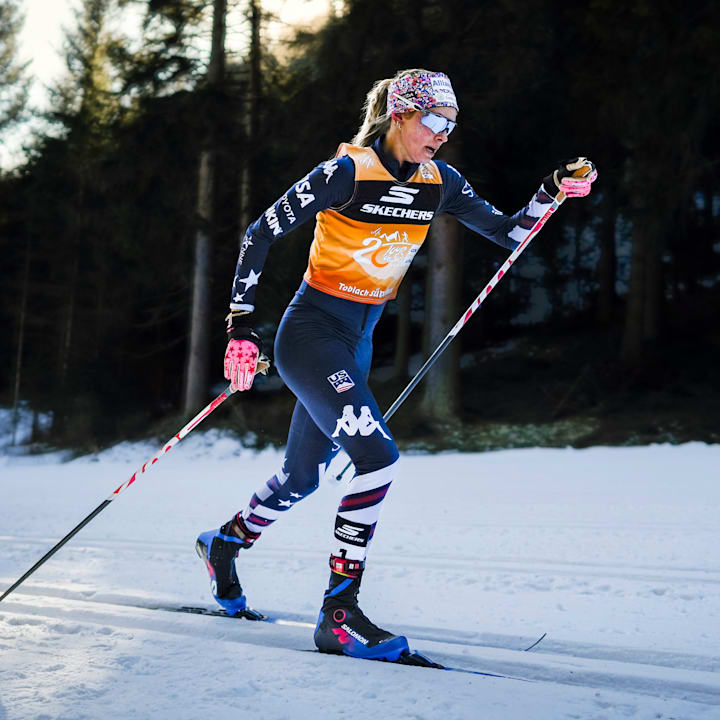
It is time to give Jessie Diggins her flowers, but she will probably say thanks and share them with everybody else in her sport. Diggins is the Michael Jordan of United States cross-country skiing—the best ever—but in some ways, she is Jordan’s antithesis. She could begin every post-win press conference by saying, “I did not take that personally.”
Fellow cross country skier Gus Schumacher calls Diggins “an anti-competition competitor.” Diggins says that sometimes before a race, “I look around, and I’m like, ‘I like her … I like her … she’s super cool … she’s worked super hard … she’s overcome an amazing injury—what a story!’ ” Why would she want to beat such lovely people?
Diggins plans to retire after the Milan Cortina Olympics. She will do so with at least three Olympic medals (one of each metal), which would be quite a haul for anybody, but especially for somebody who isn’t really driven to win. Diggins is driven to do her best. She doesn’t enjoy knowing that her best might ruin somebody else’s day.
“I just don’t think I was able to really figure that out, or articulate it very well, until later phases of my career,” Diggins says, “and then it was, like, sort of embarrassing.”
Because Diggins would rather connect than destroy, she is more comfortable sharing her struggles than touting her achievements. When she developed an eating disorder, she told the world; when she relapsed after the 2022 Beijing Olympics, she told the world again.

Her openness and vulnerability has given Diggins a deeper connection with the public than her achievements ever could. Ever since she announced her retirement in November, Diggins has been inundated with well-wishers: “It’s been so beautiful and honestly, emotional and overwhelming.” The last few months have been a victory lap for a woman who is not driven by victories.
When Diggins looks back at her previous Olympics, she does not just think about how she fared. Each one left her with a snapshot of who she was at that moment in her life. They also help explain how an athlete who places such little emphasis on winning has won so much.
Diggins made her Olympic debut in Sochi in 2014. But she was only 22, and by her own admission, she was “there to gain experience.” Her sports psychologist called it her “test round.” She dyed her hair red, white and blue. Her best finish was eighth. She had gained experience. How much it helped her is hard to say.
By the time she arrived in Pyeongchang, South Korea, in 2018, Diggins says, “a lot had shifted. I was leading the team in results in most races, I was carrying a lot of pressure. It was a very different feel.”

Theoretically, Diggins’s attitude toward winning should have been a firewall against the pressure. Her husband, Wade Poplawski, says after races, Jessie asks, “Did she do everything she can do? If the answer is yes and she didn’t end up on the podium, that’s not a bad day at the office.” But Olympians do not just compete for themselves, and Diggins shakes her head at people who say pressure is just in your mind.
“You know who’s never said that to me?” she says. “Other athletes. They know it’s real.”
When you are driven but not competitive, sometimes you have to play little mind tricks on yourself. To take her mind off the task of beating somebody she likes, Diggins thinks about winning for somebody else that she likes: “I can usually find some reason to turn it on. Like, ‘O.K., the wax techs have worked incredibly hard to give you these skis. You’ve got to do right by them.’ ”
In Pyeongchang, Diggins did not have to think about the wax techs.
“Team events are the one time where I’m like, ‘O.K., I do want to beat you,’ because [teammates] back there are waiting on the finish line for me, and I want to look them in the eye and be like, ‘I did everything I could,’ ” Diggins says.
Diggins passed three (non)rivals late in the team sprint to win the first gold in U.S. history with her friend Kikkan Randall. It was the greatest moment, for drama and achievement, in U.S. cross-country skiing. But her own greatest achievement would come next.
You know the story: Michael Jordan, wrecked by food poisoning, scored 38 points to beat Utah in Game 5 of the 1997 NBA Finals game because he just couldn’t stand losing. Now imagine Jordan doing that if he could stand losing.
Diggins started getting sick at 5 a.m. the day before the 30-km mass start at the 2022 Beijing Olympics. She skipped her last prep day, tried to get by on canned soup and bananas and showed up for the race in no condition to ski. Shortly after the race began, she was involved in a crash, leaving her way back in the pack. With 17 kilometers to go, she started cramping. For the last few kilometers, she could barely lift her knees, to the point where one of the best skiers in the world had a novice’s fear:
“I was worried I would faceplant.”

Diggins won the silver medal. She says she was so exhausted that when she crossed the finish line, “I dropped and I [could] not get back up. I literally had to be carried out. Even though my eyes were open, I couldn’t see. I was breathing horribly. My hearing was all messed up. I was like, half-conscious.” She expended so much in that race that she did not feel like herself again for at least two months.
This time, Diggins was not trying to win for Randall, she was not trying to win her country’s first cross-country gold and there is no way she powered through all of that for the wax techs. Yet she did it. It tells us that Diggins is as determined as the most dogged competitors, but in her case, the goal is simply to do her best. But that is only half of the explanation.
The other half is that Diggins derives value from what she expends—not what she receives for it. This is how she skis and how she lives. It is why she won silver that day, and why she went home and kept on expending. She promoted the sport and pushed for a World Cup in her native Minneapolis and served on the board of the Protect Our Winters foundation and did anything else she could, or somebody asked her to do.
“I was essentially becoming The Giving Tree,” Diggins says, referring to the famous Shel Silverstein children’s book. “If I had just given apples to the ski community and people, and if I just decided ‘That’s what I'm going to give,’ I could give them forever. But I started hacking off limbs. My brain was like, ‘All right, you are not listening. I’m trying to tell you, but you’re not listening. We’re going to bring your eating disorder back, because this is the one thing you’re going to listen to. I’m going to bench you.’ ”
She relapsed, recovered and did what she always does: She gave again. She wanted the world to know she had relapsed, because she had seen that sharing her story helped others in the same situation. Her husband was wary: “Once you give someone some information, they want to take and take and take,” Poplawski says. But he understands why she did it.
“In the end, Jess finds it so rewarding for her,” he says. “At times, I wish she didn’t put so much on herself.”

This brings her, and us, to Milan, the last snapshot. Many athletes—perhaps most athletes—would say that they need to treat it like any other event: focus on the goal, worry about sentiment later. Diggins knows herself too well for that.
“I’ve gotta feel the feelings,” she says. “I’m not going to try to block it out. I just want to absorb the good and the hard and everything about it.”
When it ends, she can enjoy the perks of not competing. She can spend almost the whole year with her husband in her adopted hometown of Boston, instead of half of it on the road, and she can figure out how skiing fits into the rest of her life, instead of the other way around.
Diggins says she can imagine coaching, but not at the World Cup level: “Little kids,” she says. She also says this:
“If we get another World Cup in Minneapolis, I want to be the person sprinting the skis to the start line and taking jackets for the athletes and helping test the skis. I just want to be part of it. I want to help support the team.”
Diggins says she would be “the ultimate hype woman.” This is a bit like Jordan saying he really wants to be an arena announcer introducing starting lineups or handing players towels during timeouts. But givers want to give, and one benefit of being an anti-competition competitor is that it should prepare Diggins for life after competition. She will not be searching for people to beat.
“If I ever really miss this,” she says, “I have a watch. I can go out in the woods, set a timer and hammer as hard as I can, and I will get all of those feelings again.”
More Winter Olympics on Sports Illustrated
 Add us as a preferred source on Google
Michael Rosenberg was a senior writer for Sports Illustrated, covering any and all sports. He writes columns, profiles and feature stories and has covered almost every major sporting event. He joined SI in 2012 after working at the Detroit Free Press for 13 years, eight of them as a columnist. Rosenberg is the author of “War As They Knew It: Woody Hayes, Bo Schembechler and America in a Time of Unrest.” Several of his stories also have been published in collections of the year’s best sportswriting. He is married with three children.
Follow rosenberg_mike