%20%20--%3E%0A%3Csvg%20version%3D%221.1%22%20id%3D%22Layer_1%22%20xmlns%3D%22http%3A%2F%2Fwww.w3.org%2F2000%2Fsvg%22%20xmlns%3Axlink%3D%22http%3A%2F%2Fwww.w3.org%2F1999%2Fxlink%22%20x%3D%220px%22%20y%3D%220px%22%0A%09%20width%3D%2239px%22%20height%3D%2240px%22%20viewBox%3D%220%200%2039%2040%22%20enable-background%3D%22new%200%200%2039%2040%22%20xml%3Aspace%3D%22preserve%22%3E%0A%3Cpath%20fill%3D%22%23FFFFFF%22%20d%3D%22M38.5%2C7H28.2v26h10.3V7z%22%2F%3E%0A%3Cpath%20fill-rule%3D%22evenodd%22%20clip-rule%3D%22evenodd%22%20fill%3D%22%23FFFFFF%22%20d%3D%22M26.1%2C25.5c0%2C5.8-4.1%2C7.5-12.9%2C7.5C3.9%2C33%2C0%2C31.2%2C0%2C25.2v-1.1h11.6%0A%09v2.4c0%2C0.7%2C0.1%2C1.4%2C1.2%2C1.4c1%2C0%2C1.2-0.4%2C1.2-1.3v-0.9c0-1.6-0.9-1.6-3.5-2.2C2.2%2C21.7%2C0%2C19.7%2C0%2C15.3v-0.9C0%2C9.3%2C5.5%2C7%2C12.9%2C7%0A%09c10.2%2C0%2C12.8%2C2.6%2C12.8%2C7.4v1.8h-11v-2.9c0-0.6-0.4-1.1-1.2-1.1c-0.6%2C0-1.2%2C0.4-1.2%2C1.1v0.9c0%2C1.5%2C0.9%2C2%2C3.3%2C2.5%0A%09c8%2C1.6%2C10.5%2C3.3%2C10.5%2C7.5V25.5z%22%2F%3E%0A%3C%2Fsvg%3E%0A)
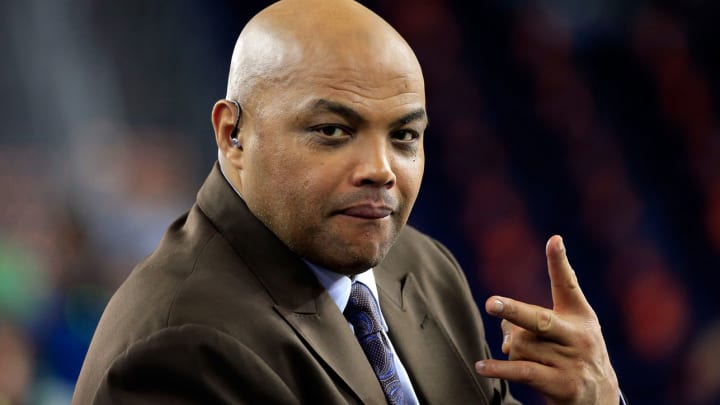
Charles Barkley? He's now just the Round Mound Of Enough Already
If both of you can laugh, you have a lot to laugh about. On the other hand, if only one of you can laugh, one of you, inevitably, is laughing at the other. — James Baldwin
Two decades ago Charles Barkley infamously cautioned us he was not a role model. He has made as much clear again and again and againand again and again over the course of his careers as a professional basketball player and an NBA analyst. He’s a notorious (and arguably proud) drinker, an avid gambler, and an ill-tempered putdown artist. He has spit at a fan (and, inadvertently, on a child), thrown a man through a plate-glass window and — as he subsequently lie bleeding — suggested that the man deserved to die,threatened police with violence, and driven drunkenly in search of a repeat performance of the best fellatio he ever had from a prostitute.
Despite — or, more realistically, because of — his very public embrace of degeneracy, Sir Charles has now comfortably settled into a Knighthood as one of America’s favorite off-color truth-tellers, a sort of lovable, inebriated, ranting uncle unrestrained by the leash of basic civility and decency that makes the rest of us mind our manners.
Barkley walks in a long line of celebrities to whom society grants exemption from the fundamental moral codes we champion; we encourage his boorishness much in the same way we celebrate the womanizing of Derek Jeter and Hugh Hefner, the crassness and dope-smoking of Snoop, and the “mischievousness” of Bill Clinton. These are figures Joan Didion described as the dreams we don’t want to admit having, evidence of “the apparently bottomless gulf between what we say we want and what we do want, between what we officially admire and secretly desire, between, in the largest sense, the people we marry and the people we love. “
Charles Barkley: ‘Good for Draymond Green’ for slapping fan
In that context — and only in that context — can we make sense of the announcement that TNT is granting Barkley a television show to discuss something as serious and significant as race. (Not “racism” of course, but “race” — and under a slanted title with an antagonistic implication nonetheless). At this moment in American society, when racial tension is at full boil; with blacks being shot dead on camera with jarring regularity; with politicians openly characterizing minorities as “sub-groups” that haven’t contributed to Western civilization, Charles Barkley has inexplicably been appointed to navigate these challenging waters.
Why? Because people will tune in. In our society, ratings and buzz and revenue have become the ultimate justifications, even in this absolutely crazy political climate.
As a player, Barkley was a once-in-a-generation talent, so prodigious an athletic specimen, he succeeded in spite of a legendarily negligent work ethic. As a thinker, he is even lazier than he was as a player, but with none of the God-given gifts to counterbalance his intellectual indolence.
In fact, Charles Barkley is objectively terrible at his current job in every way except being entertaining. (And even in that regard, his entertainment is tied less to a dynamic, compelling personality than it is bottom-of-the-barrel buffoonery.) Basketball is the one thing in life Sir Charles had a true talent for, and yet somehow he still can’t produce any legitimate insights for his audience about the game.
His opinions on players, strategies, and contenders betray a complete and utter lack of research, understanding, or even regard for the topics. He is unprepared and ineffective at discussing basketball in any way that enlightens viewers. He recycles the same empty talking points about jump-shooting teams and size ad nauseum. He rarely seems to have paid close attention to the games he subsequently analyzes, substituting “bold” opinions that run a very limited gamut — from ad hominem attacks to jokes about cities and people who are “ugly” or “fat.”
His insights on race are even less nuanced and less informed. They are, however, predictable.
Charles Barkley: LeBron can't crack my all-time top five
He believed the George Zimmerman verdict was fair and correct; he argued — in the wake of a medial examiner’s ruling to the contrary — that Eric Garner’s homicide was not in fact a homicide; he agreed with the controversial decision not to indict Darren Wilson for the murder of Michael Brown; he believed the cops who pulled over Philando Castile for having a wide nose might have been justified in murdering the man “because in fairness, because some black people out there are crooks;” he shied away from declaring slavery horrific, because — despite an inestimable amount of historical validation — he didn’t personally experience it.
Barkley seemingly has never met a clichéd talking point rooted in the noxious rhetoric of black pathology he could resist.
The point — clear though it is — isn’t just that Barkley is unfit to lead, discuss, or mediate any discussion on racism in America. The point — clear though it is — isn’t just that Barkley is a stone-cold, garden-variety moron. The point is — and we’ve covered this terrain before — the media makes itself complicit in the most cynical form of race-baiting by continually granting a platform to loud, uninformed, intellectually unqualified black sports analysts who discuss race relations almost exclusively in the framework of black cultural pathology.
Rare Photos of Charles Barkley
Charles Barkley
Charles Barkley turned 50 on Feb. 20th. In honor of the occasion, SI.com published 50 photos of the NBA legend, who led the SEC in rebounding and his teammates in pizza consumption in each season he was at Auburn.
Charles Barkley
During Barkley's three years at Auburn, he averaged 15 points, 9.6 rebounds, 1.6 assists and 1.7 blocks per game. The school retired Barkley's No. 34 jersey in 2001.
Charles Barkley, Larry Bird and Robert Parish
Barkley was taken with the fifth pick in the 1984 draft by Philadelphia, joining a veteran team that had won the NBA title the year before.
Charles Barkley and Moses Malone
Barkley smiles on the bench next to 76ers teammate Moses Malone at The Spectrum in Philadelphia in 1985. Barkley and Malone overlapped with the 76ers for two seasons, losing in the Eastern Conference Finals in 1985 and the conference semifinals in 1986.
Charles Barkley
Barkley's gregarious personality quickly made him a fan favorite. In this photo, the Alabama native takes in a movie at a Philadelphia theater.
Charles Barkley and Charcey Glenn
Barkley and his mother, Charcey Glenn, enjoy some down time at Barkley's Philadelphia home.
Charles Barkley
Barkley, who famously battled weight issues throughout his career, likes what he sees in the mirror.
Charles Barkley
Barkley has to be restrained as he gets into an altercation with Kurt Rambis during a February 1986 game against the Los Angeles Lakers.
Charles Barkley
Barkley smiles on the bench during a 76ers game against the Portland Trail Blazers in February 1986. Barkley averaged 20,0 points and 12.8 rebounds that season as the 76ers reached the Eastern Conference semifinals.
Charles Barkley and World B. Free
Barkley briefly teamed up with World B. Free in the 1987 season, bringing together two of the NBA's most outspoken personalities.
Charles Barkley
Barkley signs autographs for fans before a 76ers game against the Los Angeles Lakers in December 1987. Although Barkley had one of his best statistical seasons, Philadelphia struggled that year, going 36-46 and missing the playoffs.
Charles Barkley
Barkley gives a quick hug to a fan after diving into the stands during a game against the Portland Trail Blazers in January 1988. Barkley posted a career-high scoring average with 28.3 points per game in the 1987-88 season, including 37 points in this loss to the Trail Blazers.
Timothy Busfield, Charles Barkley, Mike Gminski and Ken Olin
Timothy Busfield (left) and Ken Olin (right), of the hit TV show "Thirtysomething," act out a fantasy scene with Barkley and Mike Giminski before a Clippers-Sixers game in Los Angeles.
Charles Barkley
Barkley gets upset during a game against the Portland Trail Blazers in November 1988. The 76ers went 46-36 that season before the New York Knicks swept them in the first round of the Eastern Conference playoffs.
Charles Barkley and Larry Bird
During the 1988-89 season, Barkley averaged 26 points and 12.5 rebounds per game.
Charles Barkley
Barkley takes a second to smile for the camera during a game against the Lakers in Los Angeles.
Charles Barkley and Manute Bol
Barkley stares down 7-foot-7 Manute Bol during a game against the Warriors. The two would later become teammates in Philadelphia.
Charles Barkley
Barkley poses for a portrait as a new member of the Phoenix Suns in 1992. After averaging more than 20 points and 10 rebounds per game for seven straight seasons with the Philadelphia 76ers, Barkley was sent to the Suns for Jeff Hornacek, Andrew Lang and Tim Perry.
Charles Barkley, Danny Ainge, Kevin McHale and Robert Parish
Barkley "interviews" his teammate Danny Ainge and Ainge's former Celtic teammates Kevin McHale and Robert Parish at the Boston Garden.
Charles Barkley
Barkley "confers" with an official during a game against Denver.
Charles Barkley
Barkley has some fun with fans before a game against the Houston Rockets in February 1993. He averaged 25.6 points and 12.2 rebounds per game during that season, his seventh of 11 straight All-Star seasons.
Charles Barkley
Barkley dresses in royal regalia with children holding his cape at a charity fundraiser in February 1995.
Charles Barkley and Billy Crystal
Barkley makes a cameo in the Billy Crystal movie, "Forget Paris."
Charles Barkley
Barkley poses for a portrait in the Phoenix Suns locker room in December 1995. The Suns sent Barkley to the Houston Rockets after the season as part of a deal to land Chucky Brown, Mark Bryant, Sam Cassell and Robert Horry.
Charles Barkley, Clyde Drexler, Isiah Thomas and Wilt Chamberlain
Barkley reminisces with NBA legends Clyde Drexler, Isiah Thomas and Wilt Chamberlain during All-Star Weekend in 1997. Barkley spent two seasons on the Houston Rockets with Drexler and played on the Eastern Conference All-Star Team with Thomas for six years.
Charles Barkley and Allen Iverson
After five seasons in Phoenix, Barkley was traded to Houston. Meanwhile, in Philadelphia, Allen Iverson became the Sixers next great star.
Charles Barkley and Reggie Jordan
Barkley was hampered by injuries in Houston, missing 145 games in four seasons before retiring in 2000.
Charles Barkley and Jack Nicholson
Actor and Lakers supporter Jack Nicholson chats with Barkley at Game 2 of the Lakers-Rockets first round playoffs series in 1995. Barkley scored 19 points with 13 rebounds in Houston's 110-98 loss as the Lakers went on to win the series in four games. Barkley is one of the best players in NBA history to not win a championship.
Charles Barkley and Leroy Neiman
Leroy Neiman presents Barkley with a painting during his retirement ceremony on March 30, 2001, at the First Union Center in Philadelphia
Charles Barkley, Martha Stewart and Jeff Probst
Barkley may be smarter than Martha Stewart, but he has a ways to go before he can match Jeff Probst. The three competed in Celebrity Jeopardy.
Charles Barkley and John Smoltz
Atlanta Braves closer John Smolts enjoys a laugh with Barkley before a game against the Philadelphia Phillies in Atlanta in October 2001.
Charles Barkley
Barkley lifts weights in a gym.
Charles Barkley
Barkley relaxes on a couch for a portrait.
Charles Barkley
Barkley poses for a portrait in February 2002. Barkley released a memoir that year titled "I May Be Wrong, But I Doubt It.
Charles Barkley and Tiger Woods
Tiger Woods interviews Barkley in Kauai, Hawaii. Despite Barkley's attempts to learn how to properly swing a golf club, the two are close friends.
Charles Barkley
A locked and chained Barkley made headlines for this 2002 SI photo shoot.
Charles Barkley
Auburn alum Barkley watches the Tigers take on Tennessee at Neyland Stadium.
Joe Dumars, Dominique Wilkins and Charles Barkley
Barkley poses with fellow Hall of Fame inductees Joe Dumars and Dominique Wilkins prior to the 2006 induction ceremony.
Charles Barkley, Carolyn Murphy and Jay Leno
SI swimsuit model Carolyn Murphy compares hand sizes with Barkley on The Tonight Show with Jay Leno.
Charles Barkley and Dick Bavetta
Barkley kisses referee Dick Bavetta after they competed in a full-court race in the Bavetta/Barkley Challenge during NBA All-Star Weekend in Las Vegas.
Charles Barkley
Barkley and his famously ugly golf shot at the Ford Wayne Gretzky Classic in Clarksburg, Ontario, Canada.
Charles Barkley and Suckki Jang
Barkley stretches with golf instructor Suckki Jang during filming for "The Haney Project." Barkley, who has a notorious hitch in his golf swing, appeared with the famed swing coach Hank Haney on his show to try to fix Barkley's swing.
Charles Barkley and Hank Haney
Barkley listens to Hank Haney during "The Haney Project," the reality show in which Haney worked with Barkley to try to fix the hitch in his swing. Haney, who coached Tiger Woods for years, was unable to fix Barkley's swing.
Charles Barkley
Barkley makes pizza on the Jay Leno Show in November 2009. Barkley appeared on the show with Biggest Loser contestant Allen Smith. He later became a spokesman for WeightWatchers in 2011.
Charles Barkley
Barkley gives a Chicago Bulls Luvabull dancer a flower while broadcasting a game between the Bulls and the Miami Heat. Upon retiring from the NBA in 2000, Barkley quickly went into broadcasting, working as both a studio and color analyst for basketball games.
Charles Barkley and Michael Douglas
Barkley greets actor Michael Douglas on The Tonight Show with Jay Leno in May 2010.
Charles Barkley
Barkley tans by the pool in Dana Point, Calif., in July 2010. Barkley competed against Shaquille O'Neal in a round of golf as part of O'Neal's television show, "Shaq VS."
Charles Barkley and Paul Brittain
Barkley acts in a sketch on Saturday Night Live with Paul Brittain in January 2012. Barkley hosted the show after appearing on NBC's coverage of the NFL Wild Card playoffs that same day.
Charles Barkley, Bill Hader, Jay Pharoah, and Kenan Thompson
Barkley appears in a sketch on Saturday Night Live in January 2012, spoofing "Inside the NBA," the basketball analysis show on which he regularly appears. Rather than play himself in the sketch, Barkley played the role of Shaquille O'Neal, complete with a fake beard while Kenan Thompson filled in the role of the sketch's Barkley.
Charles Barkley
Barkley rides onto the set in Thunder Alley on a horse before Game 5 of the 2012 Western Conference Finals between the San Antonio Spurs and the Oklahoma City Thunder.
There is no more compelling argument against the extreme form of capitalism we’ve come to practice in America than how it has bled into and begun to unravel the basic moral fabric of our society. Decency and our collective psychic health are things that should never be contingent on the market share of the offended party, nor the literal or cultural capital they wield.
Sadly, when what we most need is intelligence, insight, and moral guidance, TNT’s sanctioning such an uninformed, polarizing, and counterproductive voice to quarterback a show about race in America is unforgivable.
- From the SI Vault: Citizen Barkley (2002): He's a trash-talking, leg-pulling, high-rolling, golf-playing black Republic who says whatever's on his mind and doesn't care what you think of him.
Both Mainstream America’s and major networks’ dubious love affair with Barkley can only be seen through Didion’s lens of secret desire vs. official admiration — his popularity an oblique confession that so many of us prefer spectacle to discourse, scapegoating to responsibility. At a time when making sense of our social reality becomes more difficult by the day, Barkley offers us the easy way out; we accept it at our own peril.
Charles Barkley isn’t the voice of any constituency, black or otherwise. He certainly isn’t the voice of reason, on race or much else. He lacks any credentials or credibility to discuss complex social issues. One is left to wonder what it will take for the powers that be to figure out that moral incoherence in this country can’t be unpacked and sorted out by someone like Barkley, who is himself a symptom of it. Or whether his intended audience will ever realize that, much like the minstrels of pre-civil rights era America, Barkley functions merely to reassure his audience — barricaded inside a pen of their own innocence — of its outstanding credit rating in the midst of moral bankruptcy.
Maybe most tragically, Barkley falls short even as a minstrel character. What marked the best vaudeville characters, like Bert Williams, was a double-consciousness that subverted the surface performance. The comedy was delicately layered and ironic; the discerning observer could see the genius behind the mask of the sad clown.
In Barkley’s case, you get the sense he has played the clown for so long, and has been so handsomely rewarded for it, he long ago lost the border between the self and the costume. Maybe there never was a border. Maybe, when you peel back Sir Charles’ sad clown mask, you find an even sadder clown, one who has never realized that he devolved into the cruelest joke of all: A tragic punchline devoid of both humor and humanity.
 Add us as a preferred source on Google