%20%20--%3E%0A%3Csvg%20version%3D%221.1%22%20id%3D%22Layer_1%22%20xmlns%3D%22http%3A%2F%2Fwww.w3.org%2F2000%2Fsvg%22%20xmlns%3Axlink%3D%22http%3A%2F%2Fwww.w3.org%2F1999%2Fxlink%22%20x%3D%220px%22%20y%3D%220px%22%0A%09%20width%3D%2239px%22%20height%3D%2240px%22%20viewBox%3D%220%200%2039%2040%22%20enable-background%3D%22new%200%200%2039%2040%22%20xml%3Aspace%3D%22preserve%22%3E%0A%3Cpath%20fill%3D%22%23FFFFFF%22%20d%3D%22M38.5%2C7H28.2v26h10.3V7z%22%2F%3E%0A%3Cpath%20fill-rule%3D%22evenodd%22%20clip-rule%3D%22evenodd%22%20fill%3D%22%23FFFFFF%22%20d%3D%22M26.1%2C25.5c0%2C5.8-4.1%2C7.5-12.9%2C7.5C3.9%2C33%2C0%2C31.2%2C0%2C25.2v-1.1h11.6%0A%09v2.4c0%2C0.7%2C0.1%2C1.4%2C1.2%2C1.4c1%2C0%2C1.2-0.4%2C1.2-1.3v-0.9c0-1.6-0.9-1.6-3.5-2.2C2.2%2C21.7%2C0%2C19.7%2C0%2C15.3v-0.9C0%2C9.3%2C5.5%2C7%2C12.9%2C7%0A%09c10.2%2C0%2C12.8%2C2.6%2C12.8%2C7.4v1.8h-11v-2.9c0-0.6-0.4-1.1-1.2-1.1c-0.6%2C0-1.2%2C0.4-1.2%2C1.1v0.9c0%2C1.5%2C0.9%2C2%2C3.3%2C2.5%0A%09c8%2C1.6%2C10.5%2C3.3%2C10.5%2C7.5V25.5z%22%2F%3E%0A%3C%2Fsvg%3E%0A)
Ukraine’s Vladyslav Heraskevych Writes New Chapter in the Olympic Protest Tradition
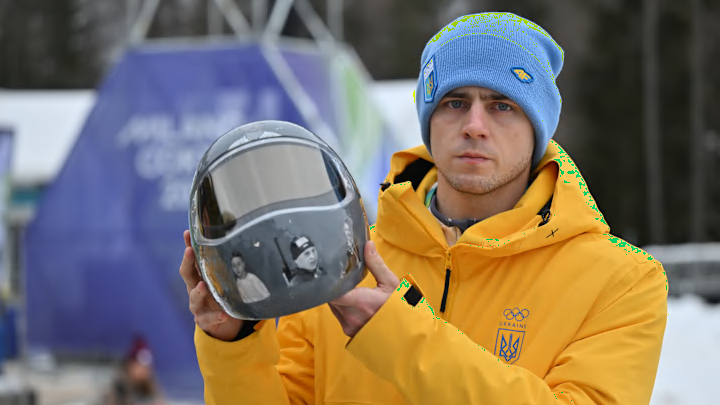

CORTINA d’AMPEZZO, Italy — Olha Scherhyna stood on an icy slope at the Cortina Sliding Center, wiping tears from the corners of her eyes. She had blue and yellow paint on both cheeks, and a flag of the same colors tied around her shoulders. The colors of Ukraine.
She took pictures of a scoreboard that bore the lineup of competitors in Heat 1 of the Olympic men’s skeleton competition. The name of the athlete she came to support was missing.
Thursday morning, not long before the competition began, Ukrainian slider Vladyslav Heraskevych was told—once and for all—by the International Olympic Committee (IOC) that he would be disqualified if he went through with what it considered an impermissible political demonstration. Heraskevych had a helmet that bore the faces of athletes from his country who have been killed in the ongoing, brutal war with Russia.
He stood his ground, saying he would not change helmets. He was disqualified, never getting to the start house to fulfill his Milan Cortina Olympic dream. A trail of tears followed.
Heraskevych’s father sat on a snow bank outside the venue, bent over, hands on his face. IOC president Kirsty Coventry, who attended the final meeting with the Ukrainian athlete and his father Thursday, departed in tears. And Scherhyna, a Ukrainian native now living in Italy, who came to the sliding center in hopes that the IOC would let Heraskevych compete in his statement helmet, was left crying in the snow.

“I think he should be allowed in the game,” Scherhyna says. “For Ukraine, he is already a winner.”
She reached into the pocket of her white coat and produced a thin black armband, asking a media member to tie it around her sleeve.
Further down the slippery hill from the sliding course, where spectators were still flowing in, other Ukrainian fans were angry. Outraged. Disillusioned.
“I’m very upset,” says Natalia Kharchuk, from Lviv, who also had a Ukrainian flag tied around her shoulders. “I’m very disappointed about this. He didn’t break any rules. He just showed the honor about the athletes who were killed by Russia. And this just shows a big corruption in this committee. I think that this is very, very, very bad decision about this. I had a big hope that he will participate. I want to cry.”
A third woman draped in a flag, Irina, moved to Italy with her husband and son five days after Russia invaded Ukraine in 2022. She did not want to give her last name to Sports Illustrated because she has family still living in Ukraine and fears for their safety.
“This is unacceptable,” Irina says. “The war is still going. These people were killed. I’m very disappointed in this decision. I came here to see him.
“I haven’t been home since [the war started]. The war is not over. My relatives are freezing in their homes. Some don’t have electricity. Some don’t have heating. We’re just brutally invaded by this power that’s this brute force with millions of people.”
For these Ukrainian natives, who came to the sliding center to watch an Olympian represent them, while simultaneously telling a story about the tragedy in their homeland, it’s one more blow. One more heartbreak. One more instance of the world turning its back on them.
But their admiration for Heraskevych has only grown as they watched him make an incredible sacrifice.
“I think it’s even bigger than the medal,” says Kharchuk. “Because he won the medal of our heart and he is a hero in the Ukraine.”
Ukrainian president Volodymyr Zelenskyy voiced his support for his athlete on social media: “I thank the flag bearer of our national team at the Winter Olympics, Vladyslav Heraskevych, for reminding the world of the price of our struggle. This truth cannot be inconvenient, inappropriate, or called a ‘political demonstration at a sporting event.’
“It is a reminder to the entire world of what modern Russia is. And this is what reminds everyone of the global role of sport and the historic mission of the Olympic movement itself—it is all about peace and for the sake of life. Ukraine remains faithful to this. Russia proves the opposite.”
His helmet bears portraits of our athletes who were killed by Russia. Figure skater Dmytro Sharpar, who was killed in combat near Bakhmut; Yevhen Malyshev, a 19-year-old biathlete killed by the occupiers near Kharkiv; and other Ukrainian athletes whose lives were taken by… https://t.co/IL2tFB786l
— Volodymyr Zelenskyy / Володимир Зеленський (@ZelenskyyUa) February 9, 2026
The entire affair is complex, wonky and ultimately sad. The IOC is trying to protect precedent, to find a line of consistency, to avoid opening a Pandora’s box of related issues. Those are fine aspirations, but they aren’t tethered to the real world.
The IOC’s stance on this issue was codified in 2021 by the Athletes’ Commission, a process in which Coventry was heavily involved before becoming president of the organization. Coventry, a decorated Olympic swimmer from Zimbabwe who competed collegiately in the U.S,, said she sought several compromises with Heraskevych on the helmet issue. She pointed out that he was allowed to wear it during training runs; that he could display it after his skeleton run, and discuss it with the media; that he could wear a black armband, which has become an IOC-approved expression of generic grief.
“I was not speaking to him in that room as a president,” Coventry said in a press conference. “I was speaking to him as an athlete. We have these rules in place to try and be fair, and also to try and allow for us to do both things—for athletes to express themselves but also to allow for athletes to be safe.
“We’re not considering them political messages, it’s any messaging, of any kind. … It’s because we had so many athletes come to us to say if you open that up, how do you keep me safe? How do you stop me from being used by others to send a message that I don’t agree with?”
A well-meaning sentiment. Also naïvely detached. At its heart, the IOC is standing on a principle rooted in a lie: that international competition can transpire within a bubble of athletic purity; that sports can be immune from the political reality that surrounds them; that the field of play is sacrosanct.
It sounds great, but it’s never really been true. First of all, to assert that this is a generic “messaging” rule vs. a political one is disingenuous. And nobody is going to suggest that politics don’t hover over every Olympic Games.

They exist in the context of constant geopolitical statements. The medal table is used as a metric to define and reinforce (or refute) a nation’s world standing. Hosting the Games is a means of promoting that nation’s worldview. Some nations’ Olympic committees are banned from formal representation due to aggressive military actions, including Russia, here and now, for the ramifications of invading Ukraine.
The 1936 Olympics were a famous collision of political ideologies—Adolf Hitler’s Nazi regime of white supremacy vs. Black American Jesse Owens’s direct refutation of it by winning four gold medals. In 1968, American sprinters John Carlos and Tommie Smith made a number of symbolic statements on the medal stand, most notably raising black-gloved fists in the air during the national anthem. The darkest moment in Olympic history came four years later, when aPalestinian terrorist organization murdered 11 members of the Israeli Olympic team.
The outside world always intrudes on the Olympics. It is inescapable and inevitable.
For less than one minute while sledding across the Cortina Sliding Center track, Hereaskevych wanted the world to get a glimpse of athletes lost to the tragic war in his homeland. The IOC bureaucracy cited the rulebook and said no. So he said no right back, sacrificing his Olympics.
His social media post after being denied: “This is price of our dignity.”
Це ціна нашої гідності.
— Vladyslav Heraskevych OLY (@heraskevych) February 12, 2026
This is price of our dignity. pic.twitter.com/00h3hlZs6i
More Winter Olympics on Sports Illustrated

Pat Forde is a senior writer for Sports Illustrated who covers college football and college basketball as well as the Olympics and horse racing. He cohosts the College Football Enquirer podcast and is a football analyst on the Big Ten Network. He previously worked for Yahoo Sports, ESPN and The (Louisville) Courier-Journal. Forde has won 28 Associated Press Sports Editors writing contest awards, has been published three times in the Best American Sports Writing book series, and was nominated for the 1990 Pulitzer Prize. A past president of the U.S. Basketball Writers Association and member of the Football Writers Association of America, he lives in Louisville with his wife. They have three children, all of whom were collegiate swimmers.
Follow ByPatForde