%20%20--%3E%0A%3Csvg%20version%3D%221.1%22%20id%3D%22Layer_1%22%20xmlns%3D%22http%3A%2F%2Fwww.w3.org%2F2000%2Fsvg%22%20xmlns%3Axlink%3D%22http%3A%2F%2Fwww.w3.org%2F1999%2Fxlink%22%20x%3D%220px%22%20y%3D%220px%22%0A%09%20width%3D%2239px%22%20height%3D%2240px%22%20viewBox%3D%220%200%2039%2040%22%20enable-background%3D%22new%200%200%2039%2040%22%20xml%3Aspace%3D%22preserve%22%3E%0A%3Cpath%20fill%3D%22%23FFFFFF%22%20d%3D%22M38.5%2C7H28.2v26h10.3V7z%22%2F%3E%0A%3Cpath%20fill-rule%3D%22evenodd%22%20clip-rule%3D%22evenodd%22%20fill%3D%22%23FFFFFF%22%20d%3D%22M26.1%2C25.5c0%2C5.8-4.1%2C7.5-12.9%2C7.5C3.9%2C33%2C0%2C31.2%2C0%2C25.2v-1.1h11.6%0A%09v2.4c0%2C0.7%2C0.1%2C1.4%2C1.2%2C1.4c1%2C0%2C1.2-0.4%2C1.2-1.3v-0.9c0-1.6-0.9-1.6-3.5-2.2C2.2%2C21.7%2C0%2C19.7%2C0%2C15.3v-0.9C0%2C9.3%2C5.5%2C7%2C12.9%2C7%0A%09c10.2%2C0%2C12.8%2C2.6%2C12.8%2C7.4v1.8h-11v-2.9c0-0.6-0.4-1.1-1.2-1.1c-0.6%2C0-1.2%2C0.4-1.2%2C1.1v0.9c0%2C1.5%2C0.9%2C2%2C3.3%2C2.5%0A%09c8%2C1.6%2C10.5%2C3.3%2C10.5%2C7.5V25.5z%22%2F%3E%0A%3C%2Fsvg%3E%0A)
The Night Banana Ball Stood Still: Jackson Olson's Battle With Panic Attacks
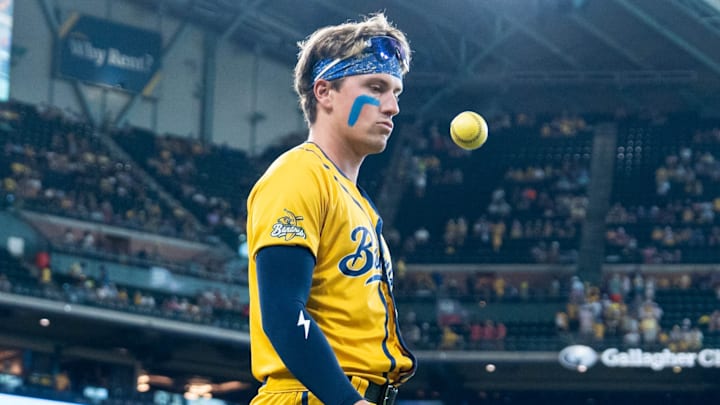
Under the bright lights in front of a sellout crowd of screaming fans at loanDepot Park in Miami last March, one of the Savannah Bananas was struggling. The Bananas were facing the Party Animals in the first MLB stadium game of their tour.
Jackson Olson, the team's second baseman and social media star, can pinpoint when he knew something was wrong.
"I'm standing out there and I [had] this really out-of-body experience where I was talking to myself and trying to get myself out of it," Olson says looking back a year later. "But it didn't even feel like it was me talking or me moving. I wasn't really controlling my body and it was a very weird feeling. That created so much anxiety for me not being able to feel everything. I'm like am I having a stroke?"
He had a panic attack. He began experiencing them a month earlier and this one wouldn't be the last. It forced him out of the game after the second inning.
"That moment caused a ripple effect for the next three months of like, I hope this doesn't come back, and then it would come back in the middle of a game," Olson says. "I'm like, 'Well, I can't play.' I have to go into the locker room and just sit there with my hands on my head and just wait for it to go away."
"In the next 24 hours, I would wonder what everyone's thinking," he says. "Like all the fans were like, 'What happened to Jackson? Is he sick? What's going on?'"
Olson had two jobs—playing baseball and creating content—and couldn't do either of them. He missed the second game in Miami and then the tripleheader the following weekend in Savannah. For a full week between the end of February and beginning of March, he didn't post on social media, either.
Near the end of May, Olson and the rest of the team participated in the first Savannah Bananas Day at Disneyland. By that point, the panic attacks had subsided and he began to think about how he could share what he had gone through with others.
"I think a lot of people see me and they think, 'Oh, that's just the happiest kid in the world, he's just playing and dancing on a baseball field and talking about how much he loves life and Disney and Taylor Swift,'" he says. "But it was cool to be able to share I'm also human like everyone else. Even though I'm doing these fun things, I still deal with anxiety."
Scroll through his social media feeds and there is a mix of Banana Ball walk-ups, silly antics with his teammates (or opponents) and plenty of both Disney and Taylor Swift. But in between there are sentimental videos about growing up and all that comes with it: losing friendships, mending relationships and his journey as a Savannah Banana.
Somewhere in the middle is a post from Sept. 1 where Olson describes the difficult start to the year, the crippling panic attacks that had begun in February and the feeling they weren't going to go away.
Olson had no idea what the impact would be, but the reaction from fans and teammates alike was overwhelmingly positive. The stigma that so often surrounds mental health—especially men's mental health—didn't even cross his mind because he has displayed so much of his personality through other videos.
"I was actually less nervous to post that than a lot of my other videos because I just felt really comfortable in the fact that people are gonna appreciate the fact that I'm doing this," he says. "It almost wasn't even for me. Other people are gonna see this and be like, 'Wow, that could help me.'"
Olson says that in the months since, he's had people tell him how much what he wrote got them through their own struggles with panic attacks. After keeping it in his head for months, having it out in the open was a relief. It also created a space for some of his teammates to talk about their own experiences.
"Even some of my teammates would come up to me and say, 'Hey, I've had these. I've had some of these too in the past. I was freaking out about it. I didn't know how to handle it. Thanks for sharing that.'"

Nearly 14 months after that night in Miami, Olson is in New York. The Bananas are set to play two games at Yankee Stadium against the Party Animals. The 2026 season is the biggest Banana Ball has ever had: six teams, an in-season tournament and 22 MLB and football stadiums. The 28-year-old knows now what works for him. He utilizes a technique called box breathing, even during games. (Olson says that while he's often called an influencer, he doesn't feel like he actually influences people to do anything. If he could, though, he recommends box breathing if you're having a panic attack.)
He is grateful for the opportunities to be creating content and playing baseball. He hints at a couple of upcoming projects that the 2025 version of himself wouldn't believe and "would never have happened if I didn't trust myself and get through that time [last year]."
For Olson, that meant leaning on a small group of friends and family for support. He recalled one day during that time when he was sitting at home, watching TV and felt really anxious. He called Bananas athletic trainer Frances Carlson for help getting through it. She walked him through some steps to calm down.
Then, he reached out to teammate Ryan Cox, who came over immediately.
"That right there, showed me like, all right, I have friends that can drop everything and come help me if I need them to help me," he says. "And that's huge in life because I never really had that before."
May is Mental Health Awareness month and Olson urged anyone struggling with their mental health to "struggle in silence for the least amount of time that you possibly can." He encouraged them not to downplay what they’re going through. He explained that at first, he told people the lights bothered him and prevented him from playing. But once he opened up, it got easier.
"When someone asks, 'Hey, man, what happened last night?' [I] don't have to say, 'Oh, it was vertigo,'" Olson says "Oh, that's nothing big. You don't want them to downplay it, because then guess what's going to happen? You're going to downplay it in your mind. So when you have those panic attacks, you're going to be like, Oh, well, it's not that big of a deal, because everybody thinks it's normal."
Twelve days after sharing his story, Olson stood on the field at Yankee Stadium, a childhood dream come true. Before his first at-bat in the bottom of the second inning, he did a specialty walk-up to Taylor Swift's "You're On Your Own, Kid." The moment meant everything to the New Milford, Conn., native.
"First of all, I grew up a Yankees fan. Second, my parents are here with me," he says. "They didn't know what I was doing four years ago, they didn't know what this journey was going to be. And then knowing that I couldn't even play at the start of the year, and I'm like, Wow, like this whole stadium is cheering for me."
The song choice embodied Olson's content: growing up, "not about not needing your parents anymore, but about being on your own." On his way to home plate, he handed out friendship bracelets that Swift's fans made synonymous with the Eras Tour. The last two people in the line were his parents, Laura and Dan.
A self-proclaimed Swiftie, the lyrics over the stadium speakers brought the moment full circle. You're on your own, kid. Yeah, you can face this. You're on your own, kid. You always have been.
More MLB from Sports Illustrated
 Add us as a preferred source on Google