
Gold, Silver, Stocks. Baseball Cards are Outperforming Traditional Assets
In this story:
The baseball card market has never been in a better place. Growing collector interest, record-breaking auction sales, and increasing attention from investors has pushed the hobby into new territory.
Sports cards should not be viewed as a guaranteed or low-risk investment. Unlike traditional assets such as stocks or commodities, baseball cards can be difficult to sell quickly, and their prices are often influenced by player performance, collector sentiment, and auction timing. A card that spikes in value one year can easily stagnate or decline the next.

Even so, institutional investors have begun treating elite sports cards as legitimate alternative assets. Alt Fund II, a dedicated alternative asset investment fund, purchased a 2009 Panini National Treasures Stephen Curry Logoman Rookie Autograph for $5.9 million a few years ago.
Fractional investment platforms have entered the cards space as well. Rally acquired a copy of the iconic T206 Honus Wagner and offered it to investors, dividing ownership into shares that allowed hundreds of investors to buy equity in the card.
Corporate buyers have also entered the market. Sporting goods retailer Dick’s Sporting Goods recently purchased the debut patch autograph card of Paul Skenes for more than $1 million. The card became a national story after it was considered the hobby’s “Golden Ticket,” and the company now displays it as a centerpiece attraction in its flagship Pittsburgh store.
The 1/1 Paul Skenes MLB Debut Patch card purchased by DICK’S Sporting Goods via Fanatics Collect’s March Premier Auction was officially unveiled this morning at DICK’S House of Sport in Pittsburgh at Ross Park Mall.
— Sports Card Investor (@SportsCardInv) May 9, 2025
📷 credit: @cllctmedia pic.twitter.com/lNn8U8HYLi
Stories like these illustrate the growing financial attention surrounding sports cards. Recent performance in the baseball card market helps explain why investors and collectors alike are paying closer attention. Over the past 12 months, several iconic baseball cards have delivered returns that surpass some of the world’s most traditional and recognizable investments.
Mickey Mantle vs. Gold

12-Month Performance of Gold: +75%
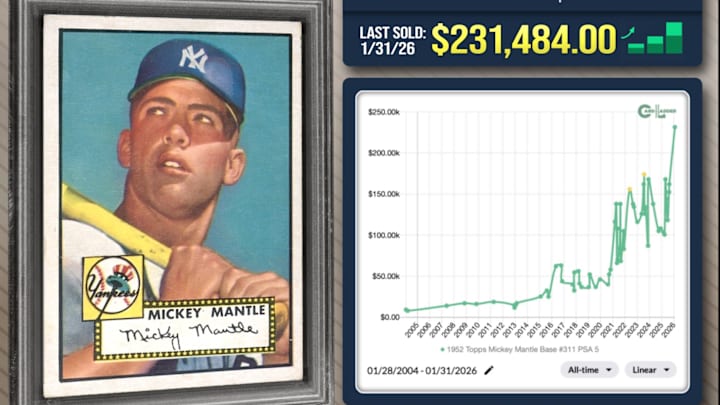
12-Month Performance of the 1952 Topps Mickey Mantle (PSA 5): +112%
Long-Term Rise: In the mid-2000s, PSA 5 copies of the card could often be found for roughly $15,000 to $20,000. Prices began climbing steadily throughout the 2010s, with PSA 5 copies approaching $40,000 to $60,000 by the middle of the decade. The market accelerated dramatically during the early 2020s hobby boom, and today PSA 5 examples regularly sell for over $200,000. Much of that growth has come in the past year alone, as collectors and investors increasingly compete for the most iconic “blue-chip” cards in the hobby.
Long-Term Strength: Some collectors have speculated that Mantle’s popularity could fade as the generation that watched him play grows older. Yet the continued demand for this card suggests otherwise. The 1952 Mantle has become the hobby’s ultimate trophy card, and it is instantly recognizable even to people who aren't collectors.
Only three PSA 10 copies of the 1952 Topps Mickey Mantle are known to exist. While PSA 5 examples are often used as a pricing benchmark for the card, a PSA 10 Mantle would become the most expensive trading card ever sold if it reached the open market. Some speculate that it would sell for more than $35 million. Arizona Diamondbacks owner Ken Kendrick owns one of the PSA 10 copies.
Scarcity in higher grades also reinforces the card’s long-term strength. Of the 1,681 copies graded by PSA, only 302 have received a grade above PSA 5. For many collectors, PSA 5 represents a sweet spot as still relatively attainable while maintaining strong eye appeal. At the top of the market, PSA 8 examples have sold for more than $1 million.
Shohei Ohtani vs. Silver

12-Month Performance of Silver: +168%
12-Month Performance of the 2018 Bowman Chrome Shohei Ohtani Rookie Card (PSA 10): +373%
Long-Term Rise: When Shohei Ohtani debuted in 2018, PSA 10 copies of his 2018 Bowman Chrome rookie could often be purchased for around $20. Prices climbed gradually as Ohtani proved himself as one of the game’s best players ever, reaching roughly $1,000 by early 2025. Over the past 12 months, however, the market has accelerated dramatically. PSA 10 copies are now selling for around $4,500, even despite the fact that the card is not rare. PSA has graded over 9,000 copies, including more than 5,000 PSA 10s. Ohtani’s global popularity has created demand that far exceeds the available supply, even for his common rookie cards.
Long-Term Strength: This card continues to attract strong demand because it has become one of Ohtani’s most recognizable rookie cards. The hobby has long shown that flagship rookie cards can carry enormous value regardless of print run (the 1986 Fleer Michael Jordan remains one of the most valuable base cards ever produced despite having a PSA population count of over 47,000). While some collectors consider Ohtani’s Topps Chrome rookie his true flagship card, many prefer the batting image on the 2018 Bowman Chrome version.

Ohtani’s global appeal also strengthens the card’s long-term outlook. Widely regarded as Japan’s most popular athlete, "Shotime" has a massive fan base in a country of roughly 125 million people. Additionally, Ohtani is still just 31 years old, which means he has plenty of time to add to an already remarkable résumé that includes four MVP awards and two World Series championships.
Babe Ruth vs. Dow Jones

12-Month Performance of the Dow Jones: +13%
12-Month Performance of the 1933 Goudey Babe Ruth (PSA 3): +67%
Long-Term Rise: In the early 2010s, PSA 3 copies of the 1933 Goudey Babe Ruth #144 could be found for $2,000 to $3,000. Prices climbed steadily throughout the late 2010s as interest in pre-war baseball cards grew, eventually reaching the $5,000 to $8,000 range. The hobby boom of the early 2020s pushed the card even higher, with PSA 3 copies now regularly selling for around $20,000. PSA has graded more than 1,700 copies of the card, but only 544 of these Ruth cards have graded better than a PSA 3. Over the past 365 days, the card has surged significantly, jumping from the low-teens range to around $20,000 as collectors continue the most iconic Babe Ruth card of all time.
Long-Term Strength: The 1933 Goudey set itself is historically significant, as it is the first mainstream baseball card set distributed in packs with pieces of bubble gum. Among the four different Babe Ruth cards in the set, the #144 card featuring Ruth’s iconic full-body pose has become the most recognizable version. Despite not being Ruth’s rarest or most expensive card, the 1933 Goudey #144 has become his most iconic.

For many collectors, owning a Babe Ruth card released during his playing days is an ultimate “flex” within the hobby. Interestingly, despite Ruth’s legendary status as arguably the greatest baseball player of all time, this card often sells for less than many of Mickey Mantle’s most famous cards, suggesting there may still be room for growth as collectors continue targeting the most historically significant cards.
Jackie Robinson vs. S&P 500

12-Month Performance of the S&P 500: +17.6%
12-Month Performance of the 1948 Leaf Jackie Robinson Rookie Card (PSA 4): +100%
Long-Term Rise: In the early 2010s, PSA 4 copies of the Jackie Robinson rookie card could often be found for less than $1,000. Prices climbed throughout the late 2010s and early 2020s as demand for iconic rookie cards increased, with PSA 4 copies eventually moving into the five-figure range. PSA has graded roughly 1,600 copies of the card across all grades, with only around 500 of the cards earning higher than a PSA 5. Over the past 365 days, the card has surged significantly, jumping from roughly $12,000 to about $25,000.

Long-Term Strength: Jackie Robinson remains one of the most important figures in American sports history, and his first mainstream baseball card represents his historic breaking of Major League Baseball’s color barrier. That historical significance, combined with Robinson’s lasting impact on both baseball and American society, continues to support strong long-term demand among collectors. For many hobbyists, owning a Jackie Robinson rookie is not just about baseball. It represents owning a piece of American history.
 Add us as a preferred source on Google
David is a collector based in Georgia and a lifelong fan of the New York Yankees, New York Giants, and New York Knicks. He is an avid sports card collector with a strong passion for vintage baseball cards and vintage on-card autographs. David enjoys obtaining autographs through the mail and loves connecting with other knowledgeable collectors to discuss the history and evolution of the hobby. He also previously wrote about the New York Giants for GMENHQ.com