%20%20--%3E%0A%3Csvg%20version%3D%221.1%22%20id%3D%22Layer_1%22%20xmlns%3D%22http%3A%2F%2Fwww.w3.org%2F2000%2Fsvg%22%20xmlns%3Axlink%3D%22http%3A%2F%2Fwww.w3.org%2F1999%2Fxlink%22%20x%3D%220px%22%20y%3D%220px%22%0A%09%20width%3D%2239px%22%20height%3D%2240px%22%20viewBox%3D%220%200%2039%2040%22%20enable-background%3D%22new%200%200%2039%2040%22%20xml%3Aspace%3D%22preserve%22%3E%0A%3Cpath%20fill%3D%22%23FFFFFF%22%20d%3D%22M38.5%2C7H28.2v26h10.3V7z%22%2F%3E%0A%3Cpath%20fill-rule%3D%22evenodd%22%20clip-rule%3D%22evenodd%22%20fill%3D%22%23FFFFFF%22%20d%3D%22M26.1%2C25.5c0%2C5.8-4.1%2C7.5-12.9%2C7.5C3.9%2C33%2C0%2C31.2%2C0%2C25.2v-1.1h11.6%0A%09v2.4c0%2C0.7%2C0.1%2C1.4%2C1.2%2C1.4c1%2C0%2C1.2-0.4%2C1.2-1.3v-0.9c0-1.6-0.9-1.6-3.5-2.2C2.2%2C21.7%2C0%2C19.7%2C0%2C15.3v-0.9C0%2C9.3%2C5.5%2C7%2C12.9%2C7%0A%09c10.2%2C0%2C12.8%2C2.6%2C12.8%2C7.4v1.8h-11v-2.9c0-0.6-0.4-1.1-1.2-1.1c-0.6%2C0-1.2%2C0.4-1.2%2C1.1v0.9c0%2C1.5%2C0.9%2C2%2C3.3%2C2.5%0A%09c8%2C1.6%2C10.5%2C3.3%2C10.5%2C7.5V25.5z%22%2F%3E%0A%3C%2Fsvg%3E%0A)
An All-Access Look at UIC’s 20-Hour Sprint Aiming for a NCAA Tournament Bid
In this story:
Sudden.
You could find all sorts of adjectives to describe the pressure-packed life of chasing an NCAA tournament berth in a one-bid conference during March, but none feel more apt than sudden.
One moment, you’re slapping your school’s name on a bracket to roars in a locker room bound together by months of sweat equity. The next, you’re poring over film cutups of baseline out-of-bounds plays from six weeks ago against an opponent you may or may not even play. The time to celebrate or soak in the moment simply doesn’t exist. Conference tournament life brings unquestionable highs and unspeakable lows, often under 24 hours apart. And nothing is more sudden than the final buzzer, the sound that ends seasons, shuts down dreams and, in some cases, brings playing careers to a close.
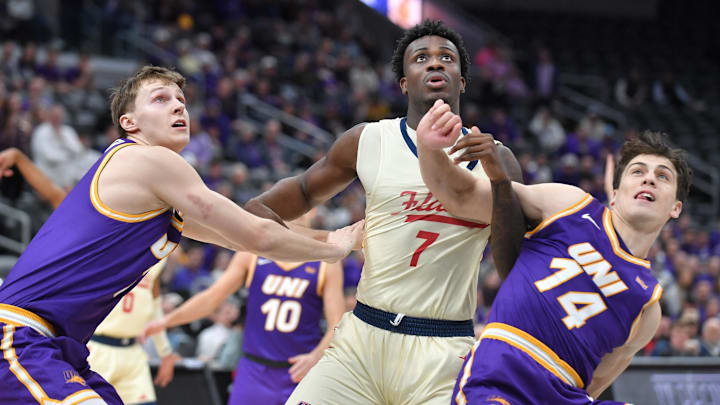
For a taste of that suddenness, Sports Illustrated embedded inside the UIC Flames’ program for the 20-hour sprint from winning their Missouri Valley tournament semifinal matchup with Drake to playing for a spot in the Big Dance against Northern Iowa in the conference title game. Here is an all-access look at the thrill, cruelty and everything in between of chasing a March dream and all the behind-the-scenes work that goes into it.
The buzzer sounded Saturday afternoon at 4:25 p.m. CT. This was a euphoric buzzer for the Flames, with freshman Andy Johnson getting to dribble the ball on the right wing to close a 72–51 victory over Drake. UIC had advanced in rather dominant fashion for the second time in as many days, and the program was officially 40 minutes from its first NCAA tournament in more than 20 years.
Six minutes later, head coach Rob Ehsan charged into the locker room, flanked by sons Davis and Ryder, fists pumping repeatedly into a rowdy mob of players. In his brief speech to the team, he left them with two critical points:
- “We get to be together for another day.”
- “All that matters now is rest.”
On the first: This was, by any measure, a team not supposed to be here. UIC started the season 5–10 overall and 0–4 in MVC play. It at one point lost eight straight Division I games. Ehsan is only 10 weeks or so removed from telling his team to treat a post-Christmas game during that slump against Division III Illinois Tech like a Final Four matchup, trying anything to boost focus and morale. If he and his players believed at that point they’d play for a spot in the Big Dance, they were the only ones.
But from that point, his team engineered a remarkable in-season turnaround. Once they finally notched a D-I win (their first in six weeks) against Southern Illinois, they got on a roll, at one point winning eight straight and charging toward the top of the standings. What had once been a lost season instead became UIC’s best in over two decades, finishing a game out of second in the MVC and knocking on the door of the top 100 nationally. Through it, they carried remnants of that Illinois Tech speech from Ehsan with them, taping postcards to their lockers before every game with a picture of the Final Four court and a simple message: 1–0. Vibes were high—another day and another game with a group like this was to be cherished. One more 1–0 would send them dancing.
On the second: There was little time for celebration. The championship game was set to tip at 11 a.m. Sunday. Take an hour away overnight with clocks changing for daylight saving time, and the countdown was on. Tip-off was a tick over 17 hours away. Players hopped on the bus immediately to get back to the team hotel, coaches grabbed laptops and headed back out to the court to watch Bradley and Northern Iowa face off in the second semifinal.
Fewer than 30 minutes after celebrating the win, four assistant coaches (David Berkun, Kevin Devitt, Ryan Davis and Kevin Zabo) were buried in their laptops courtside frantically combing through film to build plans for either opponent, looking something like college students cramming for a final. Berkun sifted through offensive clips from previous matchups with Bradley and Northern Iowa, with analytics at the ready of how efficient each play call had been. Devitt and Davis split up the defensive scouting: Devitt on Bradley, Davis on Northern Iowa. Zabo prepped personnel reports to present to the team later that night, highlighting tendencies, strengths and weaknesses. Outside of a halftime break to scarf down pasta and salad in the media room, the next two hours are a frenzy of film cutups, KenPom and Hoop Explorer analytical queries and note-taking on newfound tendencies as Northern Iowa pushes toward the finish line.

Plans were simultaneously hatched for the rest of the night for the players. The bathtubs in two of the team’s hotel rooms (athletic trainer Danielle Colegrove and grad assistants Avery Brossart and Grey Hoffman) are loaded up with buckets full of ice for recovery baths for main rotation players. A Chipotle order is placed for 8 p.m. delivery to the hotel for late-night fuel. The team will stretch, then meet at 8:30 p.m. to go over the defensive plan. Then, they are set free for the night after some pleading by staff to get to sleep as early as possible.
But the big debate, one that bleeds into a 7:30 p.m. staff meeting back at the hotel: When should the players wake up? Director of sports performance Mike Schweigert says those eating a full breakfast need to be eating by 8 a.m. For a lighter bite, they can stretch to 8:30-ish. They debate taking players’ phones overnight, but settle on allowing them to maintain a more normal routine. “Familarity breeds confidence,” Berkun says. The compromise is 10 p.m. room checks to make sure guys are winding down, with another reminder to get away from the phones and get rest.
The rest of the staff meeting is built around aligning on the game plan. Ehsan peppers the assistants with questions, challenging the offense (Berkun) and defense (Davis) on what went right, wrong and what could be different from the first two meetings with Northern Iowa. It’s part memory refresher, part interrogation.
How well did we handle their short rolls? What happened when we switched screens? UNI’s defense is aggressive in gaps: How can we create more space?
Around 8 p.m., a game plan is largely in place. Ehsan yawns, checks his phone and chuckles at a group text of his old staff at UAB reminding Devitt (also a member of that staff) to eat something. By Saturday night of conference tournament week, everyone is in a fog, fueled by adrenaline, hotel coffee and the occasional energy drink. Coaching “injuries” can even pop up: Devitt at one point joked of shoulder pain from repeatedly wheeling his arm to urge the team to get back on defense.
“You don’t even know what day it is anymore,” Ehsan says.
The 8:30 film session is defense and personnel-focused, with Davis and Zabo presenting. Offense will come in the morning. It’s fast moving: No more than 25 or so total plays are clipped, a mix of some of Northern Iowa’s commonly run set plays and five-out spacing concepts that Davis talks through. Zabo goes player by player with reminders of what they do well. Tristan Smith, who didn’t play in the last meeting, loves to shot-fake and drive. Trey Campbell, the Northern Iowa point guard?
“The two times we’ve played them, he has cooked us,” Zabo says.
Ehsan gets the last word in.
“Eat, then go to bed. Tell your friends and family we’ll celebrate afterwards.”
Sports Illustrated’s Championship Sunday with the Flames begins at 8:01 a.m, running into the precocious freshman Johnson on the staircase to the team’s second-floor meeting room.
“Wake the f--- up, let’s go!” he barks with a smile.

A few players look a bit sleepy (one even overslept and missed the 7:15 shootaround for low-minute players), but spirits are high. A quick pulse check of the coaching staff suggests they failed to heed their own advice on sleep: four to five hours seems to have been the sweet spot. A floor below, buzz is building in the lobby as fans decked out in red and blue pile in. It’s a big-game feel that a team that throughout January regularly had only several hundred fans at home games isn’t quite accustomed to. In the elevator down to a 9:15 a.m. offensive film session, fewer than two hours before what could be his final college basketball game, senior Sam Silverstein gets asked for a selfie by a pair of Flames fans. And that pales in comparison to the full send-off to the bus a few minutes later, loaded with high fives and hugs. For a day at least, the Flames are rock stars.
The team bus backs down into the arena at 9:35 a.m., some 15 hours since it left yesterday. Hoffman, who has been there since the early shootaround setting up the locker room and is working on extremely limited sleep, is there to greet them, energetic as ever.
“Bus full of motherf---ing killers!” Hoffman shouts.
The final bit of film is shown to the team via projector in the locker room, 42 minutes before introductions start. It’s a run-through of how they’ll defend Northern Iowa’s baseline out-of-bounds plays. Preparation is complete. Since last night, the players have watched around 60 plays across three short sessions: 25 offense, 25 defense and 10 special situations. The process has been heavily condensed from a traditional week with multiple days of practice to prepare. No small groups drilling specific actions on the scout team or getting to constantly teach and reteach. As Devitt says, it’s all about habits in a short prep like this: Film will remind players of tendencies and emphasize some key principles, but these conference tournament games are a lot more about doing what you do best well and making on-the-fly adjustments as the game goes on. They’re also about effort, physicality and how much you have left in the tank after playing for days on end. Northern Iowa had to play a third game to get here, so UIC is hopeful it’d have the edge there.
“I’m tired of hearing about how physical they are!” Ehsan says in his final message to the team. “Hit somebody. Hard!”
In game, the biggest challenge of single-elimination basketball is figuring out just how reactive to be. Northern Iowa blitzed UIC with a 9–2 start that prompted an Ehsan timeout. The first bucket came off Smith’s patented shot-fake (the same one they had warned of 13 ½ hours before), prompting an Ehsan reminder to the bench. Northern Iowa’s offense was on fire all first half, scoring 48 points in hyper-efficient fashion after scoring 60 and 61 points in two full games vs. UIC in the regular season. UIC felt pretty good about how it had defended in “short roll” situations (a critical part of Northern Iowa’s offense), but the Panthers had been surgical hitting skip passes for threes after UIC spent much of its scouting focus on protecting the paint.
The halftime debate that emerged in the coaches’ locker room: Stick with what we’ve done if we like the process and not the result, or make more significant changes. When you have 20 minutes to save your basketball life, you can’t necessarily afford to bet on the law of averages to kick in. The decision was to lean into switching. One of UIC’s strengths all season had been its defensive versatility, and going to its switching coverage late in the game in the last meeting helped swing the game for the Flames. Clean up some defensive fundamentals (better closeouts on shooters, for instance) and they liked their odds.
“Believe in the stupid stuff we’ve taught all year,” Ehsan says, addressing the team.
For a stretch, that worked. UIC got more stops and kept chipping away at the Northern Iowa lead, from seven to five, then to two. But each push came with a response from Campbell, Northern Iowa’s senior star who was cooking the Flames for a third time. His three on the ensuing possession after UIC freshman Rashund Washington Jr. cut the deficit to 56–54 may have been the biggest shot of the game. Washington tried to answer quickly but it was an air ball, and Northern Iowa took the saved rebound and hunted a three in transition.
Bang.
2H | 11:54
— UIC Men's Basketball 🔥🏀 (@UIC_MBB) March 8, 2026
Rashund Washington Jr. 3⃣
🔥 54
🐈⬛ 59
📺 (CBS) https://t.co/MG6kWwLTBC
📻 https://t.co/YCIif3hviC
📊 https://t.co/kP5zTl9Uir#ChicagosCollegeTeam | #BeLegendary pic.twitter.com/XEGPoKrJFf
There was still 11:26 to go, but that swing felt like an early dagger with the Northern Iowa lead extending to 11 shortly thereafter. UIC got the deficit down to six, but there was Campbell again with another back-breaking three. It was his, and Northern Iowa’s, day.
Reality never sets in as quick as it probably should in these moments, but there’s a point in every game like this where the bench collectively realizes no amount of last-ditch pressing or a three-point barrage can save them. Towels go over heads. Faces buried in hands. Eyes well up with tears. No more jokes over hotel scrambled eggs or dreams of March Madness. It’s an abrupt, sudden end.
Among the most emotional in the closing seconds was Silverstein, part of the glue that holds the 2025–26 Flames together. A Chicago area native, he started his college basketball journey with his freshman season at Harvard getting canceled due to COVID-19. He graduated four years later with a degree in applied mathematics, transferred to California Baptist for a year, then came back to Chicago for his final season of college basketball with the Flames. If UIC doesn’t get a postseason invite (they’re likely on the bubble for NIT selection), it might be the last competitive basketball game he ever plays.

Ehsan said in his postgame news conference that players had tears in their eyes “for the right reasons.” This was a team that wasn’t ready for the ride to be over, a group with a powerful connection forged through hitting rock bottom two months before. They weren’t ready to face the reality of coming up 15 points short of a goal most of them had dreamed about. Maybe most of all, they weren’t ready to not be together for another day.
And so began the 296-mile bus trip home, a slow, mindless end to a whirlwind 27 hours, pulling back into campus to a greeting from a few supporters around 7 p.m. It may not have been easy to sleep Sunday night, but Silverstein, in particular, will need the rest. On Monday, fewer than 24 hours after he was taking selfies with fans and playing on CBS for a spot in the Big Dance, he had a job interview at Goldman Sachs.
More College Basketball from Sports Illustrated
Listen to SI’s college sports podcast, Others Receiving Votes, below or on Apple and Spotify. Watch the show on SI’s YouTube channel.
 Add us as a preferred source on Google
Kevin Sweeney is a staff writer at Sports Illustrated covering college basketball and the NBA draft. He joined the SI staff in July 2021 and also serves host and analyst for The Field of 68. Sweeney is a Naismith Trophy voter and ia member of the U.S. Basketball Writers Association. He is a graduate of Northwestern University’s Medill School of Journalism.
Follow CBB_Central