%20%20--%3E%0A%3Csvg%20version%3D%221.1%22%20id%3D%22Layer_1%22%20xmlns%3D%22http%3A%2F%2Fwww.w3.org%2F2000%2Fsvg%22%20xmlns%3Axlink%3D%22http%3A%2F%2Fwww.w3.org%2F1999%2Fxlink%22%20x%3D%220px%22%20y%3D%220px%22%0A%09%20width%3D%2239px%22%20height%3D%2240px%22%20viewBox%3D%220%200%2039%2040%22%20enable-background%3D%22new%200%200%2039%2040%22%20xml%3Aspace%3D%22preserve%22%3E%0A%3Cpath%20fill%3D%22%23FFFFFF%22%20d%3D%22M38.5%2C7H28.2v26h10.3V7z%22%2F%3E%0A%3Cpath%20fill-rule%3D%22evenodd%22%20clip-rule%3D%22evenodd%22%20fill%3D%22%23FFFFFF%22%20d%3D%22M26.1%2C25.5c0%2C5.8-4.1%2C7.5-12.9%2C7.5C3.9%2C33%2C0%2C31.2%2C0%2C25.2v-1.1h11.6%0A%09v2.4c0%2C0.7%2C0.1%2C1.4%2C1.2%2C1.4c1%2C0%2C1.2-0.4%2C1.2-1.3v-0.9c0-1.6-0.9-1.6-3.5-2.2C2.2%2C21.7%2C0%2C19.7%2C0%2C15.3v-0.9C0%2C9.3%2C5.5%2C7%2C12.9%2C7%0A%09c10.2%2C0%2C12.8%2C2.6%2C12.8%2C7.4v1.8h-11v-2.9c0-0.6-0.4-1.1-1.2-1.1c-0.6%2C0-1.2%2C0.4-1.2%2C1.1v0.9c0%2C1.5%2C0.9%2C2%2C3.3%2C2.5%0A%09c8%2C1.6%2C10.5%2C3.3%2C10.5%2C7.5V25.5z%22%2F%3E%0A%3C%2Fsvg%3E%0A)
If You Want to Beat Texas, You Have to Stop Madison Booker First. Good Luck.
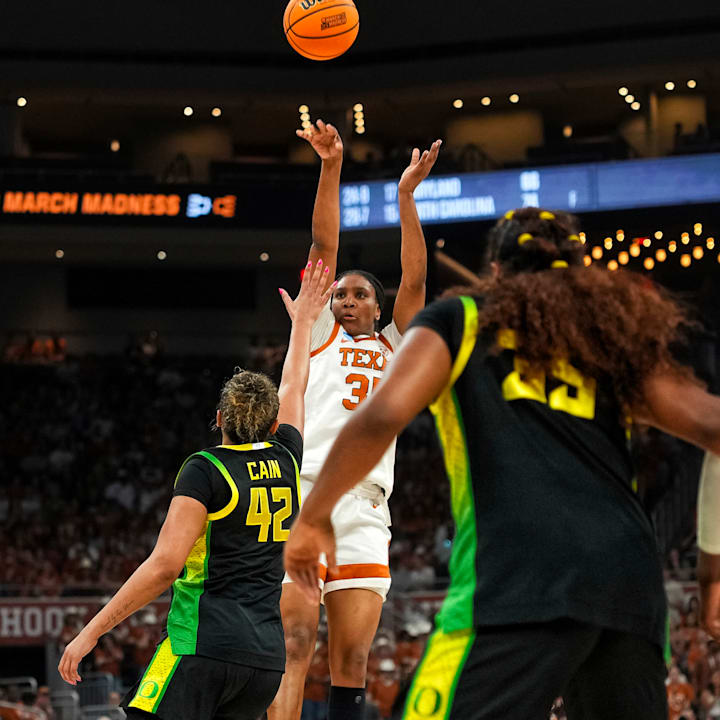
The first thing you have to understand, when you try to guard Texas star Madison Booker, is that you can’t. This can be frustrating at first, but it is also liberating, and it allows you to focus on the only strategy that works against Booker: plug her ears.
You want her to forget that South Carolina coach Dawn Staley called her “a big guard that can pretty much get her shot off at any given time.” Or that Ole Miss coach Yolett McPhee-McCuin called her “God's gift.” And whatever you do, do not let her listen to her own coach, Vic Schaefer: “I don’t care if a post player switches off of you or not. Go at them and finish them off at the rim. They can’t do anything with you anyway.”
As Texas, UConn, South Carolina and UCLA prepare for the sequel to last year’s Final Four, guarding Booker remains Mission: Impossible. If you are shaking your head because you remember South Carolina smoking the Longhorns in Tampa last April, then you don’t actually remember it that well.

Texas jumped out to a 12–4 lead in that game. Staley said later that “Madison Booker was doing a great job coming off screens and elevating and making shots. She was in a rhythm. It wasn’t like she was getting wide-open looks.” South Carolina’s big “adjustment” was that Booker got in foul trouble. With Booker on the floor in the first half, Texas outscored South Carolina 19–11. With Booker on the bench, South Carolina outscored Texas 27–16.
Texas guard Rori Harmon said later that with Booker out, “We were a little shook up.” It is no excuse for how Texas played in the third quarter, when the Gamecocks started to pull away. But it might be a bit of an explanation.
The Longhorns don’t shoot many threes or run a deceptively unconventional offense. After Texas whipped UCLA in November, Bruins coach Cori Close said, “They are a really simple team, but they are incredibly disciplined and tough.” Schaefer just wants his players to play hard, play smart and take good shots, or as he calls them in Booker’s case: shots.
“I’ve seen them all go in,” he says. “I’ve seen some of the toughest shots you can take go in. Some people might think, Oh man, that might be a tough shot. I’ve seen them all go in. Madison can make them all.”
In three years of coaching Booker, has Schaefer ever told Booker she took a bad shot?
He thinks.
“We’ve talked about … you know …”
He laughs.
“No. The answer is no. I don’t think I’ve ever told her, ‘Don’t do that,’ or, ‘Don’t shoot that.’ ”
Sometimes, Schaefer thinks Booker takes a good shot when a better one is available: “You pulled up and took a 15-footer and you could have gone all the way to the rim.” But that is not the same as saying she took a bad shot.
Booker does not stretch the floor like Caitlin Clark, cover it like Hanna Hidalgo, or tower over opponents like Lauren Betts. She is 6'1", tall but not that tall, and she prefers twos to threes. Theoretically, every major college team has a player who can physically match up with her. But Booker is stronger than Clorox, quicker than Venmo and smoother than jazz.
Calling Booker unguardable seems as hyperbolic as calling an athlete “immortal.” But Schaefer means it: “You just can’t get to her. You can’t get to her jump shot. You can’t get to her when she’s finishing at the rim.” He implores Booker: “Take it at them. There’s not anybody [who is] going to block your shot.”

This season, Booker played eight games against players who finished in the top 25 in the country in blocked shots. She took 99 shots in those games. Those shot blockers blocked three of them—and two of those actually prove Schaefer’s point.
Against Ole Miss in the regular season, Booker settled for a fadeaway rather than drive to the basket against the Rebels’ 6'4" Latasha Lattimore. Lattimore blocked the fadeaway. In that same game, Booker tried to power through Lattimore near the hoop. She drew a heavy contact, but not a foul, because Lattimore held her position and Booker rammed into her arm. Lattimore got a hand on the shot. Booker scooped up the ball and scored anyway.
There are more great players in the women’s game than ever before. Booker leads the nation in Coaching Shrugs Caused. Illinois coach Shauna Green said, “We had some great possessions defensively. She just rises up and shoots over you.” Staley said last year that ,“You have to [guard her with] one and a half players.” Before Texas’s second-round game against Oregon this NCAA tournament, Ducks coach Kelly Graves said of Longhorns guard Rori Harmon: “She’s the one that makes ’em go.” The next day, Booker made 14 of 21 shots and put up 40 points, eight rebounds, five assists, two steals, and—
“Zero turnovers,” Booker said afterward, her coach at her side.
“Zero turnovers,” Schawfer repeated. “I mean, come on. That is special.”
Graves meant no offense to Booker when he complimented Harmon. In some ways, especially defensively, Harmon does make the Longhorns go. So why did Booker score 40?
“Because she’s really damn good,” Graves said. “There’s nothing she can’t do. We just don’t have anybody physically that can match up with her.”
MADISON BOOKER CROSSOVER 🔥 pic.twitter.com/9HHVRJYFD1
— ESPN (@espn) March 31, 2026
Booker is way too quick for big defenders and way too strong for quick ones. In her freshman year, Texas’s last in the Big 12, Booker played primarily at point guard and finished third in the league in assists. Now she is listed as a forward. Schaefer says she has a “pro body. She’s got a pro frame.”
So what can teams do to slow her down? Fouling her is almost always a mistake: Booker is an 85% free-throw shooter. Staley has said South Carolina tries to force Booker to defend, so she will be tired when she elevated for fourth-quarter jumpers. But after Texas beat South Carolina in this year’s SEC tournament, Staley said, “When her shot is going like that, they are a real difficult team to beat.”
The story of Texas’s season, the one that will become legend if the Longhorns win the title, is that after a 16-point loss to Vanderbilt in February, Schaefer blasted his players for having “no heart” and said they were the “softest” team he had ever coached. The Longhorns have won 12 straight since then, and Schaefer now gushes endlessly about them.
But if Texas wins the title, reason No. 1 will be Madison Booker. She is this team’s weathervane. When Texas played UCLA in November, Booker had 13 points in the first half and the Longhorns built a 20-point lead. In the first 12 minutes of the second half, Booker shot one three, one two and one free throw. UCLA cut Texas’s lead to 10.
“She just enjoys the pass as much as the shot,” Schaefer says. “Sometimes she’s so unselfish—to a fault.”
Schaefer has tried to get Booker to understand: In her case, shooting is unselfish. Scoring helps the team, obviously, but also, when she shoots: “It doesn’t only open up for me, but open up for my teammates, too,” she says.

Three days before that loss to Vanderbilt, Texas beat a good Kentucky team, 64–53. But Booker took only six shots. Schaefer was appalled.
“I’m like, ‘That can never happen again. There’s just no way,’ ” Schaefer said. “I just told her, she’s coming down in transition: ‘Man, you gotta be hunting.’ I get it. She’s such a great teammate. She’s so unselfish. But sometimes I need her to be a little selfish. You gotta go get yours. Especially in transition: She’s a tough matchup coming downhill. You gotta be hunting your shot. You can’t always be wanting to cede to somebody else.”
Since that Kentucky game, Booker has averaged 20.5 points on 58% shooting. Nobody has stopped her. Nobody can. She is playing the best basketball of her career, her coach gave her the most hilariously simple directive in the sport’s history:
“The core progress,” Booker says, “is ‘score more.’ ”
More March Madness from Sports Illustrated
 Add us as a preferred source on Google
Michael Rosenberg was a senior writer for Sports Illustrated, covering any and all sports. He writes columns, profiles and feature stories and has covered almost every major sporting event. He joined SI in 2012 after working at the Detroit Free Press for 13 years, eight of them as a columnist. Rosenberg is the author of “War As They Knew It: Woody Hayes, Bo Schembechler and America in a Time of Unrest.” Several of his stories also have been published in collections of the year’s best sportswriting. He is married with three children.
Follow rosenberg_mike