%20%20--%3E%0A%3Csvg%20version%3D%221.1%22%20id%3D%22Layer_1%22%20xmlns%3D%22http%3A%2F%2Fwww.w3.org%2F2000%2Fsvg%22%20xmlns%3Axlink%3D%22http%3A%2F%2Fwww.w3.org%2F1999%2Fxlink%22%20x%3D%220px%22%20y%3D%220px%22%0A%09%20width%3D%2239px%22%20height%3D%2240px%22%20viewBox%3D%220%200%2039%2040%22%20enable-background%3D%22new%200%200%2039%2040%22%20xml%3Aspace%3D%22preserve%22%3E%0A%3Cpath%20fill%3D%22%23FFFFFF%22%20d%3D%22M38.5%2C7H28.2v26h10.3V7z%22%2F%3E%0A%3Cpath%20fill-rule%3D%22evenodd%22%20clip-rule%3D%22evenodd%22%20fill%3D%22%23FFFFFF%22%20d%3D%22M26.1%2C25.5c0%2C5.8-4.1%2C7.5-12.9%2C7.5C3.9%2C33%2C0%2C31.2%2C0%2C25.2v-1.1h11.6%0A%09v2.4c0%2C0.7%2C0.1%2C1.4%2C1.2%2C1.4c1%2C0%2C1.2-0.4%2C1.2-1.3v-0.9c0-1.6-0.9-1.6-3.5-2.2C2.2%2C21.7%2C0%2C19.7%2C0%2C15.3v-0.9C0%2C9.3%2C5.5%2C7%2C12.9%2C7%0A%09c10.2%2C0%2C12.8%2C2.6%2C12.8%2C7.4v1.8h-11v-2.9c0-0.6-0.4-1.1-1.2-1.1c-0.6%2C0-1.2%2C0.4-1.2%2C1.1v0.9c0%2C1.5%2C0.9%2C2%2C3.3%2C2.5%0A%09c8%2C1.6%2C10.5%2C3.3%2C10.5%2C7.5V25.5z%22%2F%3E%0A%3C%2Fsvg%3E%0A)
Inside AJ Dybantsa’s Bold Decision to Try to Lift BYU Basketball to Historic Heights
High up in the rafters of the Marriott Center is a large, empty space between a pair of Naismith Hall of Fame banners. Just five retired numbers flank the two dark blue emblems celebrating the induction of BYU head coach Stan Watts, who led the team from 1949 to ’72, and former star player Kresimir Cosic, who graduated in 1973.
Nestled under a picturesque mountain backdrop, the nondescript building that Watts and Cosic are said to have helped build is a place full of history—just not all of it distinguished. The Cougars sit firmly atop the list of programs with the most NCAA tournament appearances without having made it to the Final Four. And it takes some creative accounting, with all due respect to Converse Yearbook fourth-teamers, to find the 27 players who earned some form of an All-American nod in more than a century’s worth of play.
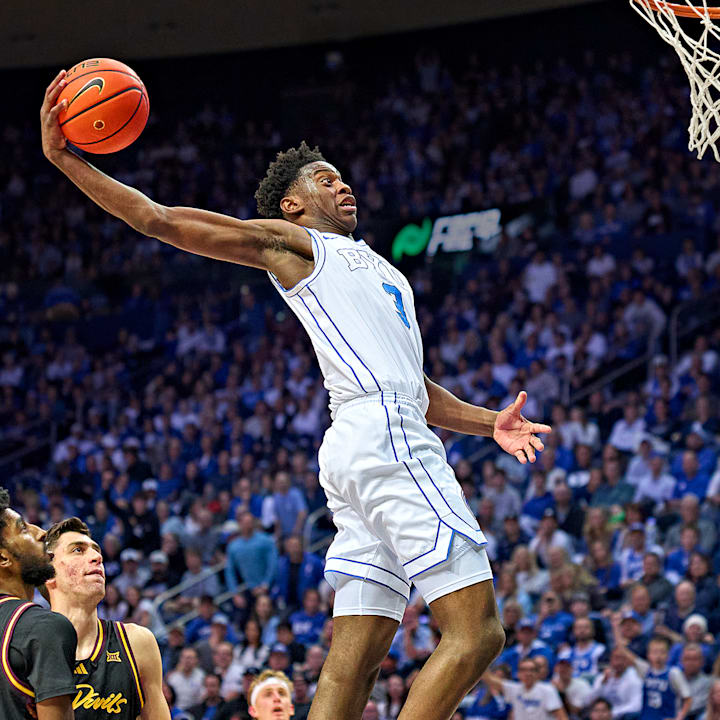
It is here, between the two banners, that freshman AJ Dybantsa aims to fill the emptiness.

Perhaps another Hall of Fame banner raised smack dab in the middle of the two existing ones. A colorful Final Four logo hung for the first time. Or a few more years down the line, a white No. 3 hanging alongside the numbers of Cosic, Danny Ainge, Mel Hutchins, Roland Minson and Jimmer Fredette.
Dybantsa speaks suavely about such aims, with a type of self-assurance that most top talents have learned to foster over the years, straddling the line between lofty confidence and arrogance. What’s different about Dybantsa, though, is simply that he’s doing so in Provo, Utah.
“If I’m being completely honest, I didn’t envision myself being at BYU. I didn’t think I was going to be in Utah [this season], so I thought the college experience was going to be different,” the Massachusetts native says from one of the few chain restaurants open on Sundays in town. “In the back of my mind, it was like, Do I want to be historic and bring this team to a place they’ve never been? Or do I, I don’t want to say be another guy, but if I went to another school [which] had numerous top picks, you would just fall into certain categories.
“It was unique to me, and I’ve been taking the unique route my whole life.”
That’s one way of describing a grand basketball experiment with few parallels in modern college sports: A Catholic kid from outside of Boston playing at a Mormon school in a state with one of the lowest percentages of Black residents in the country.
It’s not often a top prospect like Dybantsa winds up going all-in, as he has, on BYU—a place that is donned in blue but far from the blueblood programs that he considered like Kansas or North Carolina.
BYU, too, is all in on Dybantsa, the No. 1 prospect of the 2025 class. He’s known for his 7-foot wingspan, his elusiveness with the ball, the way he dominates in transition and how he shines offensively in the midrange. He arrived in Provo thanks to the confluence of the school’s move to the hard-nosed Big 12; a shifting landscape for player compensation that makes such avenues appealing; and an energetic coach whose experience courtside in the NBA has carried over to the program he runs in college.
“AJ is not in this for the money, he’s in it because he loves basketball,” says Cougars coach Kevin Young, a former 76ers and Suns assistant. “I think people oftentimes don’t understand that, not just with AJ but in general. Athletes are athletes because they love the sport they play. That’s why they got into it in the first place. The money follows because you’re good enough and people are going to pay you what you’re worth. It doesn’t faze him, because that’s not why he does this.”
The insistence that money isn’t everything is the external narrative that Dybantsa pushes back at most. He doesn’t touch his earnings, which are being carefully managed behind the scenes by his dad, and still relies mostly on an allowance from his parents that is not much more than what his two sisters receive (Dybantsa is the middle of three kids). He is completely unassuming, aside from the 6' 9" frame that sticks out even in the school-issued sweatshirt and flip-flops that are de rigueur on campus as he shuffles between classes, the BYU practice facility and a nearby apartment complex he shares with teammates.
Further proof he’s unassuming: He tools around the sleepy, wide-open streets of Provo not in a Mercedes-Benz G-Wagon, but rather in a disproportionately small Audi sedan, which the 19-year-old only started driving after recently getting his license.
“It had nothing to do with money. There’s all this, ‘Well, BYU gave him the bag.’ Puh-lease,” remarks AJ’s father, Anicet “Ace” Dybantsa, who is thankful that the large Uber bills he was footing and his own chauffeuring duties have subsided in tandem this winter. “We told all seven [finalists], ‘This is the minimum wage that we’re asking. If you don’t have it, we are not going to even bother coming to your school or wasting your time or our time.’ All seven said they had it, a couple schools had more. We never told [AJ] how much we were asking because we didn’t want money to influence his decision.
“BYU knows they got him at a good deal.”

Ace delivers this with a half-smirk and never directly addresses reports that such a figure hovered around $5 million from the school and local boosters for this season. Nor does he have to in an age when such compensation remains closely guarded by all involved. And there’s plenty more coming in the door, thanks to endorsement deals with Nike, Red Bull and others signed even before the family arrived in town.
Early in the recruitment process, Dybantsa didn’t have the school on his short list of potential destinations. He whittled down the contenders to those one might expect of a kid who was named his home state’s Gatorade Player of the Year as a ninth-grader. But BYU kept popping up when evaluating the pillars, as he termed them, that he was looking for in a program: a winning team, a family atmosphere and top-notch NBA development.
All three seemed to click into place after Young was hired in April 2024. A number of NBA players vouched for what the coach would implement at the school. After Dybantsa’s family was able to visit campus to see for themselves what things were like—they all moved to Provo to be with AJ this season—it wasn’t a difficult decision at all to commit to the Cougars.
Says Dybantsa: “No knock to the coaches and the schools that recruited me, they’re some of the top colleges that have produced NBA players. I just think it’s different coming from an NBA assistant coach where he’s actually worked with the players one-onone while they were high-level players, while they were All-Stars. It’s different than just getting a guy to the NBA.”
Young understands better than most the jump players must make between the college game and the pros. The 44-year-old has risen from running a team in the G League to becoming the NBA’s highest-paid assistant with the Suns to now leading a team perched firmly within the AP Top 25. Last season Young’s BYU roster featured Nets rookie Egor Demin, the No. 8 pick in the 2025 draft.

“Let me be clear, I think AJ’s the—and this is no disrespect to anybody else in the draft class—stone-cold No. 1 pick,” says Young, with the same matter-of-fact tone he’d use to deliver an injury update. “Having just come from the NBA, those are the types of guys that every team wants because of his versatility and his size. I think it’d be very, very hard to pass on him and there’s still so much untapped potential in there as well.”
Things are trending that way. Through 25 games, Dybantsa is leading the nation in scoring while having fueled BYU to its fourth-longest winning streak (13 games) in program history. He notched the second 30/10/10 triple-double in Big 12 conference history in just his 13th collegiate game, against Eastern Washington. He also broke the Cougars’ freshman single-game scoring record with 43 points against Utah in a Holy War win.
What has most surprised those around the program is not Dybantsa’s ability with the ball, but rather his hunger at layering on elements to his game with each passing day. In the early nonconference slate, the forward was constantly rerouted by defenses when attacking the lane by double teams and high presses, sometimes defaulting to isolated post touches if the Cougars were corralled into the half court. Young says when it comes to grasping concepts or corrections and quickly putting them into practice, Dybantsa is one of the best he’s ever seen. That has shown up at the onset of league play as the freshman has made quicker decisions around the rim and increased the number of assists he’s dishing out.
“I was fortunate enough to coach Anthony Edwards at Georgia and I played with Kobe Bryant [in AAU],” Cougars assistant coach John Linehan says. “I’ve seen kind of a blueprint of what great players look like and it’s all about the approach and mindset coming into the game. Some of these one-and-done guys can come in with the mindset of, ‘I’ve arrived, I don’t really have to work hard because I’m a top-three pick.’ But do you want to be great? For AJ, he not only wants to get there, but be great when he gets there.”
Associate head coach Tim Fanning, who previously worked with Overtime Elite and coached overseas, says he’s noticed Dybantsa’s desire to constantly improve. “That’s reared its head for AJ this year in a lot of ways, like in his defense and his rebounding,” Fanning says. “He’s more consistently getting deflections. He’s more consistently taking away the strength of the opponent, he’s more consistently challenging shots. Those are the things we’re talking about all the time with him.”

That thirst for improvement is not new. It’s an oft-repeated tale (mostly by Ace to the eye rolls of a son who has heard the story far too frequently) that a Spider-Man basket bought for 5-year-old AJ’s room sparked his interest in the game. But it was actually the absence of hoops in a gym during the pandemic that lit AJ’s quest to refine a craft that, up until then, had mostly just come naturally.
In search of competition and seeking the next steps in AJ’s basketball evolution, father and son decided to look beyond AJ’s all-boys Catholic private school, St. Sebastian’s in suburban Needham, Mass. They took trips to places as far away as Newport, R.I., where he’d play against older kids. Recruiting services began to label him as one of the top players in his class, and eventually the family arranged a move to Napa, Calif., so AJ could join the elite Prolific Prep academy, which has produced more than a dozen McDonald’s All-Americans in recent years.
Playing a national schedule featuring several other top prospects, Dybantsa’s profile, and his game, flourished even further. Offers from nearly every power-conference program rolled in, as did workouts with the likes of LeBron James, Chris Paul and Dybantsa’s idol, Kevin Durant. Hakeem Olajuwon prodded AJ to rebound more after watching him play at a tournament in Memphis. Coaches, scouts and agents beckoned constantly, eventually leading to another transfer—this time to an ambitious startup school, Utah Prep Academy in Hurricane, Utah. Not long after, BYU began to step up its interest.
Unlike the first move, however, AJ did not make it alone. “I have access to social media and see all the stuff they’re offering him. Agents throwing money, cars,” says Ace. “I’m reading the messages and I know why my wife [Chelsea] wants me to go to Utah—to protect him. I was a cop, I was making good money. My wife works [in medical insurance], she’s making good money. So money was not an issue to us. I learned one thing in life, if someone gave you a million dollars, they can make $10 million behind you. I’m from Africa, but I didn’t come to America by boat. My son is not for sale. I’m not for sale.” So in 2024 Ace turned in his retirement papers and moved to Utah with AJ.
AJ has enjoyed some of the perks that come with being a top prospect nowadays, which have included playing hoops for Utah Prep in China to watching the NBA’s Global Games in Paris. A product of the social media age, Dybantsa has seen his Instagram following balloon to more than 800,000 followers along the way, and he’s intent on building up his YouTube audience as well.
Those are all side projects in the grand scheme of things, though. When the trips are over and the phone is put away, what remains far more top of mind for Dybantsa is the reason he’s at BYU in the first place: to cram both undergraduate and master’s levels of his basketball education into this 2025–26 season.
“When you talk about player development, you think about some coach going out there with a bunch of cones and yelling, ‘You’re doing this, you’re doing that!’ But I think it’s, Can you put players in a position to be successful and show them how they’re going to be efficient?” says Young. “It’s spacing, it’s decision making, that’s how we try to develop guys. AJ has been unbelievable because you can tell him something one time and he can figure out how to go out there and do it.”
That’s been playing out so far, as Dybantsa powered the Cougars with only one nonconference loss—to UConn by a basket in November at TD Garden, an unfortunate result in a Boston-area homecoming despite his game-high 25-point performance. He scored at least 20 points and shot over 50% from the field over the course of nine consecutive games at one point too, the first time any Division I freshman had done so in the past three decades.

Most mock drafts place him somewhere in the top three picks, along with Cameron Boozer of Duke and Darryn Peterson of Kansas, depending on the results of the lottery. But Dybantsa insists he does not view himself as being a one-and-done. That’s a decision to make after the season, which he confidently thinks won’t be until sometime in April.
When the time does come, could he shock the basketball world again and remain at BYU, running it back to polish his game even further in a place few expected him to go? Dybantsa has already taken a different path to the highest levels of the sport once, so what’s another?
Dybantsa emphasizes that he’ll only make the leap to the NBA when he thinks he’s ready. He doesn’t want to just play; he wants to do so for a long time at an All-Star level.
“He can play everywhere on the floor. He’s like a blank canvas of where his game is going to go, it’s just like he’s painting, trying different things on it, and he’s great at everything,” says Linehan. “His ceiling’s through the roof.”
Or, the Cougars hope, in the rafters.
More College Basketball from Sports Illustrated
Listen to SI’s college sports podcast, Others Receiving Votes, below or on Apple and Spotify. Watch the show on SI’s YouTube channel.
 Add us as a preferred source on Google
Bryan Fischer is a staff writer at Sports Illustrated covering college sports. He joined the SI staff in October 2024 after spending nearly two decades at outlets such as FOX Sports, NBC Sports and CBS Sports. A member of the Football Writers Association of America’s All-America Selection Committee and a Heisman Trophy voter, Fischer has received awards for investigative journalism from the Associated Press Sports Editors and FWAA. He has a bachelor’s in communication from USC.
Follow bryandfischer