%20%20--%3E%0A%3Csvg%20version%3D%221.1%22%20id%3D%22Layer_1%22%20xmlns%3D%22http%3A%2F%2Fwww.w3.org%2F2000%2Fsvg%22%20xmlns%3Axlink%3D%22http%3A%2F%2Fwww.w3.org%2F1999%2Fxlink%22%20x%3D%220px%22%20y%3D%220px%22%0A%09%20width%3D%2239px%22%20height%3D%2240px%22%20viewBox%3D%220%200%2039%2040%22%20enable-background%3D%22new%200%200%2039%2040%22%20xml%3Aspace%3D%22preserve%22%3E%0A%3Cpath%20fill%3D%22%23FFFFFF%22%20d%3D%22M38.5%2C7H28.2v26h10.3V7z%22%2F%3E%0A%3Cpath%20fill-rule%3D%22evenodd%22%20clip-rule%3D%22evenodd%22%20fill%3D%22%23FFFFFF%22%20d%3D%22M26.1%2C25.5c0%2C5.8-4.1%2C7.5-12.9%2C7.5C3.9%2C33%2C0%2C31.2%2C0%2C25.2v-1.1h11.6%0A%09v2.4c0%2C0.7%2C0.1%2C1.4%2C1.2%2C1.4c1%2C0%2C1.2-0.4%2C1.2-1.3v-0.9c0-1.6-0.9-1.6-3.5-2.2C2.2%2C21.7%2C0%2C19.7%2C0%2C15.3v-0.9C0%2C9.3%2C5.5%2C7%2C12.9%2C7%0A%09c10.2%2C0%2C12.8%2C2.6%2C12.8%2C7.4v1.8h-11v-2.9c0-0.6-0.4-1.1-1.2-1.1c-0.6%2C0-1.2%2C0.4-1.2%2C1.1v0.9c0%2C1.5%2C0.9%2C2%2C3.3%2C2.5%0A%09c8%2C1.6%2C10.5%2C3.3%2C10.5%2C7.5V25.5z%22%2F%3E%0A%3C%2Fsvg%3E%0A)
2026 NBA Draft Big Board: 50 Top Players to Watch for Fans of Tanking Teams
In this story:
Tanking has taken over the final months of the NBA regular season this year, with seemingly more teams than ever in a race to the bottom and willing to do whatever it takes (and incur whatever fines go with it) to up their odds of a top pick.
Much has (and will) be written about all the potential solutions to the problem, but rest assured that struggling organizations will always do whatever it takes when talent like the players in the 2026 NBA draft class are on the table. And undoubtedly one reason why so many teams are trying to lose right now is that this year’s draft isn’t a zero-sum game with one or two prizes. Falling to fourth or fifth, especially with 2027’s draft expected to be much weaker at the top, could still net an elite asset and make a few months of added pain worthwhile.
Who are the prizes teams can’t lose fast enough to land? Sports Illustrated takes an updated look at its top 50 players in this year’s draft class with a new big board, informed by conversations with scouts and evaluators around the country.
1. Darryn Peterson, G, Kansas
Peterson stays at No. 1 on this board despite his on-again, off-again season at Kansas that has frustrated fans and scouts alike. When on the floor though, you see the moments of all-NBA potential regularly with Peterson. His shotmaking talent is matched by few in the league today, and that memorable first half against AJ Dybantsa at the end of January will certainly linger in NBA decision-makers’ minds as we inch closer to draft day. That said, it feels increasingly important with how well some of the other prospects are playing for Peterson to have a sustained stretch of healthy, productive play in February and March to ensure he holds the top spot entering the predraft process. Teams will also anxiously await his medical evaluations after the NBA draft combine to get a better sense for any potential long-term question marks tied to the consistent cramping issues that have plagued Peterson this season.
2. AJ Dybantsa, F, BYU
Dybantsa is now leading college basketball in scoring at 24.4 points per game. It’s hard not to appreciate what he has accomplished even as BYU’s season has hit bumps, regularly posting 30-plus-point outputs and doing it efficiently. It was encouraging to see Dybantsa have a strong day against Houston (28 points, 9 of 14 shooting) recently after some inefficient games against other top teams. Dybantsa sometimes gets stuck in ruts of settling for midrange shots, in part due to his limited handle that makes it more difficult for him to solve problems against bodies in the paint and forces him into tougher looks, and those types of small improvements could make a world of difference for his game as he continues to develop. The decision between Peterson and Dybantsa in some ways comes down to the type of player you’d rather build around: Peterson’s the better shooter at this stage and the more natural shot creator generally, but Dybantsa has the size, driving ability and defensive potential.
3. Cameron Boozer, F, Duke
Boozer continues to have one of the best statistical seasons on record for a freshman, ranking behind only Zion Williamson from a box plus-minus perspective in the last 15 years. Will that be enough for someone to consider passing on what are perceived to be much higher-ceiling choices in Peterson or Dybantsa to draft Boozer in the top two picks? Athletically, Boozer lacks the explosiveness or vertical pop that top picks usually have, and that has been noticeable playing against other top prospects this season, including in Duke’s last loss against North Carolina. But Boozer has consistently been the most productive of the elite prospects at every step and won more than all of them. For the right team, those tools might matter more than the physical ones at play.
4. Caleb Wilson, F, North Carolina
Wilson has been every bit as productive all season long as the big three in this class, and outdueling Boozer and Duke in his first huge rivalry game was definitely a major feather in Wilson’s cap. He also earns rave reviews for his toughness, competitiveness and leadership, something that teams will absolutely value. Wilson is currently sidelined with a broken bone in his hand suffered last week vs. Miami, but early signs suggest he’ll have a chance to return by the NCAA tournament, which is great news for scouts and Tar Heel fans alike.
5. Kingston Flemings, G, Houston
There’s so much to like with Flemings, who generates paint touches at a ludicrous rate and has been the main driver of a Houston team with plenty of talented veterans in its backcourt. He’s probably the best pure playmaker of the top point guards in this class, a daring passer in the half court and someone who constantly has his teams on the attack. Scouts will be monitoring how he closes the season from three after hitting a slump of late, having not made a shot from distance in five games and not even attempting one in his last two contests.
6. Nate Ament, F, Tennessee
Ament is averaging 22 points per game in his last 10, turning the corner in a way many scouts expected after some early growing pains of being the focal point of an elite college team. Ament has made huge strides in playing through contact and making good decisions with the ball, and it has helped that his elite shooting stroke has returned to form of late after a really slow start. Big wings with the type of scoring ability Ament has are in such short supply around the league, and it’s hard to imagine him falling much on draft night because of that if he continues to put up numbers like this.
7. Keaton Wagler, G, Illinois
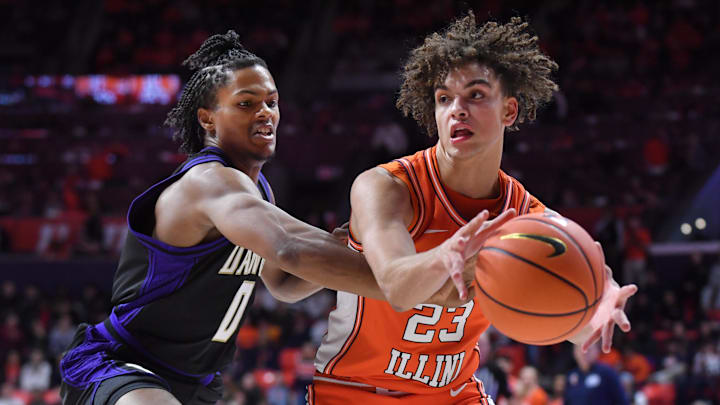
Since our last board, Wagler has gone from trending toward being a one-and-done to now being a clear top-10 and potential top-five pick. He’s having one of the most impressive freshman seasons in Big Ten history, shouldering an impossibly large role for around a month with backcourt mate Kylan Boswell out and largely shredding some of the best teams in the league. His 46-point outburst at Purdue was memorable, but that game wasn’t that big an outlier in the grand scheme. NBA teams love how he always seems to make the right play and his ability to make shots off the dribble. How he handles teams getting increasingly aggressive and physical guarding him down the stretch will be interesting to watch especially given his lack of true straight-line speed, but Wagler is clearly an elite-level prospect in this class at this point.
8. Mikel Brown Jr., G, Louisville
Any lingering struggles from Brown after his back injury were fully put into the rearview mirror this week with a pair of elite performances. First, he scored 45 points (making 10 threes in the process) in a blowout win over NC State, then followed that with 29 points on just 14 shots against Baylor. It’s a reminder of what makes him such a tantalizing prospect, with elite creativity off the bounce and top-tier potential as an off-dribble scorer. A strong finish to the season could bring him right back into the conversation for best point guard in the class.
9. Darius Acuff Jr., G, Arkansas
The run on point guards here in the back half of our top 10 continues with Acuff, who continues to make a serious push with his play of late. He dominated Auburn on Saturday with perhaps his best performance yet at Arkansas, scoring 31 points on 10 of 15 from the field and stacking up seven assists in a comfortable win over the Tigers. He’s a hyper-efficient scorer with a better than three-to-one assist-to-turnover ratio. It’s hard to imagine a player with that profile dropping out of the top 10.
10. Thomas Haugh, F, Florida
It’s rare that the first thing that stands out with a potential top-10 pick is how hard he plays, but Haugh’s best skill may be his elite motor. The Florida star is highly skilled, versatile defensively and has made real strides as a shooter. At its core, the sell for Haugh is how he finds ways to be productive and add value to winning basketball even without needing the ball in his hands. He’s a huge part of Florida’s push for back-to-back national championships and has made himself significant money by staying in school rather than turning pro after the Gators’ title run.
11. Yaxel Lendeborg, F, Michigan
Lendeborg has been the best player on top national title contender Michigan after transferring up from UAB, solidifying his standing as a lottery-level prospect in the process. His shooting has cooled some to just 30% from distance after a hot start to the season, but he’s still adding value in a number of ways with his size, versatility and toughness on the glass. He seems primed to make an instant impact in an NBA uniform, though drafting someone who won’t make his NBA debut until after his 24th birthday won’t be for everyone.
12. Braylon Mullins, G, UConn
Movement shooting is at a premium, and no one in this draft class profiles as more dynamic in that regard than Mullins. The Indiana native flies off screens, can get his shot off in incredibly tight windows and has elite shooting touch. He hasn’t been asked to do much beyond fire from distance at UConn which may hinder how teams view his upside, but Mullins has a chance to be a game-changing shooter at the next level.
13. Karim López, F, NZ Breakers
López has had some huge games lately with the NBL season coming to an end, including 32 points at the end of January against Melbourne and a 21-point, 11-rebound outburst vs. Adelaide. This isn’t an overly big upside swing selection for whoever makes it, but players with his size, feel and proven production in a high-level league usually don’t last long on draft night.
14. Jayden Quaintance, F, Kentucky
It will be fascinating to see NBA teams’ risk tolerance with Quaintance, who has played in just four games this season and has been sidelined for the last month with knee swelling. Will a team in the lottery be willing to bet on Quaintance’s elite physical tools and defensive potential despite being raw and having played very little in the last year? If a team can afford to be patient, it could pay off down the line.
15. Hannes Steinbach, F, Washington
Steinbach has been one of the most productive freshmen in college basketball, stacking double-double after double-double for Washington and quickly emerging as one of the best rebounders in the country. Defensive limitations could make teams skittish of investing a lottery pick in him, but he seems like a no-brainer top-20 pick given his consistency and offensive skill set.
16. Chris Cenac, F, Houston
Bigs who are 6' 11" with mobility and shoot 35% from three tend not to last long on draft night, and those elite tools are why Cenac could rise into the late lottery despite being more of a project than other bigs in this area of the draft. Playing on an elite team at Houston should give Cenac plenty of heavily scouted chances to prove himself this March.
17. Labaron Philon Jr., G, Alabama
Philon is one of the most electrifying players in college basketball, an absolute dynamo with the ball in his hands capable of creating a shot from basically anywhere on the court. His slender build and shoot-first mentality might be better served in a bench-scoring role at the next level, but if someone buys into him as a true point guard he could certainly climb into the lottery.
18. Brayden Burries, G, Arizona
One of the biggest risers on this board from January is Burries, who has been elite for the Wildcats over the last few months after a slow start to the season. He’s a big-time shotmaker with the type of fluidity you can’t teach, and as he’s gotten more comfortable with the speed of the college game things have really clicked for him.
19. Bennett Stirtz, G, Iowa
No matter what level he’s at, Stirtz just keeps finding ways to dominate. He’s averaging more points per game this season in the Big Ten at Iowa than he did last season at Drake, and his scoring at Drake had been a tick up from his production at Northwest Missouri State in Division II the year prior. This is a gifted three-level scorer, in spite of his athletic limitations.
20. Koa Peat, F, Arizona
Peat is a difficult player to evaluate for NBA teams as an undersized forward who doesn’t stretch the floor. There’s room in the NBA for players with his toughness, finishing ability and feel for the game, but the concerns about his fit might drop him from the lottery into the teens or early 20s.
21. Isaiah Evans, G, Duke
Evans is a streaky player, but he possesses an ability to shoot off movement that few in this draft can match. The question is whether the shooting outweighs physicality and defensive concerns that have plagued Evans despite a productive sophomore year at Duke.
22. Christian Anderson, G, Texas Tech
In a class loaded with talented point guards, Anderson holds his own statistically with all of them. He’s shooting the cover off the ball this season at Texas Tech while emerging into a high-level playmaker for others as well, leading the Big 12 in assists this season. He’s another who could benefit from waiting a year and trying his hand in a less crowded draft, though there’s little left to prove for him in college.
23. Dailyn Swain, G, Texas
Swain has put it all together this season at Texas, emerging as one of the best wings in the country and the biggest reason Texas seems poised to reach the NCAA tournament. He’s averaging 20 points and making over a three per game in SEC play, all while being versatile defensively at 6' 7".
24. Patrick Ngongba II, C, Duke
Ngongba has cooled lately after a great start to ACC play, but still is playing a valuable role for Duke as the offense-first member of their center platoon with Maliq Brown. He’s skilled enough offensively with soft touch around the basket and moves his feet well defensively, though his lack of physicality and explosiveness is a concern for some teams.
25. Alijah Arenas, G, USC
Arenas’s seven games since returning from offseason knee surgery have been a wild ride, featuring plenty of NBA-level shotmaking and offensive creativity but poor efficiency and decision making at times. It’s obvious Arenas is still playing his way into game shape, all while being thrust into a massive role offensive of late due to other USC injuries. It may make more sense long-term for Arenas to return to school next season with the runway to potentially play his way into being a top-10 pick in a much weaker 2027 class, though a team enamored with his talent could make a push for him to stay in the ’26 draft.
26. Morez Johnson Jr., F, Michigan
Johnson has shined this season at Michigan, a two-way force for one of the best teams in college basketball. He won’t be everyone’s cup of tea at the next level as an undersized four/five, but his relentless motor and elite athleticism makes him a safe bet to contribute to winning early.
27. Tounde Yessoufou, G, Baylor
Yessoufou has elite physical tools and a track record as an elite scorer, setting records as a high schooler in California before averaging north of 18 points per game so far at Baylor. There will be a learning curve to playing a more defined role at the next level, but his talent certainly pops.
28. Cameron Carr, G, Baylor
Few transfers have boosted their stock more than Carr, who has exploded at Baylor after getting inconsistent run at Tennessee. He possesses a fairly intriguing package of elite vertical athleticism and a strong track record as a three-point shooter. Continuing to add strength will be critical.
29. Aday Mara, C, Michigan
Mara is one of the tallest players in this draft class at 7' 3", and he uses that size and length well to be a game-changing rim protector for Michigan. He’s also a gifted passer, which should help aid his transition to the next level in spite of some mobility concerns.
30. Tyler Tanner, G, Vanderbilt
Tanner is shaping up to have one of the most intriguing stay-or-go decisions in college basketball after a monster sophomore season has helped him climb onto draft boards. His size will make many skeptical, but Tanner’s instincts and playmaking ability are elite.
31. Braden Smith, G, Purdue
32. Meleek Thomas, G, Arkansas
33. Amari Allen, F, Alabama
34. Zuby Ejiofor, F, St. John’s
35. Motiejus Krivas, C, Arizona
36. Henri Veesaar, C, North Carolina
37. Flory Bidunga, F, Kansas
38. Dame Sarr, G, Duke
39. Alex Karaban, F, UConn
40. Joshua Jefferson, F, Iowa State
41. Alex Condon, F, Florida
42. Dash Daniels, G, Melbourne United
43. Sergio De Larrea, F, Valencia
44. Juke Harris, G, Wake Forest
45. Joseph Tugler, F, Houston
46. Ryan Conwell, G, Louisville
47. Rueben Chinyelu, C, Florida
48. Paul McNeil Jr., G, NC State
49. Milan Momcilovic, F, Iowa State
50. Jaden Bradley, G, Arizona
More NBA from Sports Illustrated
Listen to SI’s NBA podcast, Open Floor, below or on Apple and Spotify. Watch the show on SI’s YouTube channel.
 Add us as a preferred source on Google
Kevin Sweeney is a staff writer at Sports Illustrated covering college basketball and the NBA draft. He joined the SI staff in July 2021 and also serves host and analyst for The Field of 68. Sweeney is a Naismith Trophy voter and ia member of the U.S. Basketball Writers Association. He is a graduate of Northwestern University’s Medill School of Journalism.
Follow CBB_Central