%20%20--%3E%0A%3Csvg%20version%3D%221.1%22%20id%3D%22Layer_1%22%20xmlns%3D%22http%3A%2F%2Fwww.w3.org%2F2000%2Fsvg%22%20xmlns%3Axlink%3D%22http%3A%2F%2Fwww.w3.org%2F1999%2Fxlink%22%20x%3D%220px%22%20y%3D%220px%22%0A%09%20width%3D%2239px%22%20height%3D%2240px%22%20viewBox%3D%220%200%2039%2040%22%20enable-background%3D%22new%200%200%2039%2040%22%20xml%3Aspace%3D%22preserve%22%3E%0A%3Cpath%20fill%3D%22%23FFFFFF%22%20d%3D%22M38.5%2C7H28.2v26h10.3V7z%22%2F%3E%0A%3Cpath%20fill-rule%3D%22evenodd%22%20clip-rule%3D%22evenodd%22%20fill%3D%22%23FFFFFF%22%20d%3D%22M26.1%2C25.5c0%2C5.8-4.1%2C7.5-12.9%2C7.5C3.9%2C33%2C0%2C31.2%2C0%2C25.2v-1.1h11.6%0A%09v2.4c0%2C0.7%2C0.1%2C1.4%2C1.2%2C1.4c1%2C0%2C1.2-0.4%2C1.2-1.3v-0.9c0-1.6-0.9-1.6-3.5-2.2C2.2%2C21.7%2C0%2C19.7%2C0%2C15.3v-0.9C0%2C9.3%2C5.5%2C7%2C12.9%2C7%0A%09c10.2%2C0%2C12.8%2C2.6%2C12.8%2C7.4v1.8h-11v-2.9c0-0.6-0.4-1.1-1.2-1.1c-0.6%2C0-1.2%2C0.4-1.2%2C1.1v0.9c0%2C1.5%2C0.9%2C2%2C3.3%2C2.5%0A%09c8%2C1.6%2C10.5%2C3.3%2C10.5%2C7.5V25.5z%22%2F%3E%0A%3C%2Fsvg%3E%0A)
Miami (Ohio) Forged 30–0 College Hoops Season the Old-School Way
In this story:
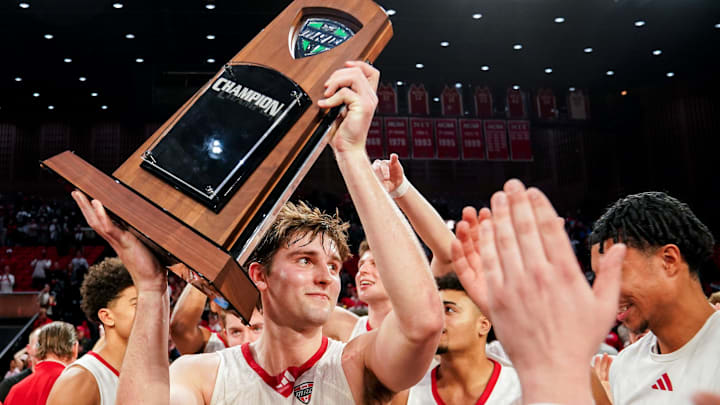
OXFORD, Ohio — Nobody would leave the Millett Hall court until the cops finally started making them. Mid-American Conference championship nets were cut, red-and-white confetti was sprayed into the air, and the fans spilled onto the floor to celebrate with their Miami RedHawks. Pictures were taken and items were autographed as little kids pantomimed jump shots.
This was the last home game, one of the closing chapters in the best ongoing story in college basketball. From the second-chance coach to the tightly bonded players to the fully invested administration and Miami community, everyone was squeezing as much as they could out of this perfect moment and perfect record.
At last, it was time to go. The building needed to be cleaned and readied for a Miami women’s game Wednesday with another MAC title on the line. “We’re going to scoop up this confetti and put it back in the shooter for tomorrow,” athletic director David Sayler says with a smile. “Recycling!”
It had been yet another Miami heart-attack game, ending in yet another victory—30 in a row now, one-third of them decided by five points or fewer or in overtime. This one was 74–72 over Toledo, the second straight game that came down to a play in the final second. It has been tense and tenuous of late.
But 30–0 is 30–0, a towering accomplishment. It has happened just five other times in the last 50 years—Indiana 1976, UNLV 1991, Wichita State 2014, Kentucky 2015 and Gonzaga 2021. Now add the RedHawks to the list, and put them in the field of 68. Unless there is something truly rotten in the sport, the RedHawks are an NCAA tournament lock.
It’s over, Miami-bashing Bruce Pearl. The RedHawks won so much that the former Auburn coach and current Auburn lobbyist on TNT lost the argument.
It’s over, metrics honks. Miami’s No. 89 KenPom rating is immaterial. Its zero Quad 1 wins is nonessential information (the RedHawks also have zero Quad 1 losses, for what that’s worth). Winning 30 games and losing none is the only math that matters.
The tournament selection committee would have to trample historical precedent to leave Miami out at this point. Its worst possible record will be 30–2, with losses in the regular-season finale at rival Ohio and in the quarterfinals of the MAC tournament next week. Since the tourney expanded to 64 teams in 1985, no eligible team with two or fewer losses on Selection Sunday has been snubbed.
Granted, the vast majority of teams with those kind of records won their conference tournaments and received automatic bids. But not all of them. The most comparable precedents from the mid-major ranks would be George Washington in 2006, which was 26–2 on Selection Sunday and received a No. 8 seed; and Bradley in 1986, which was 31–2 and received a No. 7 seed. Both were comfortably in the field.
The only team with a comparable record that might have been left out in the last 40 years was Stephen F. Austin in 2014. The Lumberjacks were given a No. 12 seed at 31–2, securing their spot by winning the Southland Conference tournament. At 30–3, would they have gotten an at-large berth? It never became an issue—and the RedHawks’ record will be better than that.
Of course, Miami has no interest in being an unprecedented victim of the creeping gigantism of college sports, where the power conferences inhale everything. Don’t leave it up to a committee. Keep winning.
“Listen, this is a big deal,” coach Travis Steele says. “This is awesome. That was one of our goals that we had at the beginning of the year, to win the regular-season title. Check. Now I want to finish this season undefeated. … And then can we go win the MAC tournament up in Cleveland? That is the goal. We want to leave absolutely no doubt. Absolutely no doubt who the heck we are.”
Who the heck are the Miami RedHawks?
Start with the guy standing on the baseline in front of the student section all game, wearing a white dress shirt and red tie beneath a school-issued pullover. The guy subconsciously clicking the heels of his Lucchese cowboy boots together when things get tight. That’s the school president.
Greg Crawford was the dean of engineering at Brown, then the dean of the college of science at Notre Dame, before becoming Miami’s president. Among his published works: Band Structures of Orientational Modes in Quasi-Periodic Mesoscale Liquid Crystal-Polymer Dispersions.
But if you watch him at a basketball game (men’s or women’s) you don’t see an academic heavyweight. You see Miami’s biggest cheerleader. Flanked by his wife, Renate—an adjunct professor of physics who is wearing red-and-white overalls—Crawford will even grab a megaphone on occasion to help rile up the crowd.
And those crowds have grown. Miami has sold out Millett Hall its last four games, which is no small feat—the 1967 building can house more than 10,000 fans. There were 10,640 in attendance for the Toledo game, with about half that number being students—a huge percentage of a student body of about 17,000.
“It’s so fun to watch,” Crawford says. “I always tell people that I never got so nervous or anxious until they got really good, because every game now is another record.”
Crawford believes he sees all the school’s most famous sayings embodied in this basketball team.
From the alma mater: Study-hearted, pure of soul. “They are resilient and they find a way to win when even the odds are against them. They’re able to come back when they’re having a tough game and not playing as well as they’d like. They get it done and they find a way. I love that about them.”
The Latin motto: Prodesse Quam Conspici. “It’s basically, ‘Lead with humility.’ They focus in on letting their actions show for them, not bragging or being out there with all kinds of narratives.”
From the fight song: Love and honor. “It’s a greeting, but it’s also our mission. These students love and they honor their university. What they’re doing on the court brings the excitement and enthusiasm of our student experiences to levels we haven’t seen in decades.”
Crawford has been the Miami president for 10 years, a long time in the modern world of higher education. He’s invested. So is the next guy you need to know, athletic director Sayler.
His slicked-back hair runs a little longer and curlier down his neck than a corporate climber AD would wear. Sayler is not an establishment type, which might be why he was willing to aggressively take on Pearl on social media—fighting the perception battle on behalf of Steele and his players, and for the hundreds of schools that fit the same athletic profile as Miami.
“I feel like I’m really sticking up for every single mid-major,” Sayler says. “For the heart and soul of college athletics, college basketball, March Madness. I don’t want to see the 12th-place Big Ten team, the 11th-place SEC team [in the tournament]. You’re going to tell me that if we lose a game in Cleveland we’re not in a field of 68? It just blows my mind that we’re even really having the debate.”

Sayler has been in his position for 13 years. His department has had a lot of success, but he hasn’t been striving to parlay it into a power-conference job. He’s put down roots in Oxford.
“I’m not planning to go anywhere. Happy what I’m doing. And honestly, I think the profession’s gotten all about hiring somebody from pro sports who’s generated revenue before. It seems to be the hot thing. You still have to hire coaches. You can have all the money in the world, but if you don’t have the right coach and the right culture, you’re not going to win.”
Which brings us to Travis Steele.
His journey from rising star to reclamation project was swift. Promoted to replace Chris Mack as head coach at Xavier at age 36, Steele won games but not the right ones. He was 70–50 overall but 31–37 in the Big East and 1–4 in the Big East tournament, failing to secure an NCAA bid in four seasons. That was the Musketeers’ longest stretch without a Big Dance appearance since 1979–82, which earned Steele a pink slip.
Miami was ready to scoop him up and give him another chance. Steele was uncertain, opting to take a vacation trip to Florida with his family to think about it. Sayler was considering Youngstown State coach Jerrod Calhoun—now at Utah State and perhaps ticketed for a power-conference job—when Steele expressed interest.
“He really owned up that his time at Xavier, while he was the head coach, he never really felt like it was his program,” Sayler says. “He kind of felt like he inherited someone else’s program. So this was the chance to kind of put his own stamp on a program.”
When Sayler and Steele met for a third time, the deal was completed. Steele showed his new boss an extensive spreadsheet of players he believed he could get who would turn around Miami after more than a decade of struggle.
It was a gradual build, from 12–20 to 15–17 to last season’s breakthrough—a 25–9 record and a run to the MAC tournament title game. Miami led Akron by as many as 18 points but was nipped at the end, falling 76–74 and missing the Big Dance.
The foundation for this season was set when six key members of that team—leading scorer Peter Suder, plus Eian Elmer, Antwone Woolfolk, Brant Byers, Evan Ipsaro and Luke Skaljac—opted to stay with the RedHawks. Suder set an almost maniacal offseason tone.
“Our spring was the best spring I’ve ever been around in college hoops in all my years,” Steele says. “Just the competitiveness, the extra work. Man, it was elite, elite, elite. Almost to the point where I told Pete, ‘Dude, stop diving on the freaking floor. It’s three-on-three. It’s April, man. Calm down.’ So I knew we were going to have a great team.”
What’s unfolded has been a triumph of chemistry, cohesion and trust. A lot of teams say they don’t care who gets the glory, but Miami’s willingness to share the ball from opening tip to final horn—no matter how tight the game—is proof positive.

“The unselfishness, in the landscape that we’re in, it’s hard,” Steele says. “I talk to a lot of my friends in the business and they may be winning, they may be talented, but they’re miserable. They say it’s hard to get this guy to play or to make the extra pass, to cut hard, to run hard because you may not get that ball. They’re only happy if they get the ball. Our guys do things that don’t show up in the stat sheet because of their connectivity off the court, because of their character of who they are.”
Miami withstood a season-ending knee injury to starting point guard Evan Ipsaro (“a stud, a monster,” Steele says) in January. It withstood a succession of nail-biter games as the undefeated target grew on its back. It even withstood a near-doom situation last week at Western Michigan.
That was the game where the pressure looked like it might buckle the RedHawks. Steele got a technical foul at halftime and probably should have been ejected, after he stormed off the court and shoved over some of the equipment belonging to “The Most Incredible DJ Chuck” the in-house DJ at WMU. Steele was fined by the MAC and paid DJ Chuck for damage to the equipment. (“I got to be better,” says Steele, who added that he was admonished by his 3-year-old daughter for the outburst.)
Miami fell behind by nine points late in the game, with Suder fouled out and fellow guard Skaljac out with a hand injury. It came down to freshman guard Trey Perry making a difficult, left-handed drive that lingered on the rim and fell with less than a second remaining.
“That shot defied physics,” says school president Crawford. “And I’m a physicist.”
TREY. PERRY. 🔥@nbadreams25 comes up CLUTCH to keep No. 21 Miami unbeaten!@MiamiOH_BBall | #MACtion pic.twitter.com/uUoedz2fwJ
— MACtion (@MACSports) February 28, 2026
That great escape led to the home finale Tuesday. Miami never trailed. Miami also never put the game away, turning the ball over in droves and playing at breakneck pace even in late-game situations.
For many coaches, this would have been enough to induce a spasm of control freakiness. To micromanage. To direct and call plays and press one’s thumbs upon the players.
Steele did none of that. He let his players figure it out. It was a remarkable display of laissez-faire coaching.
“Probably when I was a younger head coach, I wanted to control things,” he says. “You want to control every possession. Here, we don’t. I don’t call out much. I trust our guys. They make the right plays. We have guys with high basketball IQs. We give them concepts and we let them play. Don’t be a robot.”
Says Suder: “We just trust each other. We have so much fun every single day, whether it’s practice, lifting, team meals. That’s the beauty of basketball is when you’re having fun with the right group of guys, you can become unbeatable.”
The best story in college basketball has its final acts upcoming. Then there is the future, and a new story.
How much will carry over from this magical year? Seniors Suder and Woolfolk might be the only losses—but the transfer portal will beckon. And Steele will have other job opportunities back at the power-conference level.
Sayler says he’s put a new contract offer in front of his coach. Steele has four years remaining on his current deal, and Sayler wants to add four more in addition to a hefty raise. Steele says he hasn’t thought about it yet, trying to stay immersed in this undefeated season.

There is another plum on the horizon. The Miami Board of Trustees last week approved plans for a $240 million new arena, one with modern amenities and revenue streams—luxury seating that isn’t available in the nearly 60-year-old Millett Hall. Sayler looks ahead and invokes the patron saint of mid-major risers.
“You think about what Gonzaga did and the way they had to slog to get there,” he says. “I really believe we can be that type of program here, and it’s not going to take as long.”
The big dreams are out there, but the present is too precious to look far ahead. Today, everything is perfect for Miami basketball. Literally perfect.
More College Basketball from Sports Illustrated
Listen to SI’s college sports podcast, Others Receiving Votes, below or on Apple and Spotify. Watch the show on SI’s YouTube channel.
 Add us as a preferred source on Google
Pat Forde is a senior writer for Sports Illustrated who covers college football and college basketball as well as the Olympics and horse racing. He cohosts the Others Receiving Votes podcast for SI and is a regular contributor to the Tony Kornheiser Show podcast. He previously worked for Yahoo Sports, ESPN and The (Louisville) Courier-Journal. Forde has won 28 Associated Press Sports Editors writing contest awards, has been published three times in the Best American Sports Writing book series, and was nominated for the 1990 Pulitzer Prize. A past president of the U.S. Basketball Writers Association and member of the Football Writers Association of America, he lives in Louisville with his wife. They have three children, all of whom were collegiate swimmers.
Follow ByPatForde