%20%20--%3E%0A%3Csvg%20version%3D%221.1%22%20id%3D%22Layer_1%22%20xmlns%3D%22http%3A%2F%2Fwww.w3.org%2F2000%2Fsvg%22%20xmlns%3Axlink%3D%22http%3A%2F%2Fwww.w3.org%2F1999%2Fxlink%22%20x%3D%220px%22%20y%3D%220px%22%0A%09%20width%3D%2239px%22%20height%3D%2240px%22%20viewBox%3D%220%200%2039%2040%22%20enable-background%3D%22new%200%200%2039%2040%22%20xml%3Aspace%3D%22preserve%22%3E%0A%3Cpath%20fill%3D%22%23FFFFFF%22%20d%3D%22M38.5%2C7H28.2v26h10.3V7z%22%2F%3E%0A%3Cpath%20fill-rule%3D%22evenodd%22%20clip-rule%3D%22evenodd%22%20fill%3D%22%23FFFFFF%22%20d%3D%22M26.1%2C25.5c0%2C5.8-4.1%2C7.5-12.9%2C7.5C3.9%2C33%2C0%2C31.2%2C0%2C25.2v-1.1h11.6%0A%09v2.4c0%2C0.7%2C0.1%2C1.4%2C1.2%2C1.4c1%2C0%2C1.2-0.4%2C1.2-1.3v-0.9c0-1.6-0.9-1.6-3.5-2.2C2.2%2C21.7%2C0%2C19.7%2C0%2C15.3v-0.9C0%2C9.3%2C5.5%2C7%2C12.9%2C7%0A%09c10.2%2C0%2C12.8%2C2.6%2C12.8%2C7.4v1.8h-11v-2.9c0-0.6-0.4-1.1-1.2-1.1c-0.6%2C0-1.2%2C0.4-1.2%2C1.1v0.9c0%2C1.5%2C0.9%2C2%2C3.3%2C2.5%0A%09c8%2C1.6%2C10.5%2C3.3%2C10.5%2C7.5V25.5z%22%2F%3E%0A%3C%2Fsvg%3E%0A)
Sophomore Slump? Not for Michigan’s Band of Young Stars
In this story:
So you want to understand why the best team in Michigan women’s basketball history can deliver the program’s first Final Four berth, huh? The answers are written in invisible ink.
The Wolverines are defined, in many ways, by how the team wasn’t constructed; by the traps they didn’t fall into; and by everything that didn’t derail them.
They didn’t try to form a team with their friends.
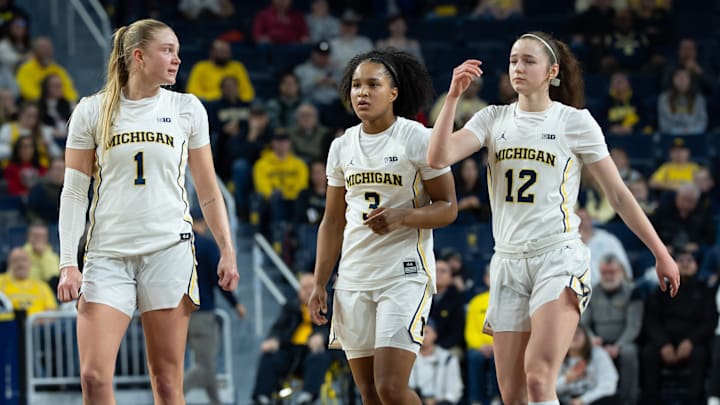
Michigan’s sophomore class is, already, the best in school history, which is not surprising to anybody who follows recruiting. Olivia Olson, Syla Swords and Kendall Dudley were McDonald’s All-Americans. Mila Holloway was a four-star recruit who came in and started at point guard immediately.
The sophomores sure appear to be a package deal. But they were not. Swords says she did not even meet Olson until after they had both committed to Michigan. Holloway committed on her own after that. Te’Yala Delfosse and Aaiyanna Dunbar joined the class shortly before signing day. Dudley started her career at UCLA before transferring.
They all planned on doing the same thing the same way at the same school for the same reasons, but they did not plan on doing it together. That just kind of happened.
Swords was a top-five recruit who played on a team full of coveted recruits at Long Island Lutheran. If she wanted to play with her pals, she could have.
“I had a lot of talent who were my best friends at the time,” she says. “I could have went and played with them and played with familiarity. I always knew I was going to go where I fit the best. It wasn’t necessarily the top program or the program that was going to pay me the most or the program that was going to get me the most followers. That’s never how I’ve done something.”
There are perks to doing it this way. Players know they chose Michigan because they wanted it, not because their pals wanted it. They also know the coaches wanted them as individuals, not just as part of a package. They still could have chemistry problems, but they don’t, because …
They don’t envy each other.
Holloway is a natural point guard; her default operation is helping teammates score. Olson is far too worried about whether she is doing enough for her team to get upset when somebody else is doing more. But it starts with Swords, who arrived as a youthful-looking top-five recruit and immediately started acting like a senior leader.
“Syla sets that example because she does not care [about stats],” coach Kim Barnes Arico says. “Sometimes kids get upset if they score two points. She doesn’t even know if she scored two points.”
Every kid in America these days is constantly being compared to other kids. It’s a symptom of the age of social media, and jealousy has wrecked teams at every level.
“I hear that so much in other programs and I see that so much with other teams,” Barnes Arico says. “As a coach, that’s in the back of my mind.”

It stays in the back of her mind, because in the back of the team bus …
They don’t seek shelter inside their phones.
When they lose, they’re quiet. When they win, as they usually do, “the coaches get annoyed sometimes with how loud we are,” Swords says. During one bus ride, they held a contest to see who can count to 60 the fastest.
“We’re actively going as far as making up a game so we can continue to interact with each other,” Swords says. “You see it on the court. There’s no type of jealousy within the team. There’s no ‘Me—I want me first.’ That starts with how we interact off the court.”
They don’t get swayed by compliments.
When Swords moved from Canada to Long Island and started shooting up the recruiting rankings, she had plenty of suitors. She was more suspicious than flattered: “Some schools, the calls became more frequent once I had a ranking next to my name.” Michigan coaches had recruited her hard early and even traveled to Hungary to watch her play. She believed in their belief in her.
Swords and Olson were top-20 recruits who joined a program that was beset by transfers in the months before they arrived. They were going to play whether they were ready or not. But Barnes Arico says, “Those two stepped on campus and played harder than anyone I’ve ever seen. From Day 1.”
Barnes Arico has a points system in practice to reward positive plays. Olson showed up for her first practice and nearly broke the system.
“I’m going: What is going on here?” Barnes Arico says. “She probably had more points than anyone has ever had. She is diving all over the floor. She makes eye contact on every correction. She tries to actually do—immediately—whatever you asked her to do. Usually it takes a lot of reps before they really understand what you mean.”

Olson was the co–Big Ten Freshman of the Year last year and a third-team All-American this year. But Barnes Arico says, “She analyzes every single thing and she worries. ‘Was that a good shot? Did I take too many shots?’ I’m like ‘Oh my gosh, pleeeeeease. I will tell you, Olivia, when you take too many shots.’ ”
Swords says: “She holds herself to such a high standard. She has that sort of perfectionist attitude. Sometimes it’s my job to remind her that ‘You’re still human. It’s O.K. to make those mistakes.’ ”
Swords rides a different personality to the same conclusion: While Olson is tough on herself, Swords is so naturally self-assured that she trusts herself to measure her contributions.
“Maybe it’s instilling confidence in Olivia to shoot the game-winning shot,” Swords says. “I find that value within myself. I never feel the need to overextend my proof to get approval.”
Swords’s percentages (41.2% from the field, 34.5% from three) don’t really reflect her skill level, because she doesn’t hunt for easy buckets. She shoots when she thinks her team needs her to shoot. Barnes Arico says, “When we’re in a tight game, she’ll take more because she knows we need her to.”
Midway through the season, Barnes Arico told Swords she needed to shoot more. Swords was taken aback. She says now that she sees her coach’s point: “I think I got really caught up in trying to play the game the right way.” But in Michigan’s first NCAA tournament game, against Holy Cross, Swords made her first five shots. She took only two the rest of the game.
Their eyes don’t wander.
When Michigan lost to Notre Dame in the second round of last year’s NCAA tournament, Swords texted Holloway and Olson about transferring. The conversation was short and quick: We’re staying, right? Right. Right. Swords then texted the news to Barnes Arico, knowing full well that after the previous year’s defections, “she needed that moment.” Yes: After a stinging loss, a freshman star wanted to put her coach at ease.

This is the transfer-portal era. Tampering is rampant. Money flows. Players have a right to ask for more. You should never assume any player is staying in the same place until they do it—even if they stayed last year. But for now, at least, Michigan has every reason to believe its nucleus will return.
That nucleus is even stronger than it appears, because …
The player who might have the highest ceiling on the team doesn’t even start.
Sophomore Te’Yala Delfosse is 6'3" with 6'7" wingspan and a little guard’s fluidity. “She can probably beat anyone up the court,” Swords says. “She can out-jump anyone. She’s starting to pick up the point guards full-court.” Barnes Arico says, “She is on the verge of dunking the basketball.” At the least, Delfosse will be a defensive menace, wrecking opposing offenses and contributing layins and open threes. But she could become so much more.
“She might have the greatest long-term [WNBA] potential of anyone in our program—and that’s being surrounded by All-Americans,” Barnes Arico says. “Her natural ability, her body type, the way she can impact the game at every level—from defense to rebounding to scoring to getting to the rim. She is a difference-maker. She’s special for us. For her, it’s about the experience. From last year to this year was a major jump. Next year is going to be another major, major jump.”
Next year is tantalizing. But next year can wait. In the meantime …
They haven’t peaked.
Michigan plays Louisville on Saturday in the Sweet 16. The winner will likely face No. 1 seed Texas in Fort Worth, a tough assignment for anybody. Some unsolicited advice for anybody playing the Wolverines: Beat them while you still can.
“It’s the end of March and a lot of these teams are as good as they’re going to be,” Barnes Arico says. “And they’re really great. But we’re a team that’s not even nearly as good as we’re going to be when this is all said and done.”
More March Madness from Sports Illustrated
 Add us as a preferred source on Google
Michael Rosenberg was a senior writer for Sports Illustrated, covering any and all sports. He writes columns, profiles and feature stories and has covered almost every major sporting event. He joined SI in 2012 after working at the Detroit Free Press for 13 years, eight of them as a columnist. Rosenberg is the author of “War As They Knew It: Woody Hayes, Bo Schembechler and America in a Time of Unrest.” Several of his stories also have been published in collections of the year’s best sportswriting. He is married with three children.
Follow rosenberg_mike