%20%20--%3E%0A%3Csvg%20version%3D%221.1%22%20id%3D%22Layer_1%22%20xmlns%3D%22http%3A%2F%2Fwww.w3.org%2F2000%2Fsvg%22%20xmlns%3Axlink%3D%22http%3A%2F%2Fwww.w3.org%2F1999%2Fxlink%22%20x%3D%220px%22%20y%3D%220px%22%0A%09%20width%3D%2239px%22%20height%3D%2240px%22%20viewBox%3D%220%200%2039%2040%22%20enable-background%3D%22new%200%200%2039%2040%22%20xml%3Aspace%3D%22preserve%22%3E%0A%3Cpath%20fill%3D%22%23FFFFFF%22%20d%3D%22M38.5%2C7H28.2v26h10.3V7z%22%2F%3E%0A%3Cpath%20fill-rule%3D%22evenodd%22%20clip-rule%3D%22evenodd%22%20fill%3D%22%23FFFFFF%22%20d%3D%22M26.1%2C25.5c0%2C5.8-4.1%2C7.5-12.9%2C7.5C3.9%2C33%2C0%2C31.2%2C0%2C25.2v-1.1h11.6%0A%09v2.4c0%2C0.7%2C0.1%2C1.4%2C1.2%2C1.4c1%2C0%2C1.2-0.4%2C1.2-1.3v-0.9c0-1.6-0.9-1.6-3.5-2.2C2.2%2C21.7%2C0%2C19.7%2C0%2C15.3v-0.9C0%2C9.3%2C5.5%2C7%2C12.9%2C7%0A%09c10.2%2C0%2C12.8%2C2.6%2C12.8%2C7.4v1.8h-11v-2.9c0-0.6-0.4-1.1-1.2-1.1c-0.6%2C0-1.2%2C0.4-1.2%2C1.1v0.9c0%2C1.5%2C0.9%2C2%2C3.3%2C2.5%0A%09c8%2C1.6%2C10.5%2C3.3%2C10.5%2C7.5V25.5z%22%2F%3E%0A%3C%2Fsvg%3E%0A)
South Carolina Is Back in the Final Four, but This Is Not Your Typical Dawn Staley Team
In this story:
SACRAMENTO — South Carolina has climbed enough ladders to make it look easy.
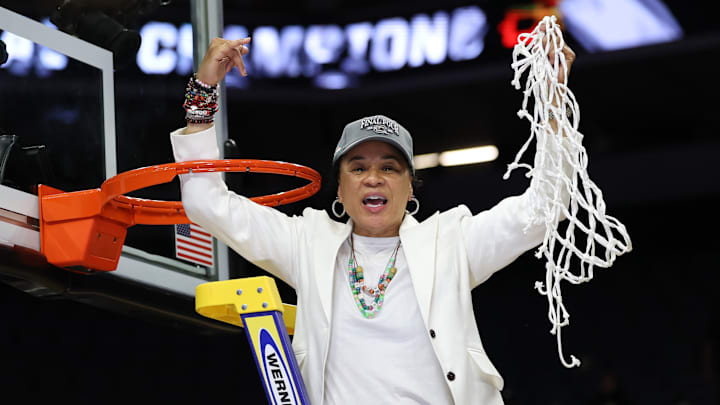
The program has a system for cutting down nets. Under the Gamecocks’ aptly named director of player development Freddy Ready—the man works to be prepared for everything—no one has to ask who climbs the ladder next or which piece of nylon should be snipped after this one. Freshmen go first. Everyone gets one linear segment of net, except for graduating seniors, who are given the privilege of cutting out a whole diamond. The whole thing is run with workmanlike efficiency. It’s still a celebration. But it’s a modest, perfunctory one, the equivalent of enjoying a slice of office birthday cake before getting right back to work.
A trip to the Final Four is plenty nice. It’s certainly worth celebrating. But it’s the norm for the Gamecocks under coach Dawn Staley.
So on Monday night in Sacramento, No. 1 seed South Carolina cut down the nets en route to the Final Four for the sixth time in six years. (And had the 2020 NCAA tournament not been canceled due to the pandemic, 32–1 South Carolina almost certainly would have made that Final Four, too, making it seven in seven.) The Gamecocks started a bit slow. But then they turned up the heat and took the life out of No. 3 seed TCU. The final score was 78–52. Yet the gap between teams felt even bigger than that margin of victory would suggest.
That puts the Gamecocks exactly where they were last year, and the year before that, and the year before that (...and the year before that, and…). Yet this is a very different group from the one that cut down the nets last year. South Carolina may have gotten to the same place it usually does at the end of March. But it did so with a new set of players, and they have put together a faster, higher-scoring product that is not quite like any that Staley has coached before at South Carolina.
“It's our sixth in a row,” Staley said on Monday, wearing the regional championship net as a necklace, like she always does. “But it really doesn't feel like that. Because the work that it requires for you to get to this place—it's a lot.”
That work had never looked quite like this before. South Carolina lost five of their seven leading scorers from last season. (Te-Hina Paopao, Sania Feagin and Bree Hall graduated into the WNBA; MiLaysia Fulwiley transferred to LSU; Chloe Kitts remains on the roster but has been sidelined all season with a torn ACL.) That group also comprised two of the Gamecocks’ three leading rebounders and two of their three leading assisters. Even with a solid young core and a few key incoming players—most notably Division I leading scorer Ta’Niya Latson joining in the transfer portal from Florida State—it was a tremendous amount of production to lose in a single offseason. But this new group figured out how to make up for that remarkably quickly.
“They’re fluid with each other,” TCU guard Donovyn Hunter said when asked what made South Carolina so tough. “They know each other's strengths and where they are on the floor.”
THIS WHOLE SEQUENCE GAVE ME CHILLS ‼️#MarchMadness x 🎥 ESPN / @GamecockWBB pic.twitter.com/m2Dg62vOlH
— NCAA March Madness (@MarchMadnessWBB) March 31, 2026
Take one particularly illustrative sequence from the fourth quarter on Monday. Gamecocks center Madina Okot rushed out of the paint to confront TCU ballhandler Olivia Miles. That action helped open up a steal for South Carolina guard Tessa Johnson, who initiated a gorgeous sequence on the fast break, beating a defender out along the length of the court before arcing a sweet lob to freshman Agot Makeer. The ball had barely touched Makeer’s fingers before she popped it right back to Joyce Edwards, who dropped it in for an easy bucket, part of a 14–0 run that opened the quarter for South Carolina.
South Carolina has traditionally not played quite that fast. But this group does not play like any group traditionally has at South Carolina. This group of new additions and newly developed youngsters has become the highest scoring team Staley has coached in her 18 seasons at South Carolina. (The Gamecocks have averaged 87.4 ppg this year compared to 79.1 ppg last year.) They’re far more efficient: Their 50.9% field-goal percentage makes them Staley’s first team ever to make more shots than they miss, a product of better shooting both in the paint and from beyond the arc, too. They are unusually deadly in transition, and their fierce defense shines in the half court, helping them record more steals than any Gamecocks team ever has under Staley.
That’s a credit to each of the players involved in that one sequence. None had been in this starting lineup last year. Okot transferred from Mississippi State and is now averaging a double-double. Makeer is a freshman, a tall, willowy guard who runs and stretches the floor with admirable grace and palpably increasing confidence. Johnson and Edwards both came off the bench last year but are shining in starting roles now. The former is as serious a sharpshooting threat as has ever played for the Gamecocks. The latter is a top recruit whose potential showed up in flashes during her freshman season last year and is now present every game as a sophomore. Her 19.6 ppg make her the highest scoring player at South Carolina since A’ja Wilson. These four have meshed and developed alongside one another this season to unlock a new brand of basketball.

But they have done that with one player who has been here all along. Point guard Raven Johnson has been a starter for South Carolina for three years and part of the program for five. (She missed the majority of her true freshman season with a torn ACL.) Johnson has been the core piece of connective tissue joining these disparate rosters. But she has done that while appearing like a different player herself. In her fifth and final season, Johnson is scoring in double figures for the first time, assisting more and shooting far more efficiently.
“Now people are seeing the type of player that she is—that she was capable of being,” Staley said.
Johnson was not the leading scorer or rebounder on Monday. (Edwards was both, as she often is, with 24 points and 12 boards.) But it was nevertheless Johnson named Most Outstanding Player. She finished with 10 points, eight rebounds, six assists and a steal, the kind of steadying, do-it-all performance that has been crucial to this team this year.
This makes five Final Fours in five seasons for Johnson. She climbed the ladder—again—to cut down the net—again. This is what she has done every March. Yet she has never gotten there quite like this.
More March Madness from Sports Illustrated
 Add us as a preferred source on Google
Emma Baccellieri was a staff writer focused on women’s basketball for Sports Illustrated. She previously covered MLB. She has also written for Baseball Prospectus and has been honored with multiple awards from the Society of American Baseball Research. A graduate of Duke University, she lives in Washington, D.C.
Follow emmabaccellieri