%20%20--%3E%0A%3Csvg%20version%3D%221.1%22%20id%3D%22Layer_1%22%20xmlns%3D%22http%3A%2F%2Fwww.w3.org%2F2000%2Fsvg%22%20xmlns%3Axlink%3D%22http%3A%2F%2Fwww.w3.org%2F1999%2Fxlink%22%20x%3D%220px%22%20y%3D%220px%22%0A%09%20width%3D%2239px%22%20height%3D%2240px%22%20viewBox%3D%220%200%2039%2040%22%20enable-background%3D%22new%200%200%2039%2040%22%20xml%3Aspace%3D%22preserve%22%3E%0A%3Cpath%20fill%3D%22%23FFFFFF%22%20d%3D%22M38.5%2C7H28.2v26h10.3V7z%22%2F%3E%0A%3Cpath%20fill-rule%3D%22evenodd%22%20clip-rule%3D%22evenodd%22%20fill%3D%22%23FFFFFF%22%20d%3D%22M26.1%2C25.5c0%2C5.8-4.1%2C7.5-12.9%2C7.5C3.9%2C33%2C0%2C31.2%2C0%2C25.2v-1.1h11.6%0A%09v2.4c0%2C0.7%2C0.1%2C1.4%2C1.2%2C1.4c1%2C0%2C1.2-0.4%2C1.2-1.3v-0.9c0-1.6-0.9-1.6-3.5-2.2C2.2%2C21.7%2C0%2C19.7%2C0%2C15.3v-0.9C0%2C9.3%2C5.5%2C7%2C12.9%2C7%0A%09c10.2%2C0%2C12.8%2C2.6%2C12.8%2C7.4v1.8h-11v-2.9c0-0.6-0.4-1.1-1.2-1.1c-0.6%2C0-1.2%2C0.4-1.2%2C1.1v0.9c0%2C1.5%2C0.9%2C2%2C3.3%2C2.5%0A%09c8%2C1.6%2C10.5%2C3.3%2C10.5%2C7.5V25.5z%22%2F%3E%0A%3C%2Fsvg%3E%0A)
The Ruthless Bottom Line Is Driving College Basketball Now
WASHINGTON — In the March Madness days of old, it was in the literal underbelly of arenas and stadiums where you would find coaches, athletic directors, administrators and even players gossiping about what was really going on in the sport.
In 2026, however, enough has changed to where the truth regarding college basketball no longer needs to be whispered. It can be said out in the open directly when anyone is asked.
This week offered up the chance to do just that at the East Regional of the NCAA men’s tournament, a rare confluence of two Hall of Fame coaches, two others trending that way, four flagship hoops brands and three of the most powerful conferences around who all are rooted in the hardwood.
What the coaches, in particular, had to say to throngs of national and local media members that will rival that of the Final Four next week was quite a stark departure from the usual platitudes uttered during the most pressure-packed games on the calendar.
Ask away all you want about rebounding and defense, but the real reason why teams win at this level has far more to do with the black ink on their checks and not what hue is running through a program anymore. This is now a bottom line sport in a bottom line enterprise, one where ruthlessness extends to the only place that really matters prior to tip-off.
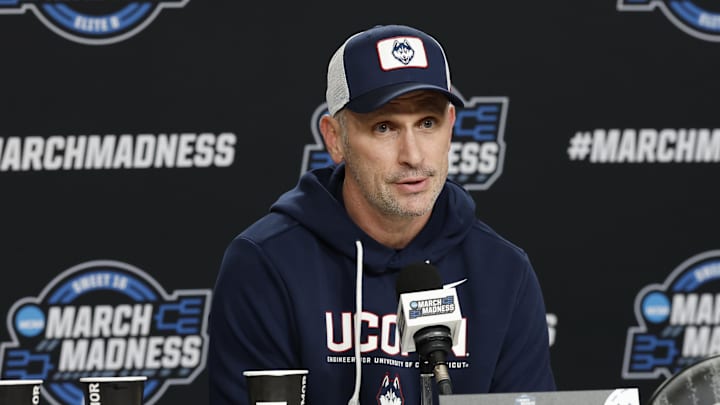
“Nowadays I think tradition, history, it doesn’t mean as much as it did to recruits, whether they’re portal or high school players. I think first and foremost right now it’s about the overall commitment that you're going to make, whether that's NIL, the way you travel, the quality of your facilities,” lamented UConn coach Dan Hurley. “You can’t get by on your brand anymore. Players dreaming of having played [at a blueblood] one day, none of these kids care about that anymore. None of the people close to them care about it because the majority of the people that are advising the kids now are agents who are looking at it from a business perspective, or are families that are not sentimental about any of this.”
Having a past history of success to sell is nice to have, certainly. Having a trophy case on campus is a solid bonus, if nothing else for the Instagram shots they can produce. Both are more for the fans than the ones they are cheering for on a yearly basis however.
This week is a good reminder of that, not just with the high-spending rosters which are present in the nation’s capital for a pair of games unlike few others in tournament history, but also because of the highly choreographed story which has overshadowed much of the action the past few days in coach Will Wade’s departure from NC State to LSU.
On the face of it, it seems so ridiculous to even comprehend. Wade was fired by the Tigers just four years ago and was barely getting his feet wet in Raleigh. He was at a school that takes overt pride in its basketball program, nestled between two of the nation’s historic powers a few miles away on either side of the Triangle, and in a very winnable league, too. After an early exit from the ACC tournament, he talked passionately about having the resources to come back in 2026–27 to win big with the Wolfpack. His now former athletic director Boo Corrigan nodded in agreement to it all in the back of the room.
Yet for all the supposed talk about those financial commitments, all it took was an even stronger-ass offer to lure him back to Baton Rouge with the Tigers. Wade will be guaranteed over $30 million in salary during the course of his seven-year deal and, crucially, be able to spend much more on his roster than he would have had he remained at NC State.
As much as you want to rightfully label Wade all that’s wrong with college athletics, you can’t fault him for doing what the sport at large is telling him to chase right now. It’s not coaching acumen or number of banners hung that can lead you on a deep tournament run, but the open wallets of boosters to fund NIL and a school willing to raise the rest of the money to properly fund revenue sharing and everything else.
“The bluebloods no longer control basketball any longer. There’s no difference between Kentucky, North Carolina than Illinois or St. John’s,” Red Storm coach Rick Pitino said. “There’s no difference between Michigan State, who is a blueblood, to any of the other teams from the conferences, from Mississippi, when they get it going. It’s all going to be the same. You’re going to see 40 to 50 teams all the same.”
Those numbers might be pushing it to an extreme, but Pitino has adapted quickly to the new reality, not only turning around his current program with their first Sweet 16 game since Y2K was dominating the news, but doing so by courting key boosters to help stock St. John’s roster with talent it didn’t have access to before. In a sign of how far things have come for someone not immune to having conversations with NCAA investigators, the coach didn’t mind joking about mega-donor Mike Repole at his news conference on Thursday—drawing hearty laughter in the room for saying the team’s NIL contributions were cut in half for next year after the BodyArmor founder lost some money on his horse racing endeavors.
That would have been taboo back in the day, now it’s liable to be clipped for the six o’clock news. It’s refreshing for most to hear, even if it can lead to uncomfortable conversations behind the scenes as everybody begs for more money to spend.
“I don’t think it’s just NIL … Am I going to be able to hire an excellent staff around me? Am I going to be playing high-major games? Am I going to be on a Southwest flight, C38 [boarding pass] with my 7-foot center the next day as opposed to being on a charter,” Hurley said. “If you’re not all in on a full commitment, you can’t win.
“You have to have everything in place. If you shortcut anything in today’s college basketball, you try to get by on nostalgia, you’ve got no shot.”
Of course, if you can have your cake and eat it too, that’s a nice shortcut to the top—and to stay there. Duke is the winningest program of the last two years and firmly fits within the category of a blueblood even as they’ve transitioned from the Mike Krzyzewski era into the current one.
How have they done it? By spending on five-stars out of high school, adding key transfers and making sure there’s enough left over to be able to win conference titles in football and women’s basketball, too.
“The fact that being at a place where basketball is valued, you don’t necessarily find that everywhere,” noted Blue Devils coach Jon Scheyer. “Our leadership, [athletic director] Nina King, president [Vincent] Price, they value basketball. Basketball’s a priority—which you can’t take for granted. That’s something that at Duke hopefully never changes.”
Scheyer noted there are some advantages to being at a school like his when the money is equal or close enough to where that isn’t a deciding factor for players. He cited the ability to play in massive games on television as a key distinction and harped on creating an environment where multiple lottery picks can play together.
“It was all part of it, but it wasn’t the main reason,” says All-American forward Cameron Boozer of why he picked Duke initially. “It was Jon Scheyer, my belief in him and what he’s going to help me do.”
The paycheck doesn’t hurt though, even for a legacy player whose dad spent over a decade in the NBA. Duke has one of the more sophisticated setups when it comes to fostering NIL and has spent big on its roster in revenue sharing each of the last two seasons that has been in effect.
Boozer has been a point of pride in that area, the likely pick to be the national player of the year as a freshman and a familiar face to viewers at home, along with his twin, Cayden, as the star of several TV commercials this season. In between winning his conference tourney and the start of the tournament proper, he was one of several players at Duke and on other teams who spent time fulfilling NIL commitments.
He’s hardly alone though in trading hardcourt success for hard currency. Pitino noted the European influence has significantly elevated the caliber of play in college basketball recently and will only continue to do so moving forward. The former Greek national team coach didn’t hesitate to bring up the reason why however, noting it is a trend rooted in green far more than anything red, white or blue.
“I think college basketball in the last two years is at the highest level of performance that I’ve witnessed in my 50 years,” Pitino said. “That’s because of the foreign influence, they no longer want to go to the Euroleague or the EuroCup. They want to go to the States because they make more money. We can even rival the Euroleague as far as pay is concerned.”
Let those words sink in: We can even rival the Euroleague as far as pay. Then remember that all the figures—discussed both openly and in hushed tones in the media—remain far from transparent from even those heavily involved in spending seven or eight figures on their players the last couple of years.
“I wish one thing everybody would understand, there’s a reason coaches are frustrated. It doesn’t matter what sport. Some of my best friends are in football,” said Michigan State’s Tom Izzo, railing for more transparency. “If a majority of coaches think something’s wrong, it’s probably wrong. For administrators to sit in their ivy towers and never come down to the basement and figure that out is disheartening.”
Next week in Indianapolis, the Final Four will get underway just down the street from NCAA headquarters as part of a rare gathering of coaches, administrators and even the hundreds that make up the national office tasked with guiding the entire enterprise.
It’s a welcome reprieve that they won’t need to pull each other aside to discuss the latest events. Far more top of mind may be what they’re finally discussing out in the open however.
Basketball has changed and it’s no longer about player development or even player empowerment. Now, this season in particular, you can’t help but notice that the bottom line is driving the sport as ruthlessly as ever.
More March Madness From Sports Illustrated
Listen to SI’s college sports podcast, Others Receiving Votes, below or on Apple and Spotify. Watch the show on the SI College YouTube channel.
 Add us as a preferred source on Google
Bryan Fischer is a staff writer at Sports Illustrated covering college sports. He joined the SI staff in October 2024 after spending nearly two decades at outlets such as FOX Sports, NBC Sports and CBS Sports. A member of the Football Writers Association of America’s All-America Selection Committee and a Heisman Trophy voter, Fischer has received awards for investigative journalism from the Associated Press Sports Editors and FWAA. He has a bachelor’s in communication from USC.
Follow bryandfischer