%20%20--%3E%0A%3Csvg%20version%3D%221.1%22%20id%3D%22Layer_1%22%20xmlns%3D%22http%3A%2F%2Fwww.w3.org%2F2000%2Fsvg%22%20xmlns%3Axlink%3D%22http%3A%2F%2Fwww.w3.org%2F1999%2Fxlink%22%20x%3D%220px%22%20y%3D%220px%22%0A%09%20width%3D%2239px%22%20height%3D%2240px%22%20viewBox%3D%220%200%2039%2040%22%20enable-background%3D%22new%200%200%2039%2040%22%20xml%3Aspace%3D%22preserve%22%3E%0A%3Cpath%20fill%3D%22%23FFFFFF%22%20d%3D%22M38.5%2C7H28.2v26h10.3V7z%22%2F%3E%0A%3Cpath%20fill-rule%3D%22evenodd%22%20clip-rule%3D%22evenodd%22%20fill%3D%22%23FFFFFF%22%20d%3D%22M26.1%2C25.5c0%2C5.8-4.1%2C7.5-12.9%2C7.5C3.9%2C33%2C0%2C31.2%2C0%2C25.2v-1.1h11.6%0A%09v2.4c0%2C0.7%2C0.1%2C1.4%2C1.2%2C1.4c1%2C0%2C1.2-0.4%2C1.2-1.3v-0.9c0-1.6-0.9-1.6-3.5-2.2C2.2%2C21.7%2C0%2C19.7%2C0%2C15.3v-0.9C0%2C9.3%2C5.5%2C7%2C12.9%2C7%0A%09c10.2%2C0%2C12.8%2C2.6%2C12.8%2C7.4v1.8h-11v-2.9c0-0.6-0.4-1.1-1.2-1.1c-0.6%2C0-1.2%2C0.4-1.2%2C1.1v0.9c0%2C1.5%2C0.9%2C2%2C3.3%2C2.5%0A%09c8%2C1.6%2C10.5%2C3.3%2C10.5%2C7.5V25.5z%22%2F%3E%0A%3C%2Fsvg%3E%0A)
UCLA Returns to the Final Four With a More Confident Lauren Betts Leading the Way
In this story:
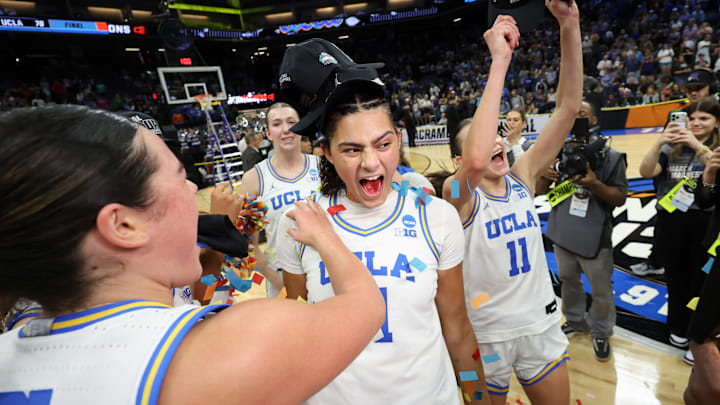
SACRAMENTO — As the confetti swirled and the ladder was set under the net, Lauren Betts asked her coach to find her coach.
UCLA coach Cori Close darted out to wave down Grandview High School coach Josh Ulitzky. They both knew what it meant to lead a team whose star was Betts. Yet they had not coached the same player, and they had not coached the same person, either. Over her four years in college, Betts has developed into a top WNBA prospect. The 6'7" center has grown her game—improving her mobility, developing in midrange, becoming more aggressive at the rim and more comfortable away from it. But she also needed to grow in a way that was far trickier. Betts had to learn how to believe in what she can do and trust herself to do it.
Which is what gave Close the opportunity to bring Ulitzky out to the floor on Sunday. No. 1 seed UCLA had just beaten No. 3 Duke, 70–58, to advance to the Final Four. It was a much less comfortable win than was suggested by the score. UCLA found itself closer to losing here than it had been in any game in months.
The Bruins were behind for more time than they were ahead. They went back to the locker room at halftime down by eight. This is not a group familiar with tight action or comeback wins: UCLA had trailed at the half just once prior to Sunday. The Bruins lost that game to fellow NCAA tournament No. 1 seed Texas back in November and have not lost since. But in the Elite Eight against Duke, they were rattled by the Blue Devils' defense, fumbling repeatedly and failing to establish any kind of rhythm.
Close had told her team before the game that she wanted to see them finish with fewer than 10 turnovers. They had 12 in the first half. And of the many (many) things going wrong for UCLA, one was a lack of drive from Betts, usually their leading scorer and rebounder.
“Going into a game like this, sometimes you just take yourself out of your head,” Betts said. “And you realize, Oh, this is the Elite Eight and my season is on the line, so I’ve got to wake up a little bit. I don’t know. I think, going into the locker room, I was just pretty certain that I wanted to win this game… I just came out with the mentality, I’m just not going to lose.”
Countless players say that kind of thing. Betts has traditionally not been one of them. If her time at UCLA has been about developing her into a game-changing presence, it has also been about making her believe she can be that game-changing presence. Close has a saying that she likes to share with players: You can’t outperform your self-image. When Betts transferred to UCLA from Stanford three years ago, Close quickly realized there was not much of a problem with the performance, but there was a big one with the self-image.

When she was a teenager playing for Ulitzky in Aurora, Colo., Betts was still growing into her frame, and she was growing into her own skin, too. “This is a kid who used to walk hunched over, because she didn’t want people to see her,” Ulitzky said. Betts was a big player always trying to make herself smaller. She was the No. 1 prospect in her recruiting class. But that felt like a source of pressure rather than a source of pride.
Close has spent her time with Betts working to change that. It has been about far more than basketball: Betts has been open about how she has grappled with her mental health over the last few years. But it has been about basketball, too, and that has meant seeing a close game like this as an opportunity to show what she can do rather than being afraid of what she cannot. In the Elite Eight on Sunday, Close needed Betts to take herself out of her head and back onto the floor.
“Adversity comes, and hard things come, and doubt comes and pressure comes,” Close said. “But I think because of her committed work from the inside out, she was able to regroup mentally and get to neutral and focus on her next right stop.”
Betts finished with 23 points, 10 rebounds, five blocks and three assists. She was the only player who did not leave the court for the entire second half. This is as veteran a team as can possibly exist in college basketball: The five starters and their leading bench contributor Angela Dugalic are all either seniors or graduate students. They went to the Final Four last year, and to make a return trip, UCLA needed all of them to tap into that experience and settle in as the clock wound down. Dugalic, especially, shone in that group effort, finishing with 15 points, six boards and two key steals: “This is a business trip,” she said. “We have a job to do, and that’s to win a national championship.” But there was no debate to be had about Most Outstanding Player.
It's only right that they brought the dance back 🪩😃
— NCAA March Madness (@MarchMadnessWBB) March 29, 2026
📺 ABC #MarchMadness x @UCLAWBB pic.twitter.com/zC96SxD3mT
It was, of course, Betts.
A tournament staffer initially tried presenting the regional trophy to Close. She shook her head and pointed to Betts. The player tried copying her coach here, pointing her own finger at Close, insisting that she be the first to touch the trophy. Close would not let her: Betts had earned this one. And so she stepped forward and took it.
Ulitzky watched her take the trophy and dance with her teammates and climb the ladder to cut down the net. Betts ran over at one point for a celebratory picture with her old coach. And what stood out was not the Final Four hat on her head or the confetti stuck to her shirt. It was that she did not bend down to squeeze herself into the frame. Betts stood up perfectly straight.
More March Madness from Sports Illustrated
 Add us as a preferred source on Google
Emma Baccellieri is a staff writer focused on women’s basketball for Sports Illustrated. She previously covered MLB. She has also written for Baseball Prospectus and has been honored with multiple awards from the Society of American Baseball Research. A graduate of Duke University, she lives in Washington, D.C.
Follow emmabaccellieri