%20%20--%3E%0A%3Csvg%20version%3D%221.1%22%20id%3D%22Layer_1%22%20xmlns%3D%22http%3A%2F%2Fwww.w3.org%2F2000%2Fsvg%22%20xmlns%3Axlink%3D%22http%3A%2F%2Fwww.w3.org%2F1999%2Fxlink%22%20x%3D%220px%22%20y%3D%220px%22%0A%09%20width%3D%2239px%22%20height%3D%2240px%22%20viewBox%3D%220%200%2039%2040%22%20enable-background%3D%22new%200%200%2039%2040%22%20xml%3Aspace%3D%22preserve%22%3E%0A%3Cpath%20fill%3D%22%23FFFFFF%22%20d%3D%22M38.5%2C7H28.2v26h10.3V7z%22%2F%3E%0A%3Cpath%20fill-rule%3D%22evenodd%22%20clip-rule%3D%22evenodd%22%20fill%3D%22%23FFFFFF%22%20d%3D%22M26.1%2C25.5c0%2C5.8-4.1%2C7.5-12.9%2C7.5C3.9%2C33%2C0%2C31.2%2C0%2C25.2v-1.1h11.6%0A%09v2.4c0%2C0.7%2C0.1%2C1.4%2C1.2%2C1.4c1%2C0%2C1.2-0.4%2C1.2-1.3v-0.9c0-1.6-0.9-1.6-3.5-2.2C2.2%2C21.7%2C0%2C19.7%2C0%2C15.3v-0.9C0%2C9.3%2C5.5%2C7%2C12.9%2C7%0A%09c10.2%2C0%2C12.8%2C2.6%2C12.8%2C7.4v1.8h-11v-2.9c0-0.6-0.4-1.1-1.2-1.1c-0.6%2C0-1.2%2C0.4-1.2%2C1.1v0.9c0%2C1.5%2C0.9%2C2%2C3.3%2C2.5%0A%09c8%2C1.6%2C10.5%2C3.3%2C10.5%2C7.5V25.5z%22%2F%3E%0A%3C%2Fsvg%3E%0A)
Why Michigan Could Absolutely Beat Texas to Take a Final Four Spot
In this story:
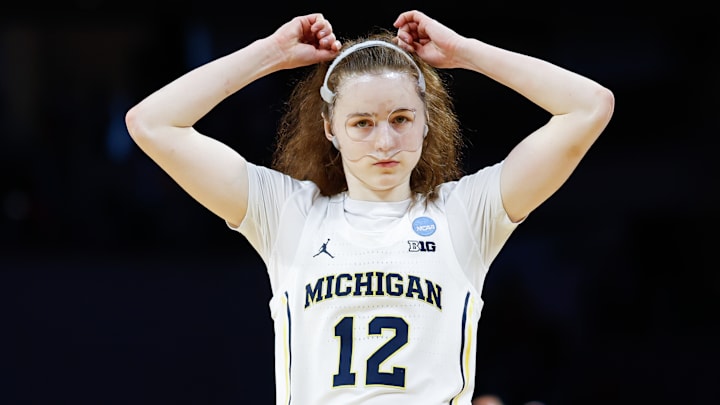
FORT WORTH — When Texas women’s basketball coach Vic Schaefer watches Michigan, he sees a team just like his own. He might be the only one.
Most fans—and Vegas oddsmakers—expect a long and winding women’s college basketball season to end right where it began. Preseason No. 1 UConn and No. 3 UCLA are returning to the Final Four. Preseason No. 2 South Carolina and No. 4 Texas can join them Monday. Those four teams are considered a cut above everyone else. But preseason No. 13 Michigan thinks it can break the chalk.
The Longhorns expect to win, because they almost always do. But the Wolverines expect to beat the best teams in the country, because they nearly have. In November, they came a lot closer to beating UConn than anybody else has this season; they fell behind by 20 at the Mohegan Sun casino in Connecticut, but came back and had a chance to win in the final minute.
In January, they lost to Vanderbilt by three at a neutral site. In February, they lost to UCLA by three at home.
This is not Notre Dame needing to play a nearly perfect game to beat UConn. Michigan has several WNBA prospects and has throttled four straight NCAA tournament opponents. As great and tough as Texas is, the Longhorns are not as complete or as talented as UConn.
Texas is favored, for obvious reasons. The Longhorns have been ranked between No. 2 and No. 4 in the AP poll the entire season. They beat mighty South Carolina twice in three tries, including a 17-point win in the SEC tournament title game. There is nothing to project: Texas has repeatedly shown, over multiple seasons, that it is a national-championship contender.
Michigan is a different story. The Wolverines’ top four scorers are all sophomores. They have never beaten a team as good as Texas. But they are improving rapidly, even from game to game, and if Michigan wins this, people might look back, in 10 years, and be surprised that they were surprised.
The Wolverines are young, but they don’t play like they’re young. They are unlikely to be overwhelmed by the moment, the way UCLA was against UConn in last year’s Final Four. They actually have a lot more in common with Texas and even UConn than people might think.
Schaefer adores this Texas team: “I’m not trading any of mine for anybody,” he said this weekend. But he sees that Michigan coach Kim Barnes Arico’s group has similar DNA.
“Her team plays really, really hard,” Schaefer said, “like mine does. Watching film on them … boy, they can play a lot of different ways defensively.”
Barnes Arico pointed out that “Texas has a little bit more size than us,” and also that “they have a little bit more experience and depth.” Both are indisputable. But will that matter?
Texas star Madison Booker is a mismatch against anyone she faces. If she gets Michigan’s Ashley Sofilkanich and Olivia Olson into foul trouble quickly, the Wolverines are in trouble. But that is less likely than one might think. Booker only averages four free throws per game.

As for size: Michigan actually had a slightly better rebounding margin this season (plus-9.2) than Texas (8.9). The Wolverines grabbed more offensive rebounds than UConn and UCLA when they played them. Guard Brooke Quarles Daniels is only 5'7", and in the Sweet 16, she gave up three inches to every player in Louisville’s rotation, yet she outrebounded them all.
Size matters in ways beyond rebounding. Booker is so strong that she can bully her way past any defender—and if you sag defensively to brace for it, she will destroy you with midrange shots. The Longhorn guards are big and physical; they could overpower Michigan’s young players.
But in the modern game, small and skilled often beats large and strong, by hitting more threes and forcing slower players to guard out on the perimeter.
Texas actually shot a slightly higher percentage on three-pointers than Michigan, but the Wolverines are a much more dangerous three-point shooting team. That sounds like a contradiction inside a paradox wrapped up in a lie. But look closer:
There are 359 Division I basketball teams. Texas was 357th in three-pointers attempted. Only Yale (which went 3-11 in the Ivy League) and UT-Arlington (which finished last in the WAC) shot fewer threes per game. The Longhorns shoot threes when they are wide open, which makes the percentage respectable. But because they shoot so few threes, they rarely make enough to swing a game. Jordan Lee is the only Texas player who shoots more than one three per game and makes at least 33% of them.
Michigan’s Syla Swords has shot 35% from three in her two-year college career, and that number probably undersells her ability, because Swords tends to shoot when she thinks her team needs her to shoot, rather than when she is open. She will bail her team out when the shot clock is winding down but pass up good looks to find a teammate. Swords has a quick release that allows her to make shots against anyone. Mila Holloway, Olson and Te’Yala Delfosse are all threats from three.
It’s possible that Michigan is not quite ready to beat Texas. It is possible that a week from now, the Longhorns will be national champions. But let’s put the assumptions aside for one night.
More March Madness from Sports Illustrated
 Add us as a preferred source on Google
Michael Rosenberg was a senior writer for Sports Illustrated, covering any and all sports. He writes columns, profiles and feature stories and has covered almost every major sporting event. He joined SI in 2012 after working at the Detroit Free Press for 13 years, eight of them as a columnist. Rosenberg is the author of “War As They Knew It: Woody Hayes, Bo Schembechler and America in a Time of Unrest.” Several of his stories also have been published in collections of the year’s best sportswriting. He is married with three children.
Follow rosenberg_mike