%20%20--%3E%0A%3Csvg%20version%3D%221.1%22%20id%3D%22Layer_1%22%20xmlns%3D%22http%3A%2F%2Fwww.w3.org%2F2000%2Fsvg%22%20xmlns%3Axlink%3D%22http%3A%2F%2Fwww.w3.org%2F1999%2Fxlink%22%20x%3D%220px%22%20y%3D%220px%22%0A%09%20width%3D%2239px%22%20height%3D%2240px%22%20viewBox%3D%220%200%2039%2040%22%20enable-background%3D%22new%200%200%2039%2040%22%20xml%3Aspace%3D%22preserve%22%3E%0A%3Cpath%20fill%3D%22%23FFFFFF%22%20d%3D%22M38.5%2C7H28.2v26h10.3V7z%22%2F%3E%0A%3Cpath%20fill-rule%3D%22evenodd%22%20clip-rule%3D%22evenodd%22%20fill%3D%22%23FFFFFF%22%20d%3D%22M26.1%2C25.5c0%2C5.8-4.1%2C7.5-12.9%2C7.5C3.9%2C33%2C0%2C31.2%2C0%2C25.2v-1.1h11.6%0A%09v2.4c0%2C0.7%2C0.1%2C1.4%2C1.2%2C1.4c1%2C0%2C1.2-0.4%2C1.2-1.3v-0.9c0-1.6-0.9-1.6-3.5-2.2C2.2%2C21.7%2C0%2C19.7%2C0%2C15.3v-0.9C0%2C9.3%2C5.5%2C7%2C12.9%2C7%0A%09c10.2%2C0%2C12.8%2C2.6%2C12.8%2C7.4v1.8h-11v-2.9c0-0.6-0.4-1.1-1.2-1.1c-0.6%2C0-1.2%2C0.4-1.2%2C1.1v0.9c0%2C1.5%2C0.9%2C2%2C3.3%2C2.5%0A%09c8%2C1.6%2C10.5%2C3.3%2C10.5%2C7.5V25.5z%22%2F%3E%0A%3C%2Fsvg%3E%0A)
Why No. 3 Michigan Hoops Losing Its Dominant Early Form Isn’t a Reason to Panic
In this story:
ANN ARBOR, Mich. — The curse of being anointed November national champions is a standard that sometimes feels unattainable. Simply winning stops being enough; style points become a necessity, questions raised about peaking too early almost a guarantee.
All that is especially true when you win the November championship as convincingly as Michigan did, in 40-point blowout fashion over Gonzaga in the Players Era Championship final in a game that felt closer to Globetrotters vs. Generals than one top-10 team vs. another. It continued to build with six more consecutive 18-plus-point wins. Michigan wasn’t just beating opponents, it was throttling them en route to record KenPom efficiency margins and even talk of undefeated seasons.
January has exposed No. 3 Michigan for its flaws. It started with a sloppy showing against lowly Penn State and followed up by the Wolverines’ first loss of the season to Wisconsin. The Wolverines’ response to that surprising loss hasn’t been as resounding as their November and December form, failing to fully blow away inferior foes like Ohio State and Oregon. It was clear we’d learn a lot about the Wolverines this week, with a home tilt against undefeated and No. 5-ranked Nebraska before a rivalry showdown with No. 7 Michigan State on Friday.
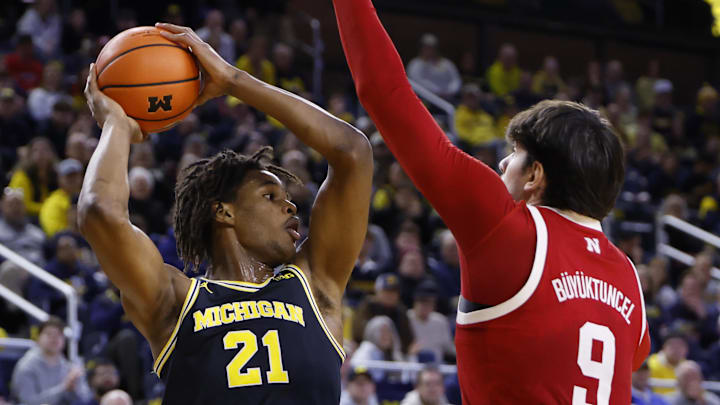
And while Tuesday’s 75–72 win over the Cornhuskers was a far cry from Michigan’s Players Era form, it also served as a reminder of the Wolverines’ potency and why it will take a monster effort to fully topple this team come March.
First, the bad. Nebraska was significantly undermanned, with sharpshooting wing Braden Frager sidelined with an ankle injury and forward Rienk Mast unable to go (after initially planning to play) due to illness. That left the Huskers undersized, lacking a pair of key offensive weapons and with little-to-no bench production. Yet somehow Fred Hoiberg’s team trailed just once (at 3–2) in the game’s first 38:53 before Michigan guard Trey McKenney’s bucket finally provided a breakthrough that felt like it was coming all night. Michigan got plenty of good looks from deep but couldn’t make Nebraska pay, shooting 6 of 26 from three to drop the Wolverines’ January deep shooting to just 28%. The turnovers, also a bugaboo of late, added up quickly with 19. And defensively, Wolverines coach Dusty May was frustrated with missed assignments that allowed Huskers guard Jamarques Lawrence and forward Pryce Sandfort to torch the nets in the first half en route to 50 Husker points at halftime.
Got all that?
Michigan didn’t have the shotmaking or offensive execution to deliver the type of knockout blows it so regularly dealt its November and December foes. Instead, this was a body-blow game. Michigan won with its offensive rebounding, its high-effort scrambles for loose balls that drew fouls, its energy and activity chasing Nebraska’s never-tiring shooters off the line in critical moments. It’s less flashy to go the distance in a heavyweight fight, but the best fighters can do both.
“They were tired early in the game,” forward Morez Johnson Jr., the team’s energizer bunny with a game-high 12 boards, said. “We’re very deep, you know, and that helped us a lot.”
Need evidence? Look at how Michigan scored its final 16 points to finally overcome the pesky Cornhuskers. Ten were off Nebraska turnovers, and four more were off critical offensive rebounds. Playing this Michigan team, dealing with the constant threat of center Aday Mara blocking your shot or Johnson flying past you on the glass or forward Yaxel Lendeborg breaking loose in transition and tearing down the rim, is both mentally and physically exhausting. And the result of dealing with it over a 40-minute game? Eventually, it’s backbreaking.
“You don’t notice it while you’re playing the game, but you notice it definitely when you go back and watch the film,” Johnson said. “Some guys aren’t crashing the glass anymore because we’re putting a body on them, or they’re not boxing out [as well] because we’re relentless on the grind.”
And the result is a Wolverine team that now sits at 19–1 overall and 9–1 in the Big Ten at the halfway point of league play. They have every chance to secure a conference title in a league with a stronger top-five teams than any in college basketball. May talked in November about the inspiration for building the three-headed frontcourt monster that has defined this Michigan season and how it upped their margin for error defensively when he was an assistant at Florida. That showed itself in the second half, while Michigan’s sheer size and effort was enough to disrupt one of the hardest-to-guard offenses in the country and held the Huskers to just 22 points in the game’s final 20 minutes.
“In the instances where we defended the three and they were able to get behind our switches, just our second effort was able to get there and change the shot with our size, length and athleticism,” May said. “Ultimately, I thought that was the difference, just the fact that we weren’t giving up on plays, even when we made a mistake … especially in the last eight or 10 minutes of the game.”
May is known not to get too high or low; his demeanor Tuesday while complaining about his team’s turnover woes and lack of offensive flow felt strangely similar to how he spoke after demolishing teams in the weeks before. He always expected his team to take some blows in Big Ten play, was well aware the days that his most important in-game question was when to put his son in were numbered. But now that Michigan’s experiencing that bump, the Wolverines’ second-year head coach gets to learn the lessons that aren’t always apparent when you’re blowing away opponents by the halftime buzzer.
“I didn’t think we did a whole lot of things well [Tuesday] other than just our sheer determination to win in the last four to five minutes was impressive,” May said.
Friday’s trip to East Lansing, Mich., will put Michigan up against one of the few teams that seems likely to be able to withstand the Wolverines’ brute force and physicality, all in a rarely forgiving building for those in maize and blue. A repeat of many of the sloppy moments from Tuesday would likely mean wrapping up a bumpy January with a loss to their bitter rival.
But for now, Michigan can take solace in the fact that it doesn’t need its best to beat college basketball’s third-to-last unbeaten. And even in the performances that leave you wanting more, Michigan has the size, the depth, the talent and want necessary to battle with the best of the best.
More College Basketball from Sports Illustrated
Listen to SI’s college sports podcast, Others Receiving Votes, below or on Apple and Spotify. Watch the show on SI’s YouTube channel.
 Add us as a preferred source on Google
Kevin Sweeney is a staff writer at Sports Illustrated covering college basketball and the NBA draft. He joined the SI staff in July 2021 and also serves host and analyst for The Field of 68. Sweeney is a Naismith Trophy voter and ia member of the U.S. Basketball Writers Association. He is a graduate of Northwestern University’s Medill School of Journalism.