%20%20--%3E%0A%3Csvg%20version%3D%221.1%22%20id%3D%22Layer_1%22%20xmlns%3D%22http%3A%2F%2Fwww.w3.org%2F2000%2Fsvg%22%20xmlns%3Axlink%3D%22http%3A%2F%2Fwww.w3.org%2F1999%2Fxlink%22%20x%3D%220px%22%20y%3D%220px%22%0A%09%20width%3D%2239px%22%20height%3D%2240px%22%20viewBox%3D%220%200%2039%2040%22%20enable-background%3D%22new%200%200%2039%2040%22%20xml%3Aspace%3D%22preserve%22%3E%0A%3Cpath%20fill%3D%22%23FFFFFF%22%20d%3D%22M38.5%2C7H28.2v26h10.3V7z%22%2F%3E%0A%3Cpath%20fill-rule%3D%22evenodd%22%20clip-rule%3D%22evenodd%22%20fill%3D%22%23FFFFFF%22%20d%3D%22M26.1%2C25.5c0%2C5.8-4.1%2C7.5-12.9%2C7.5C3.9%2C33%2C0%2C31.2%2C0%2C25.2v-1.1h11.6%0A%09v2.4c0%2C0.7%2C0.1%2C1.4%2C1.2%2C1.4c1%2C0%2C1.2-0.4%2C1.2-1.3v-0.9c0-1.6-0.9-1.6-3.5-2.2C2.2%2C21.7%2C0%2C19.7%2C0%2C15.3v-0.9C0%2C9.3%2C5.5%2C7%2C12.9%2C7%0A%09c10.2%2C0%2C12.8%2C2.6%2C12.8%2C7.4v1.8h-11v-2.9c0-0.6-0.4-1.1-1.2-1.1c-0.6%2C0-1.2%2C0.4-1.2%2C1.1v0.9c0%2C1.5%2C0.9%2C2%2C3.3%2C2.5%0A%09c8%2C1.6%2C10.5%2C3.3%2C10.5%2C7.5V25.5z%22%2F%3E%0A%3C%2Fsvg%3E%0A)
Indiana Continues Power Shift With Historic Rose Bowl Beatdown of Alabama
In this story:
PASADENA — It rained a lot here Thursday morning, and it did not matter. Sideways sleet would not have dampened the utter joy of the tens of thousands of Indiana fans who came to never-never land, also known as the Rose Bowl. They wore rain ponchos and wide smiles while pouring into this august venue, and looks of utter euphoria while floating out.
They came in massive numbers for the school’s first Rose Bowl in 58 years, dwarfing the Alabama contingent. The Hoosiers’ average home attendance this season was almost exactly half of the Crimson Tide’s, 51,184 to 100,077, but they more than doubled Bama’s crowd here.
“It felt like a home game,” says Indiana linebacker Isaiah Jones.
The Hoosiers’ biggest football moment and grandest stage became their finest hour, a 38–3 destruction of once-great Alabama. The losingest program in FBS history beat one of the sport’s bluebloods in every manner possible—beat them up, beat them down, broke them into a thousand tiny pieces.
The margin of defeat was the Tide’s largest since 1998. It was also the largest of this College Football Playoff—bigger than the losses endured by Tulane and James Madison, the teams the elitists didn’t want to play. Any of those folks piping up to say this game was terrible for the sport? Any hand-wringing poppycock about this mismatch being a “safety issue”?
Power-conference programs can be blown out, too.
Indiana also shattered the streak of playoff losses by teams that had first-round byes. It had reached six in a row—all four last season, and the first two in this one—before the Hoosiers ended it with brutal efficiency.
Maybe it’s a disadvantage to play after a long layoff against an opponent that knocked the rust off with a first-round game. Maybe Indiana is too good for it to matter.
That’s the reality that keeps sinking in, one victory after another after another. The stubborn nonbelievers have now seen the Hoosiers beat Ohio State and Alabama, two of the top-five programs in the history of the sport, in consecutive games.
Coming here, there were holdouts. Some viewed this through the prism of recruiting—Alabama had nine five-star players in the starting lineup; Indiana has never even signed a single five-star. Some viewed it as a laundry contest, falling back on tradition instead of a here-and-now game between a powerhouse that had proven itself and a flawed competitor.
The holdouts couldn’t quite wrap their brains around how much better Indiana is than Alabama, until it played out that way in dominant fashion.
The Hoosiers executed with cold-blooded precision. They ran effectively when they needed to, racking up 215 yards—the most Alabama allowed since September. They passed brilliantly when they needed to—Heisman Trophy winner Fernando Mendoza’s 250.2 pass efficiency rating was better than any single game Joe Burrow had during his Heisman season of 2019. Their blocking was dominant—lineman Pat Coogan was voted the offensive MVP of the game. Their tackling was airtight and violent. Their special teams were solid. They never self-sabotaged, committing zero turnovers and being flagged for one penalty.

It was a complete performance by a total team. None of them came to Indiana as superstars, but they’re going to leave that way.
“The thing about this unit, right here,” said Indiana offensive line coach Bob Bostad, tapping his heart. “Because listen, we played a bunch of five-stars. We’re a bunch of two-stars. We’re just a bunch of guys. A bunch of truck drivers. You know what I mean? A bunch of schleps.”
The schleps won the Rose Bowl. Won it big. Won it bigger than anyone has won the Granddaddy of Them All since 2015, and by the sixth-biggest margin in its 112-game history.
Hence the giddiness postgame. Mendoza, a nerdy sort who is powered by unbridled enthusiasm, smiled so broadly through every interview that it looked like he might burst.
“Our entire team and our coaching staff really enjoy football, and I think that’s why we work so hard at it,” he said. “We work really hard every single day because not only do we enjoy football, we also enjoy winning. And we know what that takes.”

It takes Cignetti’s force of will, grabbing a downtrodden program by the collar and dragging it to greatness. He’s now 25–2 at Indiana, furthering the greatest coaching job anyone has ever seen.
It takes a defense, coordinated by Bryant Haines, that didn’t even miss the nation’s No. 2 player in tackles for loss, injured end Stephen Daley. Even without him, Indiana hounded Alabama quarterback Ty Simpson, eventually knocking him out of the game, recording three sacks and five tackles for loss.
It takes Mendoza throwing just two incompletions and three touchdown passes, shaking off sacks on two of the first three plays and then picking Alabama apart. A guy who was the No. 134-rated quarterback in the recruiting class of 2022, originally committed to Yale and then went to Cal, has become the complete package. He has all the tangibles, plus all the intangibles.
“He’s the definition of a leader,” says receiver Charlie Becker, who caught the first of Mendoza’s TD passes Thursday. “He’s the definition of a locker room guy. He came in and immediately wanted to know everybody’s names, everybody’s faces so that he was able to build a good connection with them off the field so that it correlates to on the field.
“He’s such a hard worker. And I mean, he’s just an absolute dog.”
It takes a receiving corps that is elite at the wideouts and emerging at tight end, with Riley Nowakowski taking on a bigger role in the latter half of the season. It takes a hard-edged running back tandem of Kaelon Black and Roman Hemby, who hammered Bama for 99 and 89 rushing yards, respectively.

And it takes an offensive line that is dramatically improved over last season. Indiana was far more physical at the line of scrimmage than Alabama, which is a shocking statement given the programs’ respective histories.
“Just studs,” Coogan said of his teammates on the line.
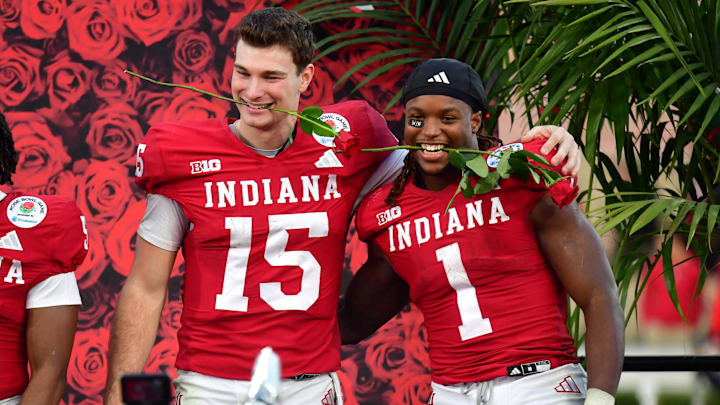
To complete the Indiana dream sequence here, the clouds finally parted late in the afternoon and the sun—normally a Rose Bowl staple—shined down on the delirious fans. They stayed in their seats for a long time, watching the players cavort on the field with roses clamped between their teeth. They raided the merchandise stands for keepsakes, then lingered outside the stadium as it grew dark.
None of them wanted Indiana’s finest football hour to end.
And now the greatest college football story ever told moves on to the next round, the penultimate round, the playoff Final Four. There is no raining on this parade, and there is no beating Indiana. Not yet, and perhaps not at all this season.
More College Football from Sports Illustrated
Listen to SI’s college sports podcast, Others Receiving Votes, below or on Apple and Spotify. Watch the show on SI’s YouTube channel.
 Add us as a preferred source on Google
Pat Forde is a senior writer for Sports Illustrated who covers college football and college basketball as well as the Olympics and horse racing. He cohosts the Others Receiving Votes podcast for SI and is a regular contributor to the Tony Kornheiser Show podcast. He previously worked for Yahoo Sports, ESPN and The (Louisville) Courier-Journal. Forde has won 28 Associated Press Sports Editors writing contest awards, has been published three times in the Best American Sports Writing book series, and was nominated for the 1990 Pulitzer Prize. A past president of the U.S. Basketball Writers Association and member of the Football Writers Association of America, he lives in Louisville with his wife. They have three children, all of whom were collegiate swimmers.
Follow ByPatForde