%20%20--%3E%0A%3Csvg%20version%3D%221.1%22%20id%3D%22Layer_1%22%20xmlns%3D%22http%3A%2F%2Fwww.w3.org%2F2000%2Fsvg%22%20xmlns%3Axlink%3D%22http%3A%2F%2Fwww.w3.org%2F1999%2Fxlink%22%20x%3D%220px%22%20y%3D%220px%22%0A%09%20width%3D%2239px%22%20height%3D%2240px%22%20viewBox%3D%220%200%2039%2040%22%20enable-background%3D%22new%200%200%2039%2040%22%20xml%3Aspace%3D%22preserve%22%3E%0A%3Cpath%20fill%3D%22%23FFFFFF%22%20d%3D%22M38.5%2C7H28.2v26h10.3V7z%22%2F%3E%0A%3Cpath%20fill-rule%3D%22evenodd%22%20clip-rule%3D%22evenodd%22%20fill%3D%22%23FFFFFF%22%20d%3D%22M26.1%2C25.5c0%2C5.8-4.1%2C7.5-12.9%2C7.5C3.9%2C33%2C0%2C31.2%2C0%2C25.2v-1.1h11.6%0A%09v2.4c0%2C0.7%2C0.1%2C1.4%2C1.2%2C1.4c1%2C0%2C1.2-0.4%2C1.2-1.3v-0.9c0-1.6-0.9-1.6-3.5-2.2C2.2%2C21.7%2C0%2C19.7%2C0%2C15.3v-0.9C0%2C9.3%2C5.5%2C7%2C12.9%2C7%0A%09c10.2%2C0%2C12.8%2C2.6%2C12.8%2C7.4v1.8h-11v-2.9c0-0.6-0.4-1.1-1.2-1.1c-0.6%2C0-1.2%2C0.4-1.2%2C1.1v0.9c0%2C1.5%2C0.9%2C2%2C3.3%2C2.5%0A%09c8%2C1.6%2C10.5%2C3.3%2C10.5%2C7.5V25.5z%22%2F%3E%0A%3C%2Fsvg%3E%0A)
Inside the Mind of Curt Cignetti, College Football’s Most Relentless Winner
In this story:
Consider the office desk of Curt Cignetti: organized, fastidious and, upon inspection, clearly the domain of a pre-Internet mind. There is a computer, of course, but more important clues about the makeup of the 65-year-old Indiana football coach are elsewhere on its surface.
It is the workspace of someone who regularly takes up a pen and writes plans and ideas down on paper, as opposed to pounding at a keyboard or tapping on a phone.
On one particular day in May, there are three yellow legal pads on the desk: two off to one side, a pair of reading glasses sitting on top; the other front and center, with a black pen resting on a page of notes arranged in various groupings. The lettering is small and precise—nothing loopy or sloppy here—as if written by an architect.

In one corner of the desk is a more revealing document. It is the Hoosiers’ 2026 schedule, painstakingly handwritten and color coded. Each opponent and its 2025 record are inscribed in black ink; the name of the head coach, his age and his career record are in blue; and what teams each opponent will have faced before taking on the Hoosiers is in red. Is there another head coach in the country who would write this out himself?
Also on the right side of the desk, three 3x5 notecards are taped down. Brief program philosophies are written on them in black ink. Some are commonplace bromides, the type almost every coach in America espouses. But the message on one card stands out:
SOFTNESS WILL NOT BE TOLERATED HERE!
FIND THE EDGE—DAILY/HOURLY
COMMIT ALL AROUND
Cignetti is authoring a new narrative now, the sequel to a masterpiece. Indiana is not just the reigning national champion, coming off the first 16–0 major-college record since the 19th century; it is the most astounding success story in the history of a rigidly hierarchical sport. What had been the losingest FBS program of all time produced one of the greatest seasons of the modern era.
How does anyone follow that?
By approaching this year’s blank page like all the previous years. The routines remain.
Put nose to grindstone. Put focus on every detail. Put plan into action. Put complacency firmly to rest. Put wins on the board. Put the world on notice. Put pen to paper. So let it be written, so let it be done.
Cignetti won so many Coach of the Year awards last season that he doesn’t have adequate office space to display them. One, named after a legend in the sport, is stashed on a side counter next to a box of Starbucks coffee pods. But individual glory doesn’t matter much in Cig’s world view, and what he did last year won’t buy a cup of coffee this year.
“A lot of requests,” Cignetti says of the offseason hoopla. “A lot of people tugging on your time, commercial things, speaking things that come with money. But you say yes to one and you open the door, and so it was pretty much a hard no [except for driving the Indy 500 pace car and visiting the White House]. It’s business as usual in the building.”

You can’t find the edge daily/hourly if you’re looking backward and celebrating yourself. The Hoosiers have clearly arrived as a force in college football, but an internal wariness of what accompanies that arrival remains.
Take wide receiver Nick Marsh, a high-profile, high-dollar transfer from Michigan State. The 6'3", 213-pound Marsh is an impressive talent, having caught 100 passes in two seasons for the Spartans. But the team went 9–15 in that time, including a pair of blowout losses to Indiana.
When Marsh showed up for spring practice at Indiana wearing gold cleats, Cignetti had an opportunity to send a message. “He learned what getting your ass ripped is all about,” the coach said at the time. “I don’t know if that happened to him very often at Michigan State.”
The situation was handled. Marsh got it. Cignetti moved on.
“The gold cleats were kind of sticking out,” he says. “It wasn’t a big deal.”

Cignetti has mined the transfer portal as well as anyone in the last few seasons. But like his former boss at Alabama, Nick Saban, Cignetti has a resistance to publicly elevating players before they’ve done something in his program. This is the third straight season that Indiana will start an incoming transfer quarterback, and the third straight season that quarterback was not among the Hoosiers to attend Big Ten media days. Senior linebacker Isaiah Jones, senior defensive tackle Tyrique Tucker and senior offensive tackle Carter Smith drew the assignment this year.
“They’re the guys that are back that played winning and productive football,” Cignetti says. “That’s where your leadership begins.”
Fernando Mendoza would go on to win the Heisman Trophy and become the No. 1 pick in the NFL draft, but the Cal transfer was hardly a front-and-center media presence until after he’d played his first game for the Hoosiers. Even after Mendoza blossomed into a star, his availability other than for postgame interviews was limited throughout the season. The same will likely be the case with this year’s import QB, Josh Hoover, from TCU.
This was not a new approach for Cignetti, nor has his recent success been a new development. This is who he’s always been, producing remarkably similar teams with remarkably similar attributes across 15 straight winning seasons in four jobs at four levels of college football, from Division II to FCS to mid-major FBS to a Power 4 program.
Team over individual? That mantra goes back much deeper than Marsh’s pair of gold cleats. Take Cignetti’s first team meeting at James Madison after taking over that FCS powerhouse in December 2018.
Cignetti had arrived from Elon, where he’d broken the school’s six-year streak of losing seasons. The biggest win in his two years with the Phoenix? A road upset over JMU, which was ranked No. 2 and riding an 18-game home winning streak.
Dukes quarterback Cole Johnson, who would go on to start two years under Cignetti, remembers the message from that meeting.
“You guys are a team of individuals,” Cignetti said, relaying what he had seen on film and from the opposing sideline. “You’re all about me, all about I.”
“His first thing was to get that out of us,” Johnson says.

In Cignetti’s fifth game at James Madison, the Dukes beat Elon 45–10. For both programs, that represented the year-over-year difference between having Cig and not having Cig.
The 2019 Dukes went 14–2, losing in the FCS championship game to North Dakota State. Like the Cignetti teams that had come before that one, and those that would come after, the statistical profile is a veritable overlay in some key areas.
Turnover Margin
James Madison was a +10 that first season, which actually is not one of the more remarkable advantages in Cignetti’s 15 seasons as a head coach. His last team at his first stop, Indiana University of Pennsylvania, led Division II at +25 in 2016. His ’21 JMU team led FCS at +19. And the ’25 Hoosiers led FBS at +22. For his career, Cignetti is +160 in the stat that correlates most strongly to winning, with just a single season in which the turnover margin was upside down. (Hard to imagine what life was like with Cig in 2014, when his IUP team was a -12 in that category.)
Along the way to last year’s +22, Indiana did something that has never been done by a team that played 14 or more games—it lost just one fumble. That came in the first quarter of the season opener, against Old Dominion. Thereafter, the Hoosiers ran an incomprehensible 1,047 offensive plays without another.
Part of that is luck, with an oblong ball that never bounced the wrong way on the seven other occasions it was loose. But it’s also attributable to the laser focus on minimizing costly errors.
“We preach it,” Cignetti says. “You still got to go out there and do it. You got to remember before you can win the game, you can’t lose the game. And how do you lose the game? Well, turnovers are number one. Those equal points, egregious missed assignments on both sides of the ball, presnap penalties, disasters in the kicking game, that kind of thing.”
Penalties
In nine seasons at the FCS and FBS levels, Cignetti has never had a team finish in the bottom half of the nation in fewest penalty yards per game. More often than not, they’re in the top 30. Elon led the nation in fewest penalty yards in 2018 at 20 per game, and Indiana last year was second only to Army, at 27.6. In no game last season were the Hoosiers flagged for 50 yards in penalties, something not even the Black Knights could say.
Efficient Quarterback Play
When Temple transfer Lenny Williams became Cignetti’s starting quarterback at IUP in 2015, he was a dual-threat player with unpolished passing skills. The coach drilled home the importance of ball security, Williams recalls.
“I know you can play,” Cignetti told him. “Don’t worry about trying to do too much. Keep the ball on our side. Just be efficient. The defense is going to get stops and create turnovers.”
In Williams’s second season, he led the nation in pass efficiency while throwing just one interception. From 2019 to ’21, Cignetti’s JMU quarterbacks were either No. 1 or No. 2 nationally in efficiency (Ben DiNucci was second in ’19, Johnson was first in ’20 and then second in ’21.)
“He always told me that a throwaway is not a bad play,” Johnson says. “Reducing mistakes and keeping you out of bad plays was the emphasis.”
All told, seven straight Cignetti QBs have finished in the top 10 in efficiency at either the FCS or FBS level. Indiana offensive coordinator Mike Shanahan has been with Cignetti for a decade, helping to produce the same results, even as the QB turnover has been brisk.
This is their best enticement for signing a top transfer at that position: In their one and only year under Cignetti and Shanahan, four straight QBs have had their lifetime best seasons statistically. From Todd Centeio in 2022 (a 169.0 efficiency rating, fourth in the nation) to Jordan McCloud in ’23 (165.94, 10th) at JMU to Kurtis Rourke (176.01, second) to Mendoza (182.91, first) at IU, the spikes have been pronounced.

If Hoover is next in line to make a big jump, the result could be spectacular. He’s posted two straight seasons of efficiency marks higher than 150, whereas Mendoza’s high at Cal was 144.59.
“Josh innately really understands how to play quarterback,” Cignetti says. “I think he’s a super smart guy. The position comes very natural to him. He’s got a quick release. Fernando’s three inches taller and 25 pounds heavier, and that’s the biggest difference. But you got a guy that understands how to play quarterback.”
Cignetti understands how to play quarterback, too. He just wasn’t very good at it.
On Sept. 12, 1981, West Virginia opened the season with a 32–18 victory at Virginia. In that game, junior backup QB Curt Cignetti threw a pass that fell incomplete. There was also a run for zero yards. That is the sum total of his varsity collegiate stats.
Cignetti’s father, Frank, was the coach of the Mountaineers from 1976 to ’79. While battling cancer, Frank was fired after Curt’s freshman year. But he retained an administrative job at WVU and had an office in the basketball coliseum. Given his dad’s health situation, Curt chose to stay at the school, remain close to his parents and finish his career there under Don Nehlen, knowing that he had little chance of playing.
“He wasn’t a good athlete, I think he’d be the first to admit that,” says Oliver Luck, the Mountaineers’ starting QB from 1979 to ’81, who went on to play in the NFL, and is the father of former NFL star QB Andrew Luck. “But you could tell he was the son of a coach. He absorbed everything. He was great for me to have on the sideline because he saw everything.
“We all probably predicted he’d go into coaching. But I don’t think any of us would have said he’d win a national championship.”

Cignetti’s career path was indeed set. He started as a graduate assistant at Pittsburgh and wound through four other schools (plus a second stop at Pitt) before landing on Saban’s staff at Alabama in 2007. After four seasons there, he took a step backward to propel his career forward, accepting the job at obscure IUP—where his father had a 20-season Hall of Fame tenure after leaving West Virginia.
Curt Cignetti’s winning began immediately and has never stopped. Did he retain a chip on the shoulder about not getting a powerconference job until age 62? Nobody disputes that. Cignetti’s still finding the edge daily/hourly.
Go back to his handwritten schedule on the desk, the one that notes the age of every opposing head coach. It’s not hard to imagine Cignetti deriving satisfaction from taking so many younger coaches to the woodshed in his 27–2 run at Indiana.
The onetime football graveyard is now full of life and thriving. Along the way, Cignetti transformed himself from an entertaining loudmouth into a figure approaching Bob Knight stature. The blast of bombast that came with his arrival—from “Purdue sucks, but so does Michigan and Ohio State,” to the famed “I win, Google me”—has been toned down and replaced with substance. He got the beatendown Hoosier fan base’s blood pumping with boldness, but winning is the best way to keep the pulse pounding.
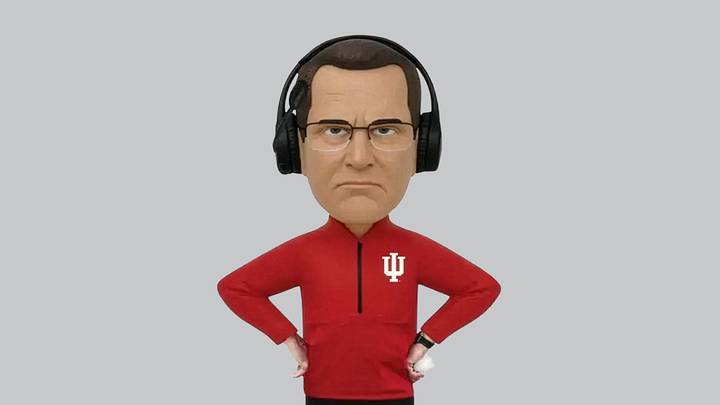
The result has been a meteoric ascension to icon status. His famously scowling face is the dominant image on a new mural in downtown Bloomington, and CIGNATTY T-shirts are hot sellers in town. Upland Brewery, which in the spring debuted a “4th & Five Cream Ale” in honor of Mendoza’s immortal touchdown run in the CFP championship game, has publicly promised Cignetti beer for life.
All of that, and the pay raise to a top-of-market $13.2 million a year (and, oh yeah, a recent national State Farm commercial and a star turn on the cover of EA Sports College Football 27), might be enough to ignite a power trip for a regular coach. For Cignetti, it’s all background noise.
Buy a vacation home somewhere? No. Get rid of his prized, ancient turquoise living room recliner? No. He took the family on an offseason vacation to St. Barts in the Caribbean, using his contractual private jet perk, but even there he had a hard time turning off his brain.
Asked for the longest period of time he’d gone during the offseason without thinking about football, Cignetti smiles (really) and says, “Five minutes, maybe 10.” When pressed for a serious answer, he says he might make it a day.
He’s just not good at downtime. Or wasting time. His practices are short and highly focused, set at almost game tempo. Away from the football facility, life is similarly structured.
Even when going out to dinner was feasible— before he reached icon status—it was a chore for Cignetti. “To sit at a restaurant for an hour,” he says, “I’m highly incapable of that.”
Know what he can do for hours on end? Watch film.
Johnson, the former JMU quarterback, remembers Cignetti’s ability to recall a defensive formation or a play call from years earlier, find it on film and apply it to one of their game plans.
“It was pretty incredible to watch,” Johnson says. “He could watch film eight to 10 hours a day. He’s so passionate about football, I don’t know if he thinks about anything else.”
Cignetti was accommodating with his time for this story. But it was his second major sitdown interview of the day, and it was keeping him from what he really wanted to do that day: watch tape on a prospect.
Even before any of the lighting or video equipment from the interview had been packed up, the film junkie was at his desk with the video cued up on a projection screen on his wall. This is his happy place—studying football, with a notepad and a pen at hand. Even after crafting his greatest masterpiece, Curt Cignetti has more chapters to write.
PODCAST: Listen to SI’s college sports podcast, Others Receiving Votes, hosted by Pat Forde, below or on Apple and Spotify. Watch the show on SI’s college YouTube channel or on SI TV.
 Add us as a preferred source on Google
Pat Forde is a senior writer for Sports Illustrated who covers college football and college basketball as well as the Olympics and horse racing. He cohosts the Others Receiving Votes podcast for SI and is a regular contributor to the Tony Kornheiser Show podcast. He previously worked for Yahoo Sports, ESPN and The (Louisville) Courier-Journal. Forde has won 28 Associated Press Sports Editors writing contest awards, has been published three times in the Best American Sports Writing book series, and was nominated for the 1990 Pulitzer Prize. A past president of the U.S. Basketball Writers Association and member of the Football Writers Association of America, he lives in Louisville with his wife. They have three children, all of whom were collegiate swimmers.
Follow ByPatForde