%20%20--%3E%0A%3Csvg%20version%3D%221.1%22%20id%3D%22Layer_1%22%20xmlns%3D%22http%3A%2F%2Fwww.w3.org%2F2000%2Fsvg%22%20xmlns%3Axlink%3D%22http%3A%2F%2Fwww.w3.org%2F1999%2Fxlink%22%20x%3D%220px%22%20y%3D%220px%22%0A%09%20width%3D%2239px%22%20height%3D%2240px%22%20viewBox%3D%220%200%2039%2040%22%20enable-background%3D%22new%200%200%2039%2040%22%20xml%3Aspace%3D%22preserve%22%3E%0A%3Cpath%20fill%3D%22%23FFFFFF%22%20d%3D%22M38.5%2C7H28.2v26h10.3V7z%22%2F%3E%0A%3Cpath%20fill-rule%3D%22evenodd%22%20clip-rule%3D%22evenodd%22%20fill%3D%22%23FFFFFF%22%20d%3D%22M26.1%2C25.5c0%2C5.8-4.1%2C7.5-12.9%2C7.5C3.9%2C33%2C0%2C31.2%2C0%2C25.2v-1.1h11.6%0A%09v2.4c0%2C0.7%2C0.1%2C1.4%2C1.2%2C1.4c1%2C0%2C1.2-0.4%2C1.2-1.3v-0.9c0-1.6-0.9-1.6-3.5-2.2C2.2%2C21.7%2C0%2C19.7%2C0%2C15.3v-0.9C0%2C9.3%2C5.5%2C7%2C12.9%2C7%0A%09c10.2%2C0%2C12.8%2C2.6%2C12.8%2C7.4v1.8h-11v-2.9c0-0.6-0.4-1.1-1.2-1.1c-0.6%2C0-1.2%2C0.4-1.2%2C1.1v0.9c0%2C1.5%2C0.9%2C2%2C3.3%2C2.5%0A%09c8%2C1.6%2C10.5%2C3.3%2C10.5%2C7.5V25.5z%22%2F%3E%0A%3C%2Fsvg%3E%0A)
Lou Holtz, One of College Football’s Great Architects, Dies at 89
In this story:
“Welcome to ‘The Lou Holtz Show.’ Unfortunately, I’m Lou Holtz.”
That’s how the Arkansas Razorbacks’ lisping wisp of a football coach opened one of his weekly TV shows, after a particularly disappointing loss. Few consistent winners were as performatively, comedically mournful as Holtz. “Heck, people on the Titanic were optimistic,” he once said.
It was all an act. Most weeks during football season, it was great to be Lou Holtz.
Early in his career he won games he wasn’t supposed to, usually after a preamble of poor-mouthing that portrayed his team as desperately outmanned. Eventually, he won games he was supposed to, up to and including a national championship at Notre Dame in 1988—the last the school has claimed.

Holtz won 249 college games at six different stops, plus three in a regrettable one-year detour to the NFL. He led teams in five different college conferences across five different decades. Woody Hayes was once his boss. Pete Carroll and Urban Meyer were once his assistants. All three of them won more national titles than Holtz, but with less humor.
The small and slender former Kent State linebacker kept churning out wins and writing books (10 of them) and cracking jokes. After retiring from coaching, he had a long studio analyst stint on ESPN, often dressing up in judge robes alongside Mark May to make “rulings” on issues served up by Rece Davis. Post-ESPN he kept finding his way to microphones into his 80s, occasionally riling up people with his conservative political views or opinions on Ohio State’s toughness.
It was an extraordinary football life.
Holtz died Wednesday at age 89. There were NCAA rules compliance issues at more than one stop, and other controversies. But upon his passing, several schools will remember Holtz as the architect of some of their finest moments.
Remembering the life and legacy of Lou Holtz pic.twitter.com/8WiEtVr6fT
— Notre Dame Football (@NDFootball) March 4, 2026
He departs with the highest winning percentage in North Carolina State history among those who coached at least 20 games (.719); the highest winning percentage in Arkansas history among those who coached at least 75 games (.735); the highest winning percentage in Notre Dame history among those who coached at least 125 games (.765); and as the coach who first proved South Carolina could compete in the SEC.
A 12–7 NC State victory over No. 7 Penn State in 1974 paved the way to the Wolfpack’s first and only Top 10 final ranking. At Arkansas, Holtz suspended three running backs before the 1978 Orange Bowl game against No. 2 Oklahoma and still won in a rout, 31–6—the Razorbacks wound up No. 3 in the polls, and haven’t finished that high since. At South Carolina, Holtz beat ranked Georgia and Ohio State teams—the Bulldogs in September, the Buckeyes in bowl games—in consecutive seasons.

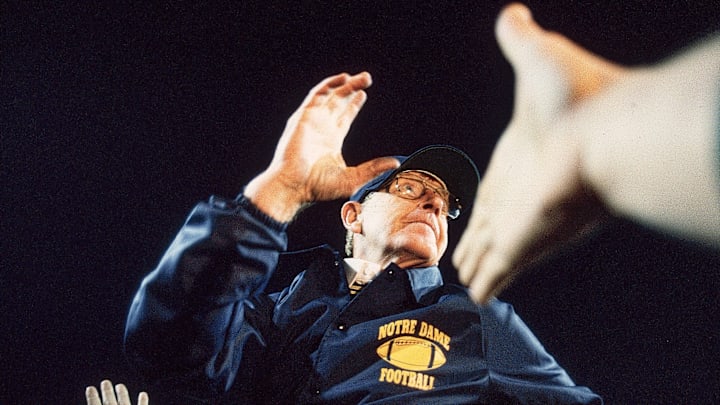
But Notre Dame was where Holtz did his most renowned work. After enduring five mediocre years with former high school coach Gerry Faust, Holtz was tasked with returning the program to the glory it enjoyed nearly uninterrupted from the 1920s through the ’70s.
After laying the foundation in 1986 and ’87, Holtz followed Fighting Irish history with a breakthrough third season. Notre Dame went 12–0 and won the national championship, highlighted by the epic, “Catholics vs. Convicts” upset of Miami in mid-October. After losing their previous four meetings with the intimidating Hurricanes by at least 18 points, Notre Dame showed that it wasn’t bringing choir boys to the matchup. The No. 4-ranked Irish sparked a pregame scuffle with the No. 1 Canes outside the stadium tunnel, setting a pugnacious tone for one of the most anticipated regular-season college football games in years. A deflected end zone pass secured a 31–30 Notre Dame victory.
Six weeks later, after assuming the No. 1 ranking, Holtz again suspended two star running backs before a big game. He sent Ricky Watters and Reggie Brooks home before playing No. 2 USC in the L.A. Coliseum. The stated reason? “Repeated, irresponsible tardiness,” Holtz said.
“There’s no excuse for anybody being late now, because everyone got a Cotton Bowl watch,” Holtz quipped at the time, referencing the team’s bowl swag from the previous season. “That’s why going to a bowl game was one of our goals: to make sure everybody would be on time.'”
For the second time in his career, Holtz turned a suspension into a huge victory. Notre Dame rolled past USC, 27–10, on its way to defeating West Virginia in the Fiesta Bowl to wrap up the national championship. That was followed by 11 straight wins to start the 1989 season—a 23-game winning streak that hasn’t been matched since—and a No. 2 final ranking behind Miami.

Holtz and Notre Dame arguably should have had a second national title in 1993. The No. 2 Irish defeated No. 1 Florida State late in the season, but after taking over the top spot were upset by No. 17 Boston College. The pollsters determined that head-to-head didn’t matter, elevating the Seminoles back to No. 1 and keeping them there after both teams won their bowl games.
Among those on the team during the Holtz era: current Notre Dame athletic director Pete Bevacqua, a walk-on punter who saw no game action. A great Holtz story: Years later, when Holtz was retired from coaching and Bevacqua was working outside the college sports realm, he mentioned to the old coach his limited role on the squad.
“Of course!” Holtz responded. “Pete Bevacqua, heart of a lion!”
Bevacqua later found out that “heart of a lion” was a standard Holtz description for former players he may or may not have remembered.
It’s now 39 years since Notre Dame’s last national championship, the longest span in school history without a title. That has spawned several cycles of existential debate about whether it can still be done there. A 15-year malaise followed Holtz’s departure before a return to prominence.

Brian Kelly got the Irish into a national championship game, as has Marcus Freeman. Given Notre Dame’s increased commitment to winning in football, there is renewed optimism that the long drought will be broken in the near future. Freeman looks like he can grab the brass ring.
But for now, Holtz stands as the last coach to get it done at the school, putting his name alongside those of Knute Rockne, Frank Leahy, Ara Parseghian and Dan Devine. He made pessimistic humor an art form, but for decades of college football Saturdays, it was good to be Lou Holtz.
More College Football from Sports Illustrated
Listen to SI’s college sports podcast, Others Receiving Votes, below or on Apple and Spotify. Watch the show on SI’s YouTube channel.
 Add us as a preferred source on Google
Pat Forde is a senior writer for Sports Illustrated who covers college football and college basketball as well as the Olympics and horse racing. He cohosts the Others Receiving Votes podcast for SI and is a regular contributor to the Tony Kornheiser Show podcast. He previously worked for Yahoo Sports, ESPN and The (Louisville) Courier-Journal. Forde has won 28 Associated Press Sports Editors writing contest awards, has been published three times in the Best American Sports Writing book series, and was nominated for the 1990 Pulitzer Prize. A past president of the U.S. Basketball Writers Association and member of the Football Writers Association of America, he lives in Louisville with his wife. They have three children, all of whom were collegiate swimmers.
Follow ByPatForde