%20%20--%3E%0A%3Csvg%20version%3D%221.1%22%20id%3D%22Layer_1%22%20xmlns%3D%22http%3A%2F%2Fwww.w3.org%2F2000%2Fsvg%22%20xmlns%3Axlink%3D%22http%3A%2F%2Fwww.w3.org%2F1999%2Fxlink%22%20x%3D%220px%22%20y%3D%220px%22%0A%09%20width%3D%2239px%22%20height%3D%2240px%22%20viewBox%3D%220%200%2039%2040%22%20enable-background%3D%22new%200%200%2039%2040%22%20xml%3Aspace%3D%22preserve%22%3E%0A%3Cpath%20fill%3D%22%23FFFFFF%22%20d%3D%22M38.5%2C7H28.2v26h10.3V7z%22%2F%3E%0A%3Cpath%20fill-rule%3D%22evenodd%22%20clip-rule%3D%22evenodd%22%20fill%3D%22%23FFFFFF%22%20d%3D%22M26.1%2C25.5c0%2C5.8-4.1%2C7.5-12.9%2C7.5C3.9%2C33%2C0%2C31.2%2C0%2C25.2v-1.1h11.6%0A%09v2.4c0%2C0.7%2C0.1%2C1.4%2C1.2%2C1.4c1%2C0%2C1.2-0.4%2C1.2-1.3v-0.9c0-1.6-0.9-1.6-3.5-2.2C2.2%2C21.7%2C0%2C19.7%2C0%2C15.3v-0.9C0%2C9.3%2C5.5%2C7%2C12.9%2C7%0A%09c10.2%2C0%2C12.8%2C2.6%2C12.8%2C7.4v1.8h-11v-2.9c0-0.6-0.4-1.1-1.2-1.1c-0.6%2C0-1.2%2C0.4-1.2%2C1.1v0.9c0%2C1.5%2C0.9%2C2%2C3.3%2C2.5%0A%09c8%2C1.6%2C10.5%2C3.3%2C10.5%2C7.5V25.5z%22%2F%3E%0A%3C%2Fsvg%3E%0A)
No, Indiana Is Not Cheating: ‘There’s Nothing Suspicious About Winning Up Front’
In this story:
The Indiana football program is reaching an inevitable next milestone in its story arc. From persistent loser to suspected fluke to delightful turnaround to awe-inspiring machine, the Hoosiers have been built up. And now it’s about that time for the cynics to start tearing them down.
Have you heard the assertions? Indiana is simply a product of old age. Indiana is only a Mark Cuban creation. Most salacious of all: Indiana is cheating.
They have defied all precedent in going 15–0 and rampaging into the College Football Playoff championship game. In doing so, the Hoosiers have sent everyone in search of a fanciful explanatory theory.
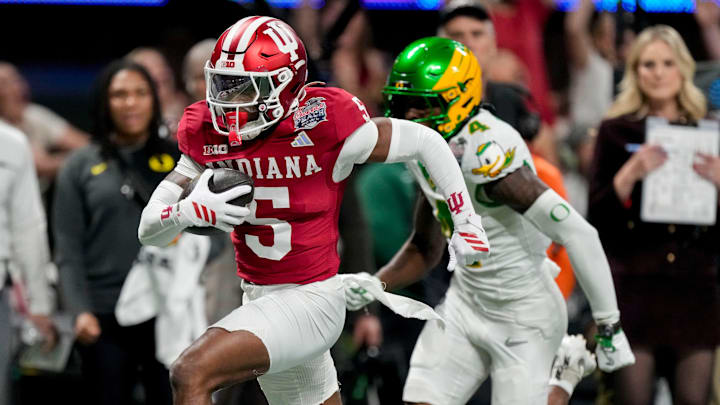
The theories are facile. Old team? Well, yeah. Welcome to modern college football. Indiana’s starting lineup for the Peach Bowl detonation of Oregon included five sixth-year veterans, three fifth-year guys, 10 fourth-year players, two in their third year and one in his second.
Being old helps. But if being old decided championships, BYU would have a trophy case full of them. And let’s not pretend other schools aren’t doing the same thing—or at least attempting to. They’re dumb if they’re not scouring the market for experienced, productive players.
If poor Oregon was at an experience disadvantage last week, what about last year when it had sixth-year starting quarterback Dillon Gabriel, who played in 64 FBS games? What about Stetson Bennett winning national titles at Georgia at ages 24 and 25? What about Indiana’s opposing quarterback in the title game, sixth-year collegian Carson Beck?
The theories are myopic. Billionaire alum Cuban made his first Indiana football donation after Curt Cignetti’s breakthrough debut season, going 11–2 in 2024. He recently told Front Office Sports that he’s made another one, larger this time. But how much money did it take to get a bunch of three-star prospects out of the transfer portal?
The Hoosiers started five James Madison transfers against Oregon, plus a sixth player who was committed to the Dukes before Cignetti left that school for Indiana. There also were transfers from Texas State and Navy in the lineup, plus nine from power-conference programs. The rest have spent their full careers as Hoosiers.
None of them arrived as market-topping free agents, or even close. There are football programs that are the pet projects of billionaires, including those that were waxed in the Orange Bowl and Peach Bowl. This Indiana team is not one of them.
The theories are irresponsible. Passive-aggressive posts were making the rounds on social media and message boards over the weekend, suggesting that the Hoosiers were suspiciously well-positioned to make plays most of the night against Oregon. The inference: Indiana had access to the Ducks’ practice film, headset communications or other advanced intel.
Thank you, Connor Stalions, for infecting college football with this particular conspiracy virus.
I asked a coach who played against Indiana this season what he thought of this theory.
“I think it’s asinine,” he says. “I just think they’re really f---ing good. I didn’t see anything when they played us other than really good players who are really well-coached.
“I didn’t see their game against Ohio State [in the Big Ten championship], but I went back and watched the all-22 [game film] and they just whipped ’em up front. Those interior guys on the D-line get no credit, but they’re really good. And the O-line is dominating. There’s nothing suspicious about winning up front.”
I asked a power-conference general manager about the possibility of stealing practice video via the widely used Catapult software system, or pirating headset communication. He was also dismissive.
“It would be very difficult to steal info from Catapult and not get caught,” he says. “The same for the headsets. You might be able to tap a frequency for a home game, but in the CFP? Highly unlikely.
“They are very good and a very good model of what can happen in today’s world when a school invests in football and they have the right leadership.”
The Hoosiers are such an outlier that they are breaking the brains of many people involved in the sport. Those folks are sufficiently stiff-necked—either about recruiting rankings or the traditional hierarchy of football, both of which are taking a beating from Indiana—that they’re inventing ghost stories.
Over the course of time, recruiting rankings have mattered. High school evaluations have gotten better in recent decades, and many of the highest-rated players at that level become the biggest stars in college and in the NFL.
This season, with this team, recruiting rankings don’t matter at all. Indiana is the ultimate revenge of the three-stars. And there is a chance that these kind of aberrations will become more frequent as we move deeper into the paradigm-shifting era of unlimited transfers.
Or there is a chance that Cignetti is simply coaching on a different plane from everyone else. It’s not like he hasn’t kicked the competition’s behinds for the last 15 years at multiple levels. He was 53–17 at Division II IU-Pennsylvania, then 33–14 at the FCS ranks at Elon and James Madison, then 19–4 with the Dukes as an FBS newcomer. Going 26–2 at Indiana is just the next progression.
Anyone want to believe Cig’s small-school record is the result of hacking someone’s practice film? Please.
Fernando Mendoza’s ability to throw perfect passes into tight windows isn’t because of cheating. The contested catches by Elijah Sarratt, Charlie Becker and Omar Cooper Jr. don’t come from stealing signals. The run blocking and tackle breaking—that’s just physical football. Same with the run stuffing.
There was one half-baked theory circulating that Indiana’s four interceptions on an opponent’s first or second offensive play of the game was evidence of knowing what’s coming. Let’s go to the video.
The first interception, against Iowa, was on a tipped pass by an onrushing Hoosier—not exactly proving the plot.
The second, against UCLA, was a one-handed stab by linebacker Aiden Fisher after reading Nico Iamaleava’s eyes.
The third, against Purdue, was off a scramble play and a bad throw by Ryan Browne.
The fourth, by D’Angelo Ponds on Friday against Oregon, was sufficiently telegraphed and thrown far enough inside by Dante Moore to allow Ponds to break on the ball for an easy pick.
Apologies to the tinfoil hat crew, but that theory doesn’t hold up.
The Indiana story has seemed too good to be true, and sports fairy tales have often had a dark plot twist. Because of that, we have become a cynical lot. But it is profoundly disrespectful to the Hoosiers to make irresponsible hints about some cheating conspiracy.
If someone has proof that they’re perpetrating the world’s greatest con, come on down from the grassy knoll and show us.
More College Football from Sports Illustrated
Listen to SI’s college sports podcast, Others Receiving Votes, below or on Apple and Spotify. Watch the show on SI’s YouTube channel.
 Add us as a preferred source on Google
Pat Forde is a senior writer for Sports Illustrated who covers college football and college basketball as well as the Olympics and horse racing. He cohosts the Others Receiving Votes podcast for SI and is a regular contributor to the Tony Kornheiser Show podcast. He previously worked for Yahoo Sports, ESPN and The (Louisville) Courier-Journal. Forde has won 28 Associated Press Sports Editors writing contest awards, has been published three times in the Best American Sports Writing book series, and was nominated for the 1990 Pulitzer Prize. A past president of the U.S. Basketball Writers Association and member of the Football Writers Association of America, he lives in Louisville with his wife. They have three children, all of whom were collegiate swimmers.
Follow ByPatForde