%20%20--%3E%0A%3Csvg%20version%3D%221.1%22%20id%3D%22Layer_1%22%20xmlns%3D%22http%3A%2F%2Fwww.w3.org%2F2000%2Fsvg%22%20xmlns%3Axlink%3D%22http%3A%2F%2Fwww.w3.org%2F1999%2Fxlink%22%20x%3D%220px%22%20y%3D%220px%22%0A%09%20width%3D%2239px%22%20height%3D%2240px%22%20viewBox%3D%220%200%2039%2040%22%20enable-background%3D%22new%200%200%2039%2040%22%20xml%3Aspace%3D%22preserve%22%3E%0A%3Cpath%20fill%3D%22%23FFFFFF%22%20d%3D%22M38.5%2C7H28.2v26h10.3V7z%22%2F%3E%0A%3Cpath%20fill-rule%3D%22evenodd%22%20clip-rule%3D%22evenodd%22%20fill%3D%22%23FFFFFF%22%20d%3D%22M26.1%2C25.5c0%2C5.8-4.1%2C7.5-12.9%2C7.5C3.9%2C33%2C0%2C31.2%2C0%2C25.2v-1.1h11.6%0A%09v2.4c0%2C0.7%2C0.1%2C1.4%2C1.2%2C1.4c1%2C0%2C1.2-0.4%2C1.2-1.3v-0.9c0-1.6-0.9-1.6-3.5-2.2C2.2%2C21.7%2C0%2C19.7%2C0%2C15.3v-0.9C0%2C9.3%2C5.5%2C7%2C12.9%2C7%0A%09c10.2%2C0%2C12.8%2C2.6%2C12.8%2C7.4v1.8h-11v-2.9c0-0.6-0.4-1.1-1.2-1.1c-0.6%2C0-1.2%2C0.4-1.2%2C1.1v0.9c0%2C1.5%2C0.9%2C2%2C3.3%2C2.5%0A%09c8%2C1.6%2C10.5%2C3.3%2C10.5%2C7.5V25.5z%22%2F%3E%0A%3C%2Fsvg%3E%0A)
5 Golf Launch Monitors We’re Excited to See in 2026
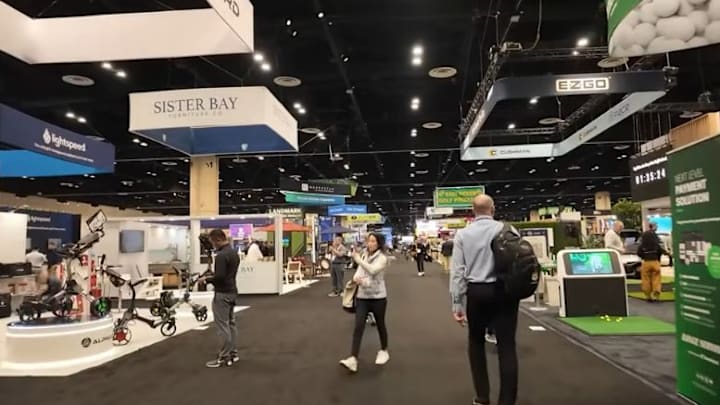
I recently returned from the 2026 PGA Show in Orlando. And of all the amazing gear displayed in 1 million square feet of exhibit space, one category towered above the rest when it came to size, money spent on the displays and buzz that they created:
Golf launch monitors.
Launch monitors and the accompanying golf simulator software were the absolute darlings of the show. It wasn’t even close.
You think the PGA Show is all talk about the newest drivers or golf fashion? Think again. In 2026, it was all about golf launch monitors. And there were a ton of them.
But of all that I saw, tested, and talked to people about, I’ve narrowed my favorites down to five. These are the five golf launch monitors I’d buy in 2026.
This isn’t a list of the most expensive or fanciest launch monitors of the year. I wanted to focus on products that were more accessible, things that regular golfers who maybe are just getting into this game could afford. Believe me, you can spend a lot of money on a golf launch monitor. These five products are what I think are some of the best ways to actually save cash while still getting a great experience.
Whether you’re in the market for a launch monitor right now or you’re just curious about where golf tech is heading, these are the products to know.
Square Omni Edition ($1,600)

Remember when Square dropped its first launch monitor and basically blew up the entire affordable launch monitor category overnight?
They’re about to do it again.
The new Square Omni Edition is Square’s sequel to what’s been one of the hottest and most talked about products in golf tech over the past couple of years. And this time, it’s not limited to only indoors.
Here’s the deal: The original Square was a sub-$1,000 camera-based launch monitor that sat beside the ball and worked well indoors. It completely changed the game for golfers who wanted accurate data without needing a ton of space or spending a fortune.
But it only worked indoors. You couldn’t take it to the range. That was a dealbreaker for a lot of people.
The Omni fixes that entirely.
Now you’ve got a photometric launch monitor with four high-speed cameras that works seamlessly both indoors and outdoors on grass. It’s got a much more robust build quality compared to the original.
Another thing, and this is huge, the Omni includes all of the key data metrics that were missing from the first version, like clubhead speed and smash factor.
You’re getting complete ball data (ball speed, direction, launch angle, spin, spin axis). And you’re getting full club data (club path, face angle, attack angle, dynamic loft, and impact location).
Plus, there’s now a built-in display. So you can see five of your key metrics right on the launch monitor without even needing to pull out your phone or connect to an app.
All of this for $1,600, with no annual subscription fees.
I mean, this is pretty exciting.
Let me put it into perspective: this is now the most affordable camera-based indoor/outdoor launch monitor you can buy. Yes, you can go cheaper, but you’ll have to go with radar. If you want camera and you want to save some money, the Square Omni should definitely be on your short list.
And on top of all of that, Square is also rolling out a completely revamped simulator software platform to go along with the Omni. It features upgraded graphics, a cleaner interface, expanded practice options, and a growing course library. There’s even a cool night driving range mode.
I’m telling you: you’re going to hear a lot about the Square Omni.
Shot Scope LM1 ($199.99)

Another launch monitor that EVERYBODY at the show was talking about was the new Shot Scope LM1.
It’s only $200! That means almost anyone can now own a launch monitor that gives the most important numbers that they can actually trust.
Shot Scope has built a reputation on delivering serious performance at prices that make you wonder how the bigger brands justify charging so much more. Their watches, their rangefinders, their GPS devices all offer serious value.
And notice, I didn’t say “cheap” or “budget.” I said “value.” These are still quality products.
And now we’ve finally got a launch monitor from Shot Scope. And for only $199.99.
Let me be clear about what this is and what it isn’t. The LM1 is not trying to compete with Trackman or Foresight Sports. It’s also not trying to be a full-blown simulator setup. It’s a straightforward practice tool that gives you the core metrics you actually need to improve.
What’s so compelling is that it does exactly what it’s supposed to do, and it does it really well for the price.
The LM1 uses Doppler radar and works both indoors and outdoors. It’s got a 3.5-inch color display. And it tracks ball speed, clubhead speed, smash factor, carry distance and total distance.
That may not sound like a lot of data. But, honestly, for most golfers, that’s everything you need.
And because it’s got a built-in display, you don’t need to connect to a phone or tablet or any other device. You just set it up six feet behind the ball and start hitting. Numbers pop up immediately on the screen in big, easy-to-read digits.
The LM1 can store up to 1,000 shots internally, so when you get home from the range, you can sync everything to the Shot Scope app and review your session data or compare it with previous sessions.
And now the real kicker: No subscriptions. Pay $200 and you’re done.
If you’ve been wanting to add a launch monitor to your setup but haven’t been able to justify the price, the Shot Scope LM1 just made that decision easier.
Blue Tees Rainmaker ($599)

Blue Tees has made a lot of noise in the golf tech space with their rangefinders, GPS devices and speakers. They’ve built a reputation for delivering premium features at competitive prices.
And now they’re jumping into the launch monitor category with the Rainmaker, priced at $599.
The Rainmaker features a 4.3-inch full-color built-in display that gives instant feedback on more than 20 metrics without requiring a connection to your phone.
As with the Square Omni and Shot Scope LM1, you can see why this one is on my list. One of the most annoying things about many launch monitors is constantly checking your phone or tablet to see the numbers. The Rainmaker also eliminates that hassle.
You’re getting all the key data, like ball speed, launch angle, spin data, clubhead speed, attack angle and more. Everything shows up right there on the screen as soon as you hit the shot.
Then, if you want to take things further, the Rainmaker integrates with GSPro and E6 Connect for simulator play.
The other really cool thing is that if you do want to pair to the Blue Tees app, you get a huge payoff. The Rainmaker can sync with Blue Tees’ new Captain rangefinders and Player Pro speaker to deliver personalized club recommendations that are based on your practice sessions with the Rainmaker.
That’s a very advanced feature. And to get that in a product that costs only $599 is extremely compelling.
The Rainmaker uses radar-based technology and works both indoors and outdoors. It’s also rated IPX7 waterproof, which means you can literally practice in the rain without worrying about damaging your equipment.
The design is really clever too. There’s an integrated handle that doubles as a stable stand, making setup quick and secure. And it comes with three standalone training modes—Target Distance, Practice, and Swing Speed—that work independently or connect to the Blue Tees Launch app for deeper analysis.
If you’re looking for a launch monitor around that $500 price point that doesn’t compromise on features, I’d seriously consider stretching just a little bit more for the Blue Tees Rainmaker.
Garmin Approach G82 ($599.99)

Some products just refuse to die.
The Garmin G80 has been around for about seven years. In golf tech, that’s basically an eternity.
But the G80 kept selling because it filled a unique niche that literally no other product could touch. It combined a handheld GPS with a radar-based launch monitor in one device. Perfect for golfers who want portable practice data and on-course yardages without wearing a watch or carrying multiple devices.
And now, finally, we’ve got the much-improved version of that product, the Garmin Approach G82. You get the same core functionality of the G80, but the G82 is modernized in every way that matters.
Let’s start with the screen. The G82 features a 5-inch transflective color touchscreen that’s significantly sharper and more modern than the dated display on the G80. It’s bright, clear and just really nice. Although I was surprised that Garmin didn’t include their top-end AMOLED display, like you get on their watches.
There’s also a built-in magnetic cart mount that is much better than the bands and clips that you previously had to use with the G80 if you wanted to attach it to anything.
As a launch monitor, the G82 tracks the same core metrics the G80 provided—ball speed, clubhead speed, smash factor and swing tempo. But here’s what’s new: The G82 now includes putting metrics. You can measure putting stroke length, tempo, and club and ball speed to help dial in consistency on the greens.
And then there’s bag mapping. You can hit shots with each club in your bag, and the G82 will build a profile of your actual distances. That data integrates with a new virtual caddie feature that recommends clubs based on wind, elevation, and your real swing data.
That’s pretty cool. You’re not just getting generic yardages. You’re getting recommendations that fit you.
On the GPS side, you’ve got 43,000 preloaded courses, full-color CourseView maps, slope-adjusted yardages, Green View, hazard view, PinPointer, wind speed and direction, and more. I mean, pretty much everything you’d expect from a premium Garmin GPS device.
I like this product a lot because it’s legit on the course and off the course.
If you want yardages you can trust while you’re playing and you don’t want to wear a watch or screw around with taking out a rangefinder, the G82 is awesome.
And if you just want core numbers that will help you improve when you’re practicing, it’s awesome for that, too.
Not everyone wants a full simulator setup. And not everyone wants to wear a golf watch. The G82 is the perfect middle ground for golfers who want quality tech without all the complexity.
TruGolf LaunchBox ($2,999)
This is the most expensive product of my picks, but hear me out, because the TrueGolf LaunchBox is genuinely exciting for a very specific reason.
Have you ever played simulator golf and realized how annoying the shot delays can be? You hit the ball and then you have to wait for what feels like forever to see the ball flight on the screen. It can be a definite buzzkill to the whole sim golf experience.
The LaunchBox totally eliminates that problem. There’s no delay at all. Just immediate feedback, which I think is awesome. Especially if you love to play simulated rounds or have buddies over. It just makes it a lot more fun.
The LaunchBox uses camera and infrared-based technology to capture ball and club data. And you don’t need marked clubs or specialty balls, which is another huge advantage.
This launch monitor is designed to work indoors, but it also functions on outdoor range mats for collecting ball data. And there’s a built-in display that shows your key metrics right on the device, though the full suite of data is available in the app.
Every LaunchBox comes with E6 Connect and 27 courses with no annual subscription required. You can play immediately right out of the box.
If you want to upgrade, there’s a bundle you can buy that adds premium courses like Pebble Beach and Oakmont. Plus, you get a 10-day free trial with E6 Apex, which is TruGolf’s top-end software with much better graphics and a huge library of around 10,000 courses.
The LaunchBox is compatible with both PC and iOS, and it connects to projectors via HDMI. Battery life is about 4.5 hours.
Now, some people are going to be annoyed that this launch monitor locks you into TruGolf’s E6 simulator software ecosystem. You can’t use it to play third-party software like GSPro. But I think there are other golfers who just want something simple and who don’t mind having one native software solution that removes all of the confusion and connection headaches.
I like it for the zero-lag and for the built-in screen. I don’t think it’s going to be right for everyone and every situation, but I do think that a lot of indoor golfers are going to turn to this as a great way to get a high-quality sim golf right out of the box.
2026 will be a great year for golf tech
I think we’re on the verge of another really strong year for golf launch monitors. And the movement in this space that has me most excited is affordability. We’re finally getting to the point where we’ve got a lot of really good choices at multiple price points.
Whether you’ve got $200 to spend or $3,000, there’s something launching this year that’s going to make your practice more productive and the game more fun.
The Shot Scope LM1 proves you don’t need to spend a fortune to get meaningful data.
The Blue Tees Rainmaker and Garmin Approach G82 show that the mid-tier market is more competitive than ever.
The Square Omni is rewriting the rules on what camera-based launch monitors should cost.
And the TruGolf LaunchBox is another really solid entry into the immersive sim experience market.
These are the products I’m watching and the ones I’m excited to see more.
More Golf from Sports Illustrated
 Add us as a preferred source on Google
As the founder of Golfers Authority, Paul has spent the last 7+ years writing about the best golf products and instruction from the top golf instructors in the world. When he's not practicing law or creating golf content on YouTube, he can be found on the Behind the Golf Brand podcast talking with the leaders of the golf industry.
Follow AuthorityGolfer