%20%20--%3E%0A%3Csvg%20version%3D%221.1%22%20id%3D%22Layer_1%22%20xmlns%3D%22http%3A%2F%2Fwww.w3.org%2F2000%2Fsvg%22%20xmlns%3Axlink%3D%22http%3A%2F%2Fwww.w3.org%2F1999%2Fxlink%22%20x%3D%220px%22%20y%3D%220px%22%0A%09%20width%3D%2239px%22%20height%3D%2240px%22%20viewBox%3D%220%200%2039%2040%22%20enable-background%3D%22new%200%200%2039%2040%22%20xml%3Aspace%3D%22preserve%22%3E%0A%3Cpath%20fill%3D%22%23FFFFFF%22%20d%3D%22M38.5%2C7H28.2v26h10.3V7z%22%2F%3E%0A%3Cpath%20fill-rule%3D%22evenodd%22%20clip-rule%3D%22evenodd%22%20fill%3D%22%23FFFFFF%22%20d%3D%22M26.1%2C25.5c0%2C5.8-4.1%2C7.5-12.9%2C7.5C3.9%2C33%2C0%2C31.2%2C0%2C25.2v-1.1h11.6%0A%09v2.4c0%2C0.7%2C0.1%2C1.4%2C1.2%2C1.4c1%2C0%2C1.2-0.4%2C1.2-1.3v-0.9c0-1.6-0.9-1.6-3.5-2.2C2.2%2C21.7%2C0%2C19.7%2C0%2C15.3v-0.9C0%2C9.3%2C5.5%2C7%2C12.9%2C7%0A%09c10.2%2C0%2C12.8%2C2.6%2C12.8%2C7.4v1.8h-11v-2.9c0-0.6-0.4-1.1-1.2-1.1c-0.6%2C0-1.2%2C0.4-1.2%2C1.1v0.9c0%2C1.5%2C0.9%2C2%2C3.3%2C2.5%0A%09c8%2C1.6%2C10.5%2C3.3%2C10.5%2C7.5V25.5z%22%2F%3E%0A%3C%2Fsvg%3E%0A)
The Best Things We Saw at the PGA Merchandise Show
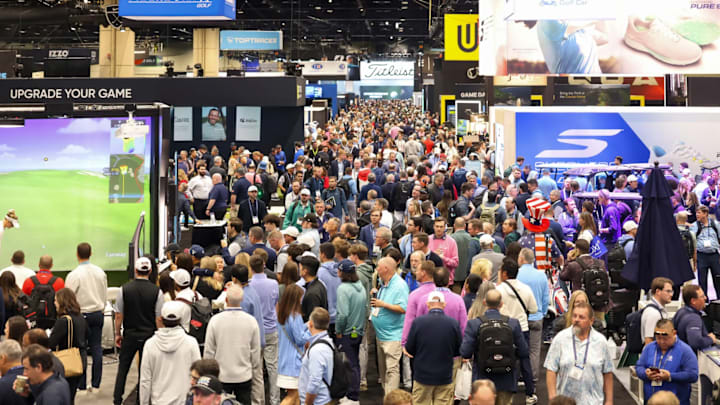
ORLANDO — The future of golf is now. That is the recurring theme of the PGA Merchandise Show, which sells faith, hope and the certain knowledge that we hacks can buy a better game.
It is not false hope. Sometimes we can buy a better game. Technology advances on our behalf and the hallways of the mammoth-sprawling-gargantuan Orange County Convention Center are filled with the effort.
There is so much to see at the PGA Show and so little time. Here are my awards for the items that stood out the most, in my humble and possibly stupid opinion:
Best In Show, south of the border

The North Korea-South Korea border, that is. Meet AutoFlex, a South Korean golf shaft with a mystery makeup. AutoFlex didn’t file for a patent for its shaft because in semi-lawless Asia, one man’s patent is another man’s blueprint to copy. The AutoFlex shaft is unusually whippy but instead of causing shorter and more crooked drives, it creates longer and straighter ones. I started using it in my driver three summers ago and instantly picked up 12 yards of carry. I later added the shaft to my 3-wood, too, and it was a game-changer. This year, AutoFlex is expanding distribution in North America and has shafts for irons, too. Due to tariffs, the price of the woods shafts has risen from $750 to over $800—yeah, it’s a big bite but in my case, well worth it. The iron shafts will be around $210.
Most Masterful Genius Move

Instead of using launch data, the Genius golf ball has high-tech electronics inside its core ($240, sleeve of 3). When struck by a putter, it provides all kinds of helpful putting data. Former PGA champ Dave Stockton, one of the great all-time putters, is working with Genius. With his help, I was able to use Genius to improve my putting score from 19 (which is way crummy) to minus-1 (which is only a little crummy). That still left me slightly behind The Master, who rolled a couple that coughed up numbers such as minus-167 and minus-174, still lower than his usual minus-200, which is ridiculously awesome. The Genius balls have sufficient battery power for at least 10,000 putts, which equates to three rounds of golf for me, I said bitterly. (O.K., it only feels that way. I’m kidding.) The data tells you if you’re hitting putts square or squirrelly or slicing and, this is the cool part, it can tell you the Stimpmeter speed of the green. Stockton predicts you’ll see tour pros rolling these things during practice rounds at Augusta National before the Masters in order to get better reads on some of the speed slopes.
Best Strap-on Tool

A working arrangement between Stitch and Bushnell led to the Link Strap ($350). It is a smarter strap to put on your carry bag or cart bag. Embedded in the strap is a Bushnell GPS and a Bushnell speaker. So even if you’re walking, you’ve got hands-free music and GPS. Even better, the speaker and GPS are removable so if you’re riding instead of walking, they can magnetically attach to a cart frame. Clever stuff.
The “Be the Right Putt Today” Award
Makefield Golf’s outstanding putter line isn’t new but its affiliation with Hal Sutton, former PGA Championship winner and Ryder Cup captain, is. The man known for uttering “Be the right club to-DAY” as he cheered on a shot to the final green to beat Tiger Woods in the Players Championship, brings his authenticity to this underappreciated brand. Makefield produces American-made putters with interchangeable parts. Creating your own putter on Makefieldgolf.com is akin to Build-A-Bear only with goose-neck shafts, weights and radial-cusp face technology. In short, they’re really good putters customized to fit your stroke. Also available in long putter versions and a new blade model. ($349-$400).
The Next Best Ping

The new Ping G440 K ($649-$705) driver is the company’s best yet thanks to modest gains in distance and accuracy. The head is titanium, the face is titanium, the crown is carbon fiber and its profile, looking down from the handle, is a little longer. Ping’s own testing shows it to be more forgiving by the numbers and with a higher moment of inertia. Translation from techno-speak: The G440 K driver is a keeper.
Most Valuable Degrees

You might think wedges are wedges and their design never substantially changes—well, you’re not necessarily wrong. But Titleist keeps refining the club with its Bob Vokey line of SM11 wedges ($199-$229). Titleist has two categories of the club, one for firm turf and one for softer turf, and several options for grind finishes. There’s more: Titleist now offers wedges down to 44 degrees—its previous lowest-lofted wedge was 48 (which used to be pitching wedge loft). Why? Because the standard lofts of other clubs has gotten stronger, thus causing a distance gap that some players need to fill. What’s the 11 stand for in the wedge name? A company guy told me it’s a nod to the old Spinal Tap movie in which one character made an amp that went to 11 instead of 10, because it’s one more than 10.
Most Intimidating Rise of the Machines
Will AI really take over the world? It is already happening. Uneekor, maker of top-notch golf simulators, has developed the AI Trainer, a new program in which a customer hits a few balls, then gets swing analysis and instruction—instruction!—and tips on how to improve. The golfer hits a few more balls and AI notes the improvement (or lack thereof) and the process continues. Attention, golf teachers everywhere: The machines are coming for you.
Finest Cover Story
It qualifies as big news anytime Titleist so much as touches a dimple on one of its best-selling golf balls. The company tweaked its popular AVX model ($49.99 per dozen) because some users wanted more spin and grab around the greens. Titleist responded by reformulating the AVX’s urethane cover to make it thicker and therefore more responsive. Now the AVX still offers maximum distance (a coveted commodity especially for aging golfers such as myself) but its new cover offers better shot-control around the greens.
Best 3-D Printer Irons That You Can’t Make on Your Own 3-D Printer … Yet

Few things sound more futuristic than golf clubs made from a 3-D printer. Cobra, the only company that’s brought 3-D to market, tried some limited-edition clubs in 2024 and they were sweet. I was sent a 7-iron that I crushed and immediately put in my bag. Despite a few emails that bordered on begging, I couldn’t fill out the set. The new Cobra 3DMP and 3DX irons ($330 per club) are just as good. I knocked some shots around the range at the PGA Show’s Demo Day and despite a nagging crosswind and creaking knees, I hit an uncanny number of straight balls in a row. Once again, I’m convinced.
Smartest Use of a Tesla Cybertruck

Since blustery winds made the 39-degree temperature feel like Arctic Circle stuff on the Demo Day range, the Bridgestone guys invited to do our interview inside their Cybertruck with the heater on. Great move. Also in the great move category is Bridgestone’s lineup of Tour B balls ($55 dozen). There are four models in two categories. The Tour B X and XS are for those skilled golfers with swing speeds above 105 mph. The Tour B RX and RXS are for the rest of us. Bridgestone used a different material for the balls’ mantle layer and, let’s skip the details, the results are an average of 2.8 mph more of ball speed and an average of 8.7 yards of additional distance, according to Bridgestone. I vote yes in favor of any small iota of distance increase, thanks.
Most Outstanding Driver Not Named After Optimus Prime

The hottest driver of 2026 may prove to be the Cobra OPTM ($600). It has nothing to do with the afore-mentioned Transformer bot but is an abbreviation for optimal. The OPTM comes in four models: OPTM Max-D for those who battle the dreaded slice; OPTM Max-K, for maximum forgiveness; OPTM X, a mix of low-spin and forgiveness for better players; and OPTM LS, for elite players. The OPTMs have slightly elongated head shapes (think a pear stretched out on a hammock) that have a throwback look. The main news is that robot testing of the clubs show a tightened pattern of dispersion. So, straighter drives for you. The driver has a light yet powerful feel that was pleasing. It was even more pleasing to the 20-something lefty from Quebec who jumped in front of me at Demo Day and blistered 310-yard carries with the LS model. He did mis-hit one that sliced and flew only 276 but his spin numbers on the launch monitor remained shockingly low (that’s good). I felt so sorry for him. (I’m totally lying.)
More Golf from Sports Illustrated
 Add us as a preferred source on Google
Van Sickle has covered golf since 1980, following the tours to 125 men’s major championships, 14 Ryder Cups and one sweet roundtrip flight on the late Concorde. He is likely the only active golf writer who covered Tiger Woods during his first pro victory, in Las Vegas in 1996, and his 81st, in Augusta. Van Sickle’s work appeared, in order, in The Milwaukee Journal, Golf World magazine, Sports Illustrated (20 years) and Golf.com. He is a former president of the Golf Writers Association of America. His knees are shot, but he used to be a half-decent player. He competed in two national championships (U.S. Senior Amateur, most recently in 2014); made it to U.S. Open sectional qualifying once and narrowly missed the Open by a scant 17 shots (mostly due to poor officiating); won 10 club championships; and made seven holes-in-one (though none lately). Van Sickle’s golf equipment stories usually are based on personal field-testing, not press-release rewrites. His nickname is Van Cynical. Yeah, he earned it.
Follow GaryVanSickle