%20%20--%3E%0A%3Csvg%20version%3D%221.1%22%20id%3D%22Layer_1%22%20xmlns%3D%22http%3A%2F%2Fwww.w3.org%2F2000%2Fsvg%22%20xmlns%3Axlink%3D%22http%3A%2F%2Fwww.w3.org%2F1999%2Fxlink%22%20x%3D%220px%22%20y%3D%220px%22%0A%09%20width%3D%2239px%22%20height%3D%2240px%22%20viewBox%3D%220%200%2039%2040%22%20enable-background%3D%22new%200%200%2039%2040%22%20xml%3Aspace%3D%22preserve%22%3E%0A%3Cpath%20fill%3D%22%23FFFFFF%22%20d%3D%22M38.5%2C7H28.2v26h10.3V7z%22%2F%3E%0A%3Cpath%20fill-rule%3D%22evenodd%22%20clip-rule%3D%22evenodd%22%20fill%3D%22%23FFFFFF%22%20d%3D%22M26.1%2C25.5c0%2C5.8-4.1%2C7.5-12.9%2C7.5C3.9%2C33%2C0%2C31.2%2C0%2C25.2v-1.1h11.6%0A%09v2.4c0%2C0.7%2C0.1%2C1.4%2C1.2%2C1.4c1%2C0%2C1.2-0.4%2C1.2-1.3v-0.9c0-1.6-0.9-1.6-3.5-2.2C2.2%2C21.7%2C0%2C19.7%2C0%2C15.3v-0.9C0%2C9.3%2C5.5%2C7%2C12.9%2C7%0A%09c10.2%2C0%2C12.8%2C2.6%2C12.8%2C7.4v1.8h-11v-2.9c0-0.6-0.4-1.1-1.2-1.1c-0.6%2C0-1.2%2C0.4-1.2%2C1.1v0.9c0%2C1.5%2C0.9%2C2%2C3.3%2C2.5%0A%09c8%2C1.6%2C10.5%2C3.3%2C10.5%2C7.5V25.5z%22%2F%3E%0A%3C%2Fsvg%3E%0A)
A ‘Fred Couples Lucky Break’ on Par-3 12th Hole Proves Pivotal at Augusta National Women’s Amateur
AUGUSTA, Ga. — The hole looks simple enough, among the most photographed and discussed in the game. At 155 yards, Jack Nicklaus has called it one of the toughest par-3s in the world.
Located at the farthest point from the clubhouse, the 12th hole at Augusta National has less than 30 feet from front to back at its narrowest point, is protected by three bunkers, and has a menacing creek that has swallowed up its share of golf balls over the years.
It found two more on Saturday, which helped swing the outcome of the Augusta National Women’s Amateur.
Asterisk Talley, the 36-hole leader who seemed so in control through the first 10 holes of the final round, hit two balls in the water from the left back bunker at the 12th to go from leading to behind.
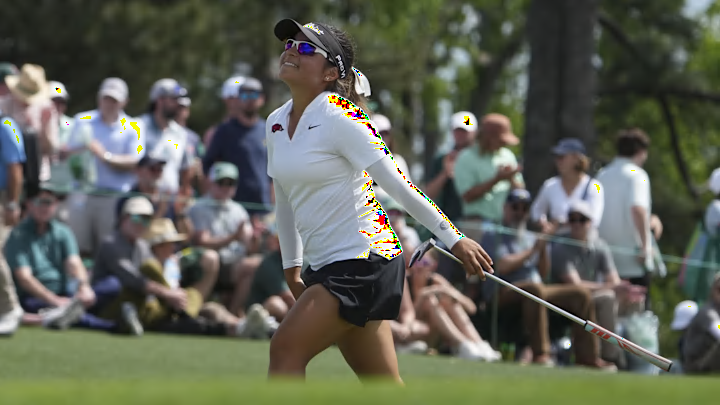
And Maria Jose Marin, whose approach earlier on the hole came up short but somehow did not roll back into Rae’s Creek. She managed to get that up-and-down for a par that would prove to be pivotal.
The 19-year-old golfer from Colombia who was making her fourth start in the tournament shot a final-round 68 at Augusta National to cruise to a four-shot win over Stanford sophomore Andrea Revuelta to capture the seventh edition of the event that is the kickoff to Masters week.

Korea’s Soomin Oh (68) finished solo third at 9 under. Talley, who began the day witk a one-shot lead over Marin, finished in a tie four fourth, six shots back after a 75.
Marin, a junior at Arkansas who in 2025 won the NCAA individual title and was coming off a victory Sunday at the Clemson Invitational, missed 11 greens during the tournament (the first two rounds were played at nearby Champions Retreat) and got up-and-down for par nine times.
None was bigger than the 12th, where the wrong result could have derailed her hopes.
“I think I've been kind of a victim of Amen Corner now because definitely gust of wind, it totally tricked me,” said Marin of the moniker for the three-hole stretch that is the 11th, 12th and 13th holes at Augusta National. “It was into the wind; it was not downwind.
“When my ball stayed there—I think it's a miracle that my ball stayed there. I just kind of have to make par and walk away out of here because this just happens once.”
Well, it has happened previously, but undoubtedly a ball landing short of the green does not stay on the bank. It almost always inevitably trickles back down into the water.
A notable exception occurred at the 1992 Masters, where Fred Couples’ final-round shot to the green landed on the bank, rolled back and amazingly stopped. He went on to win his only major title.
"You don't ever get a break like that,” Couples said at the time. “It was the biggest break probably of my life. I'm sure a million people watching on television were wondering why it didn't go in. So was I.”
Nicklaus once referred to it as “probably the most dangerous par 3 in the game. You never know what's going to happen.”

Talley, the 17-year-old phenom who was playing in her third ANWA tournament, was strong through two rounds and was headed to an Augusta National course were she had yet to make a back-nine bogey in two previous appearance.
Then she opened with birdies on three of her first four holes and was steady at 14 under par through 10. Her first bogey of the day came at the 11th and the tenor of the round changed. She had dropped into a tie with Martin—who had parred the 12th in front of her—when she sailed her 7-iron approach shot into the back bunker.
“I just didn't think that was going to be my position from the tee box,” Talley said afterward. “I didn't think I would have to be in that situation at all. It shows how hard that hole is and how much it has messed up other people as well. Obviously it's tough from any position if you're not on the green.”
Talley said she felt fortunate her ball didn’t travel farther into the bushes behind the green. From the bunker, she noted there was not much sand and simply was not able to get the ball high enough, as it landed hard and ran across the green and into the water.
With the option to drop in the bunker or drop on the other side of the creek, Talley played from the same position after being allowed to rake the sand. It was the same result.
After a penalty drop, she decided to play from the other side of the creek, hitting her sixth onto the green and then holing the putt for a quadruple-bogey 7. When Marin birdied the 13th hole ahead of her, Talley was five shots back.
“Didn't think it was that hard until today,” Talley said. “Yeah, maybe a couple people were in there already and made the bunker a little harder. I don't know. I just don't think it was the day for me, I guess. It wasn't the hole for me.”
Marin wasn’t aware of her lead until she got onto the 15th hole, where she made her own mistake by missing the green long. The bogey briefly dropped her lead to three strokes but she rebounded with a birdie at the 16th and was able to enjoy a nice two-hole stroll to the clubhouse amid one of golf’s greatest settings.
“I felt pretty in control of my game the whole week,” Marin said. “I think the confidence of the win in the last college event I got, like it kind of got to my head. I was like, okay, I think I can win this, but I have to work hard for this.
“One of the signs was the ball staying on that ridge on 12. I've never seen a ball stay there, and I think it was just God holding the ball there, like, don't move. This is happening for something.”
More Golf from Sports Illustrated
 Add us as a preferred source on Google
Bob Harig was a senior writer covering golf for Sports Illustrated. He has more than 25 years experience on the beat, including 15 at ESPN. Harig is a regular guest on Sirius XM PGA Tour Radio and has written two books, “DRIVE: The Lasting Legacy of Tiger Woods” and “Tiger and Phil: Golf’s Most Fascinating Rivalry.” He graduated from Indiana University where he earned an Evans Scholarship, named in honor of the great amateur golfer Charles (Chick) Evans Jr. Harig, a former president of the Golf Writers Association of America, lives in Clearwater, Fla.
Follow bobharig