%20%20--%3E%0A%3Csvg%20version%3D%221.1%22%20id%3D%22Layer_1%22%20xmlns%3D%22http%3A%2F%2Fwww.w3.org%2F2000%2Fsvg%22%20xmlns%3Axlink%3D%22http%3A%2F%2Fwww.w3.org%2F1999%2Fxlink%22%20x%3D%220px%22%20y%3D%220px%22%0A%09%20width%3D%2239px%22%20height%3D%2240px%22%20viewBox%3D%220%200%2039%2040%22%20enable-background%3D%22new%200%200%2039%2040%22%20xml%3Aspace%3D%22preserve%22%3E%0A%3Cpath%20fill%3D%22%23FFFFFF%22%20d%3D%22M38.5%2C7H28.2v26h10.3V7z%22%2F%3E%0A%3Cpath%20fill-rule%3D%22evenodd%22%20clip-rule%3D%22evenodd%22%20fill%3D%22%23FFFFFF%22%20d%3D%22M26.1%2C25.5c0%2C5.8-4.1%2C7.5-12.9%2C7.5C3.9%2C33%2C0%2C31.2%2C0%2C25.2v-1.1h11.6%0A%09v2.4c0%2C0.7%2C0.1%2C1.4%2C1.2%2C1.4c1%2C0%2C1.2-0.4%2C1.2-1.3v-0.9c0-1.6-0.9-1.6-3.5-2.2C2.2%2C21.7%2C0%2C19.7%2C0%2C15.3v-0.9C0%2C9.3%2C5.5%2C7%2C12.9%2C7%0A%09c10.2%2C0%2C12.8%2C2.6%2C12.8%2C7.4v1.8h-11v-2.9c0-0.6-0.4-1.1-1.2-1.1c-0.6%2C0-1.2%2C0.4-1.2%2C1.1v0.9c0%2C1.5%2C0.9%2C2%2C3.3%2C2.5%0A%09c8%2C1.6%2C10.5%2C3.3%2C10.5%2C7.5V25.5z%22%2F%3E%0A%3C%2Fsvg%3E%0A)
Augusta National Golf Club’s Five Hardest Holes in Masters History
Augusta National Golf Club might look like a butterfly, but for those playing it, it can sting like a bee.
“I think it demands so much discipline,” Ludvig Åberg said at last year’s Masters. “It demands a lot of patience … you can’t really force things around here. Sometimes par is a good score. Sometimes, even on the par-5s, sometimes par is a good score.”
In 2025, Augusta National, a par-72 that stretches 7,565 yards, was the seventh-hardest course out of all 49 played during the PGA Tour season, yielding a scoring average of 72.087 (.807 strokes over par). The last time it was lower than seventh was in 2019, when it actually played .135 strokes under par.
MORE: Ranking the nine greatest shots in Masters history
Each hole at Augusta National has a story and a uniqueness to it. But some are more grueling than others.
Here are the five hardest holes in Masters history, based on the scoring average from its previous 89 editions of the tournament.
No. 5: The 495-yard, par-4 5th (Magnolia)
Scoring average: 4.267
High year: 1956 (4.475)
Low year: 2001 (4.061)
Description: Inspired by the iconic Road Hole at the Old Course at St. Andrews, it’s an uphill dogleg left, with fairway bunkers roughly 300 yards from the tee box, putting a premium on driving accuracy. The green slopes back to the front, with a rear bunker catching balls that are overhit. Tiger Woods once said of the hole: “Carry that crest that’s about 12 to 13 yards into the green, put the ball in the center, make your par and move on.”
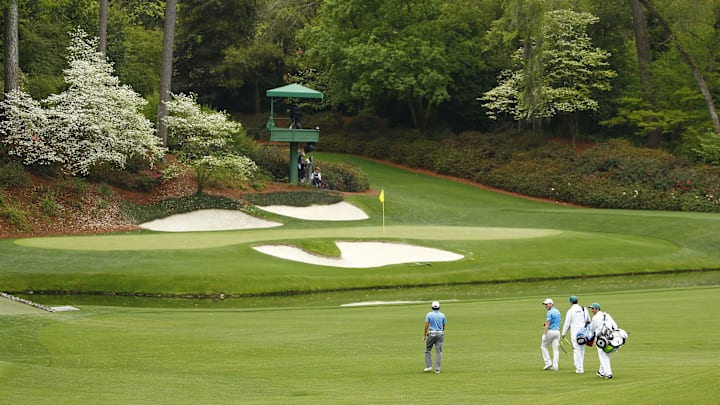
No. 4: The 155-yard, par-3 12th (Golden Bell)
Scoring average: 3.267
High year: 1966 (3.548)
Low year: 2002 (3.030)
Description: Rae’s Creek and the Ben Hogan Bridge make this one of the world’s famous holes. Tee shots are hit over the water and three greenside bunkers devour balls that fail to land on the ice-slick putting surface. And if players hit it short, the ball will trickle down into Rae’s Creek. The hole has been where many final-round contenders’ Masters dreams have been dashed, especially in blustery conditions.
No. 3: The 240-yard, par-3 4th (Flowering Crab Apple)
Scoring average: 3.282
High year: 1956 (3.497)
Low year: 2020 (3.089)
Description: Requiring a long iron, the hole dangles bunkers on the front right and left of the green, which slopes back to the front. In 2023, Jon Rahm said, “You don't see a lot of birdies here [on No. 4], but you will see a lot of quick, frustrating bogeys. There aren't many places officials can put the flagstick where you say to yourself, ‘Yeah, I'm going to get this shot close.’
No. 2: The 495-yard, par-4 10th (Camellia)
Scoring average: 4.296
High year: 1956 (4.691)
Low year: 2018 (4.082)
Description: It’s a downhill hole with an almost 60-yard-long center bunker before the green. Often, players try to drive the ball left-center for an angle into the green that pitches right to left.
No. 1: The 520-yard, par-4 11th (White Dogwood)
Scoring average: 4.303
High year: 1956 (4.644)
Low year: 1995 (4.064)
Description: This is the start of the famed Amen Corner. The tee shot is left to right and downhill, with a left of the green and a bunker in the right center. One of the most famous moments in Masters history happened on this hole: Larry Mize holing a 140-yard chip from off the green to beat Greg Norman in a playoff and claim the green jacket.
Easiest hole: The 585-yard, par-5 2nd (Pink Dogwood)
Scoring average: 4.770
High year: 1957 (4.996)
Low year: 2020 (4.467)
Description: The hole is a dogleg left and is reachable in two. There are two big and deep greenside bunkers, though, if a second shot is misplaced. In 2012, Louis Oosthuizen made an albatross on this hole.
More Masters Coverage from Sports Illustrated
 Add us as a preferred source on Google
Max Schreiber is a contributor to the Breaking and Trending News team at Sports Illustrated, covering golf. Before joining SI in October 2024, the Mahwah, N.J., native, worked as an associate editor for the Golf Channel and wrote for RyderCup.com and FanSided. He is a multiplatform producer for Newsday and has a bachelor's in communications and journalism from Quinnipiac University. In his free time, you can find him doing anything regarding the Yankees, Giants, Knicks and Islanders.