%20%20--%3E%0A%3Csvg%20version%3D%221.1%22%20id%3D%22Layer_1%22%20xmlns%3D%22http%3A%2F%2Fwww.w3.org%2F2000%2Fsvg%22%20xmlns%3Axlink%3D%22http%3A%2F%2Fwww.w3.org%2F1999%2Fxlink%22%20x%3D%220px%22%20y%3D%220px%22%0A%09%20width%3D%2239px%22%20height%3D%2240px%22%20viewBox%3D%220%200%2039%2040%22%20enable-background%3D%22new%200%200%2039%2040%22%20xml%3Aspace%3D%22preserve%22%3E%0A%3Cpath%20fill%3D%22%23FFFFFF%22%20d%3D%22M38.5%2C7H28.2v26h10.3V7z%22%2F%3E%0A%3Cpath%20fill-rule%3D%22evenodd%22%20clip-rule%3D%22evenodd%22%20fill%3D%22%23FFFFFF%22%20d%3D%22M26.1%2C25.5c0%2C5.8-4.1%2C7.5-12.9%2C7.5C3.9%2C33%2C0%2C31.2%2C0%2C25.2v-1.1h11.6%0A%09v2.4c0%2C0.7%2C0.1%2C1.4%2C1.2%2C1.4c1%2C0%2C1.2-0.4%2C1.2-1.3v-0.9c0-1.6-0.9-1.6-3.5-2.2C2.2%2C21.7%2C0%2C19.7%2C0%2C15.3v-0.9C0%2C9.3%2C5.5%2C7%2C12.9%2C7%0A%09c10.2%2C0%2C12.8%2C2.6%2C12.8%2C7.4v1.8h-11v-2.9c0-0.6-0.4-1.1-1.2-1.1c-0.6%2C0-1.2%2C0.4-1.2%2C1.1v0.9c0%2C1.5%2C0.9%2C2%2C3.3%2C2.5%0A%09c8%2C1.6%2C10.5%2C3.3%2C10.5%2C7.5V25.5z%22%2F%3E%0A%3C%2Fsvg%3E%0A)
Inside the Cabins at Augusta National, Golf’s Ultimate Stay and Play
A Masters invitation comes with far more than just a spot in the first major championship of the year. For those who work it right, it means practice rounds on a course they cherish and perhaps an overnight stay on site that elicits a giddiness usually reserved for kids on Christmas.
By now, Augusta National is bustling as the club prepares to host the Masters next week for the 90th time. Members are getting in rounds on their cherished course. The Augusta National Women’s Amateur final round is Saturday. Masters participants are getting in their own practice rounds.
Anyone in the Masters field is allowed to play the course when it is open in the days, weeks and months leading up to the tournament.
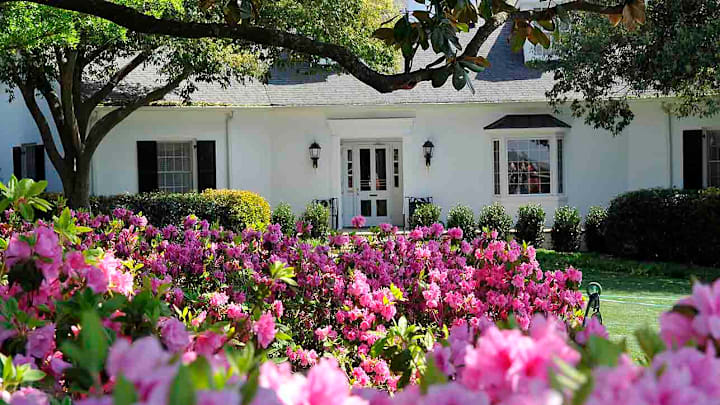
And some of those players take advantage of an added perk: a room in one of the Augusta National cabins.
“The greatest golf experience in the my opinion in the world is playing Augusta, having dinner in the clubhouse, a post-dinner glass of wine, walk around and see the history,” said 2012 U.S. Open champion Webb Simpson, who said he’s been invited to stay in the cabins a handful of times. “You go up and can call up any Masters [on TVs in the cabins] and ’97 is my favorite. And then you wake up and you do it again. It’s so great.
“There’s so much tradition around the grounds whether it’s the caddie bibs or Amen Corner. It’s just a place where you remember the shots and the putts hit more than any other place. It’s the same golf course every year so fans get to know it. You get to understand it and remember it from years past, ‘this is exactly where Jack Nicklaus won or Arnold Palmer won or Gene Sarazen.’”
Simpson is not in this year’s Masters field but is well-versed in cabin protocol, having first been a guest with his father when he was 12 years old. You don’t need a spot in the Masters field to be invited to Augusta National.
But if you are playing and want to stay on site, there’s a bit of protocol that must be followed.
The rules of Augusta National’s cabins
A player can phone the club in advance to book a tee time for practice, but staying in one of the dozen or so cabins that dot the property requires a member to serve as host.
And that can be a bit awkward, as the cabin experience is more than a high-end hotel room—guest fees, caddie fees and dinners all land on the members’ tab.
The member typically plays golf with the group, including on the adjacent par-3 course. The member might also host dinner.
Simpson said he offers to pay—the tab for a day or two can run more than $2,000—right up front but says it’s tough getting them to accept. “I want to do something,” he said. “I want to pay for the caddies, dinner. I’ve tried to pay over the years and nobody ever lets me.”
Then he adds: “I want to be able to ask them again.”
The property has more than a dozen cabins that provide housing for members and guests, and seven of them form a semi-circle just off the 10th fairway, near the par-3 course. Several would be familiar to golf fans who tune into the broadcast.

The Butler Cabin is near the clubhouse and is where the annual televised awards ceremony takes place. It was used for the first time on TV in 1965. The Roberts Cabin, named after the original club chairman, Clifford Roberts, is also near the clubhouse, as is the Eisenhower Cabin, which is just off the 10th tee.
Ben Crenshaw, who won the Masters in 1984 and 1995, recently visited Augusta National and stayed in Butler Cabin.
“We have a wonderful local member who hosts us,” he said. “I’ve stayed in a few of the cabins over the years. They’re just great, so nice and to be there on the grounds brings back a lot of cherished memories. You realize how lucky you are.”
Crenshaw said the cabins are spacious and “really well done. They’re handsome, not fancy, just so luxuriously tasteful.”
Inside the Eisenhower Cabin, fit for a President
Crenshaw, a World Golf Hall of Fame member, has also stayed in the Eisenhower Cabin, which has a history of its own and is far larger than it appears from the front. It is three stories tall, has seven bedrooms and was built in 1953 for President Eisenhower, who took office that year. The cabin, according to Augusta National, was built to specifications of presidential security.
Eisenhower became an Augusta member in 1948 shortly after a visit. The club said he visited five times prior to his presidency, 29 times while in office and 11 more following his second term and prior to his death in 1969.
It has been modernized but also retains its historical features. Members paid for its construction, and unlike other cabins, it has a basement that was designed to accommodate the Secret Service.
President Ronald Reagan stayed in the Eisenhower Cabin during a 1983 visit that became infamous for a gunman breaking onto the property and holding hostages in the pro shop in an effort to speak to the President. After a two-hour standoff, the situation ended peacefully.
Adam Scott, who won the Masters in 2013, said he’s only stayed in the cabins twice, but one time he was in the Eisenhower.
“It’s a big cabin,” Scott said. “I think there’s a lot of memorabilia in there from then. But I don’t remember it looking like it’s from the ’40s or ’50s or such.”

The club typically closes in late May so there is not much time for member play following the Masters. The summer months are devoted to course improvements and often see turf replaced or some greens altered.
It then opens again in mid-October after being overseeded with rye grass which gives the course its lush, green appearance.
Often when players visit under such circumstances, they take advantage of the time by playing multiple rounds in one day, sampling the wine cellar, eating dinner at the club and playing the par-3 course. They never leave the premises.
“Yeah. Did the whole lot,” Scott said. “Yeah. It’s fun. Super fun. Tiring, but fun.”
When asked about his experiences, Jordan Spieth answered so simply and matter-of-factly that it almost sounded routine. Like, well, “of course” he had stayed in one of the cabins at Augusta National!
“Many times,” said the 2015 champion. “Almost every time I’ve done it, it’s been with a group of members, so it’s not like it was a perk. I don’t know if I’m actually just allowed to do it on my own [he cannot].
“I know I can play it whenever and I can bring non-playing guests but I don’t know if I’m allowed to stay there and I haven’t really—any time I’ve gone solo I’ve gone in and out on the same day and the other times I stayed there it’s always been in a group of at least two groups.
“But, yeah, it’s spectacular. It’s a great experience. You have a lot of great golf courses that are fun places to take groups now. That one is very different from some of the newer ones, where it’s more casual and lit up greens and all that. Obviously it’s a little more buttoned up there ... there’s obviously history everywhere.”
Trevor Immelman, who won the Masters in 2008 and now CBS’s golf analyst, said he visited in October soon after the club reopened for the season.
“We had a wonderful day, perfect weather,” he said. “It’s like stepping into heaven, playing a round of golf. Everything about it is so special.”
Just talking about all this kind of had Simpson a bit wistful. He’s not in the Masters field this year and hasn’t played the tournament since 2022. In 2019, he had a front-row seat to history, playing in the second-to-last group, one in front of Tiger Woods, who went on to win.
Simpson said he loves throwing out a trivia question about that final round: who are the only two players among the six in the last two groups who did not hit his tee shot in the water at the 12th hole?
Woods, of course, was one of them. “Not many people get me,” Simpson chuckled.
“It’s tough not to be there again,” he said. “I’m trying. It’s such a great place.”
More Golf from Sports Illustrated
 Add us as a preferred source on Google
Bob Harig was a senior writer covering golf for Sports Illustrated. He has more than 25 years experience on the beat, including 15 at ESPN. Harig is a regular guest on Sirius XM PGA Tour Radio and has written two books, “DRIVE: The Lasting Legacy of Tiger Woods” and “Tiger and Phil: Golf’s Most Fascinating Rivalry.” He graduated from Indiana University where he earned an Evans Scholarship, named in honor of the great amateur golfer Charles (Chick) Evans Jr. Harig, a former president of the Golf Writers Association of America, lives in Clearwater, Fla.
Follow bobharig