%20%20--%3E%0A%3Csvg%20version%3D%221.1%22%20id%3D%22Layer_1%22%20xmlns%3D%22http%3A%2F%2Fwww.w3.org%2F2000%2Fsvg%22%20xmlns%3Axlink%3D%22http%3A%2F%2Fwww.w3.org%2F1999%2Fxlink%22%20x%3D%220px%22%20y%3D%220px%22%0A%09%20width%3D%2239px%22%20height%3D%2240px%22%20viewBox%3D%220%200%2039%2040%22%20enable-background%3D%22new%200%200%2039%2040%22%20xml%3Aspace%3D%22preserve%22%3E%0A%3Cpath%20fill%3D%22%23FFFFFF%22%20d%3D%22M38.5%2C7H28.2v26h10.3V7z%22%2F%3E%0A%3Cpath%20fill-rule%3D%22evenodd%22%20clip-rule%3D%22evenodd%22%20fill%3D%22%23FFFFFF%22%20d%3D%22M26.1%2C25.5c0%2C5.8-4.1%2C7.5-12.9%2C7.5C3.9%2C33%2C0%2C31.2%2C0%2C25.2v-1.1h11.6%0A%09v2.4c0%2C0.7%2C0.1%2C1.4%2C1.2%2C1.4c1%2C0%2C1.2-0.4%2C1.2-1.3v-0.9c0-1.6-0.9-1.6-3.5-2.2C2.2%2C21.7%2C0%2C19.7%2C0%2C15.3v-0.9C0%2C9.3%2C5.5%2C7%2C12.9%2C7%0A%09c10.2%2C0%2C12.8%2C2.6%2C12.8%2C7.4v1.8h-11v-2.9c0-0.6-0.4-1.1-1.2-1.1c-0.6%2C0-1.2%2C0.4-1.2%2C1.1v0.9c0%2C1.5%2C0.9%2C2%2C3.3%2C2.5%0A%09c8%2C1.6%2C10.5%2C3.3%2C10.5%2C7.5V25.5z%22%2F%3E%0A%3C%2Fsvg%3E%0A)
Taking in a New One-Two Punch of Scottish Golf at Cabot Highlands
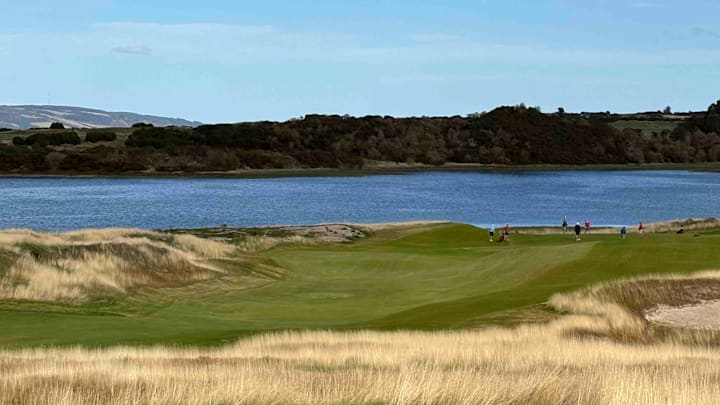
Arriving to the 3rd tee at Cabot Highlands’s Old Petty course, it’s time to settle in and hit a shot. The course’s toughest par-3 plays downhill to a narrow green with runoffs in every direction and, oh, there’s a 400-year-old castle on the left.
Castle Stuart, built in 1625 by James Stuart, 1st Earl of Moray, isn’t really in play but demands a few moments to marvel at its architecture, topped by a spire now familiar as the resort’s insignia.
And one might imagine the good Earl peeking out a westside window to watch some golf on a course that looks like it could have opened in his ’25, not 2025.

Old Petty just welcomed preview play earlier this year, but the Tom Doak/Clyde Johnson creation has the gift of a look belying its age. And getting to experience Scotland’s newest layout, as well as the rest of the Cabot Collection property, made for the best thing I saw in golf this year.
MORE BEST THINGS: Opening morning at the Ryder Cup
Cabot keeps expanding and one-upping itself, from its first properties in Nova Scotia, Canada, to the Caribbean, to France and Florida and now to a pair of must-plays on the north coast of Scotland.
Cabot acquired Castle Stuart Golf Links in 2022, the 2009 Gil Hanse design that hosted four Scottish Opens (Phil Mickelson won there before capturing the 2013 British Open) and appears regularly on top-100 lists. One standout course is nice but if two creates a destination, then the addition of Old Petty now makes Cabot Highlands a worthy addition to the Collection.
A maiden trip to Scotland
I had never taken my golf clubs across the pond—a massive hole in my golf resume—before an invitation to Scotland in September. The trip delivered plenty of stories including a travel-snafu tale. Without going into too much detail, I’ll just say I’m now intimately familiar with Amsterdam’s massive Schiphol airport.
Not massive is the airport in Inverness, Scotland, the kind where you deplane via staircase to the tarmac to baggage claim and to ground transportation with about as many steps as required for a long par-3. My plane touched down long after sunset but I was in my bedroom within a half-hour, thanks to the small airport and Cabot Highlands just 10 minutes away.

My home in the resort’s Golf Lodge is the ideal golfer’s crash pad, sitting between the 14th and 15th fairways on Castle Stuart and within walking distance of the clubhouse. Four bedrooms are equipped with dressing rooms and bathrooms with rainfall-style showers, under-floor bathroom heating and electric towel warmers—welcome on days when you come in from a round of notorious Scottish weather. A full kitchen and full living room with floor-to-ceiling windows beg players to wind down after rounds with a beverage, snacks and round recaps.
With the aforementioned convenient location, the only times I needed rides were for evening trips to downtown Inverness for dinner (reservations at RocPool restaurant are tough but worth the effort, then the king scallops are a must). On a longer trip—maybe next time—the Golf Lodge would also be a gateway to Royal Dornoch, Nairn and other Scottish Highland favorites.
But Old Petty beckoned on my first morning, including a few holes with the architects.
From farms to fairways
Grains, potatoes and root vegetables are among the crops grown in the Highlands’ rolling terrain, the same terrain Doak and lead associate Johnson were given to create Old Petty. What the land might lack compared to the dramatic shoreline holes of Castle Stuart, it takes back in creative shotmaking opportunities.
The links-style course plays true to form by not always being a point-and-shoot like so many American layouts, but one of angles and creativity.

“I spend 80% of my time when I’m on site working on the greens and the stuff around—bunkering, slopes around the greens to make them diverse,” Doak says. “Make them so there's a bunch of fun shots to play.”
He had illustrated one of those during the round, schooling me on a links-style shot from off the green at a par-3 we had both missed long. After I chunked a sand wedge on the firm turf, failing to climb the hill to the green, he took a 5-iron from his small canvas walking bag (which held about nine clubs rather than 14) and played a simple bump-and-run up to the hole. Lesson learned.
Old Petty has features that look like they’ve been there for centuries thanks to the architects’ expertise and features that look like they’ve been there for centuries because they have. The green at the par-4 5th is bordered by a bothy, a Scottish simple shelter often used to get out of the elements. The red-roofed stone structure is now a halfway house.

At the par-5 15th, which plays around the Moray Firth, a beached fishing boat is your line off the tee. And of course there’s Castle Stuart, which after the 3rd hole comes back into full view at the 15th green and then the par-4 16th—the only hole with a forced carry off the tee, over a marsh. Which is by design.

“When I’m a 12 handicap and I played with a bunch of 6-to-15 handicapped guys, I could tell you it worked fairly good for us,” Doak says from the clubhouse after the round. “And I do think most of us got around here with the same ball we started with. If you can keep the ball in play … like Alister MacKenzie said it doesn't matter if you're shooting 95 or 105 or 115, as long as you're making forward progress and having fun, it's all good.”
Cliffside drama at Castle Stuart
On my second and final day at Cabot Highlands, I set out early to tackle Castle Stuart Golf Links, the course I woke up to every morning at the Golf Lodge.
The Hanse design delivers instant drama as from the putting green you walk down a path through to a cliffside first tee—no slicing off this box. The 2nd and 3rd holes continue parallel to the Firth before turning inland back toward the clubhouse.

Off the fifth fairway sits the Old Petty church, which dates to the mid-1800s and has recently been put up for sale for 50,000 pounds (perhaps a new owner would placate the golf Gods with a renovation).

The back nine returns to the shore for the 10th, 11th and 12th holes before heading uphill and inland, a routing not dissimilar to Whistling Straits, another course whose stunning water views can also deliver weather challenges.
Incredibly, my two rounds had no weather challenges to speak of; the layers I packed never made it out of the suitcase. If this was Scotland’s way of telling me to come back soon, it worked. And I know exactly where I’ll want to go first.
More Golf on Sports Illustrated
 Add us as a preferred source on Google
John Schwarb was a senior editor for Sports Illustrated covering golf. Prior to joining SI in March 2022, he worked for ESPN.com, PGATour.com, Tampa Bay Times and Indianapolis Motor Speedway. He is the author of The Little 500: The Story of the World’s Greatest College Weekend. A member of the Golf Writers Association of America, Schwarb has a bachelor’s in journalism from Indiana University.
Follow johnschwarb