%20%20--%3E%0A%3Csvg%20version%3D%221.1%22%20id%3D%22Layer_1%22%20xmlns%3D%22http%3A%2F%2Fwww.w3.org%2F2000%2Fsvg%22%20xmlns%3Axlink%3D%22http%3A%2F%2Fwww.w3.org%2F1999%2Fxlink%22%20x%3D%220px%22%20y%3D%220px%22%0A%09%20width%3D%2239px%22%20height%3D%2240px%22%20viewBox%3D%220%200%2039%2040%22%20enable-background%3D%22new%200%200%2039%2040%22%20xml%3Aspace%3D%22preserve%22%3E%0A%3Cpath%20fill%3D%22%23FFFFFF%22%20d%3D%22M38.5%2C7H28.2v26h10.3V7z%22%2F%3E%0A%3Cpath%20fill-rule%3D%22evenodd%22%20clip-rule%3D%22evenodd%22%20fill%3D%22%23FFFFFF%22%20d%3D%22M26.1%2C25.5c0%2C5.8-4.1%2C7.5-12.9%2C7.5C3.9%2C33%2C0%2C31.2%2C0%2C25.2v-1.1h11.6%0A%09v2.4c0%2C0.7%2C0.1%2C1.4%2C1.2%2C1.4c1%2C0%2C1.2-0.4%2C1.2-1.3v-0.9c0-1.6-0.9-1.6-3.5-2.2C2.2%2C21.7%2C0%2C19.7%2C0%2C15.3v-0.9C0%2C9.3%2C5.5%2C7%2C12.9%2C7%0A%09c10.2%2C0%2C12.8%2C2.6%2C12.8%2C7.4v1.8h-11v-2.9c0-0.6-0.4-1.1-1.2-1.1c-0.6%2C0-1.2%2C0.4-1.2%2C1.1v0.9c0%2C1.5%2C0.9%2C2%2C3.3%2C2.5%0A%09c8%2C1.6%2C10.5%2C3.3%2C10.5%2C7.5V25.5z%22%2F%3E%0A%3C%2Fsvg%3E%0A)
Rory McIlroy Takes 'Unpopular Opinion' on Rolled-Back Ball, Suggests He'd Play It Full-Time
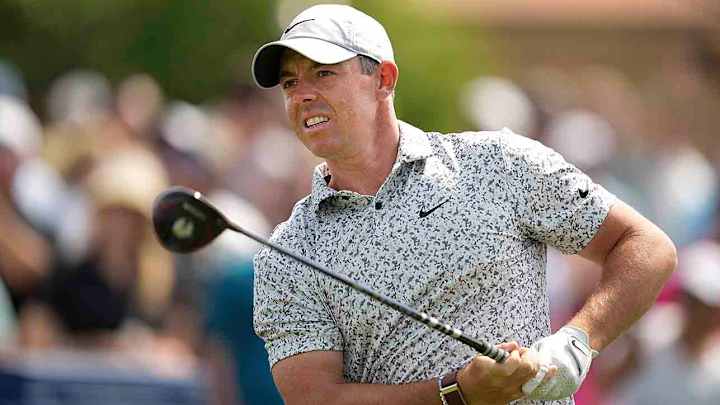
Rory McIlroy has come out in support of golf’s governing bodies and their distance proposal, saying he is in favor of a golf ball made for elite players that would not fly as far.
McIlroy’s position is in opposition to many of his peers in professional golf, who believe “bifurcation"—having different rules for pros or elite players—is bad for the game.
In an interview with the No Laying Up podcast, McIlroy said he supported the measures that were proposed by the USGA and the R&A last week and even suggested that he’d play a reduced-distance ball in PGA Tour events if the organization doesn’t go along with what is being called a Model Local Rule.
“I’ve been pretty adamant that I don’t really want the governing bodies to touch the recreational golfer because we need to make this game as not intimidating and as much fun as possible, just to try to keep the participation levels at an all-time high,” McIlroy said during the interview.
“So, I’m glad in this new proposal that they haven’t touched the recreational golfer. But for elite level play, I really like it. I really do. I know that’s a really unpopular opinion amongst my peers, but I think it’s going to help identify who the best players are a bit easier. Especially in this era of parity that we’ve been living in these past couple of decades ... I think you’re going to see people with more well-rounded games succeed easier than what the game has become, which is a bit bomb and gouge over these last few years."
The proposal, which would only be adopted for elite players, would not go into effect until 2026, if approved. It will undergo a comment and review process until August of this year.
The golf balls that would be required to be used in this narrow instance would be tested with swing speeds of 127 mph, which generally means top-level players would see a decrease in driving distance of 15 to 20 yards.
The hope is that it would require top players to hit longer irons into par 4s and par 5s. McIlroy believes it might separate the top players more.
“Selfishly, I think it helps me,” McIlroy said. “I think this is only going to help the better player. It might help the longer player too, in some ways. But I think it's going to help the overall professional game. I think making guys hit some long irons again, and some mid irons, and being able to hit every club in your bag in a round of golf. … I can't remember the last time when I've had to do that. I don't know if this change in the ball will make us do that, but it certainly is a step closer to that.”
The manufacturing industry is generally against the move. Titleist and TaylorMade have come out with statements pushing back on the need to make any changes. The cost of making a different ball has been put forth as one reason.
And many of McIlroy’s colleagues have been against the move, including Justin Thomas who last week was highly critical of the idea.
“You're trying to create a solution for a problem that doesn't exist," Thomas said. “To me, it's so bad for the game of golf. Some of the great things to me is the fact that you can play the exact same golf ball that I play. I mean, that's cool. For an every day amateur golfer, it's very unique that we are able to play the exact same equipment. Yeah, I understand that I may have a different grind on a wedge, whatever you want to call it, but you can go to the pro shop and buy the same golf ball that I play or Scottie Scheffler plays or whatever.
“But the USGA wants to bring it to a point where that's not the case. They want it to be, O.K., well, the pros play this way and the amateurs play this way, and that just doesn't—I don't understand how that's better for the game of golf. The amount of time, money that these manufacturers have spent trying to create the best product possible and now you're going to tell them and us that we have to start over for potentially if the PGA Tour, PGA of America, don't adopt this local rule. So for two of the four biggest events of the year we're going to have to use a different ball? Like, try to explain to me how that's better for the game of golf."
It is possible that the Masters, U.S. Open and the British Open would adopt the Model Local Rule, while the PGA Tour, DP World Tour and PGA Championship—which has in the past supported its members, who sell golf products—would not adopt it. That means players, potentially, would need to adapt to different golf balls.
“Honestly, for me, the major championships are the biggest deal, so if the PGA Tour doesn't implement it, I might still play the Model Local Rule ball, because I know that that'll give me the best chance and the best preparation leading into the major championships,” McIlroy said. “And again, this is personal preference and personal opinion at this stage of my career. I know that I'm going to be defined by the amount of major championships that I hopefully will win from now until the end of my career. And that's the most important thing for me.
“If that gives me the best chance to succeed at the major championships and feel as prepared as I possibly can be, then that's what I would do.”
 Add us as a preferred source on Google
Bob Harig was a senior writer covering golf for Sports Illustrated. He has more than 25 years experience on the beat, including 15 at ESPN. Harig is a regular guest on Sirius XM PGA Tour Radio and has written two books, “DRIVE: The Lasting Legacy of Tiger Woods” and “Tiger and Phil: Golf’s Most Fascinating Rivalry.” He graduated from Indiana University where he earned an Evans Scholarship, named in honor of the great amateur golfer Charles (Chick) Evans Jr. Harig, a former president of the Golf Writers Association of America, lives in Clearwater, Fla.
Follow bobharig