%20%20--%3E%0A%3Csvg%20version%3D%221.1%22%20id%3D%22Layer_1%22%20xmlns%3D%22http%3A%2F%2Fwww.w3.org%2F2000%2Fsvg%22%20xmlns%3Axlink%3D%22http%3A%2F%2Fwww.w3.org%2F1999%2Fxlink%22%20x%3D%220px%22%20y%3D%220px%22%0A%09%20width%3D%2239px%22%20height%3D%2240px%22%20viewBox%3D%220%200%2039%2040%22%20enable-background%3D%22new%200%200%2039%2040%22%20xml%3Aspace%3D%22preserve%22%3E%0A%3Cpath%20fill%3D%22%23FFFFFF%22%20d%3D%22M38.5%2C7H28.2v26h10.3V7z%22%2F%3E%0A%3Cpath%20fill-rule%3D%22evenodd%22%20clip-rule%3D%22evenodd%22%20fill%3D%22%23FFFFFF%22%20d%3D%22M26.1%2C25.5c0%2C5.8-4.1%2C7.5-12.9%2C7.5C3.9%2C33%2C0%2C31.2%2C0%2C25.2v-1.1h11.6%0A%09v2.4c0%2C0.7%2C0.1%2C1.4%2C1.2%2C1.4c1%2C0%2C1.2-0.4%2C1.2-1.3v-0.9c0-1.6-0.9-1.6-3.5-2.2C2.2%2C21.7%2C0%2C19.7%2C0%2C15.3v-0.9C0%2C9.3%2C5.5%2C7%2C12.9%2C7%0A%09c10.2%2C0%2C12.8%2C2.6%2C12.8%2C7.4v1.8h-11v-2.9c0-0.6-0.4-1.1-1.2-1.1c-0.6%2C0-1.2%2C0.4-1.2%2C1.1v0.9c0%2C1.5%2C0.9%2C2%2C3.3%2C2.5%0A%09c8%2C1.6%2C10.5%2C3.3%2C10.5%2C7.5V25.5z%22%2F%3E%0A%3C%2Fsvg%3E%0A)
The Site of the AIG Women’s Open Was the Home Course of … Winston Churchill?

Those who have played Walton Heath, host venue of this week’s AIG Women’s Open, can confirm: A round at the Surrey, England, club can easily devolve into something resembling trench warfare. Faced with constant whipping winds, bushy heather grass and firm and fast conditions, navigating the course might feel like a figurative battle.
A quick glance at the club’s early history, however, and you’ll realize that actual warfare is in fact part of its history.
At the onset of World War I, the 36-hole property was frequented by some of the most influential British politicians of the time, and they likely discussed serious wartime decisions on the club premises.
One of those members was Winston Churchill.
“Somebody once said the war was being run from Walton Heath’s 19th hole,” says Phillip Truett, Walton Heath’s club historian. (Truett, a self-professed golf bibliophile, has just come from a round of golf himself when he picks up our call. He was happy to report that his team, the British Golf Collectors Society, had won their triangular match, which was played using hickory clubs only.)
Truett is an expert on all things Walton Heath, where he is also a longtime member.
“Imagine my astonishment when I joined the club in early 1964, you’re given a list of members and in the members book there was Winston Churchill’s name. As an impressionable young man, you can imagine how impressed I was with that,” he says.
According to the club’s records, Churchill joined Walton Heath in 1910, six years after the club officially opened for play in 1904. He was 36 years old and a Liberal member of Parliament at the time.
The statesman held an 18 handicap in 1913, but by 1938 it had climbed to 24.

Churchill’s wife, Clementine, was also accepted as a club member, and documentation exists of her letter of entry.
“Dear Madame, I have the pleasure to inform you that you have been Elected a Member of this Club. Your Entrance Fee is £5.5…Annual Subscription…£4.4. I enclose Banker’s Order, which please fill up for £4.4, and return to me with Cheque for your Entrance Fee. I enclose the Book of Rules and List of Members.”
An image of the official notice appears in “Heather and Heaven” by Phil Pilley, a book about Walton Heath, which in 2003 won the USGA’s Herbert Warren Wind Award.
Annual dues at the club would have equaled around six U.S. dollars.
Churchill was not the only British Prime Minister to have joined Walton Heath. The club boasted a list of four PMs as part of its membership: Churchill, Bonar Law, Arthur Balfour and David Lloyd George, who led the country through World War I. Additionally, 24 members of parliament and 21 members of the Upper House belonged to the club.
“No political party had exclusivity,” Truett says. “There were leading Tories and there were leading Liberals.
“This was the absolute center of the universe leading up to, during, and just after the Great War.”
Walton Health’s steady transformation into a political forum had as much to do with its membership as its intimate clubhouse layout. The compact design of the club’s center and meeting place forced members to interact with each other, a trait that many other courses in the area would not have been able to replicate.
“Some of the clubs started in the 1890s in the north of England, they had great big clubhouses built by successful merchants in Liverpool and Manchester,” Truett says. “They had a mission to show people their wealth and prosperity, but we were much more modest. Our clubhouse started off as quite a humble pavilion. You couldn’t fail to get to know people. I can’t help but feel that when this tremendous group of politicians gathered, it was very easy for them all to get to know each other and communicate.”
Walton Heath is located just a short commute away from the British Parliament, but such prominent politicians were attracted to the club for more than just its geographical convenience.
A man by the name of George Riddell was the proprietor of Walton Heath and he ran a widely circulated newspaper called News of the World. Riddell’s line of work meant he was naturally in the same circles as these elite political figures, and he used his power at Walton Heath to boost his relationships even further.
“Basically, anybody who could be of any use to Riddell as a newspaperman, he greeted them at Walton Heath,” Truett says. “Most of them were honorary members. We had four prime ministers, and I find that extraordinary. If we had a prime minister now who played any golf, he would immediately get castigated for that. Back in those days, it was sort of a socially acceptable thing to be doing.”
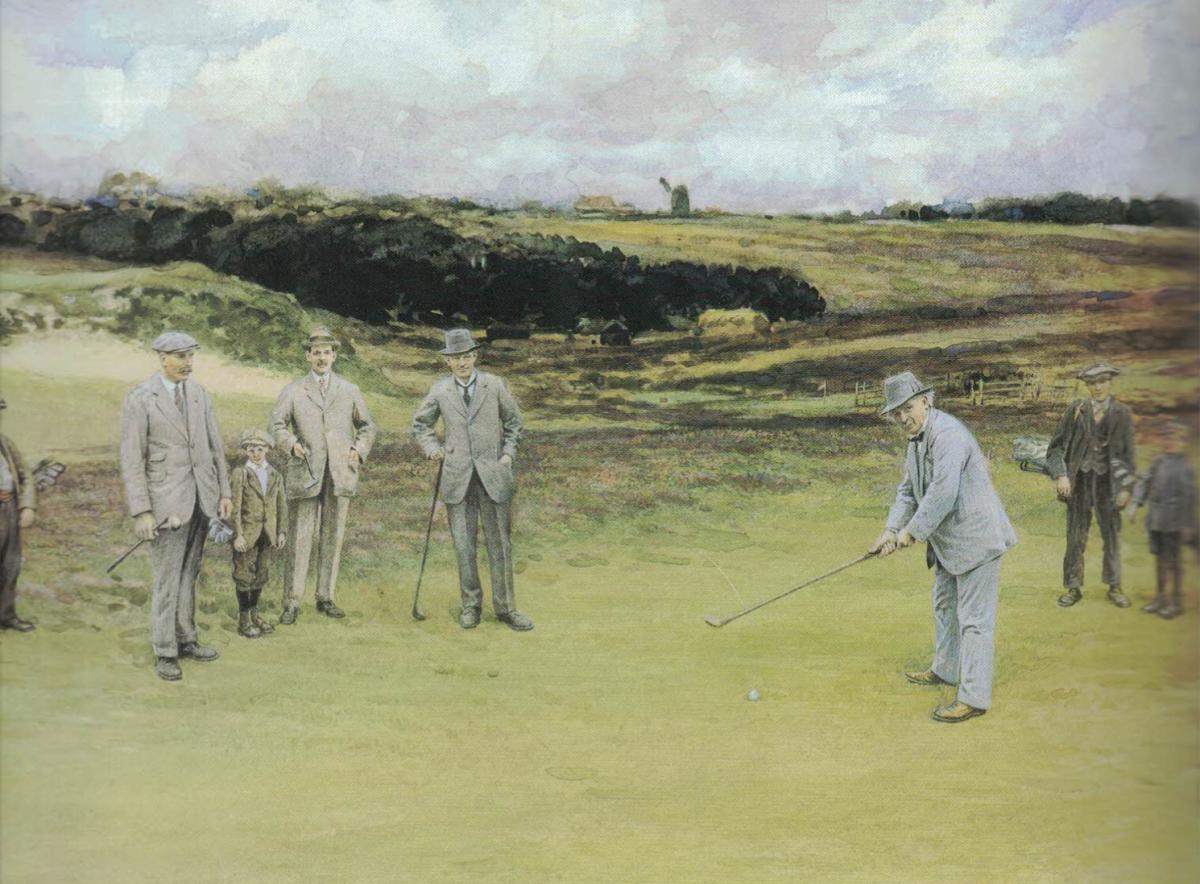
Nothing demonstrates more fittingly how well-integrated politicians were at Walton Heath—and how acceptable that was—than an image painted for an annual calendar and advertisement for the Life Association of Scotland, a life insurance company.
The telling scene was painted in 1915—a year into World War I—and was used to illustrate the 1916 edition of the calendar. It showed Lloyd George, who was the Minister of Munitions for Britain at the time, alongside Riddell, the club’s owner, Herbert Fowler, the course’s designer, and James Braid, the club’s first head professional. (If Braid’s name sounds familiar, that’s because he won five British Opens.)
“[The painting] is incorrect in every conceivable way,” Truett says. “Not only have you got these characters playing golf in the middle of the war, but you also got them supporting a commercial enterprise. But of course, in those days it was all very different.”
There is no known photographic or artistic evidence of Churchill playing golf at Walton Heath, but there is an image in which he appears to be playing somewhere else, although the location is unknown.
The photograph appeared in the November-December 1940 edition of Golfing magazine, which claims it was taken in the 1910s.

The image now hangs in Walton Heath’s clubhouse, and it is accompanied by a quote, which perfectly encapsulates Churchill’s relationship to golf and to his home course.
It is an excerpt from one of Churchill’s letters to his wife, which has been preserved in a book authored by his daughter, Mary Soames, called Speaking for Themselves.
“My Darling One,” Churchill wrote. “I shall be back tomorrow between 11 and 12 and I thought it would do us both good to play a little golf at Walton Heath.”
Like the rest of Walton Heath’s influential members, Churchill surely participated in political discourse on club grounds. But evidently, he also appreciated the venue for what it will always be: an escape from political life and an excellent backdrop for spending time with loved ones.
 Add us as a preferred source on Google
Gabrielle Herzig is a Breaking and Trending News writer for Sports Illustrated Golf. Previously, she worked as a Golf Digest Contributing Editor, an NBC Sports Digital Editorial Intern, and a Production Runner for FOX Sports at the site of the 2018 U.S. Open. Gabrielle graduated as a Politics Major from Pomona College in Claremont, California, where she was a four-year member and senior-year captain of the Pomona-Pitzer women’s golf team. In her junior year, Gabrielle studied abroad in Scotland for three months, where she explored the Home of Golf by joining the Edinburgh University Golf Club.
Follow GabbyHerzig