%20%20--%3E%0A%3Csvg%20version%3D%221.1%22%20id%3D%22Layer_1%22%20xmlns%3D%22http%3A%2F%2Fwww.w3.org%2F2000%2Fsvg%22%20xmlns%3Axlink%3D%22http%3A%2F%2Fwww.w3.org%2F1999%2Fxlink%22%20x%3D%220px%22%20y%3D%220px%22%0A%09%20width%3D%2239px%22%20height%3D%2240px%22%20viewBox%3D%220%200%2039%2040%22%20enable-background%3D%22new%200%200%2039%2040%22%20xml%3Aspace%3D%22preserve%22%3E%0A%3Cpath%20fill%3D%22%23FFFFFF%22%20d%3D%22M38.5%2C7H28.2v26h10.3V7z%22%2F%3E%0A%3Cpath%20fill-rule%3D%22evenodd%22%20clip-rule%3D%22evenodd%22%20fill%3D%22%23FFFFFF%22%20d%3D%22M26.1%2C25.5c0%2C5.8-4.1%2C7.5-12.9%2C7.5C3.9%2C33%2C0%2C31.2%2C0%2C25.2v-1.1h11.6%0A%09v2.4c0%2C0.7%2C0.1%2C1.4%2C1.2%2C1.4c1%2C0%2C1.2-0.4%2C1.2-1.3v-0.9c0-1.6-0.9-1.6-3.5-2.2C2.2%2C21.7%2C0%2C19.7%2C0%2C15.3v-0.9C0%2C9.3%2C5.5%2C7%2C12.9%2C7%0A%09c10.2%2C0%2C12.8%2C2.6%2C12.8%2C7.4v1.8h-11v-2.9c0-0.6-0.4-1.1-1.2-1.1c-0.6%2C0-1.2%2C0.4-1.2%2C1.1v0.9c0%2C1.5%2C0.9%2C2%2C3.3%2C2.5%0A%09c8%2C1.6%2C10.5%2C3.3%2C10.5%2C7.5V25.5z%22%2F%3E%0A%3C%2Fsvg%3E%0A)
Seven Things I Learned Following Rory McIlroy at the First Round of the PGA Championship
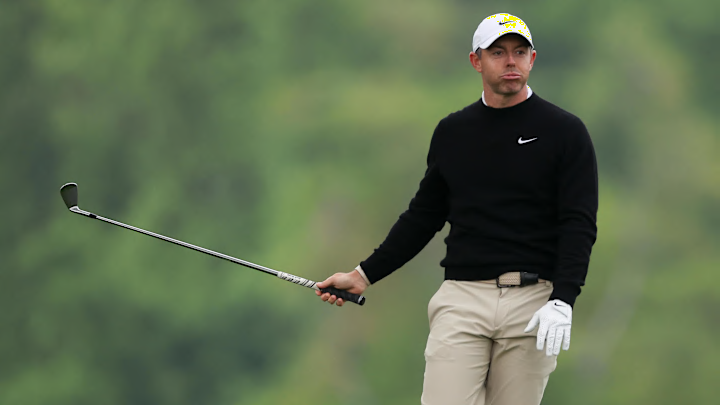
NEWTOWN SQUARE, Pa. — Rory McIlroy’s first round at the PGA Championship did not go according to plan. The two-time reigning Masters champion entered the tournament as the second favorite, trailing only Scottie Scheffler on the odds sheets, and was the headliner of the marquee group of the morning alongside Jordan Spieth and Jon Rahm.
Rahm and Spieth held up their end of the superstar bargain, both posting rounds of 1 under and hitting a few shots that got the crowds cheering. McIlroy, however, struggled, fighting against himself all day and at times looking utterly baffled by the greens at Aronimink Golf Club en route to shooting 4 over par.
Asked to sum up his round, McIlroy offered one word: “S—.”
"Rory, how would describe your round?"
— Dan Why-Ner (@ReallyDanWeiner) May 14, 2026
"Shit." pic.twitter.com/arTrL2flgl
But as any golfer knows, the toughest days on the course are often when we learn the most, and while McIlroy was understandably frustrated with his play, I certainly learned a lot about golf watching him.
I followed McIlroy, Rahm and Spieth from their first shots off the tee to their final putts of the day. While I’ve covered golf tournaments in the past, this was my first time covering a major, and also my first time having a front-row seat for such a threesome. I tried to soak in as much knowledge as I could throughout the day, from the players, the course, the crowds and the pace at which major championship golf moves. I learned a lot! Here are my findings.
Rory McIlroy’s gravity is incredible
The two biggest superstars on the PGA Tour are McIlroy and Scheffler. Scheffler might have the edge in the world rankings but in terms of star power, Rory has him beat between his longevity as one of the best players in the world, back-to-back Masters wins and ascendence to de facto Playing Captain of the PGA Tour during the Great Golf Divide of the past six years.
That star power is extremely evident on the golf course. Teeing off at 8:40 a.m. ET through a cold and foggy morning, fans packed in to watch Rory & Co. start their rounds. Throughout the day, they carried with them the biggest crowds, both in terms of fans and media—several fans joked about the “entourage” of cameras that followed the group from hole to hole.
McIlroy’s gravity is not surprising, given his current status in the game, but it was still amazing to bear witness to in person, and added even more stakes to his difficult round. If that’s the type of energy that follows him on the course for a poor, early round on Thursday, I cannot imagine the electricity he takes from hole to hole when in contention on Sunday.
Also, the cameras. So many cameras. Apologies in advance to the amount of Instagram videos I ruined by walking through the frame today—please know that I did not want to be in your photo any more than you wanted me in them. The modern panopticon is undefeated.
Reading crowd cheers is a science

I’ve never gotten to see Tiger Woods play live, but I have heard the legend of Tiger cheers—the roars that crowds would give to him, and only him, that were easy to recognize compared to the cheers earned by other players on tour. But when you’re following a group with three star players, translating the meaning of different cheers is a bit more nuanced a science.
There are still your simple sighs to analyze—the “ohhhhhhHHHHHH-ahhhhhhh” of a putt that scares the hole but drips by it and the “aaaahhhh-OWWWW” of a ball slowly gaining momentum as it rolls off the green. But for your standard wedge or iron shot into the green, figuring out how the crowd was reacting and who they were reacting to featured plenty of interesting variables. When Spieth had a brief birdie-birdie run that took him into a tie for the lead, each cheer built with his momentum. When McIlroy bogeyed four straight holes to close his round, the sighs of disbelief escalated hole after hole.
I don’t know what studies have gone into analyzing the collective reactions of crowds to shared stimuli, but golf would be a fascinating place to test out some theories.
These greens are dreams and nightmares
I play golf from time to time. I do not play golf at courses as nice as Aronimink Golf Club. Three hundred sixty days out of the year, I would be escorted off the premises here.
The courses that I play when hitting the links are delightful, affordable and just the quality I need to slowly but surely battle my way towards eventually breaking 100. They are also basically cement tracks compared to the scene here.
The greens at Aronimink are massive, and the pins for Thursday’s first round were tucked all across the course. There were no gimmes to be had, as McIlroy, Spieth and Rahm all learned at points of their round.
On the one hand, I would love the chance to putt around on a course like this some time. On the other hand, I’m not sure I’d hit a single cup.
The bottlenecks are ROUGH
Hosting a golf tournament seems like an operational and logistical nightmare. There are so many moving parts, and so many people needing to be so many places at so many different times. Garrick Higgo found out the hard way that timeliness is next to godliness in the world of golf. And while the logistics of moving across the course at Aronimink are largely solid, there are a few bottlenecks for the golfers based on the layout of the course that left the star group on Thursday waiting… and waiting… and waiting.
The worst bottleneck I noticed on the course was probably at the 14th tee. It is a par-3, meaning players can’t hit from the tee box until the group in front of them has cleared the green. It also sits within spitting distance of the 13th green, meaning that sometimes there needs to be coordination between three different parties regarding “who is about to take a shot and potentially make fans make a lot of noise?”
More than anything, I was impressed with the group’s ability to go from waiting to playing in no time at all. The trio stood at the 14th tee for at least five minutes, maybe longer, waiting for play to clear in front of them. When it came their moment to shoot, they shot and got moving once again.
It’s hard to tell if the bottlenecks here are worse than other courses, or if I was just feeling their weight more because I was waiting in person rather than zoning out during a commercial break between shots. Regardless, I have a new appreciation for the problem of slow play, which unfortunately, like so many other problems, may be more complex than I originally believed.
Blimps are loud

I don’t know if this was my first time seeing the Goodyear blimp, but it was certainly my first time hearing the Goodyear blimp. This may sound extremely stupid, but in my head, blimps were quiet beasts. Aren’t they mostly floating up there? But when compared to the silence of a gallery waiting for Spieth to hit off the tee into a dangerous par-3, the Goodyear blimp is a giant fan with subwoofers on either side.
These guys are pros, and presumably have played in front of rowdy fans and Goodyear blimps in the past and thus were unfazed. But me? I was staring up at that loud blimp for a solid five minutes.
Every angle is more extreme than it looks on television

I already knew the courses the pros played were tough, but man some of these spots are absolutely diabolical. There are several bunkers on the course that guys would need a harness and a set of carabiners to scale the front face of—McIlroy’s head was a solid four feet below the top edge of the trap he had to escape on the par 5 No. 9.
Additionally, every putt was a challenge that demanded your attention. I would like to say that I will never raise my voice at a golfer for missing a six-footer again, but I know that is untrue. Instead, I will say that the next time I do raise my voice at a golfer for missing a six-footer, I will know I am in the wrong.
One of my favorite feelings in golf is seeing a shot and wondering, “How the heck did he do that?” It turns out, I should be saying that almost every shot I watch.
The game within the game never stops

It takes four rounds of 18 holes apiece to win a major, and each one of those rounds can be its own adventure. Further, each of those rounds can contain many different adventures depending on how things are going.
Thursday’s star group felt like it played at least three different rounds of golf based on the weather alone, from the chilly fog of their opening tee shots, to the sun coming out just ahead of the turn, to the cloud cover and winds coming back as things finished up. Additionally, the game within the game is always present. If a player gets hot, every shot is a chance to keep that energy rolling. If a player gets cold, every shot is a chance to break free from the slump and reset.
McIlroy, Rahm and Spieth all had their moments of frustration on Thursday, and a few boiled over. McIlroy slammed his driver into the ground after mis-hitting his tee shot on No. 4, and Rahm took a swing at the grass on No. 7 and wound up hitting a volunteer with his divot. But for each mistake, there is a chance at redemption—Rahm would chip in for birdie on the very next hole, immediately gaining back the stroke he had lost.
The marathon nature of a golf tournament is the type of mental challenge that very few sports can replicate, and how these guys handle it is unreal. I’m impressed that more people don’t simply walk off the course.
More Golf from Sports Illustrated
 Add us as a preferred source on Google
Tyler Lauletta was a staff writer for the Breaking and Trending News team at Sports Illustrated. Before joining SI, he covered sports for nearly a decade at Business Insider, and helped design and launch the OffBall newsletter. He is a graduate of Temple University in Philadelphia, and remains an Eagles and Phillies sicko. When not watching or blogging about sports, Tyler can be found scratching his dog behind the ears.
Follow tylerlauletta