%20%20--%3E%0A%3Csvg%20version%3D%221.1%22%20id%3D%22Layer_1%22%20xmlns%3D%22http%3A%2F%2Fwww.w3.org%2F2000%2Fsvg%22%20xmlns%3Axlink%3D%22http%3A%2F%2Fwww.w3.org%2F1999%2Fxlink%22%20x%3D%220px%22%20y%3D%220px%22%0A%09%20width%3D%2239px%22%20height%3D%2240px%22%20viewBox%3D%220%200%2039%2040%22%20enable-background%3D%22new%200%200%2039%2040%22%20xml%3Aspace%3D%22preserve%22%3E%0A%3Cpath%20fill%3D%22%23FFFFFF%22%20d%3D%22M38.5%2C7H28.2v26h10.3V7z%22%2F%3E%0A%3Cpath%20fill-rule%3D%22evenodd%22%20clip-rule%3D%22evenodd%22%20fill%3D%22%23FFFFFF%22%20d%3D%22M26.1%2C25.5c0%2C5.8-4.1%2C7.5-12.9%2C7.5C3.9%2C33%2C0%2C31.2%2C0%2C25.2v-1.1h11.6%0A%09v2.4c0%2C0.7%2C0.1%2C1.4%2C1.2%2C1.4c1%2C0%2C1.2-0.4%2C1.2-1.3v-0.9c0-1.6-0.9-1.6-3.5-2.2C2.2%2C21.7%2C0%2C19.7%2C0%2C15.3v-0.9C0%2C9.3%2C5.5%2C7%2C12.9%2C7%0A%09c10.2%2C0%2C12.8%2C2.6%2C12.8%2C7.4v1.8h-11v-2.9c0-0.6-0.4-1.1-1.2-1.1c-0.6%2C0-1.2%2C0.4-1.2%2C1.1v0.9c0%2C1.5%2C0.9%2C2%2C3.3%2C2.5%0A%09c8%2C1.6%2C10.5%2C3.3%2C10.5%2C7.5V25.5z%22%2F%3E%0A%3C%2Fsvg%3E%0A)
The PGA Tour Is Shredding Its Old Playbook, and We’re Here to Help
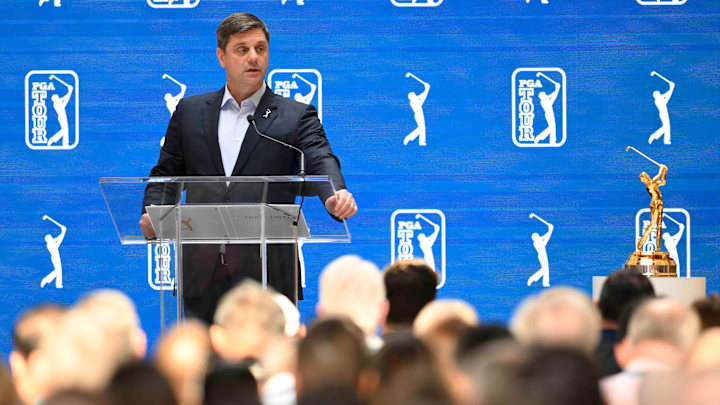
One maddening part of professional golf is that sometimes, a decision somebody made in 1904 is treated like a commandment from the Lord. So let’s give a real round of applause—not just a golf clap—to PGA Tour CEO Brian Rolapp. He isn’t just making changes. He is re-thinking the entire Tour.
Rolapp recognizes that decades of tweaks and being bound by tradition have damaged the Tour. On any given weekend, the PGA Tour is incredibly compelling. From the start of the season to the end, it is a confusing mess of an entertainment product. Rolapp wants it to make sense.
Rolapp unveiled a lot of new “themes” but no firm plans, saying “This isn’t a baked cake.” Well, the oldest rule in golf is that sportswriters love cake. I am happy to bake it for him.
The PGA Tour season should feel like a true season, with a clear start and finish and steadily building stakes. Rolapp said he wants to “open big with a marquee event at an iconic venue in the West,” and “finish on network TV in prime time on the East Coast.” Yes, yes, and take it a step further:
Who says that golf tournaments must start on Thursday and end Sunday?
The PGA Tour could start its 2027 season next January with a prime-time event from Monday to Thursday. It would be distinct enough to announce that the season is starting—and it would allow the Tour to schedule a final round in a prime TV window with no NFL games.
Rolapp also said he is exploring soccer-style promotion and relegation. Yes, please. The current system of big-money “signature events” always felt like a panic move to enrich the biggest names—because it was. There is a way to make the Tour a sensible meritocracy and bring the best players together on a regular basis.
Now, the big one:
This will be the 20th year of PGA Tour playoffs. The Tour still has never gotten it right. Every single approach has been an adaptation of an old format, instead of the creation of a new one.
Golf tournaments are always four-day, self-contained events, so they still are. The season always ended with the Tour Championship at East Lake in Atlanta, so it still must. The Tour Championship has always been a 72-hole stroke-play event, and so it shall be.
This is how the Tour ended up with players needing to finish second in the tournament to win the playoff, and with a staggered-start scoring system that seemed like a reasonable idea for approximately 11 minutes, at which point everyone hated it.
How to fix the FedEx Cup playoffs
Forget all that. Start over, with two guiding principles:
- Every player should have something to gain on almost every hole.
- The finale should be great theater and produce a worthy full-season champion.
For an example of how this could work, Rolapp just has to look at his previous employer, the NFL. Every team in the NFL playoffs has a chance to win the Super Bowl—but they don’t all have an equal chance. Division winners get home games. The top two teams in each conference get byes. The highest seeds get to play the lowest remaining seed at home.
Golf should work the same way.
(What I am about to propose will seem more complicated in text than it actually is. Take a giant swig of coffee and focus, people. We can do this.)
The last tournament of the year—which we will still call the Tour Championship, regardless of where it is played—should be a small-field match-play event, with seeds.
(You do not have to take notes.)
At the end of the regular season, the top 12 players all clinch spots in the Tour Championship.
The No. 1 player clinches a top-8 seed.
The next four players clinch top-12 seeds.
The next seven players clinch spots in the Tour Championship.
From there, they can only move up. If they play well in the first two playoff events—and especially if they win one—they improve their seeding. There is no need to protect a seed because they can’t move down.
Every other player in the first two playoff events is vying for one of those 20 available seeds—and the better they play in those events, the better their seed.
And having a better seed will matter for the Tour Championship:
Seeds 6 through 8 get byes into the third round.
The 4 and 5 seeds get byes into the fourth round.
The 2 and 3 seeds get byes into the quarterfinals.
The 1 seed gets a bye into the semifinal.

I will spare you more math, but this would work with a 22- or 36-player field, and of course the Tour could adjust the byes. (I have baked the cake but haven’t frosted it yet.) What matters here is the concept.
This would make the regular season meaningful. It would give everybody an incentive to play well in the first two playoff events. The Tour Championship would be great theater and produce a worthy full-season champion.
This would also be a much more attractive event for gamblers. Nobody likes to admit that matters, but it does, for the simple reason that people with money on the line are more likely to watch.
One other point: Golfers have abided by the same basic match-play rules roughly forever. But the Tour can tweak those rules without getting, as Rolapp said “gimmicky.”
Look: The home Ryder Cup captain gets to set up the course. It’s a clear advantage, but a subtle one. When we watch the matches, they seem straightforward and fair.
Why not give the better seed a similarly subtle advantage in match play? The better seed could choose which tees they both use on certain holes, or putt last, regardless of who is away. Both golfers would still be playing the same course from the same tees, with a starting score of 0–0. But earning the better seed would come with an advantage.
This is not really that hard to figure out. The key is to build a new season rather than renovate the old one. Better days are coming for the PGA Tour. Simpler days, too.
More Golf from Sports Illustrated
 Add us as a preferred source on Google
Michael Rosenberg is a senior writer for Sports Illustrated, covering any and all sports. He writes columns, profiles and investigative stories and has covered almost every major sporting event. He joined SI in 2012 after working at the Detroit Free Press for 13 years, eight of them as a columnist. Rosenberg is the author of "War As They Knew It: Woody Hayes, Bo Schembechler and America in a Time of Unrest." Several of his stories also have been published in collections of the year's best sportswriting. He is married with three children.