
Iron Glove leadership
Books on leadership are common. Each year, a number of them are published.
So what the person seeking to better themselves as a leader has to ask when searching online or at a bookstore for that compelling title that could provide an aha moment or kiss the left side of your cerebrum is: Will this tell me anything new? Does it really have something to say that already hasn't been said?
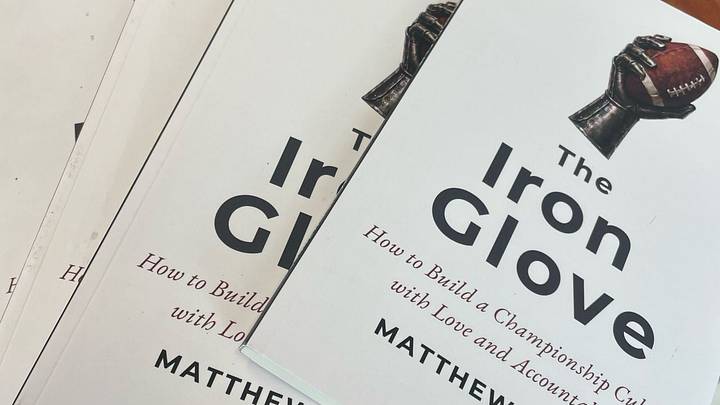
Kentucky Country Day head football coach, Matthew Jones, has written a leadership book. Released this fall, he hopes it has something to add to the crowded leadership advice book space.
The work, titled, "The Iron Glove," essentially identifies or posits a host of leadership tenets that Jones says can be used in a football program or within a corporation. The impetus for the book came from a needed rebuild of the KCD football program, which resulted in a Kentucky 1A state championship in 2025.
"It is about a philosophy I call the Iron Glove: the relentless pursuit of an elite standard, wrapped entirely in unconditional love," writes Jones in the introduction. "For too long, coaching has been viewed as a binary: you are either a drill sergeant or a 'player’s coach.' I am here to tell you that the drill sergeant eventually loses the heart, and the player’s coach eventually loses the standard. To lead the next generation, the ‘Snoopy Pajamas and Crocs’ generation that has been told they are special just
for showing up, you must be both. You must be demanding without being demeaning."
Jones' book acts as a practical workbook that stimulates critical thinking in relationship to leadership and program /workplace development. He quotes an array of diverse people, including Abraham Lincoln, Ram Dass, Dan Gable and New York Times bestselling author, Marshall Goldsmith ("The Earned Life").
Iron Glove emphasises love, answerability and unapologetic lofty standards as significant principles of effective leadership while underscoring the need for purpose, trust and resilience.
To Jones, or more precisely, his leadership philosophy, vision and culture live a symbiotic existence as do the capabilities and football inadequacies of players. Systems within the KCD program framework - outside of the fundamentals and developed culture - are molded and adapted to what the player brings to the field.
This also includes a symbiotic relationship between players and coaches; both working in tandem to continue the newly established culture.
"Acting like a KCD football player means thanking the bus drivers and the cafeteria staff. It means owning mistakes, starting with me," Jones writes. "We don’t sweep issues under the rug. If we have a crisis, we meet as a team. We talk. We align. Once that meeting ends, the drama dies, and the action begins. That is what a winning culture acts like."
The idea in the KCD program is that players own and embrace responsibility and established standards, moving away from a strictly coach-led program toward a player-inclusive one, where trust and accountability can thrive.

Like so many coaches searching for a better leadership model, Jones reached for the "Legacy" book on the shelf; the tome about the All Blacks rugby culture. The New Zealanders revere consistency, humility, fluidity, adaptability and accountability. Jones refers to it as "the ultimate intersection of unchanging culture and highly adaptive strategy." He writes that "...culture is our anchor, which allows our strategy to be as fluid as possible."
Players embrace and relish their role, no matter what it is. It doesn't have to include personal trips to the house yards gained or tackles for loss. It implies: why play the game if you don't enjoy the game as a whole, especially on Friday evening? Gunner, blocker, decoy, long snapper, wherever one finds themselves on the field is where one belongs.
Other compelling elements of the Iron Glove leadership philosophy are the Empty Tub and Uniformity of Culture.
Empty Tub describes the importance of equipping the program with communal hard work and love. Jones believes neglecting this concept could lead to ineffective leadership in critical moments.
"Every program has a 'tub,'" he writes. "Throughout the off-season, you'll fill it with sweat, accountability and shared leadership. When the playoffs arrive and the heat of the fire is turned up, that water begins to evaporate. If you haven't spent the year filling that tub with more than 'X's and O's, if you haven't filled it with genuine love and player-led sovereignty, you will find yourself bone-dry when you need it most."
Uniformity of Energy. Turn the bench into a theatre of enthusiasm. Jones says the sidelines can become a dead zone during games, so why not transform it with loud expressions of animated chants? Especially during fourth quarter timeouts, when "players are tired, coaches are frantic and the energy dips exactly when it needs to peak." Jones suggests this wins the fourth quarter, keeping the field players anchored in their immediate purpose.
He uses two assistant coaches to facilitate the energy, designating them as sideline managers.
"They would ignite the sideline, chanting 'Our house' or 'De-fense,' creating a wall of sound that the players on the field could hear and feel."
Fundamentally, the book distills efficacious leadership into the desire and ability to develop a constructive culture, primarily through the building of strong relationships. As Jones puts it, "Building Relationships as Leadership Currency."
There is plenty of meat to digest on the Iron Glove plate, but that should assure the reader that Jones does have something to say.
 Add us as a preferred source on Google

Chris Adams has been in sports media since 2013. Currently, he freelances high school sports coverage for the Emporia Gazette (remotely), located in Emporia, Kansas. In 2024, Chris covered sports full-time for The News Enterprise in Elizabethtown, Kentucky. His first stint with the Gazette (remote) began in 2021 and ended in 2023. From 2013 to 2017, he was a reporter at two Texas newspapers, covering high school sports. He began contributing to High School On SI in 2025.