%20%20--%3E%0A%3Csvg%20version%3D%221.1%22%20id%3D%22Layer_1%22%20xmlns%3D%22http%3A%2F%2Fwww.w3.org%2F2000%2Fsvg%22%20xmlns%3Axlink%3D%22http%3A%2F%2Fwww.w3.org%2F1999%2Fxlink%22%20x%3D%220px%22%20y%3D%220px%22%0A%09%20width%3D%2239px%22%20height%3D%2240px%22%20viewBox%3D%220%200%2039%2040%22%20enable-background%3D%22new%200%200%2039%2040%22%20xml%3Aspace%3D%22preserve%22%3E%0A%3Cpath%20fill%3D%22%23FFFFFF%22%20d%3D%22M38.5%2C7H28.2v26h10.3V7z%22%2F%3E%0A%3Cpath%20fill-rule%3D%22evenodd%22%20clip-rule%3D%22evenodd%22%20fill%3D%22%23FFFFFF%22%20d%3D%22M26.1%2C25.5c0%2C5.8-4.1%2C7.5-12.9%2C7.5C3.9%2C33%2C0%2C31.2%2C0%2C25.2v-1.1h11.6%0A%09v2.4c0%2C0.7%2C0.1%2C1.4%2C1.2%2C1.4c1%2C0%2C1.2-0.4%2C1.2-1.3v-0.9c0-1.6-0.9-1.6-3.5-2.2C2.2%2C21.7%2C0%2C19.7%2C0%2C15.3v-0.9C0%2C9.3%2C5.5%2C7%2C12.9%2C7%0A%09c10.2%2C0%2C12.8%2C2.6%2C12.8%2C7.4v1.8h-11v-2.9c0-0.6-0.4-1.1-1.2-1.1c-0.6%2C0-1.2%2C0.4-1.2%2C1.1v0.9c0%2C1.5%2C0.9%2C2%2C3.3%2C2.5%0A%09c8%2C1.6%2C10.5%2C3.3%2C10.5%2C7.5V25.5z%22%2F%3E%0A%3C%2Fsvg%3E%0A)
Watch Charles Barkley Speak to a Talking Basketball in Horrifying March Madness Segment
Here at Sports Illustrated we, by trade, watch a lot of basketball. We never watch more basketball than this time of year, and sometimes we watch so much basketball that by the end of the day we think we’re hallucinating.
On Saturday afternoon, we were terrified to learn that none of our hallucinations could match the horrors of the reality that was presented by CBS Sports.
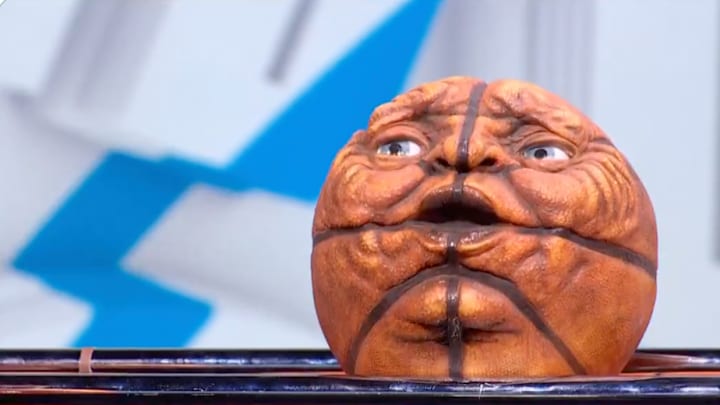
If you tuned in to watch Saint Louis and Michigan Saturday afternoon and left the station on CBS in between that game and Louisville’s clash with Michigan State, you were treated to a wildly offputting segment in which Hall of Fame forward Charles Barkley and his fellow analysts spoke to a talking basketball.
That’s right. O.B. (Old Ball), the animatronic basketball star of eponymous Instagram and TikTok accounts, made his television debut.
"I'm better looking than that, that looks like Clark" 😂😂
— CBS Sports (@CBSSports) March 21, 2026
'OB' stopped by the set to visit our squad pic.twitter.com/5KdRwABayw
“Is that you?” Ex-UConn star Renee Montgomery asked Barkley.
“I’m better looking that that,” Barkley quipped. “That looks like [fellow analyst] Clark [Kellogg].”
The ball then proceeded to run through a standup (can a sphere stand up?) routine in his trademark thick New York drawl, before kissing Barkley goodbye.
Questions abound after watching this. Who is O.B.? What’s his deal? Has God abandoned us? Could we realistically pop him?
Well, who is O.B., anyway?
O.B. is the brainchild of Funny or Die alumni Adam Aseraf, Ben Bayouth and Christian Heuer, who spoke about their invention to Thomas Golianopoulos of Complex on Sunday.
“Old Ball is a remote control talking robot with the skin of a basketball wrapped around it. If that sounds grotesque, it’s because he kinda is,” Golianopoulos wrote. “Old Ball is hideous, yet mesmerizing. He’s made of silicone and unsettling to the touch, rubbery and soft, and once you see him—the worn, leathery dermis, deeply wrinkled brow, and creepy roving eyes—you can’t unsee it.”
As Aseraf noted to Golianopoulos, he has a certain timeless quality that puts him in conversation with E.T. and similar animatronic forebears. His comedic appeal, in many respects, is easy to see.
However, he is the kind of object you can’t just spring on us. You have to warn us before showing us that on national television. The existential horror of the first two days of the tournament—will a No. 13, 14, 15 or 16 seed ever win again?—has now been supplemented by the Lovecraftian horror of this strange creature.
What does this monstrosity mean for society?
If O.B. were alive in the 1950s, he’d be relegated to a B-movie on a college campus. If he were alive in the 1970s, you’d see him on one of those late-night horror presentations on local television. In the 1990s, he’d be getting a star and a half from Roger Ebert.
However, a person—and a basketball—can only exist in their own time. O.B. comes to us during an age where he can spread further and faster than ever before. He can haunt our waking hours and pervade our sleep.
Aseraf, Bayouth and Heuer should take a bow. They have our attention, and O.B.’s cantankerous nature carries an undeniable charm (“Triumph, the Insult Comic Dog was an inspiration,” Golianopoulos writes). However, in the dark night of the chatbot, we should consider whether we want to live in a world where balls—the round, formerly nonjudgmental objects of children and adults’ play from Anchorage to Auckland—talk back to us.
One can only imagine Old Human joining the basketballs covering the NCAA human tournament in a not-so-distant future.
More College Basketball on Sports Illustrated
 Add us as a preferred source on Google
Patrick Andres is a staff writer on the Breaking and Trending News team at Sports Illustrated. He joined SI in December 2022, having worked for The Blade, Athlon Sports, Fear the Sword and Diamond Digest. Andres has covered everything from zero-attendance Big Ten basketball to a seven-overtime college football game. He is a graduate of Northwestern University's Medill School of Journalism with a double major in history .
Follow PAndres2001