%20%20--%3E%0A%3Csvg%20version%3D%221.1%22%20id%3D%22Layer_1%22%20xmlns%3D%22http%3A%2F%2Fwww.w3.org%2F2000%2Fsvg%22%20xmlns%3Axlink%3D%22http%3A%2F%2Fwww.w3.org%2F1999%2Fxlink%22%20x%3D%220px%22%20y%3D%220px%22%0A%09%20width%3D%2239px%22%20height%3D%2240px%22%20viewBox%3D%220%200%2039%2040%22%20enable-background%3D%22new%200%200%2039%2040%22%20xml%3Aspace%3D%22preserve%22%3E%0A%3Cpath%20fill%3D%22%23FFFFFF%22%20d%3D%22M38.5%2C7H28.2v26h10.3V7z%22%2F%3E%0A%3Cpath%20fill-rule%3D%22evenodd%22%20clip-rule%3D%22evenodd%22%20fill%3D%22%23FFFFFF%22%20d%3D%22M26.1%2C25.5c0%2C5.8-4.1%2C7.5-12.9%2C7.5C3.9%2C33%2C0%2C31.2%2C0%2C25.2v-1.1h11.6%0A%09v2.4c0%2C0.7%2C0.1%2C1.4%2C1.2%2C1.4c1%2C0%2C1.2-0.4%2C1.2-1.3v-0.9c0-1.6-0.9-1.6-3.5-2.2C2.2%2C21.7%2C0%2C19.7%2C0%2C15.3v-0.9C0%2C9.3%2C5.5%2C7%2C12.9%2C7%0A%09c10.2%2C0%2C12.8%2C2.6%2C12.8%2C7.4v1.8h-11v-2.9c0-0.6-0.4-1.1-1.2-1.1c-0.6%2C0-1.2%2C0.4-1.2%2C1.1v0.9c0%2C1.5%2C0.9%2C2%2C3.3%2C2.5%0A%09c8%2C1.6%2C10.5%2C3.3%2C10.5%2C7.5V25.5z%22%2F%3E%0A%3C%2Fsvg%3E%0A)
The Wild Stories Behind the 10 Most Clutch Home Runs in MLB History
In this story:
The 2026 season begins with momentum on baseball’s side, especially because of how spectacularly the last one ended. The glow from World Series Game 7 burns bright even four months later.
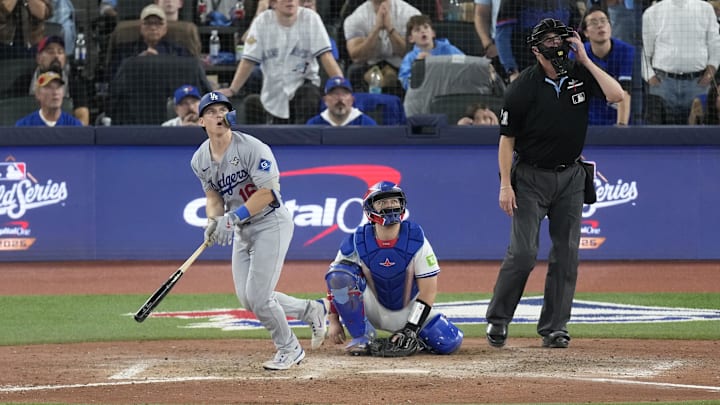
It is the only baseball game ever played with three of the 12 most clutch plays in history, as defined by championship win probability added: the game-ending double play hit into by the Blue Jays’ Alejandro Kirk with the tying run at third base (No. 4) and the home runs by the Dodgers’ Will Smith in the 11th inning (No. 5) and Miguel Rojas in the ninth (No. 12).
Game 7 reminded us in unprecedented repetition how history is made on a knife’s edge. One pitch ... one swing ... and suddenly championships can swing from one side to another. The home runs were particularly stunning because they were struck with the bases empty, not in the gathering storm of a rally. Both were hit on hanging sliders, one thrown by Shane Bieber and one by Jeff Hoffman. Look at the location of those pitches:

Ouch. It made me wonder: are hanging breaking pitches part of the DNA of historic homers? What properties do the biggest clutch home runs have in common?
So, I looked at the 10 greatest home runs according to cWPA. It’s not the same list as the most famous home runs. Kirk Gibson’s 1988 World Series home run, for instance, came in Game 1 and was knocked out of the top 10 by the two last year. And iconic blasts such as Carlton Fisk’s late-night blast in 1975, Hank Aaron’s 715th and Babe Ruth’s called shot don’t rate here. This is mostly a math exercise: which home runs most added to the probability of a team winning the World Series?
It turns out that the poison of the hanging breaking pitch is not part of a historic pattern but reflects the modern trend of fewer fastballs.
Of the top 10 most clutch home runs, seven were hit off fastballs and only three off breaking pitches, including the two last year. Hoffman threw his slider on a 3–2 count and Bieber at 2–0. That’s the modern game—passive-aggressive with spin. Fastballs (including cutters) hit an all-time low last season of 54.8%. In the postseason, they fell to 52.5%, down from 62.9% just 10 years earlier.
Diving deep into the pitches, the counts and the players of the 10 biggest home runs is like the DNA sequencing of historic moments. Here is what else we find embedded in the most clutch home runs:
- The two most clutch home runs in baseball history were hit by right-handed hitting catchers named Smith.
- Beware the back of the lineup. Among the 10 greatest home runs, the one by Will Smith is the only one from a player in one of the top three spots in the batting order.
Batting Order Spot | Home Runs in Top 10 |
|---|---|
1–3 | 1 |
4–6 | 5 |
7–9 | 3 |
Did not start | 1 |
- Beware the savvy veteran. The average age of the hitters with the 10 biggest home runs is 32.4. The median age is 34.
- We’re in a golden age of historic homers. Five of the 30 greatest home runs were hit in the past two years: Smith (2), Rojas (6), Freddie Freeman (18), Bo Bichette (28) and George Springer (30). Four of them were hit at Rogers Centre in Toronto.
- Of the top 100 home runs, only one pitcher has thrown three of them: Byung-Hyun Kim of Arizona, all in Games 4 and 5 of the 2001 World Series.
- We have count information for 254 of the top 300 home runs. Among those, 43% were hit on the first or second pitch. Only two took as many as 10 pitches: Frankie Crosetti in 1938 World Series Game 2 and DJ LeMahieu in 2019 ALCS Game 6.
- Yogi Berra hit more of the top 300 home runs than any other player:
Player Name | Top 300 Home Runs |
|---|---|
Yogi Berra | 5 |
Jose Altuve | 4 |
Johnny Bench | 4 |
Mickey Mantle | 4 |
Duke Snider | 4 |
George Springer | 4 |
Yordan Alvarez | 3 |
Cody Bellinger | 3 |
Gil Hodges | 3 |
I’ve been fortunate enough to be in the ballpark for five of the top 10 home runs and 25 of the top 46. Each one is uniquely stunning. Each one is a fingerprint of history that tells its own story. Here are the top 10 and their stories.
10. Willie Stargell (29.25% changed probability of title), 1979 World Series Game 7
Stargell was 39 years old when he came to the plate against Orioles lefthander Scott McGregor with his Pirates down, 1–0. There was one on and one out. McGregor had thrown only 60 pitches, including only four while twice facing Stargell, who slashed the second pitch of each at-bat for a single and double.
The veteran was not about to wait to attack a pitcher who had been pounding the zone. McGregor threw a first-pitch fastball over the plate and slightly down. Stargell jumped on it, sending a fly ball into the Pittsburgh bullpen for a 2–1 lead in what ended in a 4–1 victory. It is the only top-10 homer hit on the first pitch.
Stargell’s home run was part of one of the great performances in a World Series clincher. His nine total bases remain a record for a Game 7. But you can’t tell the story of Pops without mentioning his leadership.
In the eighth inning, with the score still 2–1, Pirates manager Chuck Tanner brought in reliever Kent Tekulve with two runners on base. Stargell, the first baseman, visited Tekulve on the mound.
“Teke, show people why you’re the best in the National League,” Stargell told him. “And if you don’t think you can do that, then you play first base and I’ll pitch.”
9. Joe Carter (30.28%), 1993 World Series Game 6
It began with an ominous sign for any pitcher protecting a 6–5 lead in the ninth: Mitch Williams of the Phillies walked Rickey Henderson of the Blue Jays—on four pitches! It was the fifth time Williams walked Henderson in their 10 career matchups.
Henderson began this at-bat with a bit of his razor-sharp gamesmanship. He called for time just as Williams, head bowed, deep in concentration, was about to throw his first pitch. Williams had to awkwardly stop mid-delivery upon seeing umpire Dana DeMuth call time. The tone was set; Rickey would be the one dictating terms.
One wild fastball followed another. At 2-and-0, catcher Darren Daulton visited Williams on the mound to calm him. It didn’t help. Henderson, taking all the way, bluffed a bunt. Williams missed again up and away. Henderson bluffed again at 3-and-0 and Williams again misfired up and away. The fire was lit.
Devon White batted next and would fly out, but Henderson continued to tax Williams’s attention. Williams made four throws to first base in the nine-pitch at-bat and used the slide-step delivery on seven of those nine pitches. The slide step is an abbreviated motion designed to better defend a stolen base, but one Williams had not used that year.
Paul Molitor followed with a single off the third pitch he saw from Williams, all of them with the slide step.
Facing Carter, Williams continued to pitch exclusively with the slide step with Henderson on second base, an uncommon commitment. The lefty missed up and away with fastballs on his first two pitches. At 2-and-0, Williams grooved a fastball down the middle. Carter took it for a strike.
The next pitch was a sharp-breaking slider, down and in. Carter reacted as if expecting fastball. He swung and missed badly. Carter later said he lost the ball in the jersey of second baseman Mickey Morandini, who was keeping Henderson close at second.
Carter, a renowned guess hitter, guessed Williams would come back with another slider at 2-and-2. Carter saw Williams shake the sign of Daulton.
They’re messing with me, Carter thought. He’s going to throw a slider.
Williams wanted to throw a fastball up and away, seeking either a swing and miss or a weak fly ball to right field. The right-handed Carter was a dead pull hitter. Of his 396 career home runs, only two were hit to the opposite field.
“Almost as soon as it left my hands,” Williams said, “I knew I made a mistake.”
Williams pulled his fastball down and in—right into Carter’s nitro zone. He blamed his fateful miss on throwing with the slide step. Sitting on a slider allowed Carter to stay balanced rather than jumping at a fat pitch and hooking it foul. He slammed it over the wall in left field.
8. Howie Kendrick (32.9%), 2019 World Series Game 7
The Nationals trailed the Astros, 2–0, in the seventh inning when Houston starter Zack Greinke began to wobble. Anthony Rendon homered. Juan Soto walked. Manager A.J. Hinch brought in Will Harris to pitch to Kendrick.
On the first pitch from Harris, Kendrick, a 35-year-old DH, swung over a nasty top-to-bottom curve. Harris came back with his best pitch, a cut fastball, and put it in a good location, down and away.
Kendrick somehow hit the most important home run in Nationals history, a two-run shot to turn a 2–1 deficit into a 3–2 lead. The fly ball hit the right field foul pole. The Nationals would win, 5–2.
How strange was the home run?
- It was Kendrick’s first opposite field homer in three years and the last of only 12 hit the other way in his 15-year career.
- It would have been a home run in only 10 of the 30 ballparks.
- Since pitch-tracking data began in 2008, Kendrick saw 752 fastballs in that low-and-away segment in the strike zone. This was the only one he hit for a home run.

7. Yogi Berra (34.32%), 1960 World Series Game 7
This one seems a bit odd to be on the list because of how early it happened in the game—sixth inning. But it makes the list because it turned a two-run deficit into a one-run lead in a winner-take-all World Series game. It was in fact the first of three home runs on this list from the same contest.
The Yankees trailed the Pirates, 4–2, when Berra batted against Elroy Face with two runners on. Berra fouled off the first pitch. Face then challenged Berra with an inside fastball. Berra, 35, smashed it into the upper deck in right field, just inside the foul pole.
6. Miguel Rojas (34.91%), 2025 World Series Game 7
Two outs from a Blue Jays World Series championship, Hoffman missed with a lousy slider to Rojas to run the count to 3-and-2. Hoffman knew he could not walk Rojas, a mistake that would bring Shohei Ohtani to the plate as the go-ahead run. What pitch should he throw as a can’t-miss strike?
A) Fastball? Made sense. Hoffman throws his 96-mph four-seamer more than any other pitch. Since Sept. 16, he had thrown 104 fastballs and given up one hit, a single. Hitters were 1-for-21 (.048) against his four-seamer over the past six weeks.
Also, Rojas struggles against velocity. He had not hit a home run off a 96+ four-seamer in six years (Sept. 3, 2019), hitting .207 against 555 such heaters.
B) Slider? It’s a great chase pitch, but it’s dangerous as a strike-to-strike pitch.
Hoffman and Kirk chose slider. Hoffman knew he could not throw another non-competitive one like the previous. He guided the slider to make sure it was a strike. It had 300 fewer rpms, three inches less vertical drop and three inches less horizontal break. In layman’s terms, it was a hanger. It was the only pitch Rojas could have hit for a home run.
Middle-in. Home run. Tie game.
Rojas, 36, was batting ninth. Among the top 150 home runs, only two were hit by players who started the game in the ninth spot: Rojas and Bucky Dent (1978 AL Tiebreaker, No. 119). It was the first home run Rojas hit off a righthander all year (not including off a position player).
5. Bobby Thomson (35.56%), 1951 NL Tiebreaker Game 3
This is the only regular season home run among the top 57 homers. Thomson won the pennant for the Giants by swatting an 0-and-1 high, inside fastball from Brooklyn reliever Ralph Branca into the left field seats at the Polo Grounds. With one out in the bottom of the ninth, that one swing turned a 4–2 deficit into a pennant-winning 5–4 victory.
But did Thomson know what was coming?
The Giants stole signs in the second half of that season from a window in center field at the Polo Grounds. (They also stole signs on the road sometimes, though they did not dare do so in Brooklyn.) Branca learned about the scheme about two years later. In 1962, the Associated Press reported the Giants used a spy system. In 2001, the Wall Street Journal detailed the scheme.
Asked to respond then, Thomson said, "Sure, I've taken signs, obviously, in the not-very-nice way the Giants did it. But did it happen on that fateful pitch? No, it didn't. If you want to believe me, that's fine. If not, O.K.”
4. Bill Mazeroski (36.74%), 1960 World Series Game 7
Mazeroski led off the bottom of the ninth against Ralph Terry, who had relieved Coates the previous inning after the Smith home run. Terry threw Mazeroski a first-pitch slider. He hung it high and outside for a ball. The pitch worried catcher Johnny Blanchard. He called time and walked out to the mound. He reminded Terry that Mazeroski liked pitches up.
“Keep it down and away,” Blanchard told him.
Blanchard called for another slider. Its intended spot was down and away. Terry, who had warmed five times in the New York bullpen in a crazy back-and-forth game, hung this one, too—except over the plate. Mazeroski hit it over Berra’s head in left field and over the wall.
After the game, Terry went to see Casey Stengel, who was alone in his office after what was his last game managing the Yankees.
“Sorry I ended it that way for you,” Terry said. “How’d you pitch him?” Stengel asked. “Well, I tried to pitch him low and outside,” came the reply.
“As long as you pitch, you won’t always get the ball where you want to. As long as you weren’t going against the scouting report—then I wouldn’t sleep at night. Forget it, kid. Come back and have a great year next year.”
The next year Terry went 16–3 with a career-best 3.15 ERA.
Also in 1961, on Sept. 27, Mazeroski hit the only other walk-off hit of his career: another home run, this time breaking a tie against the Giants with two outs in the ninth.
3. Rajai Davis (39.04%), 2016 World Series Game 7
This is one of two homers on the list by a player from the losing team. It is one of the most unexpected clutch home runs ever hit.
Davis, 36 years old then, was not much of a power threat when he stepped in against Cubs reliever Aroldis Chapman with Cleveland trailing 6–4 with one on and two outs in the eighth inning. Davis had not hit a home run in more than two months. Chapman had faced 158 batters since joining the Cubs and had not allowed a home run.
You know what happened next.

Chapman threw Davis seven straight fastballs. The last one was 98.4 mph, his least velocity of the inning and nearly three full ticks below his average fastball. It was also the 44th straight fastball Chapman threw with David Ross calling pitches. (Ross typically did not catch Chapman.) It also was down in the zone and on the inner half, a danger zone for Chapman. Right-handed hitters batted .529 that year against his fastball when he threw it in the zone down and in.
Davis, choking up on the bat, took a short, violent swipe at the baseball. The pitch ran right into his barrel. The ball jumped out of the park, smashing against the lens of a television camera atop the high wall in left field.
“We threw him a [bleep]-ton of fastballs,” Ross told me. “I was hesitant to throw him a slider and speed up his bat. If he connects with a slider I’m not going to be able to live with myself.
“With a guy like Chappy who throws that hard, I’m thinking, If I give up a homer on a slider to tie this game, I’ll never be able to forgive myself. And everybody would be asking me why I called a slider when this guy throws 105. He threw a fastball down and in, and he was choked up so much … the wind just went out of our sails. When that thing went over it was a bad feeling.”
Just 10 years later, Ross’s thinking about getting beat with a non-fastball seems archaic.
2. Will Smith (41.03%), 2025 World Series Game 7
This is the definition of a classic mistake pitch.
Bieber, the Toronto righthander, had two outs and the bases empty in the top of the 11th inning. The score was tied at four. He started Smith with a slider, but overcooked it, bouncing it in the dirt, low and away. Bieber came back with another breaking ball, this time a knuckle-curve, but again missed badly—not too far from the first pitch.
With a 93-mph fastball, Bieber is not the kind of pitcher to throw challenge fastballs behind in the count. In fact, the pitch Bieber threw the most in 2025 when behind in the count was a slider.
He stuck with a breaking ball—and why not? Smith, the Dodgers catcher, had not hit a home run off a breaking pitch in the past 101 days, batting .211 against them in a streak that began July 21.
This one was an absolute hanger—a cement-mixer, middle-middle, hit-me slider. Smith hit it high. Almost too high. At 39 degrees, it had the fifth-highest launch angle of his 138 career homers. It carried over the wall in left field. It was the first time in Smith’s career he hit a 2–0 breaking pitch for a home run.
The Dodgers hung on for a 5–4 win. Including the 2021–23 seasons with the reliever Will Smith, it marked the fifth straight year a team with a Will Smith won the World Series.
1. Hal Smith (63.2%), 1960 World Series Game 7
You would think this spot would be reserved for the walk-off home run by Mazeroski that won this same game. I did say math would be involved.
The home run by Smith in the eighth inning more greatly improved the odds (not the outcome) of the Pirates winning. Why? Smith’s home run with two on and two out turned a one-run deficit into a two-run lead.
Smith, a 29-year-old catcher, is the only hitter on this list who came off the bench to make history. It was his first at-bat after manager Danny Murtaugh used a pinch runner for his starting catcher, Smoky Burgess. On the mound for the Yankees was Jim Coates, a tall, slender righthander who was known as “The Mummy.” Teammate Jim Bouton said Coates looked like the model for an undertaker’s sign.
With Pittsburgh down 7–6, Smith took the first pitch for a strike and the second for a ball. Coates then challenged him with three straight fastballs. Smith swung and missed at one right down the middle and then checked his swing on the next, a pitch high and inside. Coates came back with another challenge fastball. Smith knocked it over the wall in left field.
By cWPA, this is the greatest play (not just home run) in baseball history. Makes no sense, right? It was the eighth inning, not the ninth, and the lead didn’t even hold up for the next half inning. Smith’s home run is mostly known for ... not being famous. But algorithms don’t care. The Pirates were in worse shape down 7–6 with two outs in the eighth than tied 9–9 in the ninth.
The coolest part of baseball’s most championship-changing play is it defines the democracy of the game. Smith was a backup catcher who started the game on the bench, had only eight at-bats in the seven-game series and hit only 58 career home runs in an otherwise unspectacular 10-year career. One swing changed his baseball life—and infuriated the Yankees.
In the New York clubhouse after the game, Dale Long, a former Pirate, scoffed, “The best team lost. Imagine Hal Smith hitting a home run!”
More MLB on Sports Illustrated
 Add us as a preferred source on Google
Tom Verducci is a senior writer for Sports Illustrated who has covered Major League Baseball since 1981. He also serves as an analyst for FOX Sports and the MLB Network; is a New York Times best-selling author; and cohosts The Book of Joe podcast with Joe Maddon. A five-time Emmy Award winner across three categories (studio analyst, reporter, short form writing) and nominated in a fourth (game analyst), he is a three-time National Sportswriter of the Year winner, two-time National Magazine Award finalist, and a Penn State Distinguished Alumnus Award recipient. Verducci is a member of the National Sports Media Hall of Fame, Baseball Writers Association of America (including past New York chapter chairman) and a Baseball Hall of Fame voter since 1993. He also is the only writer to be a game analyst for World Series telecasts. He lives in New Jersey with his wife, with whom he has two children.