%20%20--%3E%0A%3Csvg%20version%3D%221.1%22%20id%3D%22Layer_1%22%20xmlns%3D%22http%3A%2F%2Fwww.w3.org%2F2000%2Fsvg%22%20xmlns%3Axlink%3D%22http%3A%2F%2Fwww.w3.org%2F1999%2Fxlink%22%20x%3D%220px%22%20y%3D%220px%22%0A%09%20width%3D%2239px%22%20height%3D%2240px%22%20viewBox%3D%220%200%2039%2040%22%20enable-background%3D%22new%200%200%2039%2040%22%20xml%3Aspace%3D%22preserve%22%3E%0A%3Cpath%20fill%3D%22%23FFFFFF%22%20d%3D%22M38.5%2C7H28.2v26h10.3V7z%22%2F%3E%0A%3Cpath%20fill-rule%3D%22evenodd%22%20clip-rule%3D%22evenodd%22%20fill%3D%22%23FFFFFF%22%20d%3D%22M26.1%2C25.5c0%2C5.8-4.1%2C7.5-12.9%2C7.5C3.9%2C33%2C0%2C31.2%2C0%2C25.2v-1.1h11.6%0A%09v2.4c0%2C0.7%2C0.1%2C1.4%2C1.2%2C1.4c1%2C0%2C1.2-0.4%2C1.2-1.3v-0.9c0-1.6-0.9-1.6-3.5-2.2C2.2%2C21.7%2C0%2C19.7%2C0%2C15.3v-0.9C0%2C9.3%2C5.5%2C7%2C12.9%2C7%0A%09c10.2%2C0%2C12.8%2C2.6%2C12.8%2C7.4v1.8h-11v-2.9c0-0.6-0.4-1.1-1.2-1.1c-0.6%2C0-1.2%2C0.4-1.2%2C1.1v0.9c0%2C1.5%2C0.9%2C2%2C3.3%2C2.5%0A%09c8%2C1.6%2C10.5%2C3.3%2C10.5%2C7.5V25.5z%22%2F%3E%0A%3C%2Fsvg%3E%0A)
The Five Biggest Mistakes of Arte Moreno’s Angels Ownership
In this story:
The Angels are in the midst of yet another dismal year, closing out August on pace for the franchise’s first 100-loss season. For teams like this, September is the time for playing out the string, with very little for fans to get excited about.
That all changed Tuesday morning with the bombshell announcement that longtime owner Arte Moreno was selling the team to Stan Kroenke. Kroenke, through his company Kroenke Sports & Entertainment, owns numerous franchises across multiple sports, including the Rams, Nuggets, Avalanche and Arsenal.
OFFICIAL: Kroenke Sports & Entertainment ("KSE") announced that it has entered into a definitive agreement to acquire a controlling interest in the Los Angeles Angels Baseball Club from the Moreno Family.
— Los Angeles Angels (@Angels) September 1, 2026
The transaction is expected to close in the first quarter of 2027, subject… pic.twitter.com/sy60AAz5Bp
The news brings an abrupt end to Moreno’s ownership, which dates back to 2003, a year after the franchise won its lone World Series title. After an initially successful run that included five postseason trips in six years from ‘04 to ‘09, the Angels have been among the most languid organizations in professional sports.
The team has made the playoffs just once in the 17 years since 2009, which resulted in getting swept out of the ‘14 ALDS. The Angels have had 11 consecutive losing seasons and counting, the longest active streak in the sport. The dearth of on-field success has been marked by dysfunction at the highest levels of the organization.
During that span, the team has run through five general managers. The Angels have employed six different managers in the past nine years. As the losses piled up, Moreno garnered a reputation for meddling in personnel decisions and handicapping his deputies’ ability to operate autonomously. In recent years, he cut back severely on payroll, refusing to go over the luxury tax, all while neglecting to invest in scouting and analytics infrastructure.
Even worse than the team’s on-field failures, the Angels suffered several ugly off-field scandals under Moreno’s stewardship. There was the tragic 2019 death of pitcher Tyler Skaggs from a drug overdose, which led to the conviction of former team communications director Eric Kay for distributing the drugs that killed Skaggs.
In 2022, the Angels’ agreement with the city of Anaheim for the team to purchase Angel Stadium and the surrounding land was voided after an FBI investigation revealed Anaheim mayor Harry Siduh provided confidential information to the team with the expectation that, in exchange, he would receive a $1 million contribution for his reelection campaign. Siduh eventually resigned from his position and pleaded guilty to obstruction of justice and wire fraud.
All of that contributes to Moreno’s legacy. As for the various ill-fated moves that have contributed to the Angels’ standing as one of baseball’s most incompetent organizations, here are the five that stand out.
Announcing his intention to sell the team in 2022—then changing his mind

Tuesday was not the first time the notion of Moreno selling the Angels reached the public. In August 2022, he announced he would explore options to sell the team, with Warriors owner Joe Lacob among those reportedly pursuing an acquisition. Instead, in January ’23, Moreno changed course in a move that surprised people around the league and even within the organization.
In announcing his decision not to sell, Moreno cited “unfinished business” and the belief that he could still make a “positive impact” on the team. Of course, that did not transpire, and the losing continued. But what was particularly debilitating about Moreno’s reversal was the timing.
The 2023 season was the Angels’ last year with Shohei Ohtani under team control. Faced with pressure to capitalize on having the game’s best player, Moreno did not permit then-GM Perry Minasian to trade Ohtani at that year’s deadline, instead making the choice to buy assets in hopes of making a run at a wild-card spot. Those efforts failed, and Ohtani eventually left in free agency to the crosstown Dodgers.
It felt at the time like 2023 was a fork-in-the-road season for the franchise, and hindsight has only made that more clear. Had the Angels changed owners prior to that pivotal year, perhaps the new bosses could have convinced Ohtani to re-sign instead of joining the Dodgers in free agency. Or, more realistically, they could have seen the writing on the wall and maximized their return for Ohtani by trading him to the highest bidder and injecting the organization with much-needed young talent.
Instead, Moreno did nothing, and let Ohtani walk as a free agent without even making a counter offer.
Signing Anthony Rendon to a $245 million deal

Nearly a decade before Moreno’s doomed decision to sign Rendon, he lost out on the free-agent bidding for another veteran third baseman: Adrian Beltre, who in 2011 signed with the division rival Rangers, becoming a thorn in the Angels’ side en route to turning in the second half of a Hall of Fame career. That outcome reportedly ate at Moreno, and, apparently dead set on not making the same mistake twice, he eight years later placed a heavy bet on Rendon, who at the time had established himself as one of the game’s best hitters and had just won the 2019 World Series with the Nationals.
Rendon did enjoy a productive, pandemic-shortened 2020 season, but otherwise proved to be an absolute calamity of a signing. From ‘21 to ‘24, he played in just 205 out of a possible 648 games with a .666 OPS, eventually agreeing to defer the remaining money on his contract to stay away from the team.
Rendon wasn’t the only high-priced, big-name player that Moreno insisted on signing, but he was the last and arguably worst major free-agent acquisition in team history. That trend, of course, began in earnest back in December 2011.
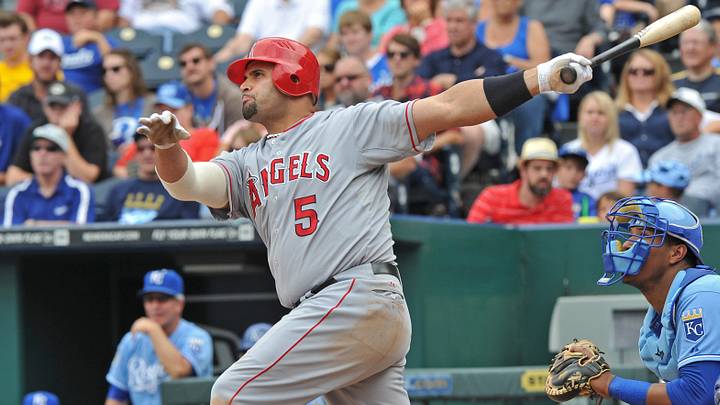
Signing Albert Pujols to a 10-year contract

In many ways, signing Albert Pujols to a 10-year, $240 million contract was Moreno’s original sin as a meddler in baseball operations. The Angels’ success in the previous decade came as the team largely operated in MLB’s middle class. They had star players, many of them high-priced (including Vladimir Guerrero, whom Moreno signed in his first offseason with the team), but largely thrived by developing depth through homegrown players.
But in signing Pujols—by then already a three-time MVP, two-time World Series champion and no-doubt future Hall of Famer—ahead of the 2012 season, the Angels took shape in Moreno’s vision. After changing the team name from the Anaheim Angels to the Los Angeles Angels of Anaheim a half-decade prior, he made clear his intentions to operate like a major-market team. Landing Pujols backed up that vision with action.
Of course, all that bluster and dollars spent proved to be disastrous. Pujols aged into a shell of his former self almost immediately, his last productive season coming in 2015 (which was also the last time the Angels finished above .500). From ‘16 to ‘21, he put up a combined -0.9 bWAR with the Angels before ultimately getting released before the end of his contract.
As it turned out, adding Pujols was only the start of Moreno’s ill-advised spending spree.
Signing Josh Hamilton to a $125 million deal

By comparison, the Pujols contract was a big success compared to the decision to sign Josh Hamilton. Almost a year to the day after the Pujols deal, Moreno doubled down by adding the five-time All-Star and 2010 American League MVP to a five-year deal. By this point, the Angels and Rangers had combined to win five of the previous six AL West titles, and poaching a Texas icon like Hamilton who appeared to still be in his prime years (he hit a career-best 43 homers the previous year) had to have felt like a sweet victory for Moreno. It seemed like a move that would, at the very least, set the Angels up for short-term success, with Hamilton and Pujols joining with reigning AL Rookie of the Year Mike Trout to form a powerful lineup.
Hamilton, whose battle with drug addiction prior to his MLB debut was well-known, ended up not even sticking around in Anaheim for half of the length of the deal. He relapsed in 2015 after a pair of lackluster, injury-shortened seasons, and was eventually traded back to the Rangers that year, while the Angels were still responsible for the remaining money on his contract.
Hiring Joe Maddon

When Moreno bought the Angels, the team was in its fourth year under manager Mike Scioscia, who would eventually helm the team for 19 seasons. Scioscia, a former All-Star catcher and World Series champion as a player with the Dodgers, was the undisputed face of the franchise, a respected symbol of stability and consistency that fueled the franchise’s unprecedented success in the 2000s.
When Scioscia stepped down following the 2018 season, the team replaced him with Brad Ausmus, another former big-league catcher who had previously managed the Tigers from ‘14 to ‘17. But Ausmus lasted just one season, with Moreno abruptly opting to chase another big fish in former Cubs manager Joe Maddon.
Maddon was just three years removed from leading Chicago to a World Series title, but was let go by the Cubs in what at the time was a bit of a surprise move. Despite hiring Ausmus on a three-year contract, Moreno could not resist the allure of a big-name skipper, and brought Maddon in to revive his team.
This proved to be just the beginning of Moreno’s knee-jerk decision-making with respect to leadership positions within the organization. Maddon stewarded two losing seasons and had the Angels sitting at 27–29 in 2022 when he was fired. The team ended up finishing the ‘22 campaign at 73–89.
Phil Nevin was named the interim manager in Maddon’s stead, and, rather than spend more money on another big-name skipper, Moreno decided to promote Nevin to the full-time position in 2023. He was let go at the end of that season and replaced by Ron Washington, who also lasted just two years. And ahead of this season, Moreno hired Kurt Suzuki to a one-year contract, a rarity for new manager hires.
Years of interfering with baseball decisions left Moreno to spin his wheels with his GM and manager positions, all while the team toiled in permanent dysfunction.
As the losing seasons piled up, Moreno took on a more inconspicuous approach. He rarely conducted interviews or was seen at the ballpark, further alienating a fan base that had long grown tired of the team’s failures.
In February of this year, he took flak for saying that, from the fans’ perspective, seeing the Angels win was “not in their top five” of priorities. Unsurprisingly, that struck a chord. In response, large sections of fans have routinely congregated in the stadium to loudly chant “Sell the team!” during games.
Today, seemingly out of nowhere, those fans have gotten their wish. What comes next for the Angels under Kroenke is unclear. But after years of being stuck in neutral, fans of the team can dream of a brighter future and feel like, for the first time in over a decade, it might actually be attainable.
 Add us as a preferred source on Google
Nick Selbe is a programming editor at Sports Illustrated who frequently writes about baseball. Before joining SI in March 2020 as a Breaking and Trending News writer, he worked for the Orange County Register, MLB Advanced Media, Graphiq and Bleacher Report. Selbe received a bachelor’s in communication from the University of Southern California.
Follow NickSelbe