
A's Pitching Report: When Will No. 3 Prospect Gage Jump Debut?
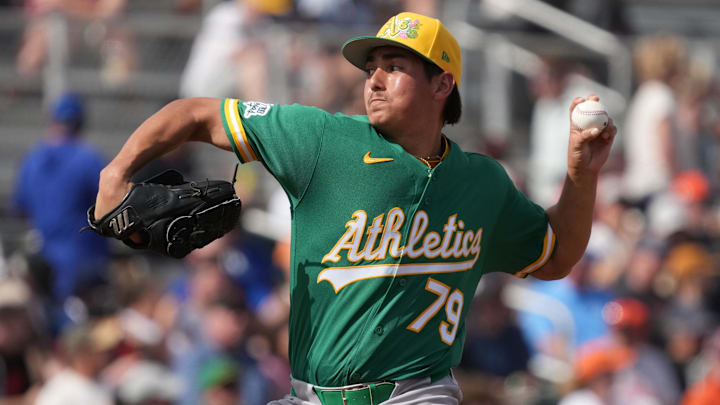
In this story:
The A's went 3-3 this past week at home, and the ball was flying. They ended up being outscored by the Kansas City Royals and Cleveland Guardians, 32-20 over the six games, with the big blow being the team's 14-6 loss on Saturday.
Following that start, the A's need to figure out how to get Jacob Lopez past five innings, and into the sixth or seventh inning. He's cruised through the early frames this season, but holds an ERA of 22.50 in the fifth and sixth.
A's manager Mark Kotsay said before Sunday's game, "there's always options on the table for how we manage that situation" when asked if the team could potentially go with an opener in his starts to try and maximize his production later into games. "We still see Jacob as a valuable starter, and someone that has had success in the past, and has been able to manage a lineup the third time."
Earlier this week when we reflected on April, we said that one thing we're looking for in May is for a pitcher to break out. That could be Lopez figuring out what's ailing him, or a minor leaguer getting a look in the rotation. Today, we want to take a look at those minor-league options, because sooner or later, we'll see them this season.
Gage Jump's timeline to Sacramento

The A's 2024 draftee made his pro debut in 2025, and called plenty of attention to himself with a breakout performance that saw him in Double-A by the middle of May. With the Midland RockHounds, Jump held a 3.64 ERA last season with a 1.30 WHIP.
This season he has gotten off to a rocky start, holding a 5.64 ERA with a 4.53 FIP, while striking out an impressive 31.7% of batters. He also has a walk rate of 13.5%, which is about double where it was last season.
The big takeaway stat that fans should pay attention to is that he hasn't pitched past 4 1/3 innings this season, and a big reason for that has been how inefficient he's been at getting through innings. He's averaging 21 pitches per inning across the full season, and in the majors, you want to see that number closer to 15.
We looked at his balls and strikes from every outing to date, and he's been at or above a 60% strike rate in five of his six starts. With the high pitch counts every inning, that seems to signal that batters are able to just foul his pitches off — costing him a pitch but counting as a strike — while the lefty has been unable to put hitters away.
Once he is able to fix his efficiency inning by inning, then we can have the conversation about when he'll get called up.
The good news here is that Jump's results were solid his last time out, going four innings and giving up two hits, one earned run and a hit batter, while walking four and striking out six. Without those walks, his outing lasts another inning and his overall performance is trending in the right direction. He may be close, but he's not there yet.
On the bright side, this is a type of turnaround that can happen quickly, so if he dominates in May, he could be up in June — potentially for the A's two home series in Las Vegas. That would certainly line up for the franchise if he is ready by then.
Triple-A options

The rest of the Triple-A options on the A's 40-man haven't been stellar this season. Braden Nett is on the injured list, and we just saw that Luis Morales needs some time to refine his mechanics after a quick stint in Sacramento over the weekend.
That leaves just Joey Estes and Mason Barnett as the 40-man options, and as we've discussed previously, Barnett's numbers look good, but his underlying metrics cause plenty of concern.
He currently holds a 3.86 ERA across 23 1/3 innings of work, but that comes with a 5.57 FIP thanks to a 12.9% walk rate, a left-on-base rate of 83.9% that figures to come back to league average, and a home run to fly ball rate of 17.4%. Granted, he's playing in hitter-friendly Las Vegas, but it's not as though Sacramento is a pitcher's paradise.
Barnett may be the top option at the moment, but there are a few worrisome numbers in that mix.
Joey Estes holds a 5.13 ERA with a 6.44 FIP in 26 1/3 innings, and his strikeout rate of 15.5% is way too close to his walk rate (13.8%). Effective pitchers usually have the spread between those numbers at around 14%. He's likely not the answer if a spot in the rotation opens up either.
The only other non-roster option at starting pitcher is Kade Morris, the A's No. 12 prospect. He holds a 4.60 ERA with a 6.58 FIP, and has had a problem with long balls, giving up six so far in 31 1/3 innings.
That all said, his past two outings have looked better on paper, with the righty combining for 12 1/3 innings and giving up just 11 hits and one earned run, with six walks and six strikeouts. The problem being that all six of those walks came in the same outing, and Tacoma only scored once. His K-BB% isn't high either, with a strikeout rate of 16.9% and a walk rate of 11.3%.
Arnold, Lin dominating Double-A

Jamie Arnold and Wei-En Lin have been solid this season, with Arnold posting a 2.95 ERA (3.43 FIP) in his first 21 1/3 professional outings and Lin being even better with a 1.61 ERA and a 3.06 FIP.
The key data point for each is their high strikeout rates, and low walk rates by comparison. Lin holds a 21.1% K-BB rate, while Arnold's is even better at 23.7%. Both are off to tremendous starts to the season, but it's also unclear how much the A's want to rush either player to the majors.
While the team's window is beginning to open, they don't want to start pushing all of their chips in just yet, either. Many A's fans know of Jump and Arnold due to their high draft status, but Lin is still just 20 years old and is already dominating Double-A just like the highly touted draftees have also done. A's fans should remember the name.
 Add us as a preferred source on Google
Jason has been covering the A’s at various sites for over a decade, and was the original host of the Locked on A’s podcast. Mason Miller once said he likes Jason's content.
Follow byjasonb