
Chicago Cubs Just Showed Why a Free Agent Deadline Wouldn't Work
In this story:
Earlier in the week, there was plenty of discussion from MLB Commissioner, Rob Manfred, about his desire for a signing deadline during free agency. Other leagues have a deadline, and that day is always a big deal for those sports. Manfred would like to grab some headlines like that as well.
Yet, players like the A's DH Brent Rooker have also said on social media recently that "...this is pretty close to the most anti-player idea you could possibly have." He followed that up by asking a question to the fans: "What difference does it make if a guy signs on Dec. 1 instead of Feb. 1? How does that extra 2 months negatively affect the experience as a fan?"
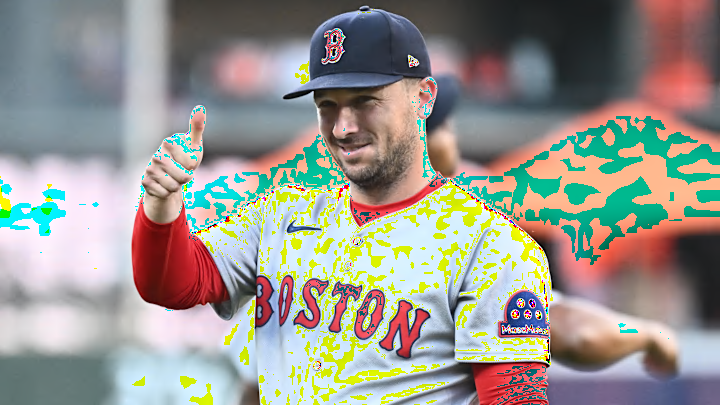
The Chicago Cubs may have just proven Rooker's point. Late on Saturday night, free agent Alex Bregman came to terms on a five-year, $175 million contract with Chicago. He began the offseason by opting out of the remaining two years in his three year, $120 million deal with the Boston Red Sox, making him a free agent yet again. So in essence, he will be collecting six years and $215 million between the two contracts.
The Cubs are getting a good deal on the years, taking him form his early to mid-30's, while Bregman continues to receive a solid AAV at $35 million per season.
If there had been a deadline, perhaps weeks ago, the likelihood of him realizing his full monetary potential would have been a lot lower. The offers would have been take this, or remain a free agent. At that point, what is a player supposed to do?
The reason that having a deadline works in other sports is that they also have a salary cap, so there is only so much that a team can offer players each offseason. There's not as much of a negotiation happening. And in football, the contracts aren't even all guaranteed, so they don't even have to be too careful with how they spend their money.
Floating the idea of a deadline, which has come up in previous negotiations, is perhaps an indirect step for MLB owners towards a salary cap. At least, that is the path that they'd hope to be on if they were able to get a deadline for free agents. Take a jump to the deadline, and then a jump towards a cap, instead of one huge leap.
From a fan perspective, deadlines can be fun. Obviously the trade deadline is a good time, but there are times when there are just too many deals to keep track of as well. Letting free agency trickle both allows the fun to be spread out a bit longer, and ensures that the players are more likely to get fair market value for their services.
In his piece in The Athletic (linked above), Evan Drellich provided this quote from Manfred: "Let’s face it, on both sides of these negotiations, there’s really sophisticated people who negotiate for a living all the time,” Manfred said. “You tell them whatever the hell the rules are, it’s all going to turn out the same no matter what — the money’s the money is the money."
The money is the money and the negotiators can do their jobs once they know the rules. So why does this free agency period seem slower? If the money is the money, why aren't teams spending it? This tends to happen every few years (around CBA time), when players will see the market just dry up all of a sudden, leaving a free agent class out in the wind for months at a time.
There are a number of top-tier free agents left in this class, from Kyle Tucker to Framber Valdez, Cody Bellinger and Ranger Suarez. All four are proven players in MLB, and all four could be difference makers in a pennant race.
The big drawback for teams in terms of spending is that there isn't a ton of incentive to push from an 88-win projection to a 95-win season, because either way you're going to make the postseason. Better seeding could be helpful, or could pair you with the hottest team in the league in the first round. Long-term contracts also come with some risk, but that is baked into the contract price.
With only a handful of owners seemingly trying to improve each offseason, that leaves the fans thinking that there are the haves and the have-nots, but it's simply the majority of owners being unwilling to spend.
Baseball fans have spent the past few offseasons saying that the Los Angeles Dodgers are ruining baseball, and they've barely done anything this winter, leaving the door wide open for any other club to just walk right through. Instead, there have been crickets.
A's owner John Fisher spent two decades not spending any money on payroll and not signing a young homegrown star to an extension.
As soon as the team left Oakland he found his checkbook (because he had to), and has handed out three long-term extensions to his own players. This is all while he's on the hook for a huge $2 billion ballpark project in Las Vegas and his team in playing in a minor-league facility. Somehow he found the money to swing a few deals for the first time in 20 years.
All owners can do the same, they just choose not to. They claim that they can't afford things anymore, but won't open their books. The reason that free agency takes so long is because they're trying to get the best deal they can. Waiting until spring training is just a game of contract chicken.
Instituting a free agent deadline during the offseason would just be another way for the owners to squeeze money out of the labor force they employ.
The reason none of this is landing with the public is because MLB's branding is off for the entire discussion. They're floating it as baseball trying to be more like other sports, but fans don't want to have to subscribe to five streaming packages to be able to watch their team. Baseball being different is part of the appeal. The fans would also love cheaper game tickets.
If the owners framed this more as a way to limit the cost for the consumer at the ballpark, then perhaps they would get somewhere. Instead, they're focused on their own profits, and whatever path leads them there.
Recommended Articles:
 Add us as a preferred source on Google
Jason has been covering the A’s at various sites for over a decade, and was the original host of the Locked on A’s podcast. Mason Miller once said he likes Jason's content.
Follow byjasonb