
How Jacob Wilson's Extension Impacts A's Payroll Moving Forward into Las Vegas
In this story:
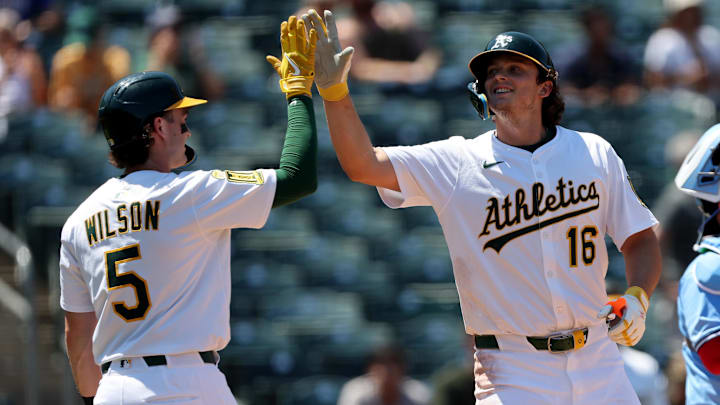
Earlier this week, Jacob Wilson became the fourth player to officially sign an extension with the Athletics as they plan their move to Las Vegas for the 2028 season. The 23-year-old agreed to a seven-year, $70 million contract with the A's, which includes a team option for the eighth year.
We now also know how the payments will be broken down over the life of the contract, which provides insight into how the A's payroll will be shaping up in the coming years, too. Here is how the Wilson's contract is structured, according to Jon Heyman of the NY Post.
2026: $1 million
2027: $2.5 million
2028: $4.5 million
2029: $9 million
2030: $12 million
2031: $17 million
2032: $19 million
2033 (team option): $26 million with a $2 million buyout
Heyman is also reporting that his pay in 2033 raises by $2 million for each first through fifth-place MVP finish in 2031 and 2032. He would get another $1 million tacked on for 2033 for a sixth through tenth place finish in MVP voting in those two years.
Just an initial takeaway from that final part is that it's an odd provision to sneak in there as an incentive, since it's adding money to a team option year that's already set at $26 million.
We just saw Luis Arraez, who is a fairly similar hitter to Wilson, settle for a one-year, $12 million deal with the San Francisco Giants in his first taste of free agency. It's tough to see the valuation for Wilson being closer to $30 million a year, although we'll have a couple of CBA negotiations to get through by that point, and who knows what contracts look like by 2033.
So with Wilson's contract largely being back-loaded, how will the A's payroll look when they arrive in Las Vegas, and in the subsequent first few years in Sin City?
A's payroll projection for Las Vegas
While the A's have a decent amount of money on the books for the 2026 campaign, projected to be at $139 million for luxury tax payroll purposes, three of those contracts could be on their way off the ledger heading into 2027.
Luis Severino holds a $22 million player option for next season, while Jeff McNeil ($15.75 MM) and Jeffrey Springs ($15 million) have club options attached to them. How those options all play out will depend on how the roster comes together in 2026.
If the A's are seeing plenty of production from their young arms, perhaps they let Springs walk. Same goes for McNeil with the crop of position player prospects.
The A's only have four players under contract for 2028, but here is how those four contracts add up over the next slew of seasons.
2028 | 2029 | 2030 | 2031 | 2032 | 2033 | |
|---|---|---|---|---|---|---|
Rooker | $15 MM | $19 MM | $22 (VEST) | |||
Soderstrom | $10.5 MM | $12.5 MM | $16.5 MM | $17.5 MM | $19.5 MM | $27 MM |
Wilson | $5 MM | $9.5 MM | $12.5 MM | $17.5 MM | $19.5 MM | $26 MM |
Butler | $8.5 MM | $10.5 MM | $14.5 MM | $16.5 MM | $20 MM |
The final year of everyone's contract has some sort of wrinkle to it, with Rooker's being a vesting option, while the other three are club options. Here is how those four contracts all add up over the first few years in Las Vegas.
2028: $39 million
2029: $51.5 million
2030: $65.5 million with Rooker, $43.5 million without
2031: $51.5 million
2032: $59 million with Butler, $39 million without
2033: $53 million (minus incentives), $0 if both options are denied
While the contract figures look low in total, it's also important to remember that this is just for four players. Nick Kurtz will also be entering his first year of arbitration in 2028 (if he's not extended by then), and he could be collecting some big money deals through arbitration if he continues to produce like Aaron Judge and Shohei Ohtani at the plate.
2030 is also Kurtz's final year of arbitration eligibility, meaning that if he hasn't signed an extension by that point, he could be in line for a sizable payday, likely topping what will be owed to Wilson, Soderstrom and Butler, while giving Rooker a run for his money.
If all five players are on the roster and Kurtz is making at least $20 million, that would bump the A's up to $85.5 million based solely on five guys.
We obviously don't know what kind of financial constraints the A's will be dealing with by that point, or how much success the club will be having in Las Vegas, but back in Oakland, that would have been an entire team's payroll most years. We'll have to wait and see how far ownership allows the front office to push payroll moving forward.
Recommended Articles:
 Add us as a preferred source on Google
Jason has been covering the A’s at various sites for over a decade, and was the original host of the Locked on A’s podcast. Mason Miller once said he likes Jason's content.
Follow byjasonb