%20%20--%3E%0A%3Csvg%20version%3D%221.1%22%20id%3D%22Layer_1%22%20xmlns%3D%22http%3A%2F%2Fwww.w3.org%2F2000%2Fsvg%22%20xmlns%3Axlink%3D%22http%3A%2F%2Fwww.w3.org%2F1999%2Fxlink%22%20x%3D%220px%22%20y%3D%220px%22%0A%09%20width%3D%2239px%22%20height%3D%2240px%22%20viewBox%3D%220%200%2039%2040%22%20enable-background%3D%22new%200%200%2039%2040%22%20xml%3Aspace%3D%22preserve%22%3E%0A%3Cpath%20fill%3D%22%23FFFFFF%22%20d%3D%22M38.5%2C7H28.2v26h10.3V7z%22%2F%3E%0A%3Cpath%20fill-rule%3D%22evenodd%22%20clip-rule%3D%22evenodd%22%20fill%3D%22%23FFFFFF%22%20d%3D%22M26.1%2C25.5c0%2C5.8-4.1%2C7.5-12.9%2C7.5C3.9%2C33%2C0%2C31.2%2C0%2C25.2v-1.1h11.6%0A%09v2.4c0%2C0.7%2C0.1%2C1.4%2C1.2%2C1.4c1%2C0%2C1.2-0.4%2C1.2-1.3v-0.9c0-1.6-0.9-1.6-3.5-2.2C2.2%2C21.7%2C0%2C19.7%2C0%2C15.3v-0.9C0%2C9.3%2C5.5%2C7%2C12.9%2C7%0A%09c10.2%2C0%2C12.8%2C2.6%2C12.8%2C7.4v1.8h-11v-2.9c0-0.6-0.4-1.1-1.2-1.1c-0.6%2C0-1.2%2C0.4-1.2%2C1.1v0.9c0%2C1.5%2C0.9%2C2%2C3.3%2C2.5%0A%09c8%2C1.6%2C10.5%2C3.3%2C10.5%2C7.5V25.5z%22%2F%3E%0A%3C%2Fsvg%3E%0A)
Cases for the Baseball Hall of Fame’s 12 First-Time Candidates
In this story:
Just getting on a Baseball Hall of Fame ballot is an honor. This year only a dozen newcomers are on the ballot. None are getting elected, but the key is to survive the 5% cutoff point and stick on the ballot long enough to gain momentum, as have Andruw Jones (7.3%), who may be elected this year when results are announced Jan. 20, and recent electees Scott Rolen (10.2%), Billy Wagner (10.5%) and Todd Helton (16.5%).
Last year saw 14 first timers on the ballot. Among them, Ichiro Suzuki and CC Sabathia were elected, Felix Hernandez and Dustin Pedroia cleared the 5% mark and the other 10 were one-and-done.
The good news for first timers is that ballot space has opened over the past few years as Curt Schilling, Barry Bonds, Roger Clemens and Gary Sheffield, all of whom polled more than 60%, exhausted their 10 years on the ballot. Manny Ramirez gets his final shot on the BBWAA ballot this year (though Ramirez never reached more than 34%).
This year, Cole Hamels seems like the best candidate to clear the 5% hurdle. But in all 12 cases, the first-time players on this ballot deserve recognition for falling just short of the elite one percent that get enshrined in Cooperstown. Here is a look at the mark left on the game by each of those 12 nearly legendary players.
Ryan Braun

The Brewers outfielder had a fabulous career, with a major asterisk. He is one of only 18 players in baseball history to reach 350 homers and 200 stolen bases—and one of only three in that group to play only with one team (Jeff Bagwell and Mike Trout are the others).
Unfortunately, he is defined by one of slickest and mean-spirited acting jobs in baseball history: his standup routine in 2012 spring training after winning an appeal of a positive drug test. “If I had done this intentionally or unintentionally, I’d be first one to step and say, ‘I did it.’” He added, “I would bet my life” the banned substance never entered his body. He blamed the urine sample collector. A year later he admitted to using PEDs. Sadly, his career is defined by a fraud times two.
Shin-Soo Choo
He fashioned a long, lucrative career by being very good, though short of greatness. Choo never hit 25 homers, never drove in 100 runs, made one All-Star team, could not hit lefties well and in the postseason hit .222, when his superpower—taking walks and getting hit by pitches to boost his OBP—disappeared. But he was the kind of on-base machine winning teams need.
Baseball Reference lists his closest statistical comp as Jayson Werth, which feels about right. The outfielders finished with close numbers in terms of home runs (229–218, edge to Werth), RBI (799–782, Werth), OBP (.377–.360, Choo) and money earned ($147 million-$136 million, Choo).
Edwin Encarnacion
The Parrot alone gets him on the ballot. Any list of the all-time best home run trots must include Rickey Henderson, Jeffrey Leonard, Adam Rosales and Encarnacion, who in 2012 stuck his right arm up while rounding first base on a line drive that went over the wall, enjoining chuckles from teammates and a parrot meme from a Blue Jays fan. It stuck, and so did Edwin.
Encarnacion hit 424 home runs, including at least 30 for eight straight seasons, a streak that began when he was 29. Only three players not connected to PEDs hit 30 homers at least seven straight seasons in their thirties: Babe Ruth, Mike Schmidt and Encarnacion.
Gio Gonzalez
Who was the last lefthander to win more than 20 games and throw 199 innings? It’s Gonzalez, who did it in 2012, his first year with the Nationals after the White Sox, Phillies and A’s all traded him before he was 26. Gonzalez threw a beautiful, if oddly gripped curveball that his father taught him on the side of the family home in Hialeah, Fla. His low-effort delivery and easygoing style kept him durable. Gonzalez won 131 games and threw 1,933 innings. Only 20 other lefties have done that in the past 30 years.
Alex Gordon
Gordon played 14 years with one team, the Royals, won eight Gold Gloves, was named to three All-Star Games and in 2015 won a World Series. He is also the main character in a popular “What If?” parlor game. What if third base coach Mike Jirschele had waved him home as the potential tying run in 2014 World Series Game 7? Gordon had ripped a single off Madison Bumgarner that Giants center fielder Gregor Blanco and left fielder Juan Perez both misplayed in a game of hot potato. Gordon was nearing third as the ball finally was being returned to the shortstop Brandon Crawford. Salvador Perez was on deck. The answer to the “What If?” question is Gordon gets thrown out with anything other than a terrible throw by Crawford. But hey, it’s fun to play.
Cole Hamels

Underrated greatness. I’ll keep this simple. Hamels won 163 games with an ERA+ of 123. Only nine other lefthanded pitchers ever did that, and all of them are in the Hall of Fame or will be: Rube Waddell, Lefty Grove, Carl Hubbell, Lefty Gomez, Hal Newhouser, Whitey Ford, Sandy Koufax, Randy Johnson and Clayton Kershaw.
Matt Kemp
In 2011, Kemp led the league in WAR (8.0), runs (115), home runs (39), RBI (126), total bases (353) and OPS+ (172)—all career highs—won a Gold Glove and a Silver Slugger, but lost the MVP to PED scofflaw Braun. He was 26 years old and one of the best players in baseball. It was the height of his career, which was marred by injuries, most infamously by one caused by a lack of hustle.
During a 2013 game at Washington, Kemp was on third base with the bases loaded and two outs when a ball was hit slowly to first base. Kemp was jogging when the first baseman, who had no play at first, realized Kemp was not running hard. He threw home. Kemp made a panic stab with his leg to beat the throw but didn’t. Worse, he twisted his left ankle. He missed the postseason because of a lack of hustle, which to his credit he admitted. “I wasn’t running hard,” he said. He added, “I’m always off and on. Play some games, sit some games. It is what it is, man.” Kemp played 15 seasons, seven of which he played 115 games or fewer.
Howie Kendrick
He hit one of the most important home runs in Nationals history, a two-run shot off Will Harris in the seventh inning of 2019 World Series Game 7 to turn a 2–1 deficit against Houston into a 3–2 lead. The flyball hit the right field foul pole. The Nationals would win, 5–2.
The weird part of that home run was that it was Kendrick’s first opposite field homer in three years and the last of only 12 the other way in his 15-year career. A hitting machine in the minors who peppered line drives up the middle, Kendrick became a better hitter with age and with then-Nationals hitting coach Kevin Long. Kendrick batted .289 through his first 11 years and .320 in his last four.
Nick Markakis
Markakis has the highest career WAR (33.7) of anybody who attended Young Harris College, where Trouble with the Curve with Clint Eastwood was filmed. Markakis did not have much power for a corner outfielder, but he was a splendid defender with a line-drive stroke who never wanted a day off. He played in 160 games seven times. Only Ichiro Suzuki (eight) logged more such seasons in the wild card era. Finishing with 2,388 hits, Markakis was 34 years old when he made his first All-Star team, in 2018 with the Braves.
Daniel Murphy
Here is yet another Kevin Long success story. When the Mets hired Long in 2015, Murphy was a .290 hitter and .419 slugger who was turning 30. He was a doubles hitter and a poor defender. Long, along with assistant hitting coach Pat Roessler, showed him how to hit for power. They moved him closer to the plate and encouraged using his legs more. Murphy slugged .449 that year and went off in an unforgettable postseason, slugging a franchise record .724.
The Mets, bullish on somebody named Dilson Herrera to replace him at second base, let him leave as a free agent to Washington. Murphy promptly led the league in slugging at .595. In his twenties, Murphy slashed .290/.333/.419. In his thirties, he slashed .304/.351/.497, which is crushing the ball at Hall of Famer Orlando Cepeda levels (.297/.350/.499).
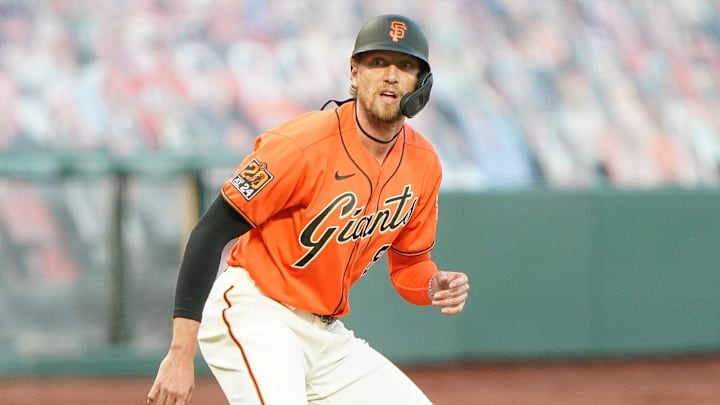
Hunter Pence
Pence played baseball like a marionette—all long hinges and wires jangling and at all moments seemingly on the brink of collapse. There was a reason for that, which was not discovered until the San Francisco Giants in 2013 gave him a physical exam while signing him to a five-year, $90 million extension. They discovered he had Scheuermann’s Disease, the spinal condition caused by vertebrae that are more wedge-shaped than the usual rectangular shape. It explained why Pence had a broad, curved back and moved in a herky-jerky style.
It also explained why he could get his bat on a pitch thrown just about anywhere; he was 6' 5" but had the wingspan of someone 6' 8". Pence was a true “glue guy” who made teams better with his hustle, unselfishness and dugout sermons. A career .279 hitter, he won World Series titles with the 2012 and ’14 Giants.
Rick Porcello
In the live ball era, only four pitchers have won 22 games while walking no more than 32 batters: Grover Alexander (1923), LaMarr Hoyt (1983), Roy Halladay (2003) and Porcello (2016, his Cy Young season). Two years out of Seton Hall Prep, Porcello in 2009 threw 170 2/3 innings for Jim Leyland’s Tigers, including a start in Game 163 in which he allowed one earned run.
His smooth mechanics and pinpoint command made him the last of a breed: a young workhouse. From ages 20–29, Porcello made 307 starts, fourth most in the past 50 years at those ages, behind only Hernandez, Sabathia and Fernando Valenzuela. The cost: he was done at 31. The only pitchers in the Live Ball Era to retire as young as 31 with 150 wins are Porcello (150 at 31) and Sandy Koufax (165 at 30).
More MLB on Sports Illustrated
 Add us as a preferred source on Google
Tom Verducci is a senior writer for Sports Illustrated who has covered Major League Baseball since 1981. He also serves as an analyst for FOX Sports and the MLB Network; is a New York Times best-selling author; and cohosts The Book of Joe podcast with Joe Maddon. A five-time Emmy Award winner across three categories (studio analyst, reporter, short form writing) and nominated in a fourth (game analyst), he is a three-time National Sportswriter of the Year winner, two-time National Magazine Award finalist, and a Penn State Distinguished Alumnus Award recipient. Verducci is a member of the National Sports Media Hall of Fame, Baseball Writers Association of America (including past New York chapter chairman) and a Baseball Hall of Fame voter since 1993. He also is the only writer to be a game analyst for World Series telecasts. He lives in New Jersey with his wife, with whom he has two children.