
Jose Soriano's Problem Can Still Define His Success With the Blue Jays
In this story:
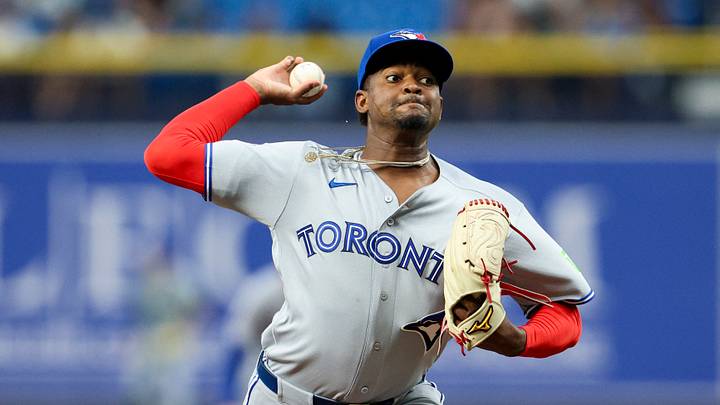
José Soriano made a small turn toward his left, looked deep into right field and then lowered his head in a slight gesture of frustration. Since Cal Raleigh hit the pitch up and out of the zone, Soriano knew that his fastball had failed again.
The problems are not new for the Dominican right-hander, one of the reinforcement pieces acquired by the Toronto Blue Jays at the past trade deadline. During his four-season career, 57.8% of the home runs he has allowed have been against his fastballs. This year, 10 of the 14 home runs hit against him were against his fastball, which has also allowed 22 of the 32 extra-base hits.
Among all the home runs allowed by Soriano in his 27 starts this season, hitters have taken advantage of pitches up in the 70%.

That is one of the reasons why his performance began to fade after an incredible start to the season when he posted a 0.48 ERA in 42 ⅔ innings between March and April. In his next two months, his durability dropped to 28 ⅔ innings and 5.34 ERA, marks recorded in May and June, respectively.
That said, the way the opposition began to decipher his pitches increased drastically: during March/April and May, Soriano allowed six home runs against 289 opponents. In June, he allowed that same number of home runs after facing only 134 batters.
His fastball has been seriously threatened and, since May, he has been trying to reduce the chaos. A big part of Soriano’s talent that attracted the Blue Jays was his ability to offer durability and generate high ground-ball rates.
However, his strikeout rate has dropped from 10.34 K/9 in the March/April stretch to 6.75 since joining the Blue Jays. This month, he has gone through the biggest pressure situation when it comes to avoiding contact. His opponents’ Z-Contact% has jumped to 94.1%, the highest rate he has allowed in any month this season.
August Offers a Sign of Hope for José Soriano

Now, the best news in August is that he had not allowed home runs against his fastball until Raleigh crushed his 96 mph fastball to give the Seattle Mariners a 1-0 lead on Saturday afternoon at Rogers Centre. Here are some interesting details to look at.
Opponents vs. José Soriano’s Fastballs
Month | Pitch% | HR% | SLG | Whiffs% | Barrel/BBE% |
|---|---|---|---|---|---|
Mar/Apr | 52.4% | 2.2% | .286 | 23.9% | 11.7% |
May | 49.7% | 4.4% | .491 | 21.1% | 12.5% |
Jun | 45.8% | 6.1% | .596 | 21.8% | 10.0% |
Jul | 53.3% | 0.0% | .174 | 14.6% | 2.4% |
Aug | 54.9% | 1.4% | .479 | 18.7% | 7.1% |
There are a couple of interesting details in this research. First, Soriano has not stopped trusting his fastball. This is the month in which he is using it the most, with an increase to 54.1% from July and August combined. Between April and June, he trusted only 49.3% of his pitches.
That is a good starting point while he also adapts to working alongside his new catchers, most of the time with Alejandro Kirk and Brandon Valenzuela. We already know that he is allowing fewer home runs against his fastballs, so the other interesting trend is in the reduction of his Barrel/BBE% rate to 7.1%. In July, he obtained the best results, allowing only 2.4%, and this month he managed to make a good part of those adjustments happen again.
The negative points remain in the contact he allows. Hitters have batted .479 BABIP against his fastballs this month, which has been a little striking because even his Whiff% rate improved a little.
Behind his four-seam fastball and sinker, Soriano has three highly competitive secondary pitches that help him a lot to survive: a highly effective slider, the splitter and his curveball. These last two are the two extermination weapons when he has opponents with two strikes. With that lethal combination, Soriano has accumulated 62% of his 149 strikeouts this year. But the slider does not stay behind in the mix. To attack the opposition, it is the pitch that prepares his strategy. Opponents have batted only .167 against the slider and have not hit a home run.
A Start That Puts His Adjustments to the Test Again

After Raleigh’s home run, the Mariners scored two runs in the fourth inning, but Soriano then threw three consecutive scoreless innings to complete his second start of at least seven innings in his last 17 outings. Toronto supported him with a pair of two-run rallies in the fifth and sixth innings, respectively. He had not done it since last July 20 against the St. Louis Cardinals. Although he has demonstrated durability, Soriano has only five starts of at least seven innings all season.
This time, his fastball was at the center of the dominance. Seattle hitters went 2-for-14, including Raleigh’s home run. The bullpen took care of preserving the one-run lead in the final third of the game, and that way Soriano secured his 11th win of the season, lowering his ERA to 3.45.
With the Blue Jays’ effective group of relievers, many of Soriano’s starts that used to end in losses or undecided results could turn into wins. Everything depends on his fastball continuing to locate where it can reduce the impact of the opposition, the one that has moved him away from the surprising version he showed in April.
 Add us as a preferred source on Google
Yirsandy is a baseball writer specializing in MLB coverage with experience across multiple teams and storylines. He currently writes for Diamond Centric, where he covers the New York Mets, San Diego Padres, Chicago Cubs, Milwaukee Brewers, and Kansas City Royals. My work focuses on game coverage, player analysis, and storytelling that connects performance with context. My Substack has also been an important part of my writing development, where I’ve built much of my baseball coverage and storytelling voice over time. I’m passionate about combining reporting, research, and thoughtful analysis to produce engaging baseball content for readers.
Follow Yirsandy