%20%20--%3E%0A%3Csvg%20version%3D%221.1%22%20id%3D%22Layer_1%22%20xmlns%3D%22http%3A%2F%2Fwww.w3.org%2F2000%2Fsvg%22%20xmlns%3Axlink%3D%22http%3A%2F%2Fwww.w3.org%2F1999%2Fxlink%22%20x%3D%220px%22%20y%3D%220px%22%0A%09%20width%3D%2239px%22%20height%3D%2240px%22%20viewBox%3D%220%200%2039%2040%22%20enable-background%3D%22new%200%200%2039%2040%22%20xml%3Aspace%3D%22preserve%22%3E%0A%3Cpath%20fill%3D%22%23FFFFFF%22%20d%3D%22M38.5%2C7H28.2v26h10.3V7z%22%2F%3E%0A%3Cpath%20fill-rule%3D%22evenodd%22%20clip-rule%3D%22evenodd%22%20fill%3D%22%23FFFFFF%22%20d%3D%22M26.1%2C25.5c0%2C5.8-4.1%2C7.5-12.9%2C7.5C3.9%2C33%2C0%2C31.2%2C0%2C25.2v-1.1h11.6%0A%09v2.4c0%2C0.7%2C0.1%2C1.4%2C1.2%2C1.4c1%2C0%2C1.2-0.4%2C1.2-1.3v-0.9c0-1.6-0.9-1.6-3.5-2.2C2.2%2C21.7%2C0%2C19.7%2C0%2C15.3v-0.9C0%2C9.3%2C5.5%2C7%2C12.9%2C7%0A%09c10.2%2C0%2C12.8%2C2.6%2C12.8%2C7.4v1.8h-11v-2.9c0-0.6-0.4-1.1-1.2-1.1c-0.6%2C0-1.2%2C0.4-1.2%2C1.1v0.9c0%2C1.5%2C0.9%2C2%2C3.3%2C2.5%0A%09c8%2C1.6%2C10.5%2C3.3%2C10.5%2C7.5V25.5z%22%2F%3E%0A%3C%2Fsvg%3E%0A)
Bruce Meyer Is a Logical Yet Remarkable Choice to Replace Tony Clark at the MLBPA
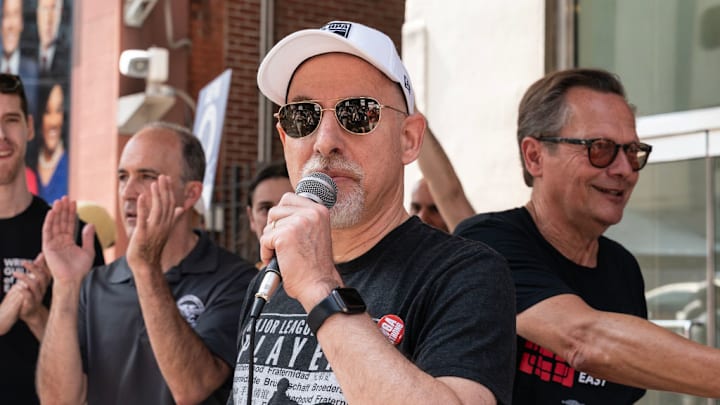
In March 2024, then MLB Players Association deputy executive director Bruce Meyer survived a palace coup. His defense strategy included a letter to players in which he left certain his hawkish reputation in his long career in labor negotiations. Two years after the 99-day lockout ended with agreement between owners and players on a collective bargaining agreement, Meyer sided with those players who preferred shutting down the game rather than taking that deal.
“Some players emerged from bargaining disappointed that we did not accomplish more and in particular that we did not miss games to see if more [gains] could be made,” Meyer wrote. “To be clear, I sympathized and still do with these players and this position.”
Meyer owns a distinguished career in sports labor law. That one paragraph best defines his approach. Even with two years passed, he preferred missing games to see if more could be won at the table.
Meyer on Wednesday was named interim executive director of the MLBPA after the stunning resignation of Tony Clark. That he emerged more powerful than ever from the 2024 opposition is testament to his experience and tenacity. Given Meyer’s hindsight on the current CBA deal established in ’22, not to mention his history with other leagues, one agent summed the change from Clark to Meyer this way: “The owners aren’t happy.”
Philosophically, nothing changes at the MLBPA bargaining table. Meyer has been its lead negotiator and will continue as such. The MLBPA maintains a deeply rooted opposition to a salary cap.
But two areas bear watching when it comes to possible changes with Meyer replacing Clark: 1. Style. 2. Strategy.
Meyer’s elevation is the equivalent of a football defensive coordinator becoming head coach. The decision tree just grew scores of branches—such as, to borrow from the 2022 settlement, when to punt and when to go for it. It also places a greater responsibility on leadership and communication skills.
A union leader is a political leader, a kind of speaker of the house. Solidarity is the backbone of union strength. The director is charged with creating a universally supported consensus. Clark, while not necessarily dynamic, had the inherent advantage of being a former major league player. He spoke their language, knew their successes and felt their pain.
Meyer, more direct of manner, is a labor negotiator who never had to worry much about the “soft skills” of leadership, which was apparent in 2024 when some players and agents wanted him out. They wanted Clark to replace him with Harry Marino, a young lawyer and former minor league pitcher who brought minor leaguers under the union umbrella. Starting with his tour of camps this spring training, Meyer has a chance to show players he has the chops to lead, not just dig in his heels at the bargaining table.
Building a universally supported consensus becomes more delicate as financial gaps widen among players, just as happens among teams. About 60% of players make the minimum salary. Minor league reps hold 47% of the votes of the 72-member executive board. The average big league career is less than the six years of service required for free agency. One in five rookies never make it back for a second season.
A change in strategy from Clark to Meyer will not be clearly evident until we get closer to Dec. 1, when the CBA expires. Meyer has said owners likely will follow that expiration with a lockout, as was the case in 2021. The '21–22 lockout ended March 10, leaving barely enough time to avoid losing games. (The season began a week later than scheduled and ended three days later, with the first week of scheduled games sprinkled into the season.)
The eight players on the executive subcommittee then felt as Meyer did about the last-ditch offer: they voted 8–0 against accepting the deal. It stood as a recommendation to their rank and file to reject it. But after team representatives met with their teammates about the proposal, the players repudiated leadership and voted 26–4 to accept it. The only teams that rejected it had a player on the subcommittee (Yankees, Mets, Astros and Cardinals).
Commissioner Rob Manfred was pragmatic in explaining why it took so long to get an agreement: “Time and economic leverage. No agreement comes together before those two things play out.”
Most players did not wish to risk losing paychecks to try for more bargaining gains, such as greater bumps in the luxury tax thresholds.
What could be different about the same scenario with Meyer, not Clark, wearing the headset and calling the plays? One agent said he expects Meyer to be more like Marvin Miller and Donald Fehr, past executive directors who held the union together by concentrating influence on the front lines of bargaining—the negotiating team and the subcommittee.
Meyer’s job as lead negotiator hasn’t changed. But as executive director, he has the added responsibility of building and holding consensus from about 6,700 members of the rank and file.
More MLB on Sports Illustrated
 Add us as a preferred source on Google
Tom Verducci is a senior writer for Sports Illustrated who has covered Major League Baseball since 1981. He also serves as an analyst for FOX Sports and the MLB Network; is a New York Times best-selling author; and cohosts The Book of Joe podcast with Joe Maddon. A five-time Emmy Award winner across three categories (studio analyst, reporter, short form writing) and nominated in a fourth (game analyst), he is a three-time National Sportswriter of the Year winner, two-time National Magazine Award finalist, and a Penn State Distinguished Alumnus Award recipient. Verducci is a member of the National Sports Media Hall of Fame, Baseball Writers Association of America (including past New York chapter chairman) and a Baseball Hall of Fame voter since 1993. He also is the only writer to be a game analyst for World Series telecasts. He lives in New Jersey with his wife, with whom he has two children.