%20%20--%3E%0A%3Csvg%20version%3D%221.1%22%20id%3D%22Layer_1%22%20xmlns%3D%22http%3A%2F%2Fwww.w3.org%2F2000%2Fsvg%22%20xmlns%3Axlink%3D%22http%3A%2F%2Fwww.w3.org%2F1999%2Fxlink%22%20x%3D%220px%22%20y%3D%220px%22%0A%09%20width%3D%2239px%22%20height%3D%2240px%22%20viewBox%3D%220%200%2039%2040%22%20enable-background%3D%22new%200%200%2039%2040%22%20xml%3Aspace%3D%22preserve%22%3E%0A%3Cpath%20fill%3D%22%23FFFFFF%22%20d%3D%22M38.5%2C7H28.2v26h10.3V7z%22%2F%3E%0A%3Cpath%20fill-rule%3D%22evenodd%22%20clip-rule%3D%22evenodd%22%20fill%3D%22%23FFFFFF%22%20d%3D%22M26.1%2C25.5c0%2C5.8-4.1%2C7.5-12.9%2C7.5C3.9%2C33%2C0%2C31.2%2C0%2C25.2v-1.1h11.6%0A%09v2.4c0%2C0.7%2C0.1%2C1.4%2C1.2%2C1.4c1%2C0%2C1.2-0.4%2C1.2-1.3v-0.9c0-1.6-0.9-1.6-3.5-2.2C2.2%2C21.7%2C0%2C19.7%2C0%2C15.3v-0.9C0%2C9.3%2C5.5%2C7%2C12.9%2C7%0A%09c10.2%2C0%2C12.8%2C2.6%2C12.8%2C7.4v1.8h-11v-2.9c0-0.6-0.4-1.1-1.2-1.1c-0.6%2C0-1.2%2C0.4-1.2%2C1.1v0.9c0%2C1.5%2C0.9%2C2%2C3.3%2C2.5%0A%09c8%2C1.6%2C10.5%2C3.3%2C10.5%2C7.5V25.5z%22%2F%3E%0A%3C%2Fsvg%3E%0A)
Carlos Beltrán’s Hall of Fame Candidacy Presents a Complex Moral Quandary
In this story:
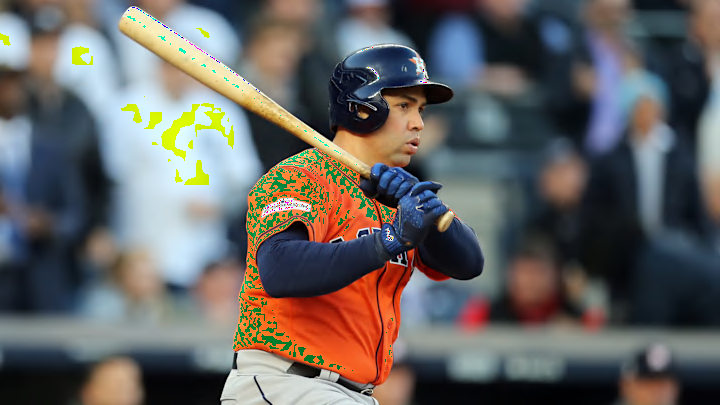
Leading up to the Baseball Hall of Fame class announcement on Jan. 20, we’ll be examining the cases of notable candidates. Andruw Jones and Félix Hernández led us off, and Carlos Beltrán, a fourth-year nominee who has been steadily ascending toward induction, is up next.
Many years ago, a general manager who had just signed a very expensive free agent, with a push from ownership, indicated second thoughts to me soon after the signing.
“When you sign someone at those kinds of dollars, you should feel good about it,” said the GM, who had reservations about the player’s makeup and how he fit in the clubhouse.
The GM was prescient. The signing did not work well.
I feel the same way about the Hall of Fame ballot. You should feel good about checking the box next to a player’s name. An endorsement for the highest honor for a career should be done gladly. The candidacy of Carlos Beltrán challenges that tenet. It is complicated and unprecedented, a canary in the coal mine of the age of technology, even more tangled than that of spitball legend Gaylord Perry.
Beltrán is the player most likely to be elected Jan. 20, when results are announced in balloting of the Baseball Writers Association of America. Beltrán is the leading returnee on a ballot with no strong first-time candidates. He secured 70.3% of the vote last year, 19 votes short of the 75% requirement for election. He has been trending upward, from 45.5% in his first year to 57.1% in his second year to his 70.3% support last year.
There is no good argument against Beltrán’s statistics as Hall of Fame worthy, especially measured against modern voting trends. He was Andre Dawson with 545 more games in center field and a better postseason resume (but no MVP):
Player | OPS+ | AVG | Hits | HR | RBI | SB | TB |
|---|---|---|---|---|---|---|---|
Dawson | 119 | .279 | 2,774 | 438 | 1,591 | 314 | 4,787 |
Beltrán | 119 | .279 | 2,725 | 435 | 1,597 | 312 | 4,751 |
Dawson, Beltrán and Willie Mays are the only players not connected to PEDs with 2,500 hits, 400 homers and 300 stolen bases. They were do-it-all stars who could beat teams in many ways. Add bonus points for Beltrán with his extraordinary success rate stealing bases (86.4%, best since 1920 for those with at least 200 steals) and in the postseason (1.021 OPS, eighth best among those with 100 plate appearances), and he had a Hall of Fame career.

But ... he cheated. Beltrán wasn’t just a part of the sign-stealing, trash-can-banging scheme of the 2017 Astros. He was a mastermind. He was a respected veteran in his last season with as much clout in that clubhouse as anyone, and he abused that authority.
Beltrán and catcher Brian McCann came to the Astros in 2017 from the Yankees. Beltrán told his Houston teammates they were “behind the times” in those Wild West days when video and computer-savvy analysts were developing the dark arts of finding an edge. Beltrán took it to a new level. He helped come up with the idea of a faster relay system of in-game sign stealing: install a monitor close to the Houston dugout. With a real-time feed from a center-field camera, an Astro could alert a hitter what was coming by the audible code of banging on a trash can.
As deplorable as were Beltrán’s actions, he did not fully own them. He lied when he told the New York Post he was not aware of a center-field camera being used to steal signs. He didn’t stop there. He stretched the lie to say the Astros “took a lot of pride studying pitchers [on] the computer ... That is the only technology that I use and understand.”
Oh, please. It smacked so much of the PED users citing how “hard” they worked in the gym. Nobody wants their achievements seen as illegitimate, and so they lie, obfuscate and distract from the truth.
The Mets hired Beltrán to be their manager in 2020, but when the scandal broke and MLB launched its investigation, Beltrán knew his lie would not hold. He and the Mets “mutually parted ways.” He released a statement saying, “Over my 20 years in the game, I’ve always taken pride in being a leader and doing things the right way, and in this situation, I failed. As a veteran player on the team, I should’ve recognized the severity of the issue and truly regret the actions that were taken.
“I am a man of faith and integrity and what took place did not demonstrate those characteristics that are so very important to me and my family. I’m very sorry.”
In April 2022, five years after the scandal, Beltrán gave his first interview on the topic, to the YES network. He took responsibility for his actions, but even then, when the facts of the scheme had been laid bare, he blamed others.
“A lot of people always ask me why you didn’t stop it,” he said. “And my answer is, I didn’t stop it the same way no one stopped it. This is working for us. Why you gonna stop something that is working for you? So, if the organization would’ve said something to us, we would have stopped it for sure.”
But he was told to stop. McCann told him to stop midway through the season, according to The Athletic, which quoted a source saying Beltrán “disregarded it and steamrolled everybody,” which helps explain why they called him The Godfather.
The manager, A.J. Hinch, broke a monitor to signal to his players he did not approve of the arrangement.
And still, Beltrán continued with the practice, which continued through the postseason as the Astros won the World Series.
I did not vote for Beltrán in his first year on the ballot. It was a small penalty, to be sure, but I could not vote for him as a first-ballot Hall of Famer—an unofficial title imbued with added honor—as if nothing happened. After that, I did vote for him.

I studied the case of Perry, who while playing wrote a book admitting his use of the spitball, though after that he pretended the admission was just a ruse to heighten the paranoia hitters had about facing his dancing sinker. Perry won 314 games. It took him three tries to get elected, but he debuted at a very strong 68% on a ballot with Johnny Bench, Carl Yastrzemski and Ferguson Jenkins also debuting.
There was little pushback against him for cheating. Steve Jacobson of Newsday cast his vote for Perry, explaining, “Perry used what they let him use and got hitters out; those were the rules.”
At his induction, Perry told the story of how his spitball began. Giants manager Alvin Dark brought him into a game in the 13th inning of the second game of a doubleheader against the Mets in 1964. Perry had warmed up in the bullpen throwing to a security guard; the Giants were out of catchers.
“It’s time to put something on the ball,” Dark told Perry, who had been working on his spitter.
Perry had been a mediocre pitcher in a hybrid role: 6–8 with a 4.50 ERA in 53 career games. That day he threw 10 shutout innings. Starting with that relief gem, Perry allowed two earned runs in his next 43 innings. His career was transformed.
Doctoring the baseball was common in Perry’s day. He did it longer and more famously than most and was the only one to profit off it in book form. The difference: what Beltrán did shocked even his peers. Yes, teams were paranoid in 2017 about sign stealing. But no one else was so bold as to hang a monitor near the dugout and bang out a code on a trash can.
Beltrán created an uneven playing field, a charge I use against PED users. Is it the same? No. In Hall of Fame voting, take the merits of each case. Cheating in baseball is not any more uniform than breaking the law is in a civil society, which is why we have misdemeanors and felonies and judges and juries.
Using PEDs is a more egregious form of cheating than what Beltrán did. It involves illegal use of federally controlled substances, physical risk and a long-established taboo in sporting culture, going back to Ben Johnson in 1988 and even before then. The established penalties by MLB for using PEDs are much harsher than for illegally stealing signs, which speak to the degrees of difference in severity of these forms of cheating.
I totally get and respect why some voters will not vote for Beltrán. He broke a sacred, if unwritten code in the game by playing unfairly. He had to know when he was doing it that it was very wrong. And no, I did not feel very good about checking the box next to his name, but I did again.
Even if Beltrán does get elected, it does not mean his cheating is forgotten or condoned. It is part of the first paragraph of his legacy. When Perry was elected, the Hall made winking reference on his plaque to his “playing mind games with hitters through array of rituals on the mound.”
Perry in his own words upon being voted in admitted to being “an outlaw in every sense of the word.” Beltrán, forever a fellow outlaw, may soon join him in Cooperstown.
More MLB on Sports Illustrated
 Add us as a preferred source on Google
Tom Verducci is a senior writer for Sports Illustrated who has covered Major League Baseball since 1981. He also serves as an analyst for FOX Sports and the MLB Network; is a New York Times best-selling author; and cohosts The Book of Joe podcast with Joe Maddon. A five-time Emmy Award winner across three categories (studio analyst, reporter, short form writing) and nominated in a fourth (game analyst), he is a three-time National Sportswriter of the Year winner, two-time National Magazine Award finalist, and a Penn State Distinguished Alumnus Award recipient. Verducci is a member of the National Sports Media Hall of Fame, Baseball Writers Association of America (including past New York chapter chairman) and a Baseball Hall of Fame voter since 1993. He also is the only writer to be a game analyst for World Series telecasts. He lives in New Jersey with his wife, with whom he has two children.